8 Best SERP APIs in 2026 for Real-Time Search Results
Compare the best SERP APIs for real-time search results, features, tradeoffs, and which tools fit AI, SEO, and monitoring workflows.
Published
Written by
Chris P.
Reviewed by
Nithish A.
Read time
7
minutes
Search results still drive discovery for billions of users daily. Google processes 5 trillion searches every year, making search rankings a core signal for visibility, buying intent, and market positioning.
Teams building AI agents, SEO tools, competitor trackers, or real-time workflows need structured search output because it lets systems act on live rankings, snippets, and features without dealing with fragile scraping or stale data.
This guide compares the eight best SERP APIs worth considering. You'll see what each one returns, how reliable it is at scale, and which workflows it fits best.
What Does an SERP API Do?
A SERP API gives you direct access to search engine results in a structured format. Instead of scraping HTML pages and dealing with layout changes, CAPTCHAs, or blocked requests, you send a query and receive clean data your systems can work with right away.
A typical SERP API response includes:
Organic result titles and URLs
Page snippets and descriptions
Ranking positions
Sources and result types (web, news, local, ads, or rich results)
Teams use SERP APIs when search visibility itself is the signal. Teams use SERP APIs when search visibility itself is the signal. Common use cases include:
SEO teams: Track keyword rankings and page position changes over time
Sales and GTM teams: Gather prospect context like podcast appearances that reveal pain points, competitor pricing from product pages, or product features from company blogs
Recruiters: Find candidate information that standard databases miss, like GitHub profiles, research papers, or personal portfolios
AI developers: Ground agents in live web context for sales outreach, candidate sourcing, and investment research
The key difference from traditional scraping is reliability. A SERP API handles result parsing, schema normalization, and delivery so your workflows can focus on using the data rather than maintaining infrastructure. Instead of dealing with raw HTML that changes with every Google update, you receive consistent JSON fields like title, URL, snippet, and position that integrate directly into your systems.
8 Best SERP APIs to Consider in 2026
To make it easier for you to choose, the table below compares the top 8 SERP APIs side by side.
SERP API | Best For | Engines Covered | Output Type | Real-Time Focus | Workflow Model | Starting Price / Month |
Crustdata SERP API | AI agents, GTM automation, live monitoring | Structured JSON | Yes (on-demand queries) | Request-based, event-driven | Usage-based (contact sales) | |
SerpApi | SEO platforms, analytics tools | Google, Bing, Yahoo, Baidu, Yandex | Structured JSON | Near real-time | Polling-based | $75 |
Zenserp | Lightweight SEO tracking, internal reports | Google (primary) | Structured JSON | Near real-time | Polling-based | $49.99 |
ScrapingBee | General web scraping, custom extraction | Google (rendered pages) | Raw HTML (optional parsing) | Depends on request timing | Request-based scraping | $49 |
DataForSEO | Large-scale SEO analytics | Google, Bing, Yahoo, regional engines | Structured JSON | Near real-time | Async batch jobs + polling | Pay-as-you-go |
Bright Data SERP API | Enterprise teams needing geo-specific data | Structured JSON | Near real-time | Sync and async jobs | $499 | |
Oxylabs SERP Scraper API | Enterprise SERP monitoring | Structured JSON | Near real-time | Batch-oriented | $49 | |
Apify (Google Search Scraper) | Custom scraping workflows | JSON, CSV, datasets | Depends on actor execution | Actor-based async runs | $39 |
1. Crustdata SERP API
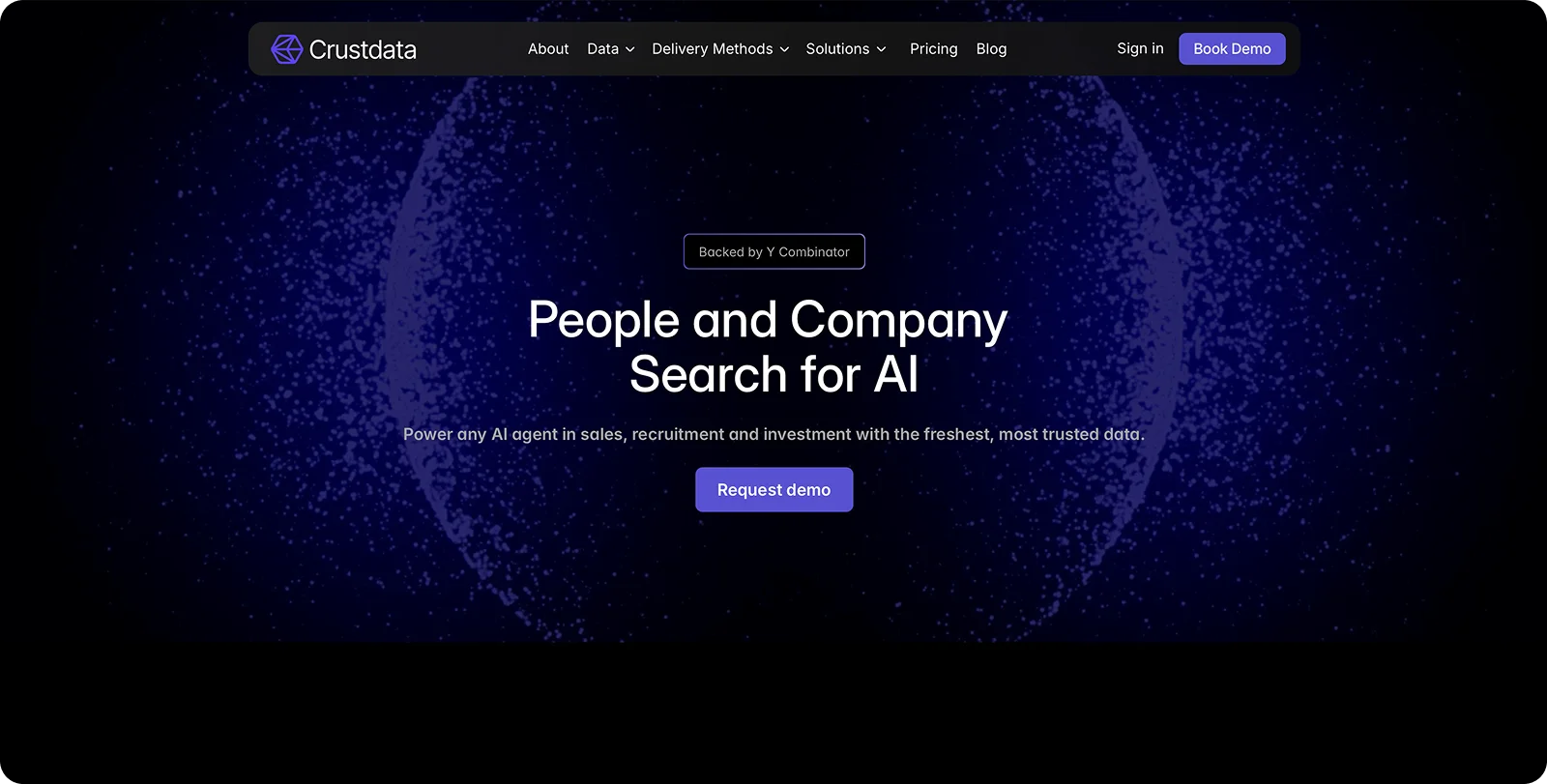
Crustdata has an SERP API built for AI agents that need live web context to personalize outreach and make better decisions. Teams use it to find product features in company blogs for sales outreach, surface GitHub profiles and conference talks for candidate evaluation, and track founder interviews for investment signals. The API delivers search results in structured JSON that feeds directly into agent workflows, enabling context-aware actions based on what's publicly visible right now.
Key Features
Live SERP indexing: Returns real-time Google search results instead of relying on cached or pre-collected datasets.
Structured JSON output: Delivers titles, URLs, snippets, positions, and metadata in a consistent schema ready for ingestion.
Localization controls: Supports geolocation and language parameters for region-specific search results
Event-driven architecture: Designed to work alongside Crustdata’s real-time data stack for trigger-based workflows.
High-throughput infrastructure: Built for large-scale, high-volume use cases like AI agents that require thousands of search queries in production workflows.
Pros
Enable faster reactions to public market signals while they still matter
Improve AI decision quality by grounding agents in live search context
Combine SERP data with B2B contact and company data to give AI sales, recruiting, and investment agents complete prospect context through one API provider
Cons
Requires technical setup to integrate API into existing systems
Pricing
Crustdata uses a credit-based pricing model with self-serve access. Plans scale with usage, and custom pricing is available by contacting our sales team.
2. SerpApi
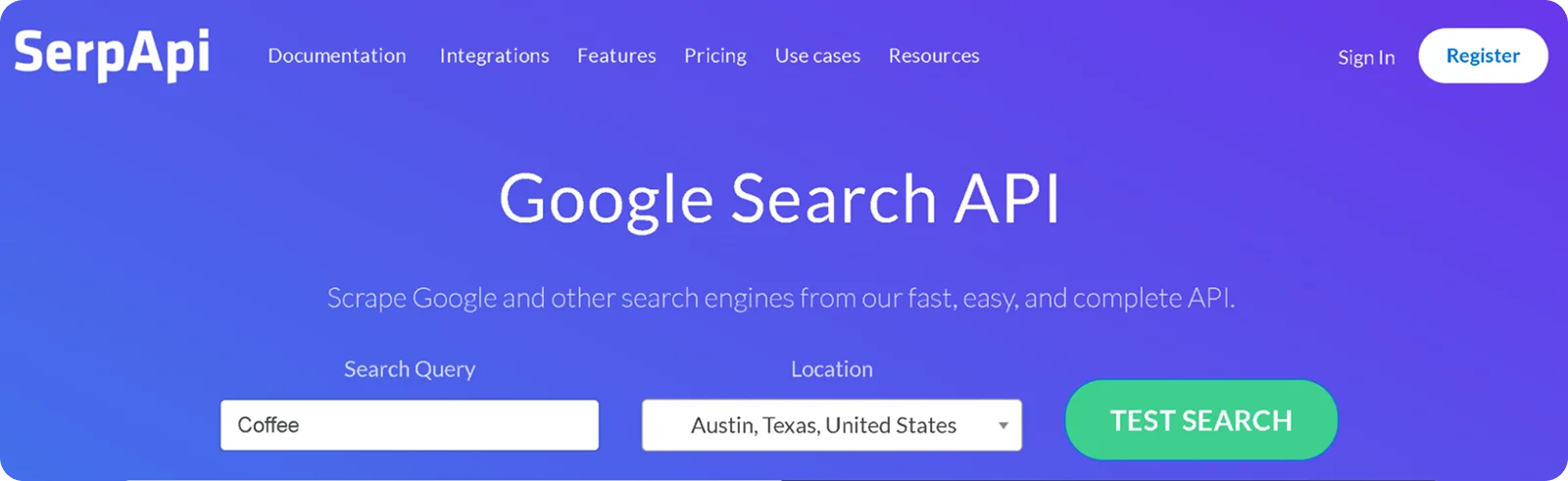
SerpApi is a long-standing option for teams that want consistent access to search engine results without running their own scraping infrastructure. It’s often embedded into SEO platforms and analytics products where stability, documentation, and broad engine coverage matter more than real-time automation.
Key Features
Search engine coverage: Supports Google, Bing, Yahoo, Baidu, Yandex, and others via dedicated endpoints
SERP result types: Returns organic results, paid ads, shopping listings, news, and featured snippets
Localization controls: Supports country, language, device, and location parameters
Managed extraction: Handles proxies, CAPTCHAs, and browser behavior internally
Pros
Support global products that rely on consistent SERP access across markets
Simplify long-term maintenance by outsourcing scraping reliability
Speed up development with mature documentation and predictable behavior
Cons
Enforce plan-based throughput limits per hour
Require polling to check for SERP changes, since it’s request–response rather than push-based
Pricing
SerpApi offers a free tier, with paid monthly plans starting at $75 per month.
3. Zenserp
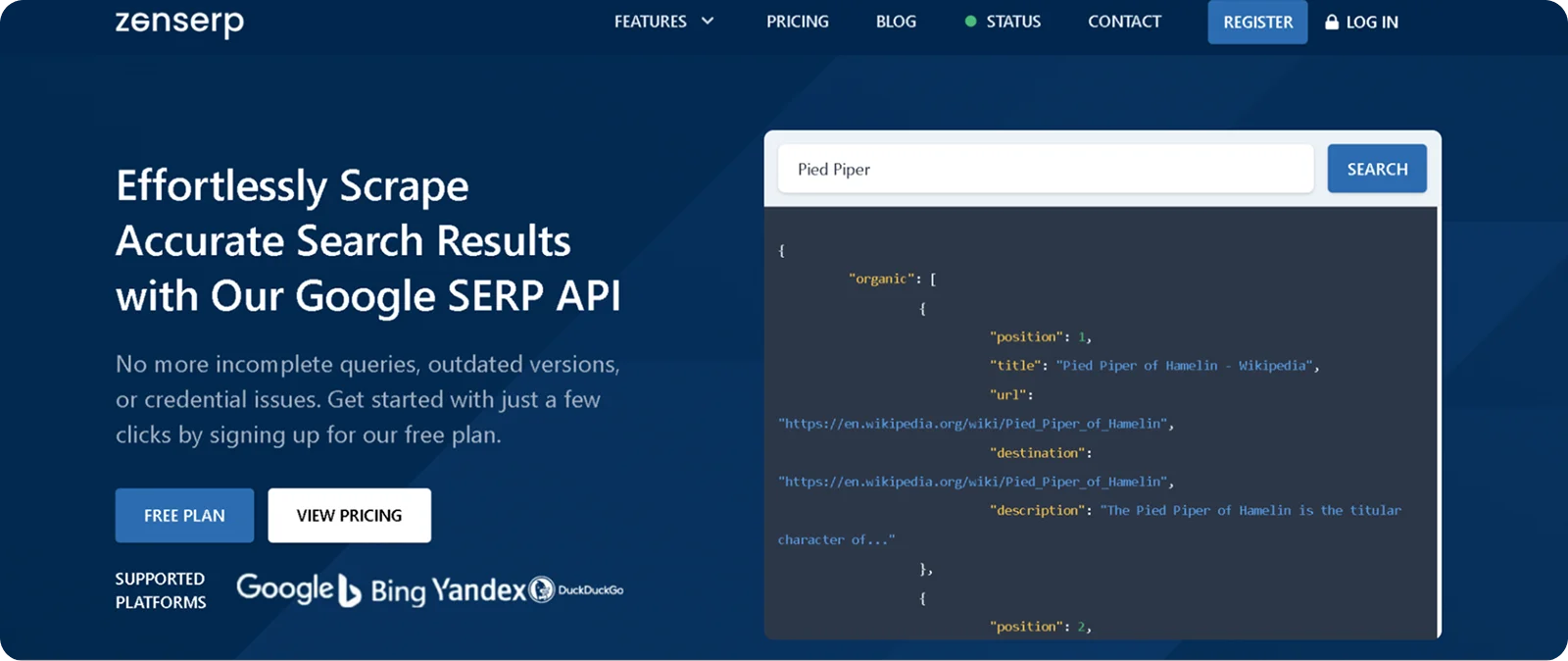
Zenserp is aimed at teams that want a straightforward way to pull Google search results into internal tools or reporting pipelines. It’s most often used when response speed and simplicity are priorities and the scope is limited to ranking and visibility checks.
Key Features
Real-time SERP retrieval: Returns search engine results in JSON as queries execute
Multi-engine support: Provides results from Google, Bing, and Yahoo search engines
Search type diversity: Offers standard, images, news, maps, and other search result types
Localization options: Enables geolocation and language parameters for region-specific data
Developer-friendly integration: Works with any programming language via simple HTTP requests and includes examples
Pros
Keep ranking checks lightweight for internal tools and reports
Reduce setup time for teams that only need core SERP visibility
Maintain fast turnaround for simple, recurring SEO queries
Cons
Limit coverage primarily to Google
Restrict use cases mainly to SEO workflows
Pricing
Zenserp includes a free plan with limited monthly searches. Paid plans start at $49.99 per month and scale based on search volume, with higher tiers available on request.
4. ScrapingBee
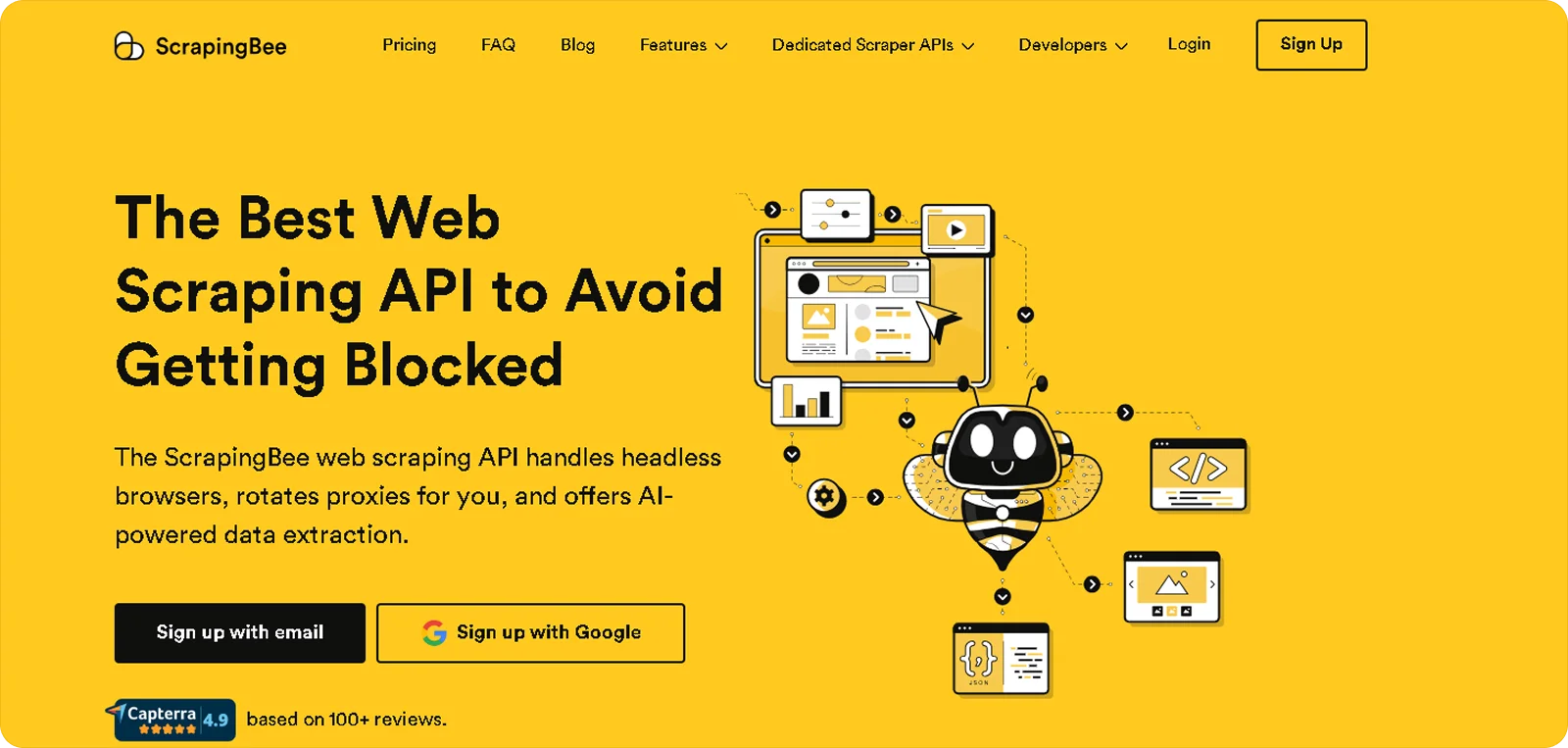
ScrapingBee approaches search results from a general web scraping perspective rather than as a dedicated SERP product. Teams tend to use it when SERP data is just one part of a broader scraping workflow that requires full control over page rendering and execution.
Key Features
Headless rendering: Executes JavaScript before returning page content
Proxy management: Automatically rotates IPs and handles blocking
HTML responses: Returns full page content instead of parsed SERP fields
Request customization: Supports headers, cookies, and wait conditions
Pros
Retain full control over how search pages load and execute
Adapt workflows when structured SERP outputs are too limiting
Reuse the same infrastructure for SERPs and broader scraping tasks
Cons
Require manual parsing of SERP data
Increase engineering effort for production pipelines
Pricing
ScrapingBee pricing starts at $49 per month, based on a monthly credit allowance. Higher tiers are available for increased usage, and a free trial includes limited credits.
5. DataForSEO
DataForSEO is designed for data-heavy products that analyze search results at scale across markets and regions. It’s commonly used in platforms where SERP data feeds into long-running analytics, forecasting, or competitive intelligence pipelines.
Key Features
Multi-engine SERP access: Supports Google, Bing, Yahoo, Baidu, and regional engines
SERP result coverage: Returns organic results, paid ads, featured snippets, local packs, and shopping results
Batch querying: Allows large asynchronous jobs for high-volume use cases
Structured outputs: Provides normalized JSON designed for analytics pipelines
Pros
Process large SERP datasets efficiently across regions
Align well with analytics and reporting-heavy pipelines
Scale usage gradually through granular, credit-based consumption
Cons
Favor batch workflows over ad-hoc querying
Depend on polling instead of webhooks
Pricing
DataForSEO follows a pay-as-you-go credit model, where pricing depends on the type of endpoint used and the volume of requests made.
6. Bright Data SERP API
Bright Data’s SERP API is used by teams that already rely on enterprise-grade proxy infrastructure and need dependable access to search results across locations. It fits environments where request reliability and geographic precision are core requirements.
Key Features
Google SERP extraction: Supports organic results, ads, maps, and SERP features.
Location targeting: Allows city-level and country-level geolocation.
Enterprise proxy network: Built on Bright Data’s residential and mobile IPs.
Managed blocking handling: Automatically addresses CAPTCHAs and throttling
Pros
Increase success rates in heavily restricted search environments
Achieve consistent results for geo-sensitive SERP analysis
Meet enterprise reliability expectations at high request volumes
Cons
Require Bright Data zone setup before making requests (you must create a SERP zone and use an API key)
Offer both sync and async modes, which can add implementation choices for queueing and result collection in async workflows
Pricing
Bright Data offers a free trial and pay-as-you-go pricing at about $1.50 per 1,000 successful results. Monthly subscription tiers include plans at $499, $999, and $1,999 per month with reduced per-1,000-result rates at higher volumes.
7. Oxylabs SERP Scraper API
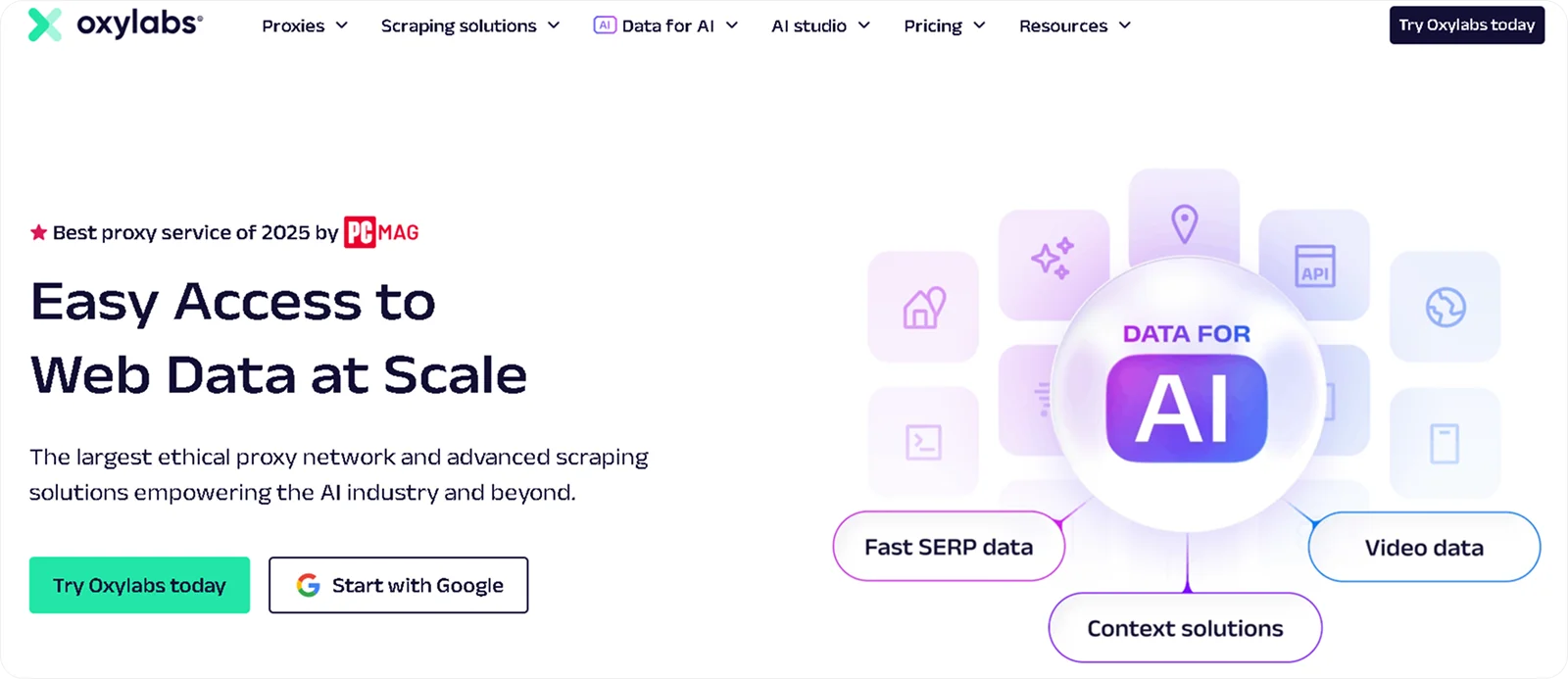
Oxylabs’ SERP Scraper API targets teams collecting search data continuously and at scale. It’s often deployed in monitoring or research systems where minimizing failures over long runs is more important than rapid iteration.
Key Features
Google SERP support: Covers organic results, ads, and SERP features.
Advanced geolocation: Supports country, city, and device targeting.
Automated proxy rotation: Uses Oxylabs’ residential and datacenter IPs.
Parsed SERP data: Returns structured JSON outputs.
Pros
Maintain stability during continuous or long-running collections
Reduce operational risk in large monitoring jobs
Scale confidently in research-focused environments
Cons
Center the product on Google SERP extraction
Use batch-style collection options, which can push you toward asynchronous job handling for larger pulls
Pricing
Oxylabs pricing for SERP and web scraping APIs starts at $49 per month, with higher tiers and enterprise plans based on usage volume.
8. Apify
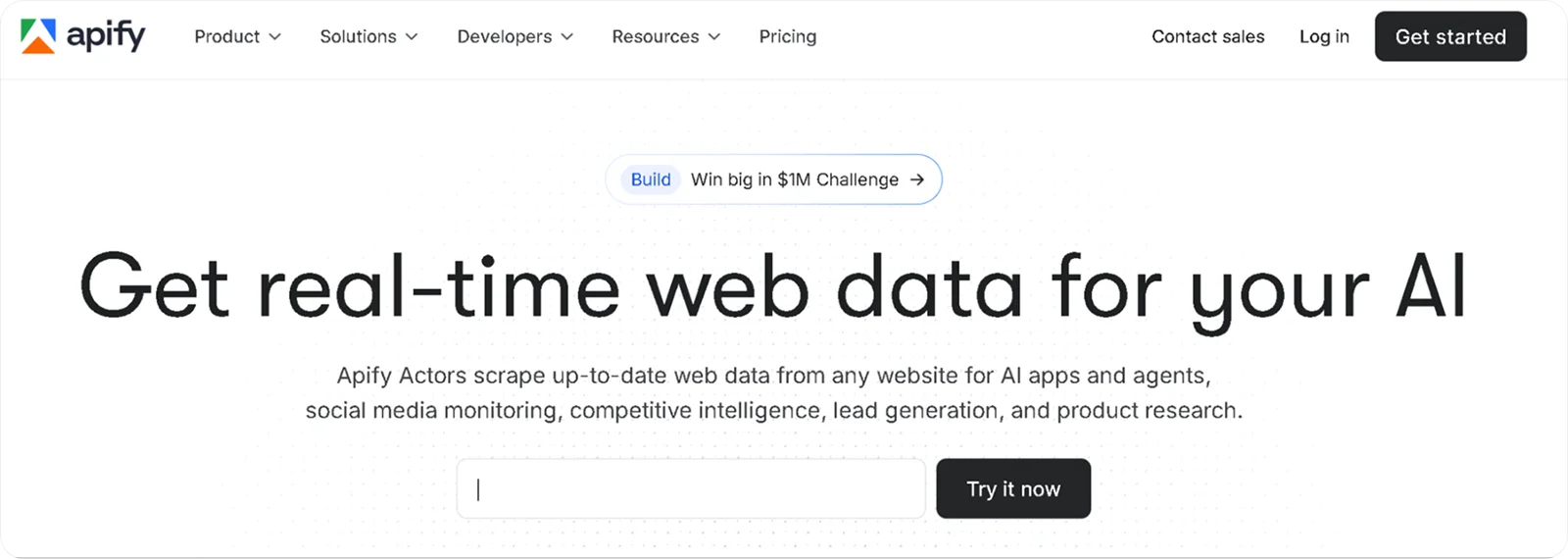
Apify provides access to search results through configurable scraping workflows rather than fixed APIs. It’s typically used by teams that want flexibility in how data is collected and are comfortable shaping and maintaining the extraction logic themselves.
Key Features
Google SERP scraping: Extracts organic results, ads, and snippets
Actor-based workflows: Allows customization through configurable scrapers
Cloud execution: Runs jobs asynchronously on Apify’s infrastructure
Multiple output formats: Supports JSON, CSV, and dataset exports
Pros
Customize extraction logic for niche or evolving use cases
Experiment freely without committing to rigid schemas
Extend SERP collection into broader data-gathering workflows
Cons
Require more configuration to maintain consistency
Depend on actor setup for output reliability
Pricing
Apify offers a free plan with limited compute units. Paid plans start at $39 per month, scaling based on compute usage and actor run time.
Why Crustdata is the Best Choice for Real-Time SERP Workflows
Product launches, executive moves, and funding announcements show up in search before they hit press releases. SERP signals add qualitative context that quantitative data misses.
Quantitative signals, such as headcount growth or new hires, tell you what's changing. SERP data surfaces why it matters. When a new VP of Engineering publishes a blog post about migrating to microservices, that shows up in search results before it reaches your CRM. Your outreach can reference their specific plans instead of generic role changes.
Crustdata's Web Search API feeds into the same enrichment and scoring pipelines already handling company and people data. Sales teams layer SERP signals on top of firmographics and headcount growth to catch buying intent earlier. Recruiting teams combine search results with candidate profiles to surface recent projects or publications that standard databases don't capture. VCs track product launches and founder interviews alongside funding data without switching between platforms.
This is how account-based intelligence workflows operate in practice: catch signals early, route them to the right system, and act before they're stale. Crustdata handles the infrastructure, so your teams focus on what the data reveals, not how to collect it.
Book a demo to see how live SERP data can fit into your production workflow.


Products
Popular Use Cases
Competitor Comparisons
95 Third Street, 2nd Floor, San Francisco,
California 94103, United States of America
© 2026 Crustdata Inc.
Products
Popular Use Cases
Competitor Comparisons
95 Third Street, 2nd Floor, San Francisco,
California 94103, United States of America
© 2026 CrustData Inc.
Products
Popular Use Cases
Competitor Comparisons
95 Third Street, 2nd Floor, San Francisco,
California 94103, United States of America
© 2026 Crustdata Inc.
🎉 We hit $10M ARR!
$600k to $10m in 1.5 years. Our entire GTM is powered by our own APIs.
🎉 We hit $10M ARR in 1.5 years!