



“
“
I really want to rip out Scrapin.io entirely from the stack and build my own agent that I could just drop into a customer's environment. The founders would prefer something that wasn't based around a UI.
Scrapin.io provides real-time scraping and enrichment APIs, but customers must build their own monitoring logic, change detection, and downstream intelligence layers for agent-based systems. Crustdata’s APIs are designed to power AI agents, internal tools, and production-grade data products that require structured schemas, cross-entity relationships, and event-driven updates.
Real-time monitoring
Scrapin.io positions itself as real-time, but its data is primarily returned through direct extraction and enrichment APIs without native support for continuous monitoring or change-based triggers. Crustdata retrieves and enriches people and company data at the moment of request using live crawlers, real-time pipelines, and on-demand enrichment.
| Feature | Crustdata | Scrapin.io |
|---|---|---|
| Update frequency | Real-time (all profiles) | Real-time (on request) |
| Real-time monitoring webhooks | ✅ Yes | ❌ No |
| Custom event tracking | ✅ Yes | ❌ No |
| Feature | Crustdata | Scrapin.io |
|---|---|---|
| Firmographic data | ✅ Yes | ✅ Yes |
| Employee data | ✅ Yes | ✅ Yes |
| Technographic data | ✅ Yes | ✅ Yes |
| Job posting data | ✅ Yes | ✅ Yes |
| Post data | ✅ Yes | ❌ No |
| Website traffic data | ✅ Yes | ❌ No |
| Product review data | ✅ Yes | ❌ No |
| Employee review data | ✅ Yes | ❌ No |
| News | ✅ Yes | ❌ No |
Data coverage for your needs
Scrapin.io focuses primarily on extracting and structuring professional network and public web profile data for people and companies. Crustdata provides structured data on people, companies, posts, and events across multiple verified sources.
While both platforms provide structured data APIs, Crustdata is designed to support a broader range of entity relationships, including posts, engagement data, and activity signals.
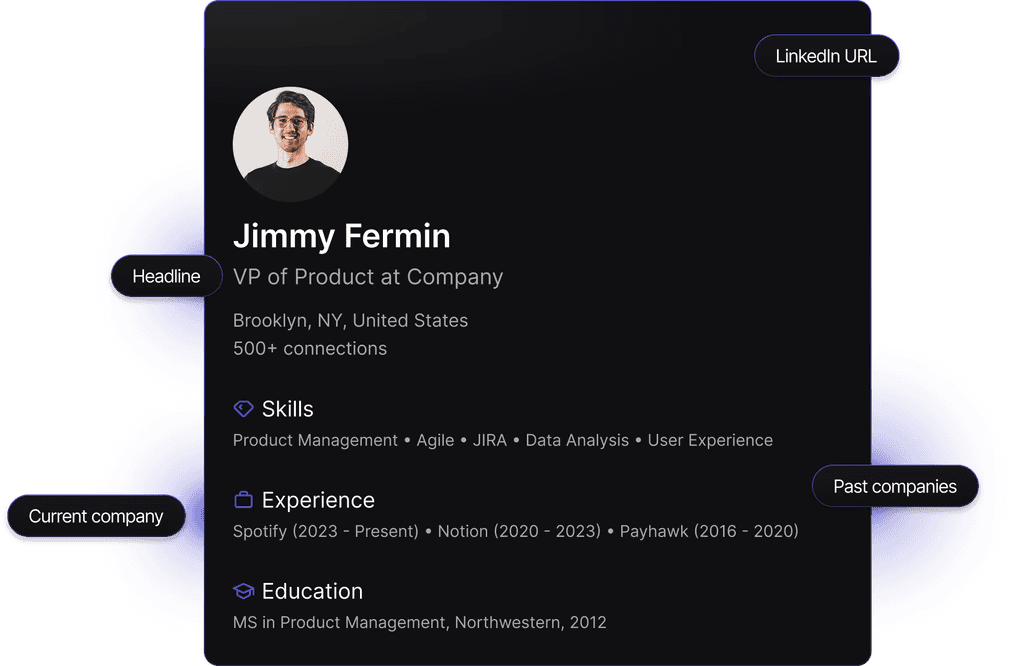
Use filters to discover companies and people and build lists that automatically update whenever a new profile matches your criteria. With our real-time discovery APIs, you receive profiles and updates as soon as they appear, rather than managing discovery logic manually within your own systems.
All our company and people profiles are enriched with more than 350+ datapoints, including granular information such as job start and end dates, education history, job descriptions, skills, and company-level growth and activity signals.
| Feature | Crustdata | Scrapin.io |
|---|---|---|
| Social media post tracking via webhooks | ✅ Yes | ❌ No |
Use filters to discover companies and people and build lists that auto-update whenever a new profile matches your criteria. With our real-time discovery and monitoring capabilities, you can track meaningful changes as they happen rather than polling for updates.
Crustdata is built for AI agents & tools
Scrapin.io provides real-time scraping and enrichment APIs, but customers must build their own monitoring logic, change detection, and downstream intelligence layers for agent-based systems.
Crustdata’s APIs are designed to power AI agents, internal tools, and production-grade data products that require structured schemas, cross-entity relationships, and event-driven updates.
User support
Clay's table-based interface works for manual workflows, but breaks down when you need to build automated systems, respond to real-time events, or embed enrichment into your product.
✅ Yes
❌ No
Scrapin.io provides real-time extraction and enrichment capabilities, but does not offer a native intelligence layer for monitoring, change detection, or automated downstream actions.
Crustdata’s APIs are built for products that require live data to function over time. From real-time enrichment to continuous discovery and event tracking, Crustdata is the infrastructure layer designed for AI agents and platforms that need to react instantly to changes in the world.
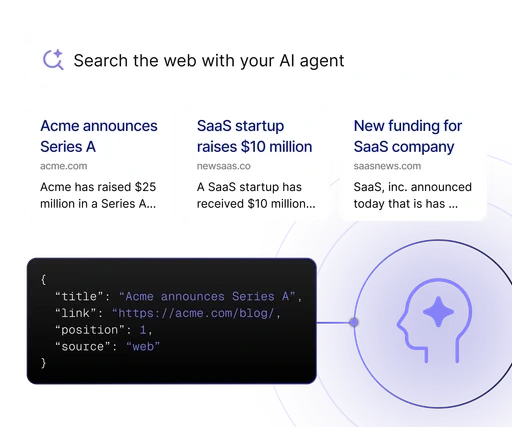
Web Search API
Crustdata’s Web Search API converts live web search results into structured, machine-readable JSON. Instead of scraping result pages and parsing HTML, your systems receive normalized data including titles, URLs, snippets, ranking position, result type, and source.
This allows AI agents to reason over live web data, enrich profiles, power RAG pipelines, and monitor markets without maintaining scraping infrastructure.
Book a demo to see how Crustdata replaces scraping workflows with a real-time, structured data layer built for AI agents and modern data products.
Can I use Crustdata if I'm not a developer?
Yes. With AI coding tools like Claude Code or Cursor, non-technical users are building API-driven workflows. Our API is simple and well-documented. Plus you get Slack access to our team for technical support.
Do you offer a database download like Clay?
Yes. We offer monthly flat-file exports (Parquet) with 400M+ people and 20M+ companies. But most customers prefer API calls for fresher data.
What if I need historical data, not just current?
Our person enrichment includes full work history. Company enrichment includes historical headcount trends, funding rounds, web traffic and more.
Do you verify emails?
Yes. We verify through our own technology. You only pay for verified emails. If we can't verify, you don't get charged.
How fast is real-time enrichment?
Typically 5-15 seconds for person enrichment, 10-30 seconds for company enrichment. Faster if data is cached.
Can I use both Clay and Crustdata?
Yes. Many teams use Clay for SDR manual list building while using Crustdata API for automated systems. Clay can even call Crustdata as an underlying data source.
What if I only need 100 enrichments per month?
Clay might be more cost-effective at very low volumes. Crustdata is built for teams doing 1,000+ enrichments/month or building automated systems.
What is a good substitute for Clay?
It depends on what you're trying to do. If you need a spreadsheet interface for manual list building, alternatives include Persana, Databar, Floqer. But if you need programmatic control and are looking to build automated workflows, AI agents, or event-driven enrichment systems, you need an API-first solution like Crustdata.