Case Study
How The Firm used Crustdata to grow sourcing capacity by 50% without hiring

Company
The Firm
use case
Candidate sourcing and qualification
company overview
The business runs entirely on referrals from their VC network, and demand outpaced what two people could service: roughly 80% of each founder's week went to sourcing, the lowest-leverage use of their judgment. Rather than hire a third recruiter, they built infrastructure — a custom Claude skill on Crustdata's APIs that encodes how they evaluate candidates. Capacity up 50%, no new headcount, no margin loss.
Toward autonomous sourcing
Dominique Kimbrough and Mike Cannon have a combined 25+ years in recruiting. They run The Firm, a two-person recruiting agency specializing in robotics, hardware engineering, and ML/AI roles. Given their expertise, the entire business has been run through referrals, specifically from their VC network. At a firm this small, the product was never really recruiting. It's the judgment they make about who's a good candidate.
A double edged sword, the two founders were unable to handle how fast the referrals were pouring in. Despite using software and tooling to increase operational efficiency, there was still not enough time to be able to service all of the demand. To give more context, about 80% of each founder's week went to sourcing candidates for the open roles which is the lowest-leverage use of decades of recruiting judgment.
The obvious move at this point would be to hire a third recruiter, which is the route most agencies of their size take, with some even making press announcements about their first in-house engineering hire. Dominique and Mike went the other way and built infrastructure instead.
Rather than scale like a traditional agency, they operate like a product team, encoding their judgment into software, not adding headcount is the way to grow without diluting the quality of the business. It was also the more efficient way to grow. A third recruiter would have meant a new salary every month. Building the system barely moved their costs, so they added capacity without losing margin.
Before Crustdata
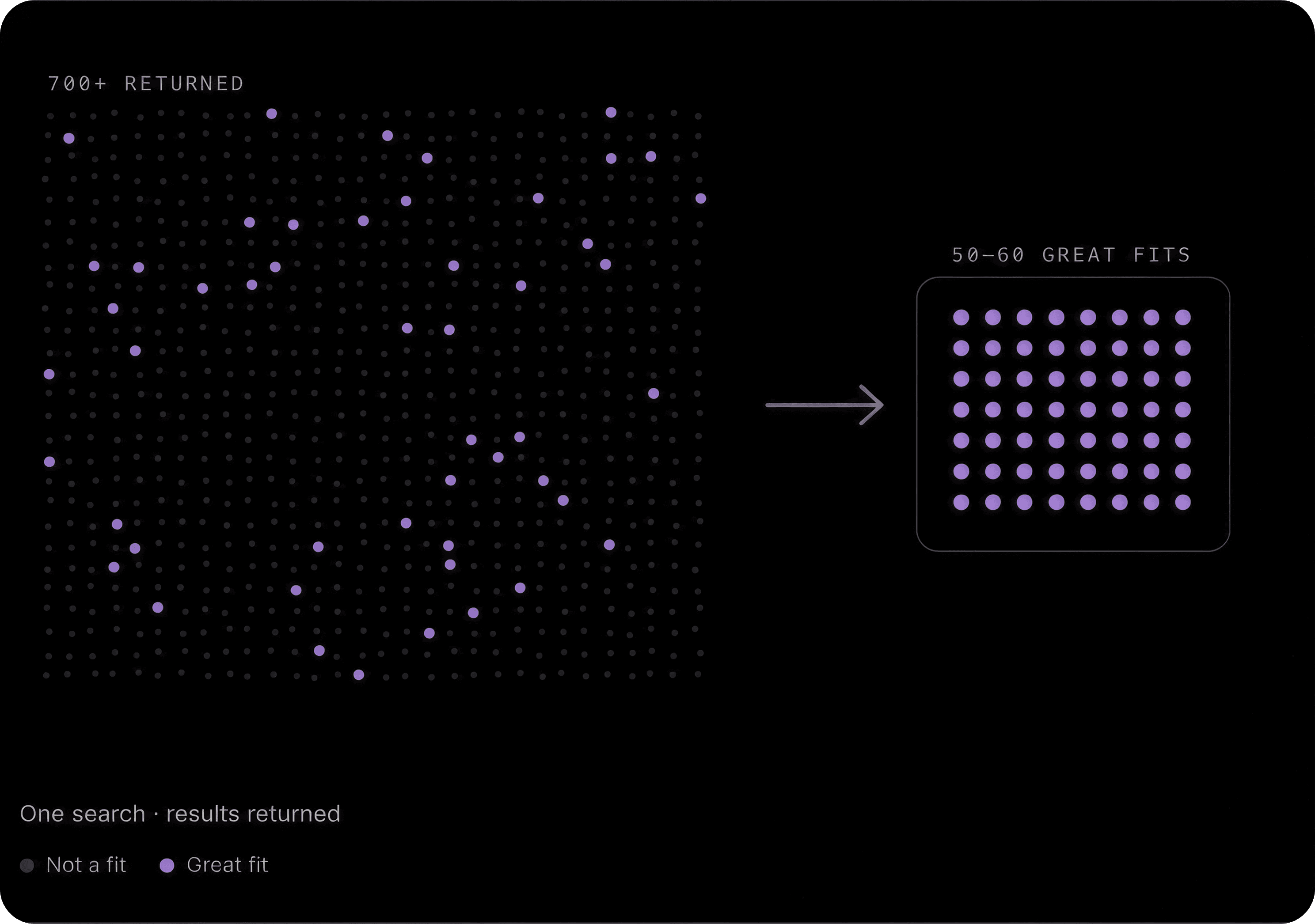
Prior to Crustdata, The Firm's main sourcing tool was Juicebox. A typical candidate search returned 700+ results, most of which were noisy, inaccurate, and just straight incorrect matches. There was also an issue with data freshness, meaning the profiles it surfaced had outdated information, i.e. a candidate would have been a great fit but once you click in, they had actually just started a new position thus were not applicable in the search.
This along with a deeper issue was in how the tool handled the searches themselves, specifically by fragmenting queries into independent keywords. Mike watched it split "GCP" into three separate terms, G, C, and P, with "engineer" treated as its own keyword on top. The more context the founders added to a search, the worse the results became.
What Dominique and Mike set out to build
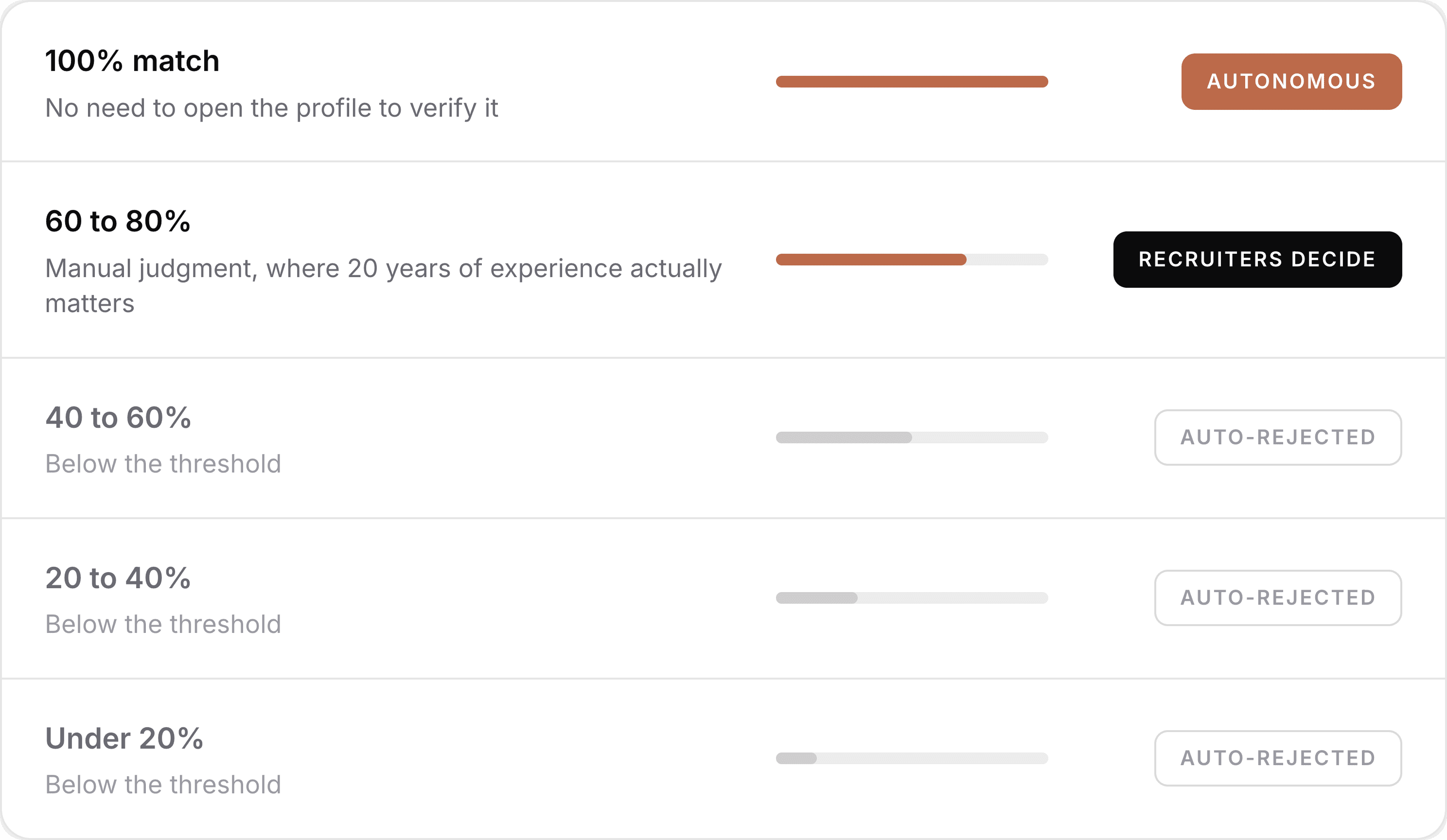
The clear goal for using and investing in tools is to increase the founders' capacities, therefore the baseline expectation is that these tools would give accurate results. The tool would deem a candidate to be a 100% match and yet the opposite surfaced as the truth once the founders reviewed the profile. This was not only frustrating, it defeated the purpose of the investment and created more work.
The ideal tool would be one that was accurate and autonomous, meaning if a candidate is flagged as a 100% match, the founders should not have to open that profile to verify it. Manual judgment should be reserved for the candidates with a 60 to 80% confidence score, where 20 years of experience actually matters.
The goal was to replicate what two experienced recruiters do, so the business could take on more work without adding a third person, all while ensuring searches could run even when both founders were unavailable.
What changed using Crustdata
Rather than buying another off-the-shelf recruiting tool, the founders built their own. Working with the Crustdata team, they developed a custom Claude skill on top of Crustdata's APIs, encoding 25+ years of recruiting judgment into a system that runs their searches the way they would. The same searches that previously returned 700+ noisy results now return 50 to 60 high-confidence candidates.
For years that logic only lived in the founders' heads, filtering just one profile at a time. The judgment was already there. It just had nowhere to operate at scale.
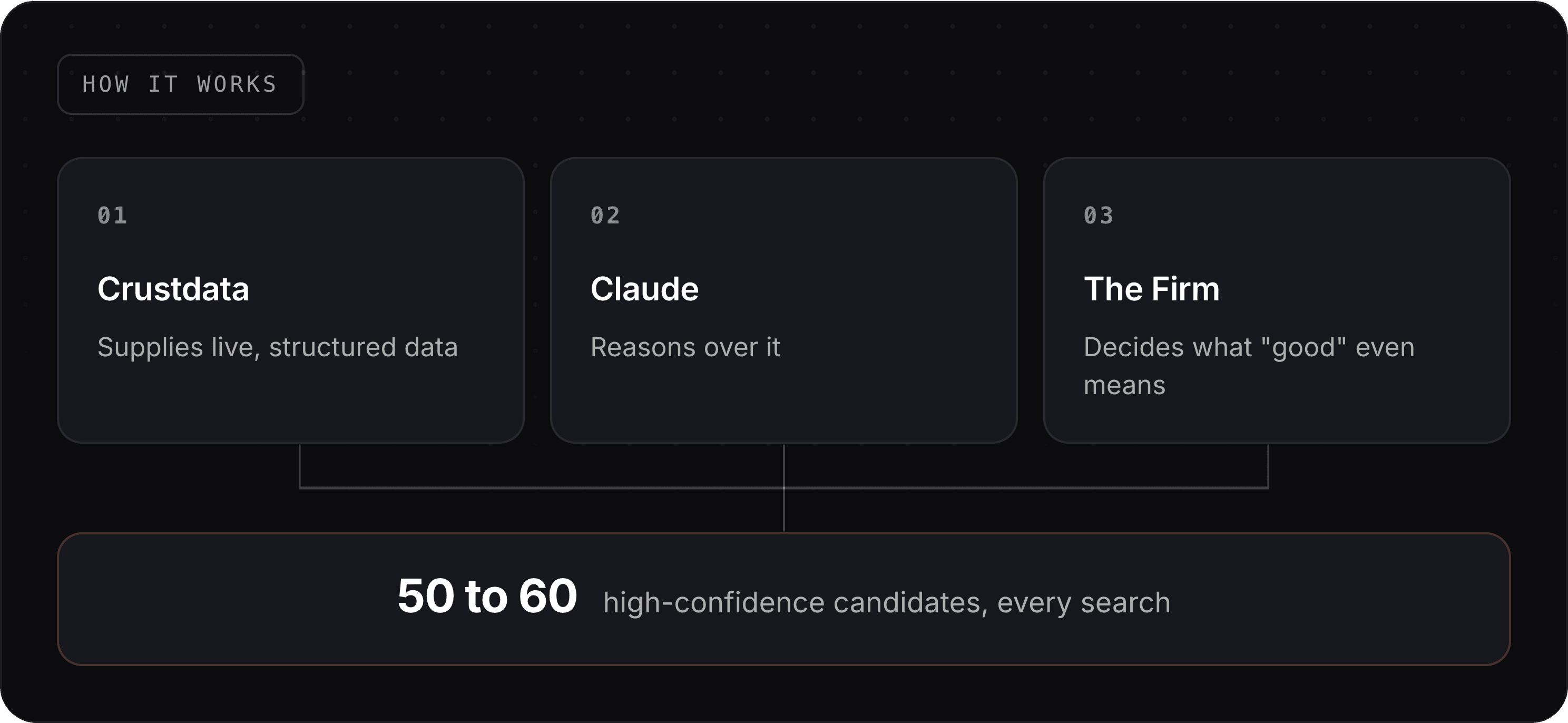
It only works because three things are present at once. Crustdata supplies live, structured data. The People Search API has 60+ filters that nest, so the founders' whole search logic runs as a single query instead of a scatter of keywords. The data behind it is live and properly structured, with full career histories and role-by-role timelines, so the skill can follow someone across adjacent industries and still catch the fit when their current title doesn't show it. Claude reasons over it. And the Firm decides what "good" even means for a given role. If any one of them is taken away, the candidate list goes back to an irrelevant list that they'd have to manually filter from.
The gap shows up most in the roles The Firm specializes in. They work heavily in robotics and physical hardware, where the best candidate is rarely the one whose title actually reads "roboticist." A recruiting tool based on keyword search can only match the words, so it misses the people whose background fits even when their title doesn't. In the system they built with Crustdata, the founders can layer in the kind of criteria a keyword can't express.
Within a week, the founders had a robust working skill they were already using to fill roles with.
What began as a single search has since grown into an internal system that helps the overall business. Alongside candidate searches, the founders now run live market maps, compensation benchmarking data, and automated outreach.
They treat the system like a product team treats a codebase - shipping new versions, recalibrating with learned data, and bettering the process after each search. This flywheel further instills the unique touch The Firm's founders have on recruiting while allowing them to focus on the most important and human parts of recruiting.
The bottom line
Using Crustdata, The Firm increased its capacity by 50% without hiring anyone. The search to outreach sequencing is now fully automated, with no manual handoffs in between. The clearest return, according to Mike, is the three extra clients they can now take on, work they'd previously have turned away. Within about two weeks of the system going live, The Firm sourced and placed their first candidate through it.
Their candidate interest rates now run at 8 to 10%, well above the 2 to 3% industry average, and roles close in half the time they used to.
The day-to-day difference in sourcing is just as visible. A search that once took a full day of manual filtering now takes about two and a half hours from a single prompt. The hours saved go back into candidate conversations and the higher-touch client work only the founders can do.
What they've built is a recruiting operating system, a digital twin of how Dominique and Mike recruit. It carries their judgment across the whole job, from the first search to the outreach that reaches a candidate, and it keeps learning their instincts as they run more searches through it.
The bet they made is starting to look like a defining one. Most agencies handle more demand by hiring more recruiters. The Firm did it by building its own technology, pairing decades of expertise with software to out-operate firms many times their size.