8 Best B2B Contact Data Providers [2026 Comparison]
Discover the best B2B contact data providers and explore tools that work best for prospecting, enrichment, and scalable GTM systems.
Published
Written by
Chris P.
Reviewed by
Nithish A.
Read time
7
minutes

Choosing a B2B contact data provider affects who you can reach, how much effort prospecting takes, and how reliably your CRM routing and scoring work.
Most teams already use some form of contact data provider. The problem is that many of those tools were designed for list building and periodic exports, not for workflows that need to stay accurate as data changes.
What changes in 2026 is how closely that data needs to fit the way teams actually work. Some teams rely on list building and exports. Others pull contact data directly into CRMs, enrichment jobs, AI agents, or outbound systems and expect it to stay usable without constant cleanup.
This guide compares 8 B2B contact data providers with that reality in mind. Each one is described based on who it serves best, how contact data is delivered, and the trade-offs teams typically encounter when using it.
What Is a B2B Contact Data Provider?
A B2B contact data provider gives teams access to information about people inside companies they want to reach. This usually includes names, roles, company details, and professional contact information.
Teams rely on these providers to:
Find new prospects for outbound sales
Enrich CRM records so routing and scoring stay accurate
Support automated GTM workflows that depend on structured people data
Providers differ in how they deliver contact data. Some focus on UI-based list building. Others are designed for programmatic access so data can be pulled directly into internal systems. That difference shapes how well a provider fits into day-to-day workflows.
8 Best B2B Contact Data Providers Comparison
Every B2B contact data provider solves a slightly different problem. Some are built for list building and manual prospecting. Others are designed to supply contact data directly into systems where it can be filtered, enriched, and acted on programmatically.
The table below compares eight providers across delivery model, data scope, and ideal use case.
Provider | Primary Focus | Delivery Model | Best Fit For | Contact Discovery | API Access | Starting Price |
Crustdata | Programmatic contact + company data | API-first | System-driven GTM and automation | Yes | Yes | Free trial available; paid plans are custom quote |
Cognism | Compliance-focused contact data | UI + integrations | Regulated outbound teams | Yes | Limited | Custom plan |
Lead411 | Contact data with sales alerts | UI-first | Timing-driven outbound | Yes | Limited | 7-day free trial, paid plans start $49/month |
Demandbase | Account-based marketing | Platform | ABM programs | Limited | Limited | Custom plan |
Lusha | Lightweight contact enrichment | UI + extensions | Fast manual prospecting | Yes | Limited | Free plan, paid plans start at $22.45/month |
Datanyze | Technographic market data | UI + integrations | Tech-focused targeting | Limited | Limited | 90-day free trial, paid plans start at $21/month |
Hunter.io | Email discovery and verification | UI + API | Email-led outbound | Limited | Yes | Free plan available, paid plan starts at $49/month |
ZoomInfo | Broad sales intelligence | UI-first platform | Enterprise prospecting | Yes | Limited | Custom quote |
1. Crustdata
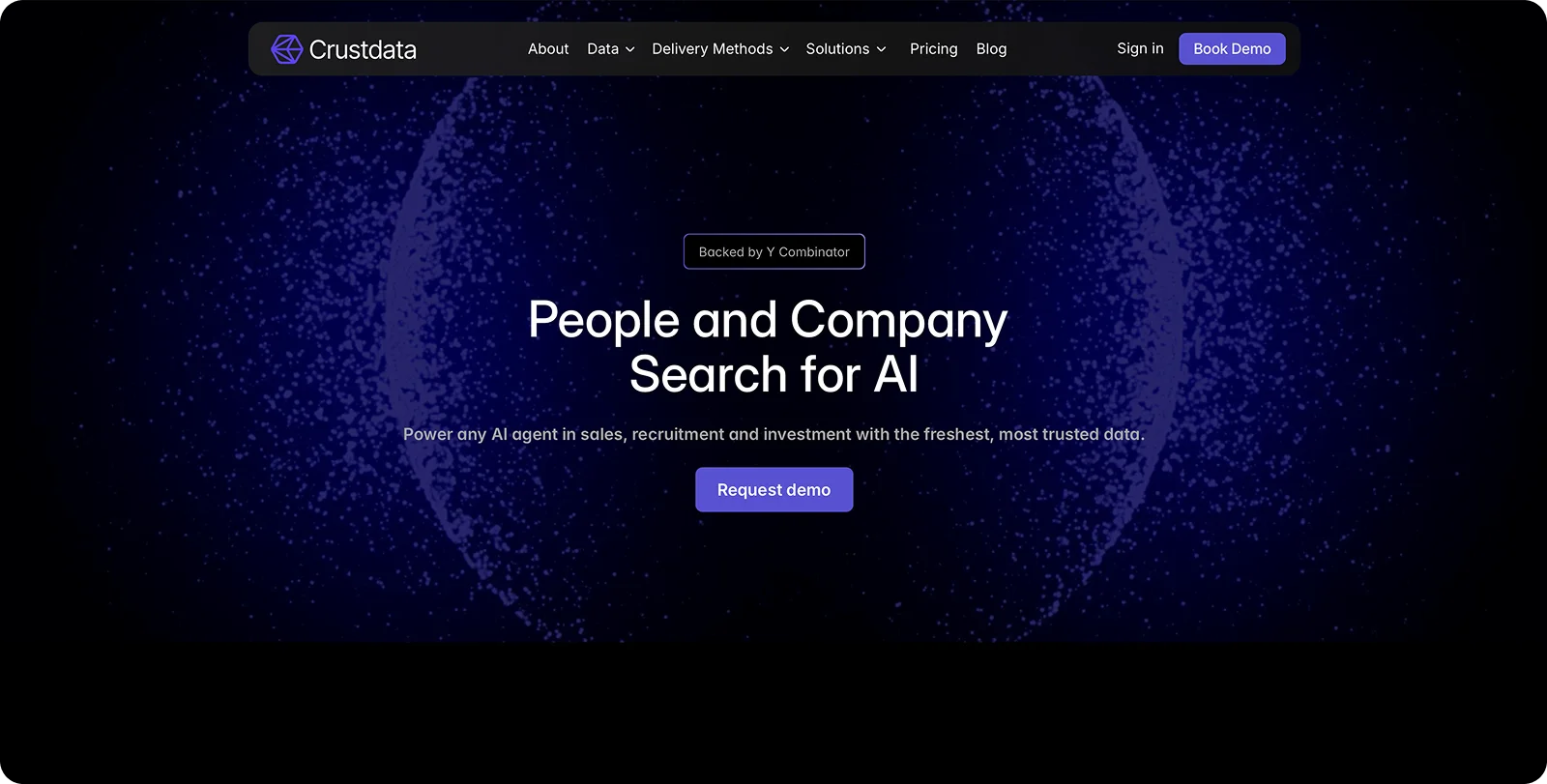
Crustdata is an API-first B2B contact data provider built for teams building AI agents, recruiting platforms, and deal sourcing tools. The platform aggregates data from 16+ verified sources to deliver over 250 company fields and 90 people fields for workflows that identify prospects, trigger outreach based on role changes, and maintain accurate contact records.
Key Features
Real-Time Contact Enrichment: Append missing email addresses, phone numbers, and social profiles to existing leads or accounts through live data crawling at the moment of request
Email-to-Profile Enrichment: Send a business email and receive complete professional profiles including current job title, skills, social links, and detailed work history
Multi-Source Data Integration: Combine contact information from multiple public sources including social platforms, SEC filings, funding announcements, and employee ratings into unified profiles
Webhook Profile Monitoring: Receive instant notifications through the Watcher API when tracked contacts change jobs, update profiles, or show notable activity for timely outreach
Flexible Data Delivery: Access enriched contact records through API integration or download lead databases as parquet files for immediate use in outbound campaigns
Pros
Supports programmatic workflows where contact data needs to stay relevant and up-to-date inside internal systems
Automatically surfaces new contacts when companies meet your criteria, so prospect lists stay current without manual rebuilding
Enriches only the specific contacts you query instead of requiring bulk database purchases, reducing costs for teams that don't need entire contact list
Cons
Requires technical setup to get full value from APIs and webhooks
Pricing
Crustdata offers a free trial and custom pricing that scales with API consumption.
2. Cognism
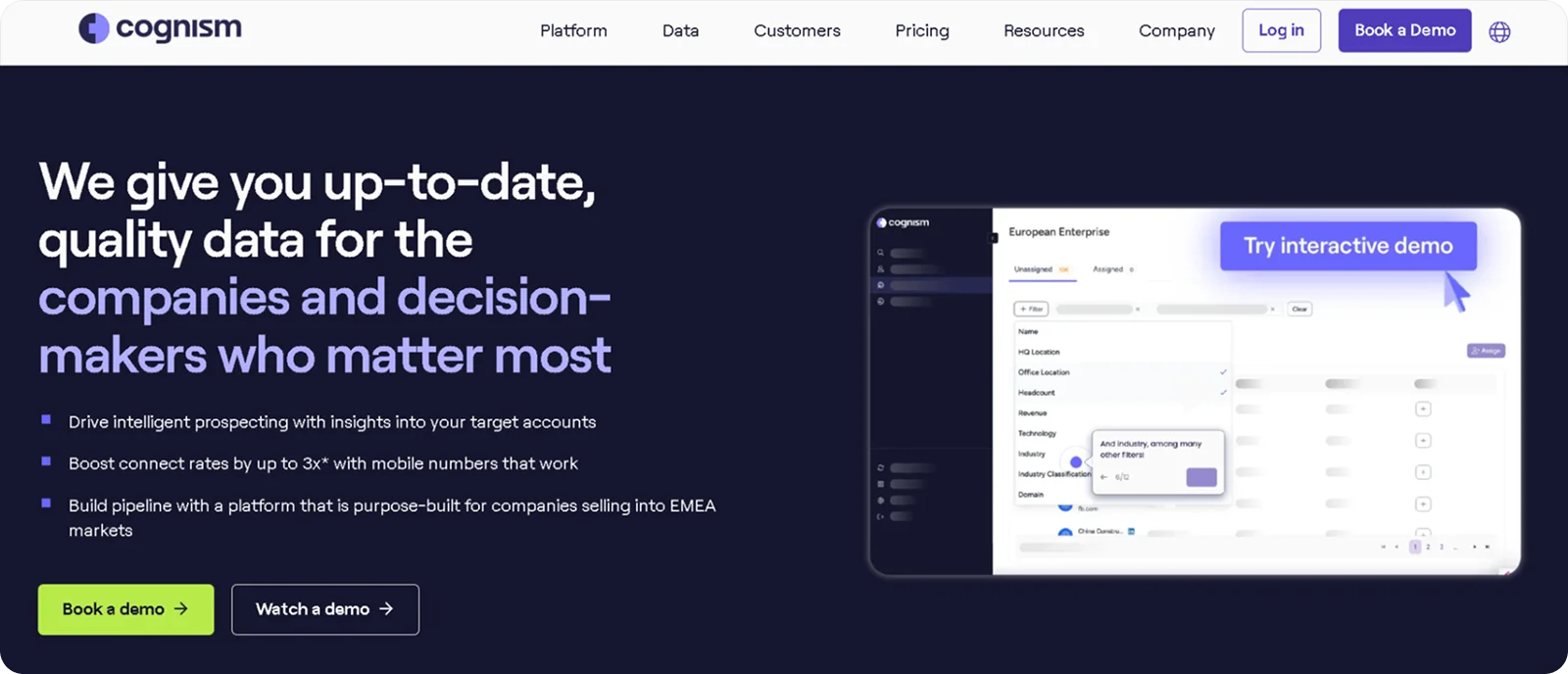
Cognism is a sales intelligence and contact data provider used by outbound teams operating in regulated markets. It emphasizes managed data delivery and compliance-focused processes alongside contact and account data.
Key Features
Diamond Data: Access phone-verified mobile numbers with 87% connect rates, significantly higher than industry standard direct dial accuracy
Diamonds-on-Demand: Request fresh mobile number verification within 48 hours when existing contact data doesn't meet quality standards
AI/ML Email Verification: Validate email deliverability using artificial intelligence and machine learning algorithms combined with SMTP checks before emails enter your system
VP+ Contact Refresh: Automatically update vice president and C-level contacts every 30-60 days to account for high executive turnover rates
Compliance-First Verification: Maintain GDPR and CCPA compliance with 13-country Do Not Call list checking to protect teams from regulatory violations
Pros
Supports teams operating under strict compliance requirements
Handles GDPR compliance checks, removing the need for internal legal review of contact data
Fits structured outbound sales motions
Cons
Centers usage around UI-driven workflows
Limits flexibility for custom or API-first data pipelines
Constrains targeting logic to predefined platform workflows
Pricing
Cognism pricing is custom and varies by region, seat count, and data access. Contact sales for a quote.
3. Lead411
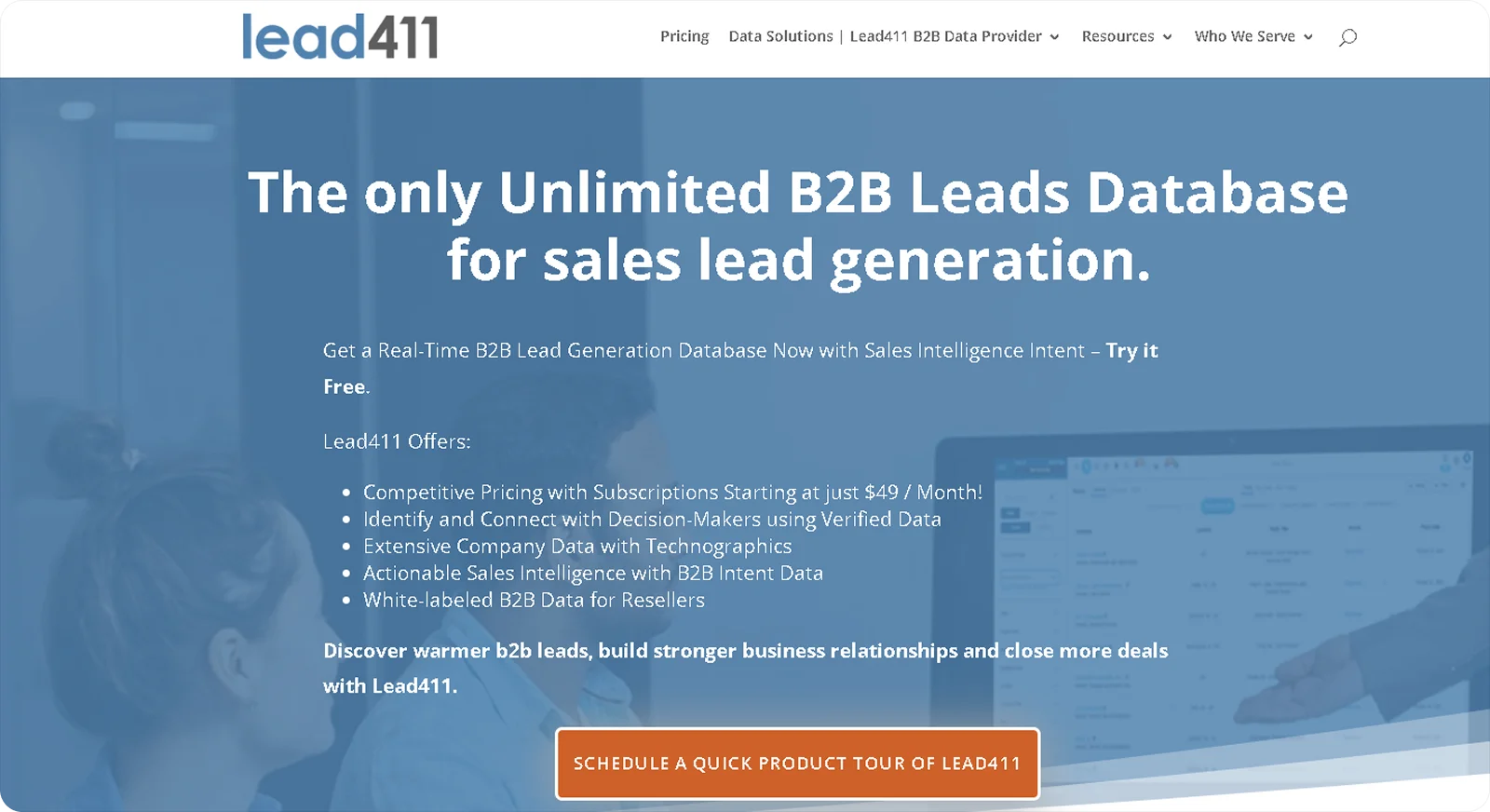
Lead411 is a B2B lead generation database that combines contact records with sales alerts tied to company activity. It is commonly used by teams that want event-based signals to guide outbound timing.
Key Features
Triple Email Verification: Validate every email address through SMTP checks, AI pattern recognition, and human verification for maximum accuracy
Send Technology Verification: Test email deliverability across different platforms and providers to ensure messages reach inboxes rather than spam folders
Double-Verified Direct Dials: Confirm phone number accuracy through two separate validation processes before contact data enters your CRM
90-Day Re-Verification Cycle: Automatically recheck all contact data quarterly to catch job changes, disconnected numbers, and updated email addresses
24-Hour On-Demand Verification: Refresh critical contacts before major campaigns with same-day verification for highest-priority outreach targets
Pros
Adds event context to contact discovery
Supports timing-based outreach
Works well for alert-driven prospecting
Cons
Provides event alerts for timing but lacks comprehensive org charts, budget cycle data, and multi-stakeholder buying group analysis
Limits flexibility outside native workflows
Restricts high-volume enrichment and automated workflows through limited API functionality
Pricing
Lead411 offers a 7-day free trial with paid plans starting at $49/month per user. Annual subscriptions include discounted rates.
4. Demandbase
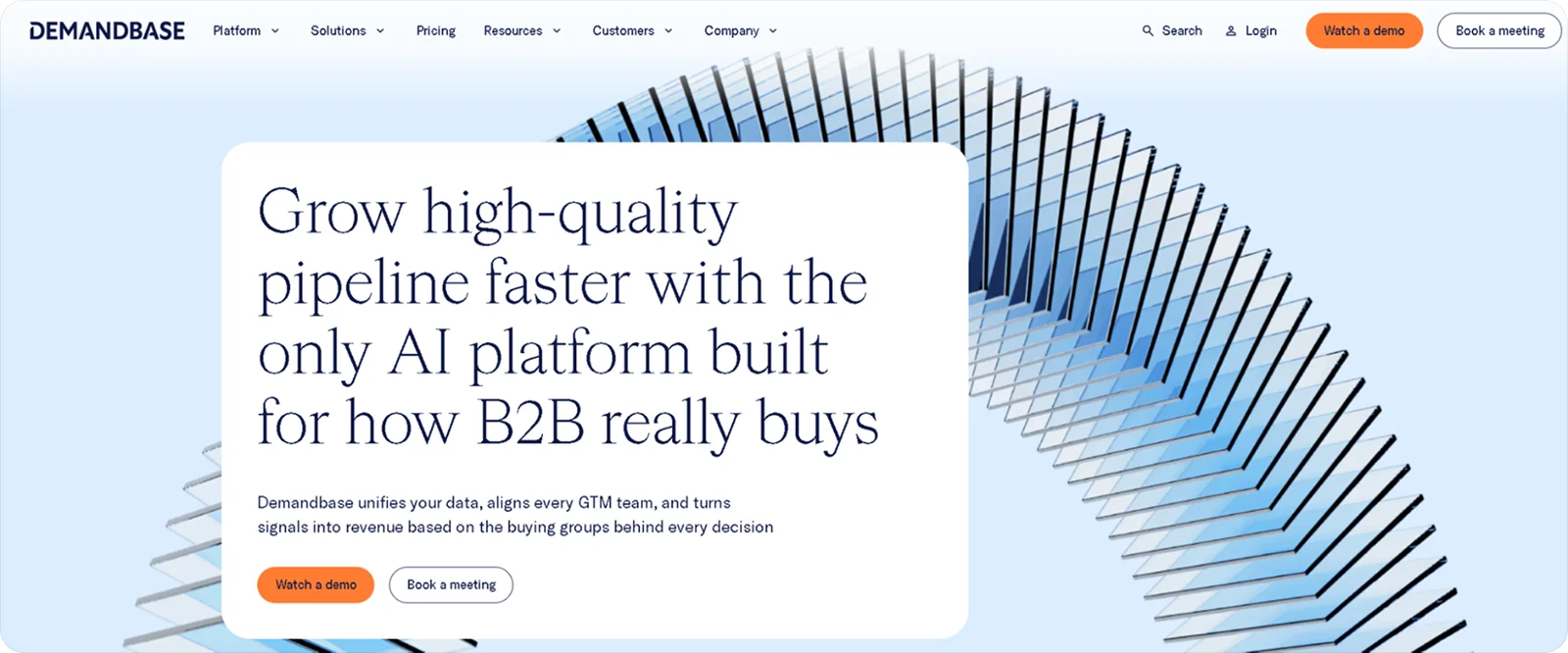
Demandbase is an account-based marketing platform that includes contact and account data to support ABM execution. It is designed to coordinate sales and marketing activities at the account level rather than contact-first prospecting.
Key Features
Real-Time Enrichment: Automatically update new CRM contact records as they're created when they match configured enrichment criteria
Email Validation: Run verification checks across all CRM and marketing automation contacts to confirm deliverability and flag risky addresses
Scheduled Enrichment Workflows: Configure automated contact data updates to run hourly, daily, or weekly through Data Integrity workflows
Forms Enrichment: Capture visitor contact data through IP-API and Domain API methods, using email addresses to identify companies and append contact details to form submissions
Multi-API Priority: Ensure contact identification accuracy by preferring Domain API results (based on email) over IP-API or Company Autocomplete for higher reliability
Pros
Aligns sales and marketing around shared accounts
Supports large ABM programs
Provides account-level buying signals and decision-maker mapping across departments, not just individual contact records
Cons
Prioritizes account orchestration over contact-first prospecting
Requires significant setup and cross-team coordination
Offers limited flexibility for standalone contact enrichment
Pricing
Demandbase uses custom enterprise pricing based on modules, account volume, and contract length. Contact sales for a quote.
5. Lusha
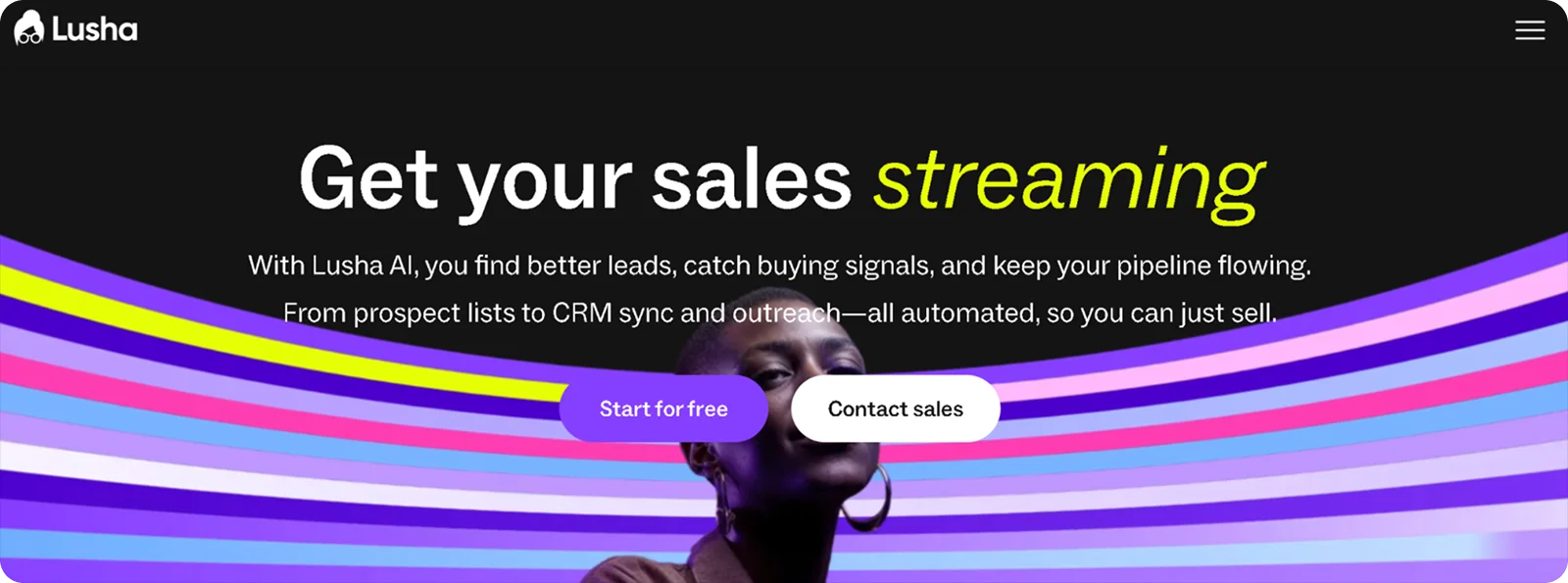
Lusha is a B2B contact data provider focused on fast access to contact details during prospecting. It is commonly used by individual sales reps and small teams that need lightweight enrichment without complex setup.
Key Features
Confidence Scoring: Evaluate contact data quality with confidence scores across every email and phone number record
List Verification: Automatically enrich and validate email addresses and phone numbers before outreach campaigns to reduce bounce rates and protect sender reputation
Bulk Contact Enrichment: Process thousands of contact records simultaneously through CSV uploads or Google Sheets integration, appending verified emails, phone numbers, and job titles at scale
Real-Time Verification: Check email deliverability and phone number validity at the point of enrichment to ensure current contact information
Chrome Extension: Reveal verified contact information directly on LinkedIn profiles and Sales Navigator without switching tools or exporting data
Pros
Speeds up individual rep workflows
Has a low barrier to entry
Works well for small teams
Cons
Caps usage through credit-based limits
Provides limited account-level or organizational context
Supports manual prospecting better than automation-heavy workflows
Pricing
Lusha offers a free plan with 40 credits per month and paid plans starting at $22.45/user/month billed annually for 3,000 credits per year. Higher tiers start at $52.45/month (7,200 credits) and custom enterprise plans with advanced features.
6. Datanyze
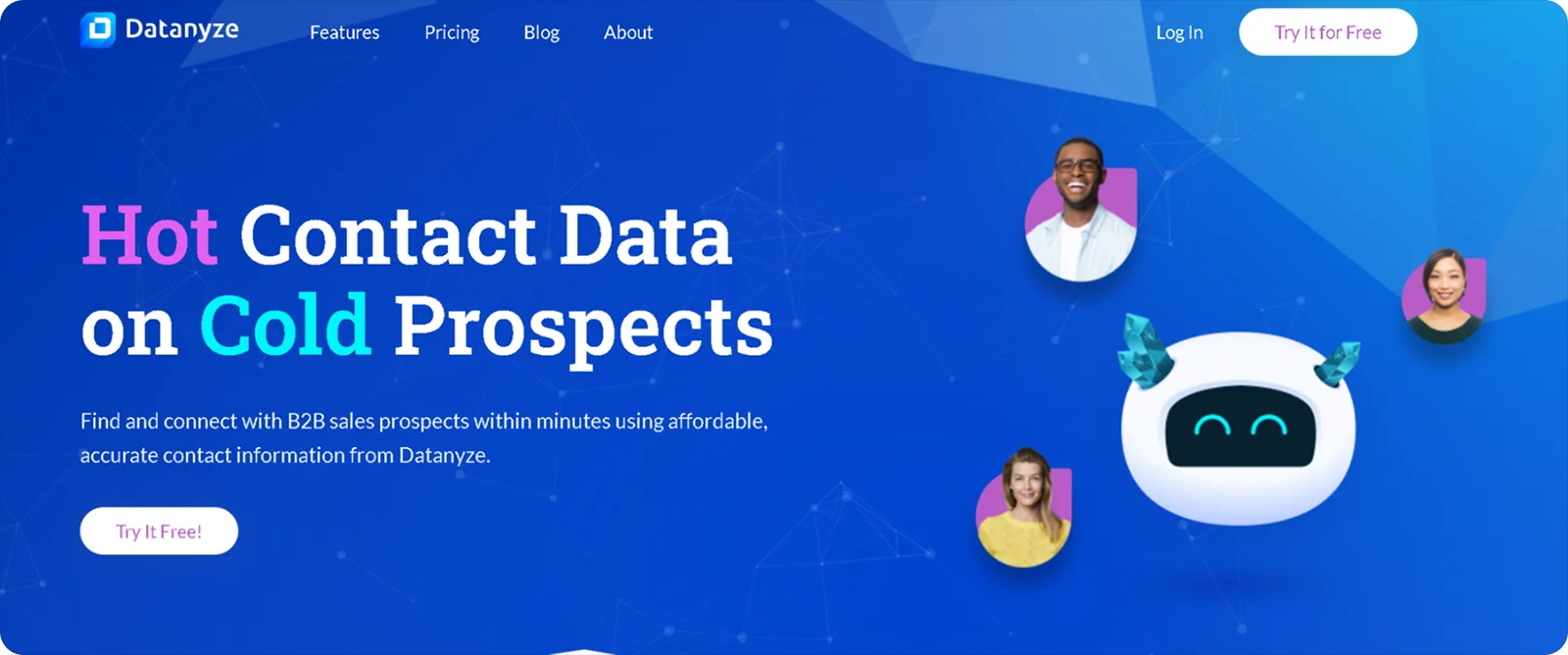
Datanyze provides technographic and market intelligence data alongside business contacts. It is commonly used to support prospecting and targeting in technology-focused segments.
Key Features
Verified Direct Dials: Access verified phone numbers with regular verification updates focused on established companies and North American markets
Technology-Linked Contacts: Identify decision-makers at organizations running specific tech stacks by connecting contact data to technographic intelligence
Continuous Verification: Maintain contact accuracy through automated refresh cycles that update firmographic and employee information regularly
Mobile Number Accuracy: Access verified mobile phone numbers with high accuracy for direct outreach to decision-making units
Credit-Based Contact Access: Pay only for accurate contact data with a credit system where each retrieved contact consumes credits
Pros
Supports tech-focused prospecting
Adds context beyond basic firmographics
Helps align outreach with product fit
Cons
Centers more on technographic insights than direct contact discovery
Covers non-technology industries less deeply
Supports limited large-scale enrichment or automation workflows
Pricing
Datanyze offers a 90-day free trial with paid plans starting at $29/month per user. Enterprise plans require custom quotes.
7. Hunter.io
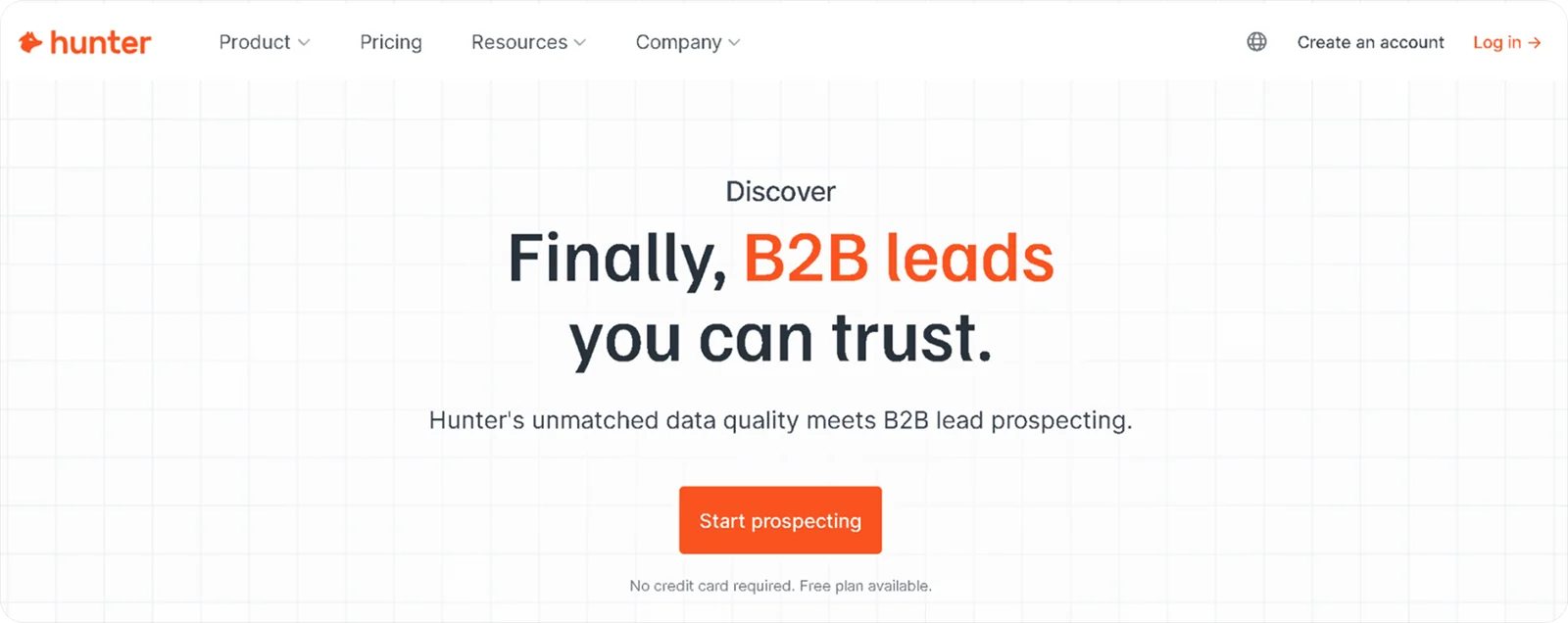
Hunter.io is a B2B contact data provider focused on finding and verifying professional email addresses tied to companies and domains. It is most often used by sales, marketing, and growth teams that prioritize outbound email accuracy over broad account intelligence.
Key Features
Email Finder: Discover professional email addresses using name and company domain, with automatic verification and confidence scoring for each result
Multi-Layer Email Verification: Validate email addresses through syntax checks, domain verification, MX records, SMTP server testing, and catch-all detection before sending
Bulk Email Verification: Process large contact lists simultaneously through CSV uploads or Google Sheets integration to check thousands of emails at scale
Disposable Email Filtering: Identify and filter temporary or disposable email addresses that are typically used to bypass authentication
Domain Search: Extract all email addresses associated with a specific company domain along with contact names and job titles
Pros
Improves email deliverability by reducing hard bounces
Works well for outbound email campaigns
Offers clear, focused functionality
Cons
Focuses narrowly on email discovery rather than full contact profiles
Excludes role hierarchy, seniority, and buying context
Lacks account-level and intent-based signals
Pricing
Hunter.io offers a free plan with 25 monthly searches and paid plans starting at $49/month for 2,000 credits. Annual billing provides two months free.
8. ZoomInfo
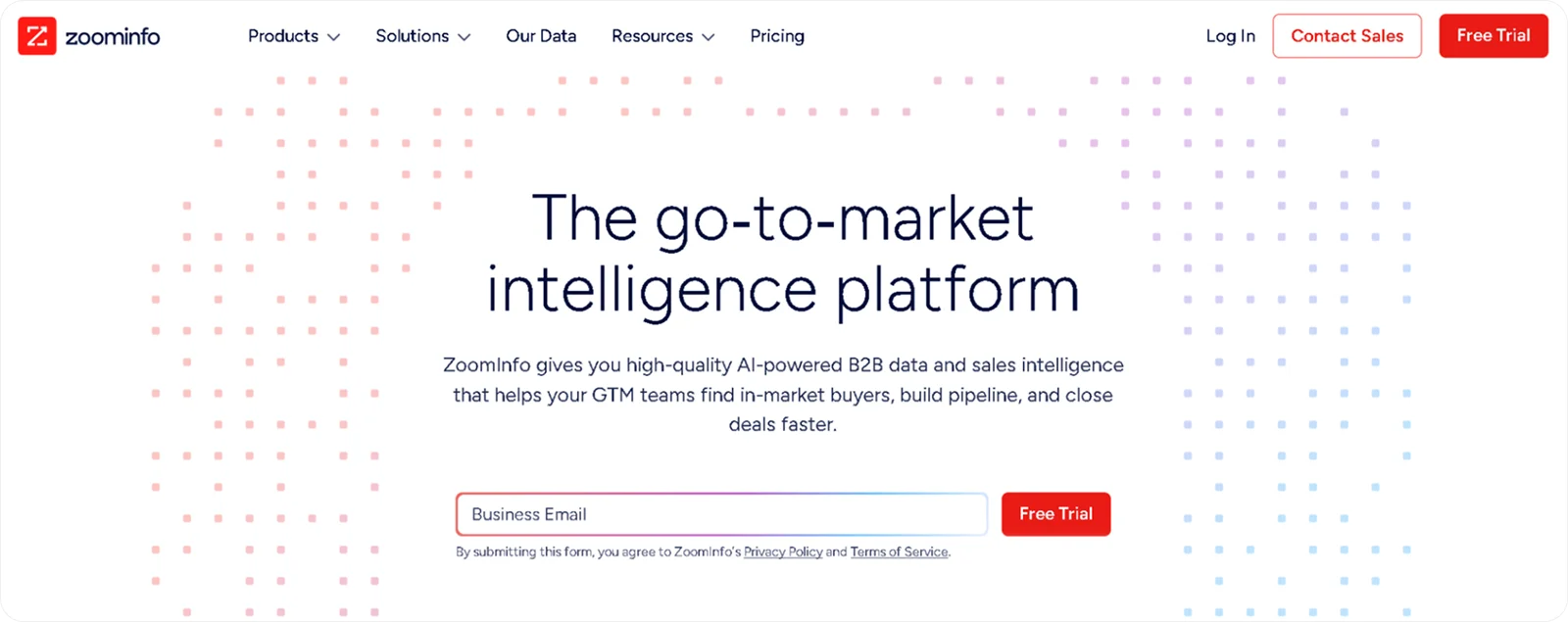
ZoomInfo is a B2B contact data provider widely used by mid-market and enterprise sales teams that want large-scale contact and company coverage delivered through a sales-facing platform. It is most often used for prospecting, account research, and CRM population within structured sales workflows.
Key Features
Proprietary Send-and-Bounce Data: Overcome SMTP check limitations by leveraging unique bounce data to verify domains that cannot be validated through standard methods alone
Multi-Layer Verification: Combine Natural Language Processing, AI, machine learning, and 300+ in-house researchers to validate contact information through both automation and human expertise
Real-Time Contact Enrichment: Automatically update contact and account records across your tech stack on-demand, on-schedule, or in real-time through APIs and webhooks
Contact Accuracy Scoring: Evaluate contact reliability using machine learning algorithms that assess multiple factors beyond just last updated date or human verification status
Multi-Vendor Data Enrichment: Access contact data from 60+ vendors through flexible, rules-based enrichment workflows via a codeless interface
Pros
Covers a wide range of roles and markets
Fits well into enterprise sales workflows
Combines contact and company context in one system
Cons
Relies heavily on UI-based workflows
Offers limited flexibility for API-first use cases
Requires long-term contracts for most customers
Pricing
ZoomInfo pricing is custom and varies by features, user count, and contract length.
Which B2B Contact Data Provider Should You Choose?
The right B2B contact data provider depends on how your team works and what systems you're feeding.
UI-first providers like ZoomInfo, Lusha, or Lead411 fit teams where reps build lists manually, prospecting happens inside the platform, or simple CRM syncs handle most workflows without custom automation.
API-first providers like Crustdata or Hunter.io work for teams building AI agents or automation platforms, running workflows that require programmatic data access, or enriching records selectively based on triggers rather than in bulk.
ABM-focused platforms like Demandbase serve GTM motions centered on account orchestration, where sales and marketing coordinate around shared targets and individual contact prospecting matters less than account-level campaigns.
How Crustdata Fits Into Modern B2B Contact Data Workflows
Crustdata is built for teams that need contact data to stay accurate inside real systems, not just look good in a prospecting interface. It provides REST APIs and webhooks that push contact and company data into your existing systems as conditions change, without requiring manual exports or UI-based list building.
What sets Crustdata apart is how it supports continuous workflows. Teams use it to power data enrichment workflows that run only when contacts qualify, maintain account-based intelligence without rebuilding lists, and rely on live employee data to keep roles and seniority aligned as organizations change. Event-based updates make it possible to surface new contacts at the right moment, which is critical when AI SDR timing depends on the current context.
For teams building scalable, automated GTM systems, Crustdata offers the most control over how contact data is discovered, enriched, and activated over time.
Book a demo to see why Crustdata is the best fit for modern B2B contact data workflows.
FAQs
Do Contact Data Providers Verify Phone Numbers The Same Way They Verify Emails?
No. Email verification runs automated SMTP checks that happen instantly. Phone verification needs carrier lookups, line-type detection, and sometimes actual dial testing. Cognism even uses human callers to verify mobiles. That's why phone accuracy tends to be lower and why some providers specialize in one contact type over the other.
What Happens To My Contact Data Accuracy When Someone Changes Jobs?
Work emails usually deactivate within days of a job change, and direct dials disconnect within weeks. Real-time providers catch these changes immediately through live crawling. Batch-update systems can take months to reflect the same moves. Job change alerts let you reach contacts before competitors know they switched roles.
Can I Use Multiple Contact Data Providers Without Creating Duplicates?
Yes. Waterfall enrichment checks providers one after another until it finds what you need. If Provider A doesn't have a mobile number, it automatically tries Provider B. You can also set rules for which provider handles specific fields. Just configure your system to only fill empty fields so you don't overwrite existing data.


Products
Popular Use Cases
Competitor Comparisons
95 Third Street, 2nd Floor, San Francisco,
California 94103, United States of America
© 2026 Crustdata Inc.
Products
Popular Use Cases
Competitor Comparisons
95 Third Street, 2nd Floor, San Francisco,
California 94103, United States of America
© 2026 CrustData Inc.
Products
Popular Use Cases
Competitor Comparisons
95 Third Street, 2nd Floor, San Francisco,
California 94103, United States of America
© 2026 Crustdata Inc.
🎉 We hit $10M ARR!
$600k to $10m in 1.5 years. Our entire GTM is powered by our own APIs.
🎉 We hit $10M ARR in 1.5 years!