B2B Data API Providers Ranked: Which of the Big 5 Should You Choose
Not all “real-time” B2B data APIs are equal. This guide ranks the top providers based on data freshness, API strength, accuracy, and scalability.
Published
Written by
Nithish A.
Reviewed by
Manmohit G.
Read time
7
minutes
The B2B data API market has become a battlefield of bold claims and buried limitations. Every provider promises "real-time" data and "comprehensive" coverage, but when your AI SDR contacts someone who left their job three months ago, or your campaign’s bounce rate never seems to decrease, you realize that these marketing promises don't match reality.
The difference between genuine real-time signals and monthly database dumps marketed as fresh can determine whether you reach a newly promoted decision-maker first or call their old number while competitors close the deal. Our guide on real-time vs batch data enrichment breaks down which is which.
With 70.3% of B2B data becoming outdated within a year, and AI-driven workflows demanding instant triggers for job changes and funding rounds, choosing the right data API provider directly impacts your competitive advantage.
This analysis examines five major providers dominating different market segments. We'll evaluate each against metrics that actually predict success:
Genuine data freshness.
API reliability and response times.
Match rates for your specific ICP rather than vanity numbers.
Transparent pricing without mid-quarter surprises.
Integration capabilities that determine whether implementation takes days or months.
First, let's review the essential criteria for choosing a B2B data API provider and how to test whether they meet your needs. If you want the full rundown, our guide to criteria for selecting B2B data providers goes deeper on each.
What to look for in a B2B data API provider
While selecting a B2B data provider, you need to consider more than the size of their database. It requires a strategic evaluation of their underlying technology, business model, and support structure. A provider optimized for manual sales prospecting is fundamentally different from one built to power automated, AI-driven sales workflows.
Before committing, scrutinize potential providers against these five critical factors.
1. Data freshness and update frequency
"Freshness" is the lag time between a real-world event (like a promotion or job change) and its appearance in the API.
The test: Ask providers to define their refresh cycles. Many competitors market "real-time" data that is, in reality, a static database that receives a batch update monthly or quarterly.
Why it matters: For event-driven sales, this lag time determines success or failure. Reaching a newly promoted VP of Sales within hours of their announcement places you in the critical window when they are evaluating new tools. Reaching them 60 days later means you're contacting someone who has likely already been demoed by your competitors.
2. API architecture and developer experience
Evaluate whether the provider is truly API-first or if they are a platform-first company that offers an API as an afterthought. We dig into that distinction in our B2B data API vs platform guide.
The test: Review their technical documentation for completeness and clarity. Modern API-first providers offer detailed schemas, sample payloads, SDKs, error handling conventions, rate-limit rules, and webhook documentation. If the docs feel shallow, ambiguous, or incomplete, the API is likely an afterthought. While API-first providers typically offer robust, well-documented endpoints, modern teams should also look for webhook (push) capabilities that eliminate constant polling.
Why it matters: A platform-first vendor often gates API access behind expensive, mandatory enterprise subscriptions. Their API may be poorly documented, have lower reliability, and lack the flexible webhook infrastructure needed to build sophisticated, real-time automation. Webhooks aren't guaranteed just because an API exists, but they are increasingly essential for real-time workflows like job-change alerts, funding triggers, or hiring surge detection. Beyond documentation quality, evaluate technical fundamentals like API uptime and historical reliability, average and P95 latency, and rate limits and burst limits.
3. Data coverage vs. measurable accuracy
Accuracy will always trump sheer volume. Don't be swayed by vanity metrics like billions of profiles.
The test: The only actionable metric is the match rate for your specific Ideal Customer Profile (ICP). Ask the company to provide a list of 100 target accounts to acquire account-based intelligence and measure the match rate and accuracy yourself.
Why it matters: A provider's quality is linked to its source diversity. A modern provider should aggregate data from multiple sources (professional networks, company websites, SEC filings, app reviews, web traffic data, etc.). Ask if their API can only query its existing database, or can it perform real-time crawling to find new or updated profiles on demand.
4. Pricing model and scalability
The critical consideration here is that the provider's business model must align with your workflow.
The test: Analyze the pricing structure for transparency and scalability. Is it a self-serve, credit-based model, or does it require opaque sales negotiations?.
Why it matters: Seat-based pricing is designed for human-scale sales teams and becomes economically unviable for AI agents or automated systems. A usage-based (credit) model aligns cost directly with value, allowing you to scale programmatic workflows without penalty.
🚨 Watch out for hidden platform taxes where API access is gated behind a costly base subscription you don't need.
5. Technical and responsive support
When you build a product or automated workflow on a third-party API, you create a hard dependency.
The test: Look for providers that offer dedicated engineering support, clear Service Level Agreements (SLAs), and a public-facing API status page.
Why it matters: If their API has an issue, your product or sales operation has an issue. For development teams, slow or unqualified support can become a critical bottleneck that halts your operations and damages your reputation with your own customers.
Comparing the top 5 B2B data API providers
So, who are the top B2B data API providers? Sales leaders often praise the big, all-in-one platforms that promise a massive database, while developers and RevOps teams frequently prefer companies offering fresh data, affordable costs, and true API flexibility. In an ideal scenario, you want a data provider that offers both.
To cut through the noise, we’re putting five of the most-discussed providers head-to-head: Crustdata, ZoomInfo, Cognism, People Data Labs, and Coresignal, analyzing their core architecture, data freshness, and the specific use cases they were really built for.
1. Crustdata
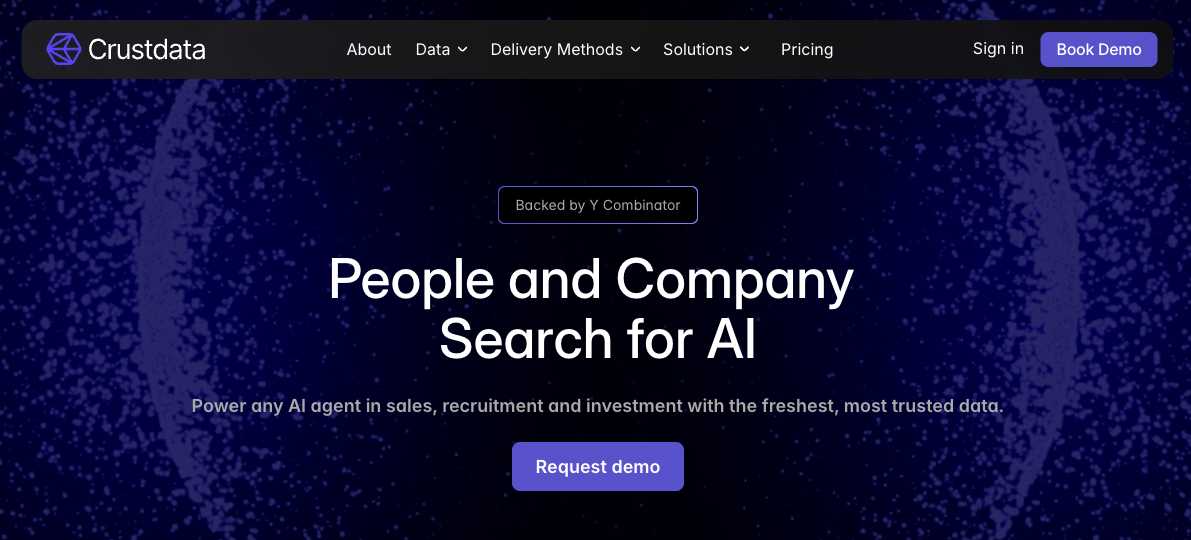
Crustdata differentiates itself with a fundamentally distinct architectural approach, positioning itself as the infrastructure layer for real-time, event-driven applications. Its core strength is the delivery of genuine real-time data.
Crustdata covers 1B+ people and 60M+ companies from 10+ live sources.
While most competitors serve data from pre-compiled, cached databases with monthly or quarterly refreshes, Crustdata operates as a live indexer. This allows it to perform on-demand web-crawling to find and enrich profiles, with a documented ability to return data for untracked companies within minutes.
This real-time architecture enables its unique Watcher API. This feature eliminates the need for traditional API polling. Instead, users can subscribe to custom events, and the Watcher API will actively push notifications via webhooks the moment a change is detected. This provides near-instant alerts for triggers like job changes, funding rounds, or department-specific hiring, which most competitors do not offer or only provide with significant delays.
Key characteristics include:
Data depth. The platform aggregates data from over 10 diverse sources, including non-traditional signals like app store reviews, product reviews, social media metrics, and web traffic analytics.
User validation. Platform builders and technical teams consistently highlight Crustdata's capabilities in community discussions. As one Reddit user reports,
“Crustdata is the best people search API we’ve used. They have a real-time search option that I haven’t seen the other data providers like PDL offer. Usually, how data providers operate is that they have a database and pull results from this database, most often monthly updated. Crustdata, from what we’ve seen, indexes the web in real-time when you add your filters, so we get way more accurate results. We also use them for enrichment because they have the same real-time enrichment option, and they combine data from 10 sources all in one record.”
High-touch customer support. Recognizing that clients often build entire products on their data, Crustdata provides a high-availability support model. All customers receive dedicated Slack channels staffed by 4-5 members of the Crustdata team, ensuring immediate request resolution.
Pricing. The structure is a transparent, credit-based API pricing model with self-serve access. This model avoids the hidden platform fees or mandatory enterprise subscriptions required by many competitors.
However, Crustdata does not yet offer phone data like Cognism does, or salary data that Coresignal provides.
Best for: teams building products, agents, or internal tools on live B2B people and company data by API.
2. People Data Labs
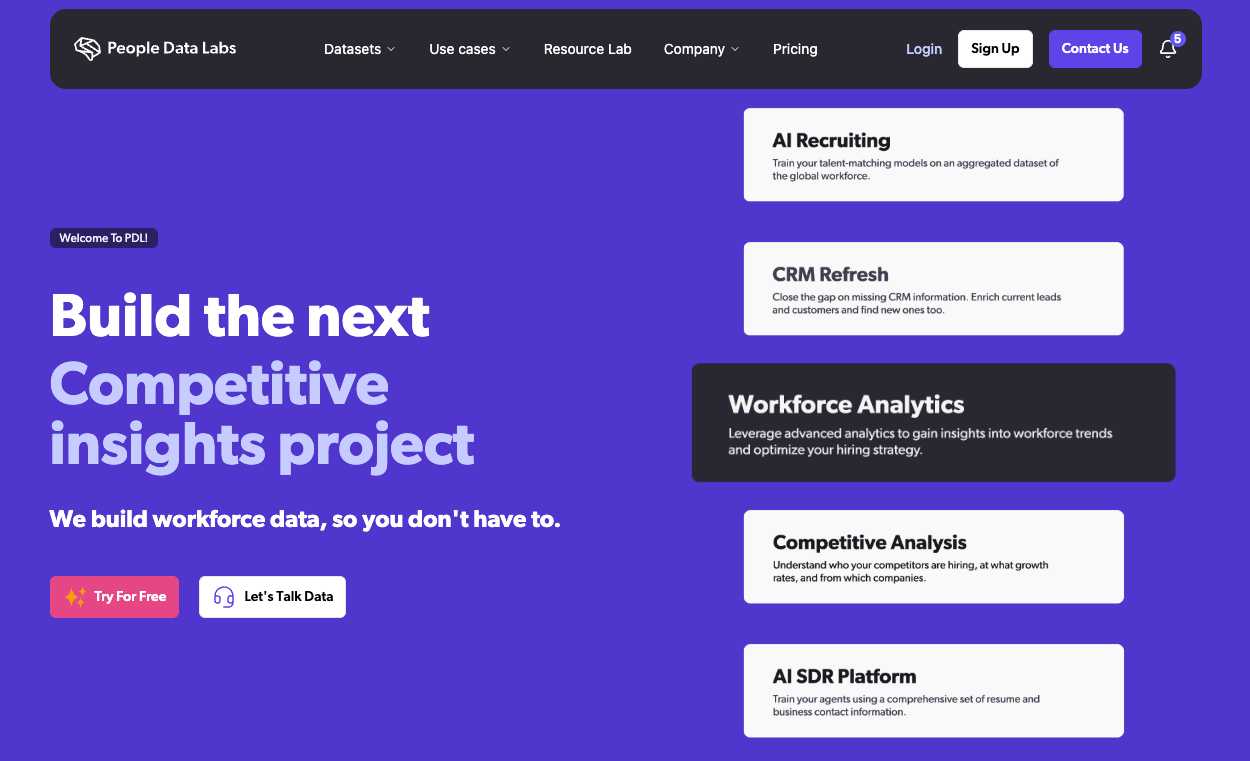
People Data Labs (PDL) is a well-regarded, API-first provider that excels in database scale and historical depth. Its core strength is a massive, person-focused database, and it's built with a true developer-first philosophy, offering excellent documentation and a free tier that makes testing easy. PDL offers comprehensive work histories, including specific start and end dates for roles. This makes it well-suited for large-scale, batch enrichment where you need structured work histories across millions of records. However, because the dataset is updated in monthly cycles, these histories can lag behind real-world changes, especially around recent job moves or promotions.
Key characteristics include:
API reliability & documentation: PDL offers best-in-class documentation and maintains high availability. The platform has clear API docs, SDKs (Python, JS, Ruby), and an API dashboard for keys, rate-limit visibility, and usage.
Throughput & rate limits: Typical default rate limits are 100 requests/min for free accounts and 1,000 requests/min for paying customers on key endpoints like Person Enrichment, Company Enrichment, and IP Enrichment.
Structured QA pipeline: New sources go through a battery of tests (linkage accuracy, email validation, etc.). PDL claims to reject roughly 3 data sources for every 1 accepted, and every monthly release is regression-tested against the previous version.
Match-rate optimization for specific ICPs: They increase field fill-rates and add new partners specifically to improve match rates, especially on high-value attributes. APIs expose likelihood scores and allow you to control match strictness and required fields (e.g., via “minimum likelihood score” in Salesforce integration), which lets data teams tune precision vs coverage for their exact ICP (e.g., “US SaaS, 200–2000 employees, VP+ only”).
Pricing. The model is transparent and genuinely API-first, with no hidden platform fees. It’s a straightforward, credit-based system with a free tier that offers 100 records per month for testing.
However, the primary trade-off with PDL is data freshness. The platform operates on a monthly batch-processing schedule, meaning its entire database is updated in cycles. While comprehensive, this architecture means that at any given time, a significant portion of the data is inherently stale, lagging behind real-world job changes and promotions by weeks.
PDL's data is heavily focused on professional profiles. While its Job Posting Dataset is sourced directly from company career pages, you won't get the diverse, non-traditional signals that other providers offer, such as web traffic analytics, product reviews, or recent news mentions. PDL offers webhook support, but only for their enterprise customers. For all other users, data is updated once a month, so it cannot discover new profiles on demand; it can only query its existing database.
Best for: PDL is an excellent choice for large-scale, batch enrichment projects where comprehensive historical data is more critical than second-by-second freshness.
3. Coresignal
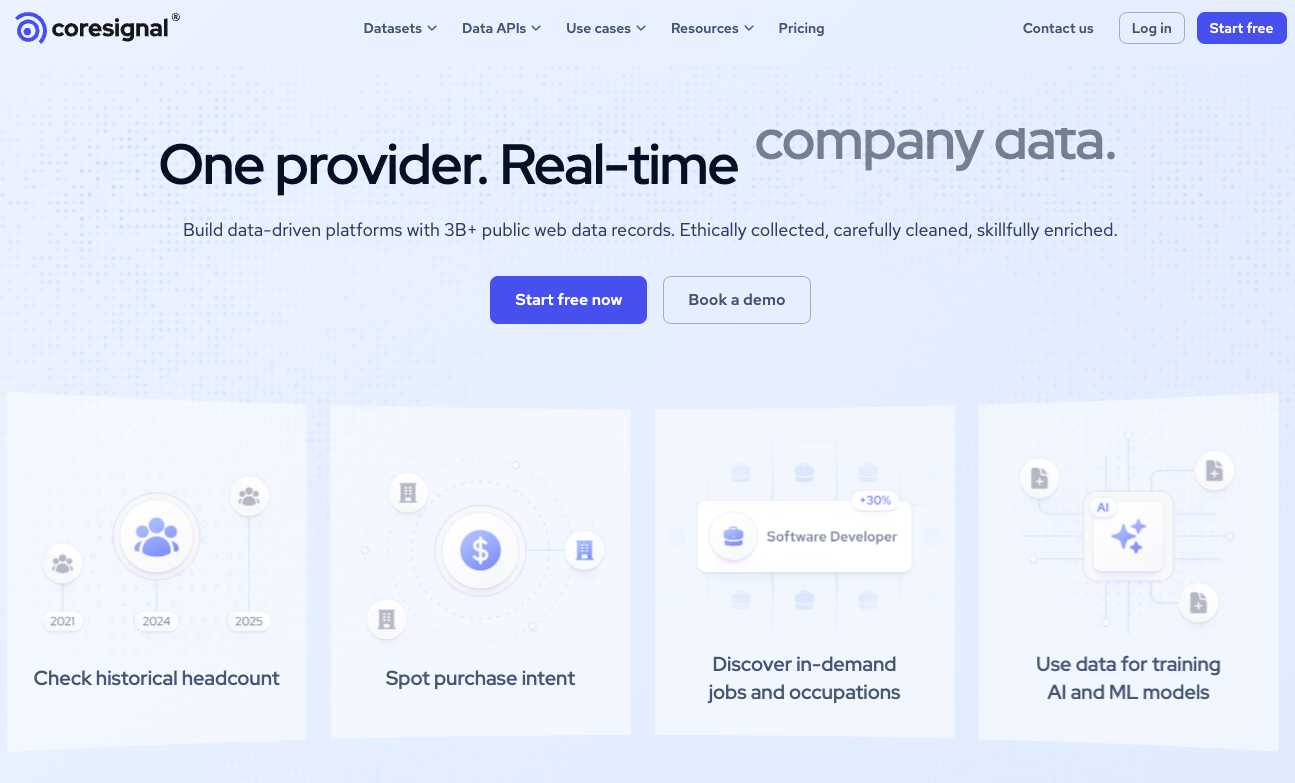
Coresignal sells refreshed datasets of companies, professionals, and job postings for teams that want a fixed dataset to load. Crustdata is the choice when the data has to be live.
Key characteristics include:
Extensive B2B database: Coresignal features over 780 million people profiles and 74 million enriched company profiles. It offers comprehensive data points that go beyond firmographics, including salary data, technographics, job postings, and social media metrics.
Hybrid data freshness model: The database connected to their API is updated in real-time, but most of the underlying datasets are refreshed on daily, weekly, or monthly cycles.
Flexible data access through APIs, flat files, and multiple clouds: Delivery via APIs, direct downloads, S3/GCS, Snowflake, Azure Storage, Pub/Sub, and SFTP gives data teams freedom to integrate Coresignal into almost any modern data stack.
Pricing. The platform's pricing is transparent and highly accessible, with entry-level plans starting at $49/month for dataset access. This makes it one of the more budget-friendly options for mid-market companies that need rich data.
However, it's important to understand its specific API limitations. Coresignal lacks a real-time search API. This means you cannot discover new profiles on demand; you can only query the existing database entries. While they do offer real-time monitoring webhooks, the system does not support custom event tracking, which limits its flexibility for complex automation workflows compared to more advanced webhook systems.
Best for: Coresignal is ideal for investment firms, recruiters, market research teams, and competitive intelligence analysts. These users benefit from comprehensive historical company data, salary insights, and technographic analysis, but do not require real-time prospect discovery or extensive custom event automation for outbound sales.
4. ZoomInfo
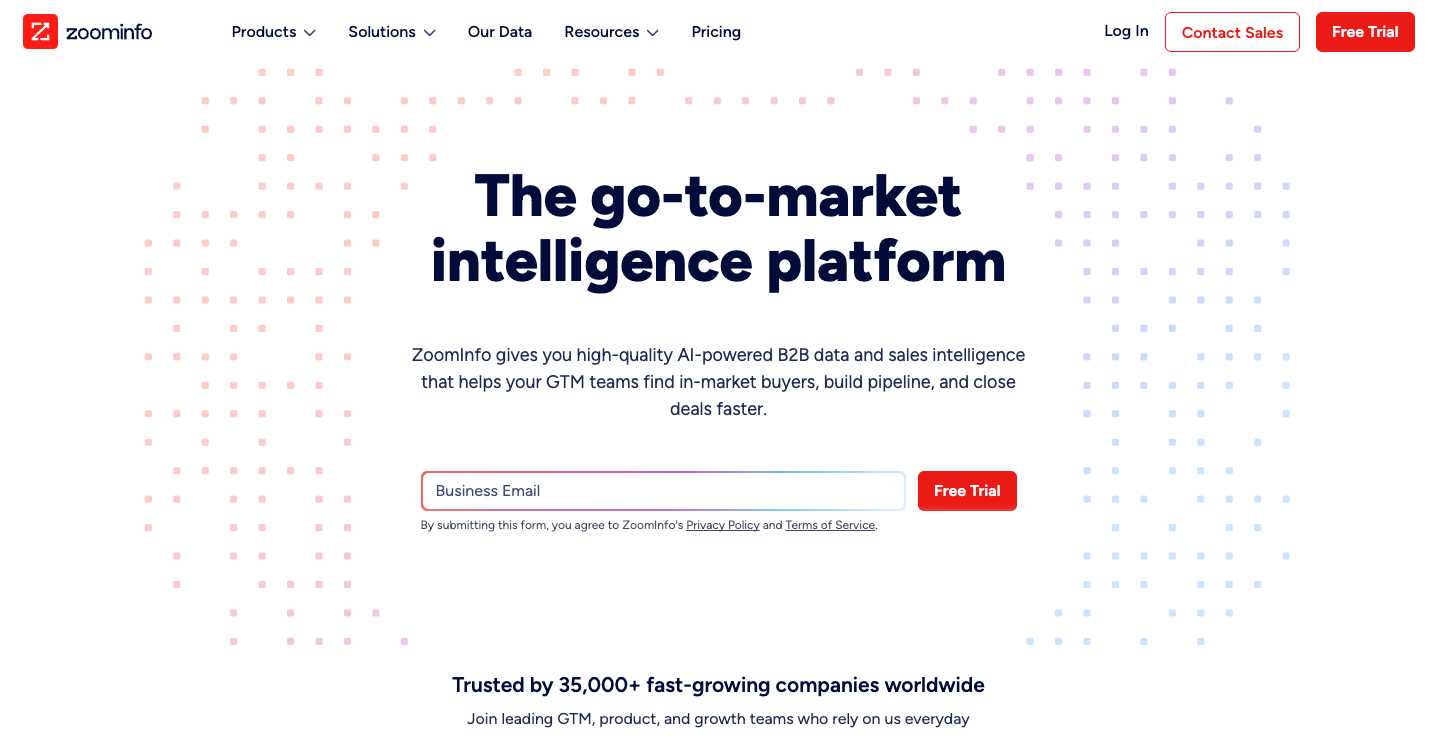
ZoomInfo is a U.S.-based go-to-market (GTM) data and intelligence platform that combines a massive B2B contact database with workflow tools for sales, marketing, RevOps, and recruiting teams. It functions as a comprehensive, all-in-one platform rather than just a data API. Its core strength is its extensive, US-focused database. ZoomInfo’s RevOS platform is used by many companies worldwide to find and engage prospects, enrich CRM data, run ABM programs, and support recruiting.
Key characteristics include:
Massive, mature B2B dataset (especially in North America): 260–320M+ contacts, 100M+ companies, deep firmographics/technographics, and intent signals give excellent coverage for classic B2B ICPs.
Enterprise-grade API and integrations: High API throughput (up to ~1,500 RPM and 25 records per call), strong docs, and deep integrations with Salesforce, HubSpot, Marketo, Outreach, Salesloft, etc., make it fit naturally into mature RevOps stacks.
End-to-end GTM platform (RevOS): SalesOS, MarketingOS, TalentOS, and OperationsOS let you move from ICP definition → targeting → activation → measurement in one system rather than stitching tools together.
Strong fit for high-ACV, US-centric outbound teams: High phone accuracy and deep filters make it particularly effective for US SDR/AE teams running call-heavy outbound and ABM motions.
“It's the most comprehensive database for finding accounts and contacts for our outbound efforts. I can trust that the data I'm pulling will be robust and accurate, and the interface is incredibly easy to use.” – A.J. A. via G2
However, ZoomInfo is built as a platform-first solution, not an API-first one. It's designed around seat-based licenses for human sales reps with CRM integrations, Chrome extensions, and mobile apps.
For developers or teams looking for programmatic access, this model presents significant hurdles. The platform's own documentation confirms that data is "updated in monthly cycles." While webhooks are available for notifications, the base data refresh happens monthly, not in real-time.
There is zero transparent pricing. All access, especially for the enterprise API, requires demo requests and direct sales negotiations, making it impossible to evaluate costs upfront.
Additionally, user feedback reveals persistent issues with data accuracy and freshness. Contact information is frequently outdated or incorrect, and company-level data like employee counts and revenue figures can be unreliable. The staleness extends beyond contact data – ZoomInfo's own representatives have acknowledged that intent data can be months old, by which point purchase decisions have often already been made. For teams powering AI agents or automated outreach, these accuracy gaps become critical: your systems are only as effective as the data feeding them, and monthly refresh cycles mean you may be operating on outdated information from day one.
Best for: Large enterprise sales teams with significant budgets who want a comprehensive, out-of-the-box platform and are willing to accept monthly data refresh rates and navigate a traditional enterprise sales cycle.
5. Cognism
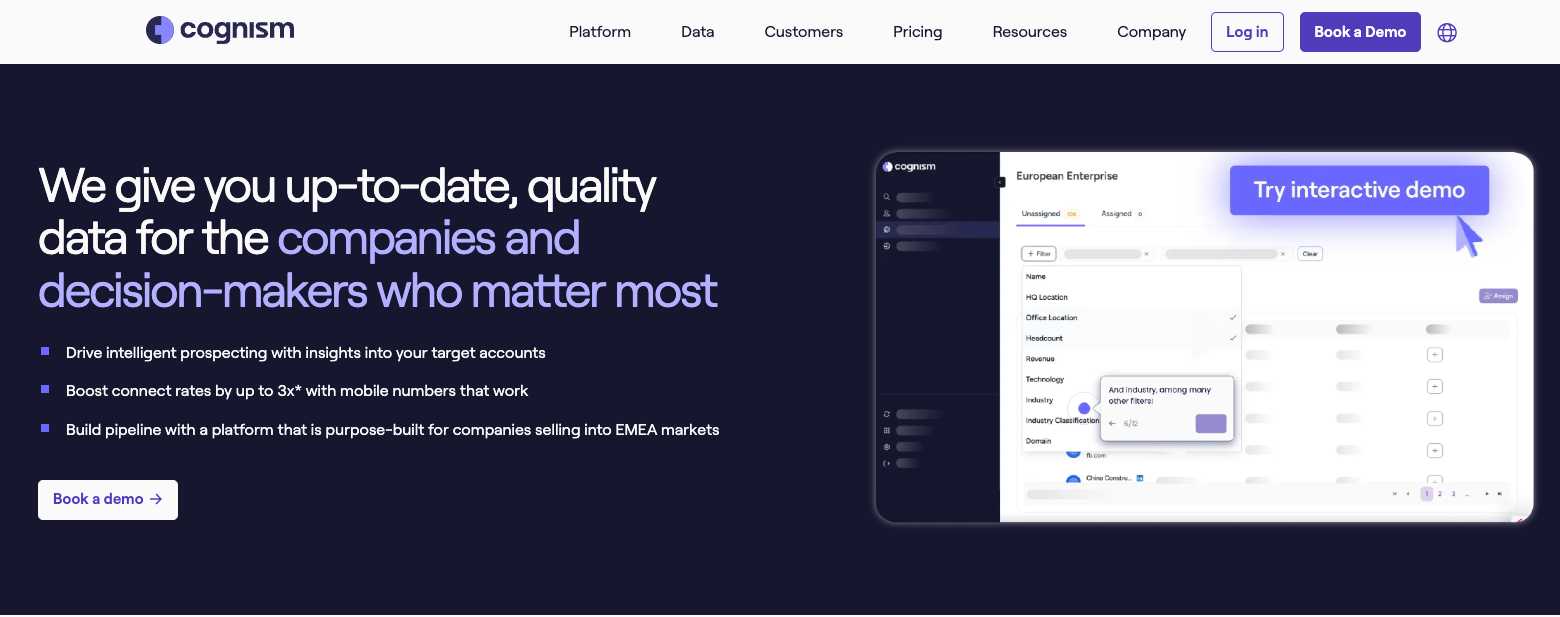
Cognism has built a strong reputation on a single, compelling value proposition: data accuracy for phone outreach. Its core strength is its phone-verified "Diamond Data," a database of mobile numbers that promise exceptionally high connect rates. This, combined with strong coverage in the EMEA market (especially for director-level and above contacts), makes it a strong option for traditional sales teams.
Key characteristics include:
Phone-verified mobile numbers with quantified accuracy: Cognism’s mobile dataset is phone-verified and marketed as delivering up to 87% accuracy across EMEA, especially in Germany and the broader DACH region.
Native integrations: Cognism provides integrations for CRMs like Salesforce, HubSpot, Pipedrive, Microsoft Dynamics, Bullhorn, etc., and sales engagement platforms like Outreach and Salesloft.
Real-time enrichment and solid API story: Real-time enrichment APIs, CSV enrichment, and DaaS delivery give data teams multiple ways to consume the same underlying dataset.
Licence-based, not credit-based pricing: Cognism emphasizes licence-based pricing with unlimited views and exports, and contrasts this with credit-based competitors that can create unpredictable mid-quarter bills. However, Cognism does not publish exact pricing, so you won’t get a clear price without a sales cycle, and smaller teams may feel priced out.
“I really enjoy the ease with which I can export bulk data into a CSV file using Cognism, which streamlines the data handling process for my role significantly. The platform's vast availability of contact data helps me extensively, although there can be some inaccuracies. Nonetheless, being able to quickly and easily filter through useful contacts when prospecting makes it invaluable.” – Josh P. via G2
However, Cognism is a clear example of a platform-first solution built for human reps, not automated systems. Its architecture and pricing model create significant barriers for any team needing API access or real-time data.
Cognism uses a seat-based licensing model that makes automation economically impossible. An AI agent making thousands of API requests would consume an entire, expensive seat. Moreover, the platform's high-quality contacts (director-level and above) are refreshed every 30 days, not in real-time. This lag, combined with no documented webhook support, makes Cognism unsuitable for teams needing instant signals on job changes or company events.
The platform's signature Diamond Data mobile numbers are not included by default; they are a paid add-on for the base package. The same applies to advanced intent data, requiring additional purchases beyond the main subscription.
Best for: EMEA-focused sales teams that do high-volume phone outreach, can work within seat-based constraints, and do not require data that is fresher than a 30-day cycle. Not recommended for AI agents or any real-time sales automation.
Crustdata: The clear choice for modern GTM teams
While legacy providers continue to compete over the size of their static databases, Crustdata has established a new paradigm focused on data velocity and discovery. Backed by extremely responsive, engineering-led customer support, it delivers genuine real-time updates through live crawling and can find any profile on demand.
For modern go-to-market teams building AI-powered systems, Crustdata's event-driven model makes it the only provider on this list truly equipped for automated, real-time workflows.
The ROI calculation becomes straightforward. You get:
The value of reaching a prospect hours after a trigger event, not weeks later.
The efficiency of powering AI SDRs with current data, not 60-day-old information.
The stability of building on an API designed for systems, rather than one retrofitted from a human-first platform.
So, if the difference that real-time data makes is important to you, book a demo with Crustdata and see how genuine B2B intelligence can transform your GTM strategy!


Products
Popular Use Cases
Competitor Comparisons
95 Third Street, 2nd Floor, San Francisco,
California 94103, United States of America
© 2026 Crustdata Inc.
Products
Popular Use Cases
Competitor Comparisons
95 Third Street, 2nd Floor, San Francisco,
California 94103, United States of America
© 2026 CrustData Inc.
Products
Popular Use Cases
Competitor Comparisons
95 Third Street, 2nd Floor, San Francisco,
California 94103, United States of America
© 2026 Crustdata Inc.
🎉 We hit $10M ARR!
$600k to $10m in 1.5 years. Our entire GTM is powered by our own APIs.
🎉 We hit $10M ARR in 1.5 years!