Data Enrichment API Complete Guide with Benefits and Leading Providers
Unlock richer B2B profiles with real-time data enrichment APIs. Learn how they work, pricing models, key use cases, and the top providers to power your GTM.
Published
Written by
Chris P.
Reviewed by
Nithish A.
Read time
7
minutes
Have you ever felt that your go-to-market (GTM) strategy could be much more effective if only you had better data?
Incomplete B2B data is the norm today, capturing basic emails but missing the context, like titles, size, and tech stack, needed for qualified outreach and personalization.
This is further complicated by aggressive data decay: B2B data becomes outdated annually as people change jobs every 3.9 years on average in the US, companies evolve, and tech stacks shift, turning your lead lists into missed opportunities or embarrassing outreach.
This guide cuts through the noise to show you how data enrichment APIs solve this by transforming minimal input into comprehensive, current profiles.
What is a Data Enrichment API?
A Data Enrichment API is an automated tool that transforms minimal known data points into comprehensive, structured profiles. Think of it as an on-demand research assistant that works at machine speed.
You provide a simple identifier, such as a company domain name (e.g., crustdata.com) or a professional email address. The API then programmatically appends third-party attributes by pulling data from a vast network of external sources. These sources include web crawlers, government filings, professional networks, social platforms, and technology detection scripts.
This mechanism enables real-time enrichment at scale. You can instantly qualify a lead upon form submission with sub-second response times for cached data. Alternatively, you can batch-process millions of your existing database records overnight, replacing manual research that would take sales teams months to complete.
How data enrichment APIs work
When you input an identifier like a company domain (e.g., "acme.com") into a sophisticated Data Enrichment API, you trigger a multi-step process that determines whether you receive stale, incomplete data or comprehensive, real-time intelligence. This technical architecture directly impacts your business outcomes.
The moment you submit the domain, it triggers a multi-source, parallel lookup process, which can include (depending on the type of data enrichment API you are using):
Proprietary database check: The API first queries the provider's internal database for cached data that has been previously indexed and cleaned.
Real-time crawlers: Simultaneously, real-time web crawlers are deployed to check the company's website and other public sources for the absolute latest updates.
Technology detection scripts: Specialized scripts analyze the website to identify the installed software stack, providing technographic data.
Signal aggregators: The system checks social media APIs, news aggregators, and government filings for recent, time-sensitive signals like funding announcements, headcount changes, or executive movements.
The API then aggregates this information, resolving any conflicts and returning potentially hundreds of structured data points in a clean JSON format. What you get back transforms a simple domain into actionable intelligence.
This entire process can be completed in seconds (sub-1s for cached enrichments with Crustdata). The main difference lies in the architecture: are you getting month-old cached data, or genuinely current information?
This is the difference between reaching out to a prospect who left the company weeks ago versus catching them in their first week at a new, high-budget role.
The waterfall architecture: why match rates matter
Not all data enrichment attempts succeed on the first try. Sometimes, a simple email lookup fails to return a profile, but intelligent waterfall architecture allows the API to find the information through a series of alternative paths.
This sophisticated sequencing is crucial because the quality of an enrichment API is ultimately judged by its match rate, i.e., the percentage of records you can successfully enrich.
Modern APIs use a multi-step process when the initial lookup fails:
Email lookup fails → extract domain from the email.
Search by domain across company databases.
Still no match → try fuzzy matching the company name or check parent company databases.
Aggregate all found data → return a unified profile.
This waterfall approach increases match rates significantly, but it requires providers to maintain multiple data sources and complex routing logic. Cheaper providers often skip this complexity, leading to frustratingly low success rates.
For businesses, the difference is stark: it's the gap between enriching 400 or 850 out of every 1,000 leads, directly impacting your pipeline volume and overall revenue potential.
Real-time versus batch: choosing your implementation strategy
One of the most important decisions in adopting a data enrichment API is determining the right implementation architecture: real-time or batch.
Real-time enrichment for speed
Real-time enrichment is powered by immediate API calls or webhooks (like Crustdata's Watcher API) and is designed for workflows where speed is essential to success. This architecture enables:
Instant lead routing: A form is submitted, the lead is enriched in milliseconds, and it is routed to the right sales representative for a call within minutes while the prospect's interest is still hot.
Dynamic personalization: A visitor from a Fortune 500 company instantly sees enterprise-level pricing or messaging on your website, creating a hyper-personalized experience.
Event-driven automation: A high-fit candidate leaves their current job. You reach out to them before anyone else, ensuring that you secure the right candidate for your client in no time.
Real-time execution empowers your team to act within the critical window of opportunity, driving higher reply rates from high-intent prospects, increasing investment opportunities in early-stage companies with high growth potential and finding and placing top candidates before competition.
Batch processing for scale and cost efficiency
Batch processing, where large volumes of data are processed at once, handles use cases that don't require instant action. This method is highly effective for reducing API costs significantly through efficient bulk operations.
Common batch use cases include:
Quarterly CRM cleanup: Processing 100,000 records overnight to fix decay-prone fields like job titles and headcount.
Pre-event enrichment: Enhancing an attendee list before a major conference to provide sales teams with talking points and context.
Historical analysis: Enriching past customers for deeper analysis of win/loss patterns, customer lifetime value (CLV), and product-market fit.
While real-time provides the temporal advantage, batch processing ensures your baseline data quality is high without incurring the higher cost of a real-time call for every record.
Person vs. company enrichment
While both are crucial for a successful Go-To-Market (GTM) strategy, Person Enrichment and Company Enrichment APIs focus on fundamentally different entities and use cases.
Person enrichment
Person enrichment focuses on individual attributes. You typically input a professional email address or a social media URL, and the API returns a comprehensive profile of the individual.
The data points returned are essential for lead-centric GTM motions where individual outreach drives the pipeline. Key information returned includes:
Current job titles, seniority levels, complete work history with start and end dates, and educational background.
Verified professional email addresses and phone numbers.
Associated social media profiles across professional networks.
Company enrichment
Company enrichment focuses on organizational data. You start with a simple identifier like a company domain or IP address. This data is critical for Account-Based Marketing (ABM) strategies that target entire buying committees. A practical way to deepen this process is by using a DNS history checker to reveal past infrastructure changes, acquisitions, and domain ownership patterns that often signal company growth or risk signals within ABM targeting.
The API provides deep insights into the company's structure and operations, including:
Firmographics: Industry classifications, revenue ranges, employee counts, and departmental breakdowns.
Technographics: The complete installed software stack, which is important for assessing product compatibility.
Growth signals: Real-time indicators like hiring velocity, funding rounds, and web traffic changes.
Hierarchy data: Details on the parent company, subsidiaries, and key decision-makers.
Common pricing models for Data Enrichment APIs
Understanding how data enrichment APIs charge you is crucial to avoiding bill shock and managing your budget effectively. The most common pricing models vary widely, often reflecting the provider's architecture and target customer.
Pay-as-you-go
This model charges you per individual API call, regardless of whether a matching record is found.
It's best suited for testing, proof-of-concept projects, or irregular enrichment needs where your volume is entirely unpredictable.
The primary risk is unexpected costs at scale, as even unsuccessful lookups often incur charges.
Credit-based subscriptions
You purchase monthly or annual packages of credits, and each enrichment consumes a certain number of credits from your balance.
Credits are typically only consumed for successful matches, not failed lookups, providing better value alignment.
Common tiers range from starter packages for small teams to enterprise volumes for large-scale operations.
This model, which Crustdata uses, generally offers the best balance of predictability and fairness, as you pay for successful enrichments while maintaining budget control through defined packages.
Tiered volume subscriptions
This involves fixed monthly access to a predetermined volume of API calls within specific tiers.
It often creates "use it or lose it" scenarios where unused capacity doesn't roll over.
Beware of steep overage charges when you exceed your tier limits.
Platform/seat licenses
This is an annual, per-user pricing model that bundles data access with a full platform interface and other tools, such as sales engagement or analytics.
API access is often sold as a separate add-on beyond the base seat licenses.
This model targets enterprises prioritizing an all-in-one solution over flexible API access.
Hybrid models
These models combine elements, such as a base platform fee plus usage-based API charges.
They may include complex credit systems where premium data points, like nested fields or trigger-based webhooks, cost more credits than basic firmographic data.
Use cases for integrating Data Enrichment APIs
Data enrichment APIs are the infrastructure layer for a huge array of modern, automated business processes. Integrating them allows you to power tools and systems that demand fresh, comprehensive context.
Key integration scenarios include:
AI-Powered Tools (SDRs, Recruiters, Investors): Enrichment provides the foundation for generative AI applications. An AI Sales Development Representative (SDR), for instance, needs an enriched prospect profile (e.g., company size, technology stack, pain points, funding announcements) before it can draft a highly personalized, relevant message.
Sales automation and CRM: Enriching new lead records in platforms like Salesforce or HubSpot is essential for routing leads effectively, calculating accurate lead scores, and enabling hyper-personalized messaging.
Recruitment and talent sourcing: APIs augment candidate profiles with comprehensive professional history, specific skills, and contact information, allowing recruiters to prioritize outreach and build rich talent pools.
Investment due diligence: Enriching company data with financial signals, funding rounds, growth metrics, and executive contact information significantly accelerates investment research and analysis for VCs and Private Equity firms.
Most integrations rely on native connectors or vendor-provided guides on how to use code to run the API.
How would I use a Data Enrichment API with Python?
While many integrations use no-code platforms like Zapier, in complex scenarios, custom Python logic is used to build a proprietary "Golden Record". This is necessary when merging data from multiple sources (e.g., your API, a credit agency, and an intent data vendor).
The Python code serves as the essential orchestration and reconciliation layer. It applies bespoke logic to prioritize, merge, and resolve conflicts between these diverse data streams to create a single, validated record tailored to your unique business rules.
For those starting out, vendors provide clear code examples. Here is an example of how our own API would be called for a person enrichment:
curl --location 'https://api.crustdata.com/screener/person/enrich?fields=profile_url,flagship_url,name,location,email,title,last_updated,headline,summary,num_of_connections,skills,profile_picture_url,profile_picture_permalink,twitter_handle,languages,all_employers,past_employers,current_employers,education_background,all_employers_company_id,all_titles,all_schools,all_degrees' \
--header 'Authorization: Token $auth' \
--header 'Accept: application/json, text/plain, */*' \
--header 'Content-Type: application/json'
Leading Data Enrichment API providers
Choosing the right data enrichment provider is instrumental to the success of your Go-to-Market (GTM) strategy. Let’s now talk about some of the leading B2B data enrichment API providers, comparing their features, pricing, and integration capabilities to help you evaluate which provider best fits your data enrichment needs and budget.
1. Crustdata
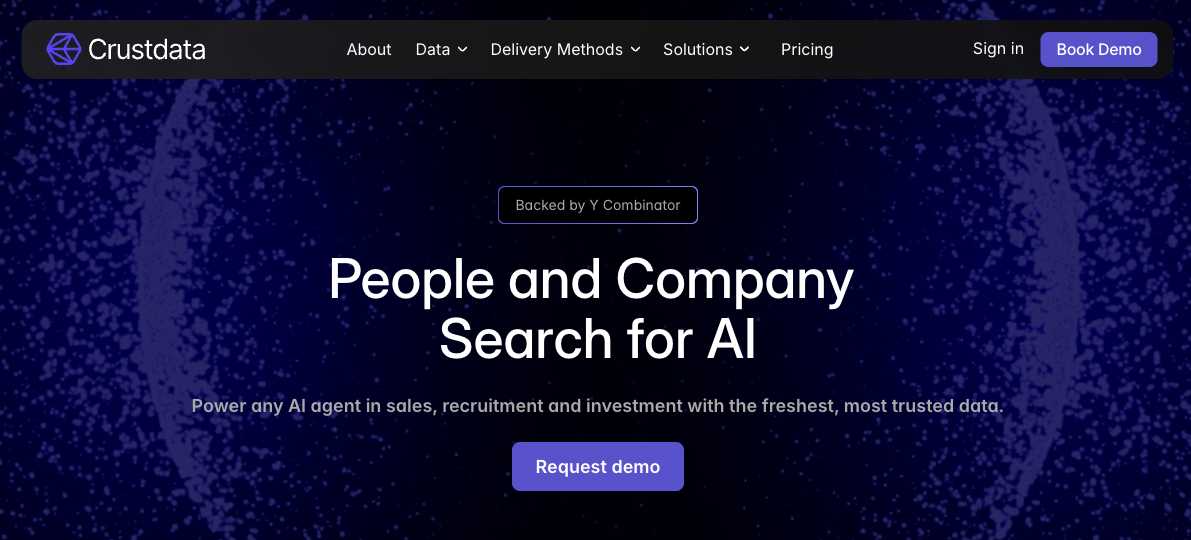
Crustdata offers real-time B2B data enrichment and is positioned as the infrastructure layer for sophisticated, time-sensitive workflows. Its core differentiator is genuine, near-instant data updates versus the monthly or quarterly refreshes competitors often label as "real-time".
Data coverage: The platform provides company data (250+ firmographic datapoints, including headcount trends, funding history, tech stack, and web traffic) and people data (90+ datapoints).
Key feature: Real-time data enrichment provides webhook-based infrastructure for real-time signals on key accounts and personnel changes, enabling instant notifications for promotions, job changes, and funding rounds within hours.
Pricing:
Real-time API access: Credit-based usage tiers with monthly and annual payment plans.
Flat file data: Monthly refresh of millions of company and people datasets delivered via S3 for backfills and baseline data.
Free trial: A "try it for free" option is available.
Integrations: The API-first approach means highly flexible integration into CRMs, ATS, sales, and recruiting tools via REST APIs and webhooks.
2. People Data Labs (PDL)
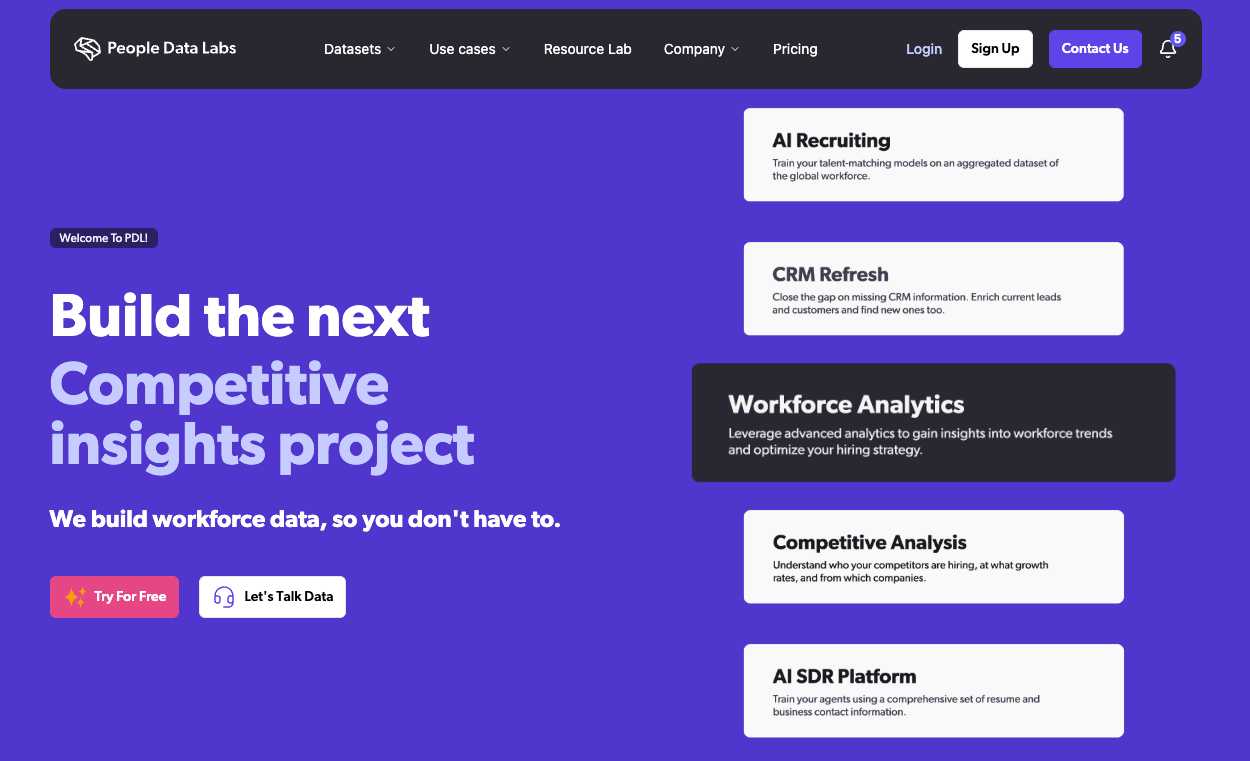
People Data Labs positions itself as a pure data infrastructure provider for developers who are building data-driven products. They offer massive scale with over 2 billion person profiles and 50+ million companies.
Data coverage: PDL offers access to comprehensive person and company data points, including contact information and work history, aggregated from 100+ sources.
Key feature: It excels at providing massive data scale and flexible APIs, making it ideal for bulk lookups and developer-friendly implementations. However, their datasets are typically updated monthly rather than in real-time.
Pricing:
Free Tier: Up to 100 monthly records for testing and proofs-of-concept.
Pro Tier: Starts at $98/month for commercial volume.
Enterprise/Bulk Data: Custom pricing for large-scale operations delivered via APIs, Snowflake, or Databricks.
Integrations: The platform is API-only and highly integrated with development tooling, supporting flexible REST APIs.
3. Apollo
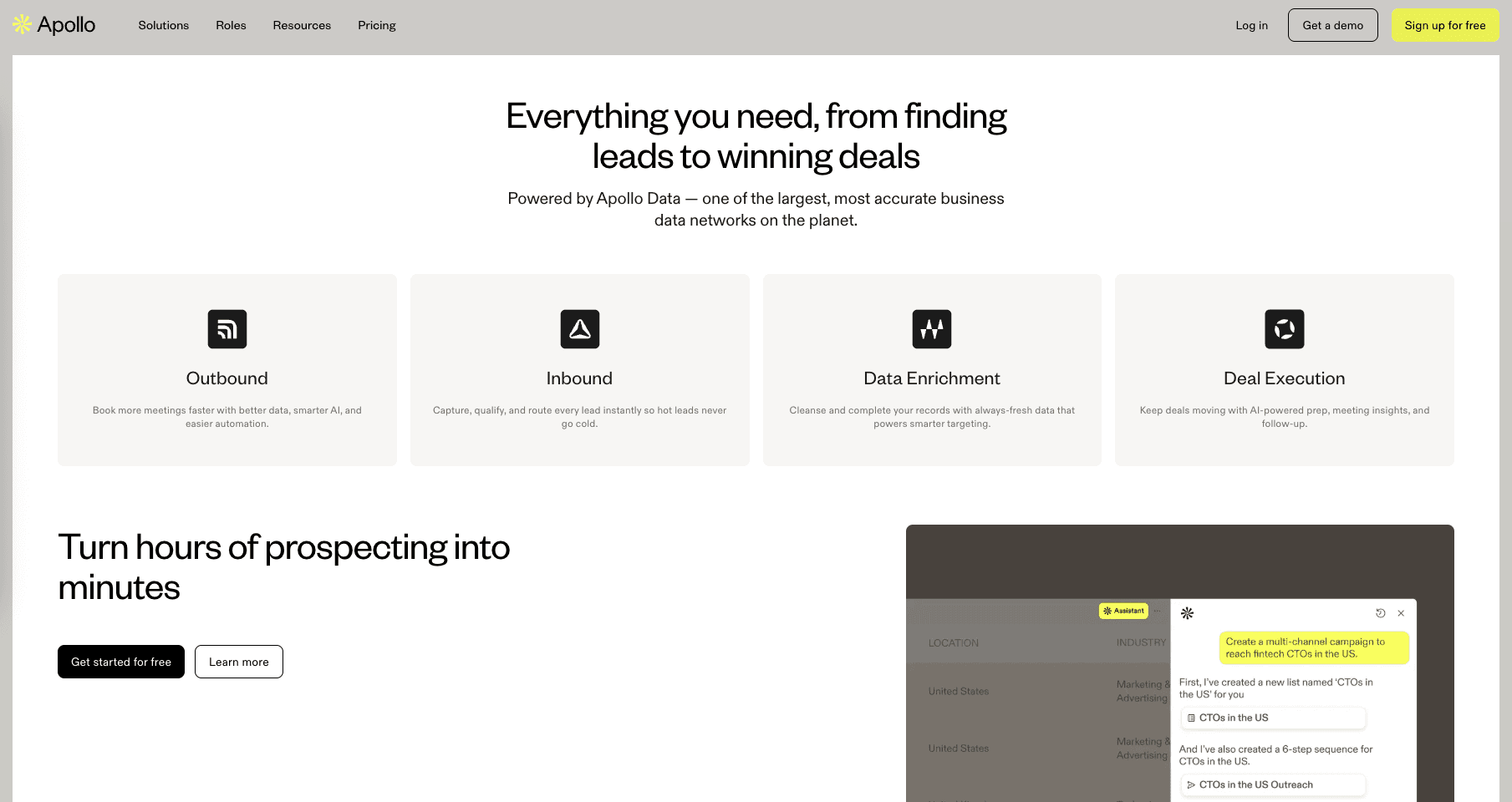
Apollo has emerged as a popular mid-market alternative by combining a large database with built-in sales engagement tools, offering an all-in-one platform.
Data Coverage: Apollo boasts a database of 210+ million contacts and 35 million companies, providing firmographic, technographic, and contact data.
Key Feature: The platform bundles data enrichment with sales engagement features, including email sequencing and dialers, allowing sales teams to prospect, enrich, and engage without switching tools. However, their data updates follow batch cycles rather than real-time.
Pricing:
Free Plan: Includes 1,200 credits per user per year.
Paid Tiers: Basic ($49/user/month), Professional ($79/user/month), and Organization ($119/user/month), all billed annually.
Add-ons: An Inbound Add-on is available for website visitor identification.
Integrations: Apollo features deep native integrations with major CRMs, including Salesforce and HubSpot, and offers a Chrome Extension for quick prospecting.
4. Clearbit (by HubSpot)
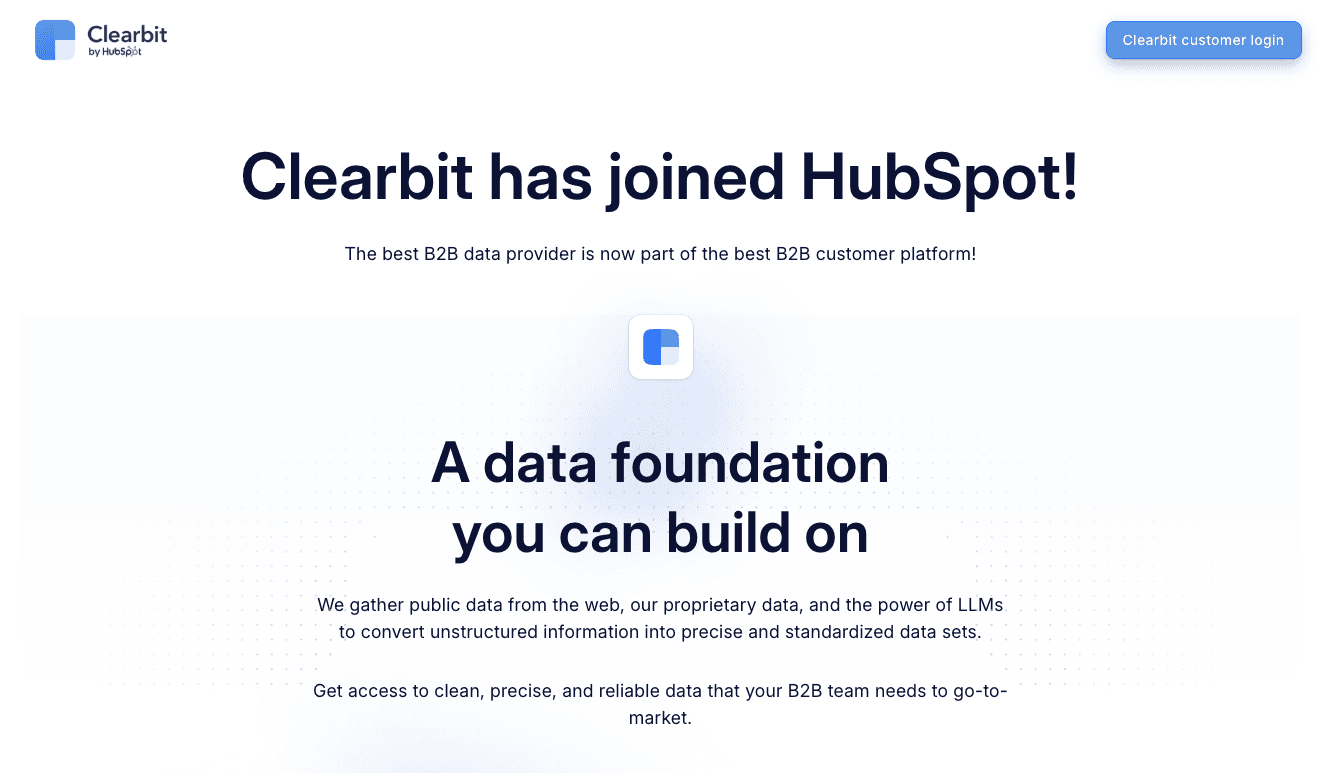
Clearbit pioneered API-first data enrichment and is known for its developer-friendly design and initial real-time capabilities. It is now part of the HubSpot platform.
Data Coverage: Clearbit provides 100+ B2B data points per contact or company, including comprehensive firmographic data, technologies installed, and location data.
Key Feature: Clearbit specializes in real-time enrichment and Reveal Intent, identifying website visitors to enable dynamic form shortening and personalized web experiences.
Pricing: Pricing is now integrated with HubSpot's platform. Standalone pricing is less transparent, and some features are tied to HubSpot subscriptions. It focuses on enterprise and mid-market solutions.
Integrations: It features deep native integration with HubSpot's entire ecosystem due to the acquisition. It is the ideal choice for HubSpot-centric organizations.
5. ZoomInfo
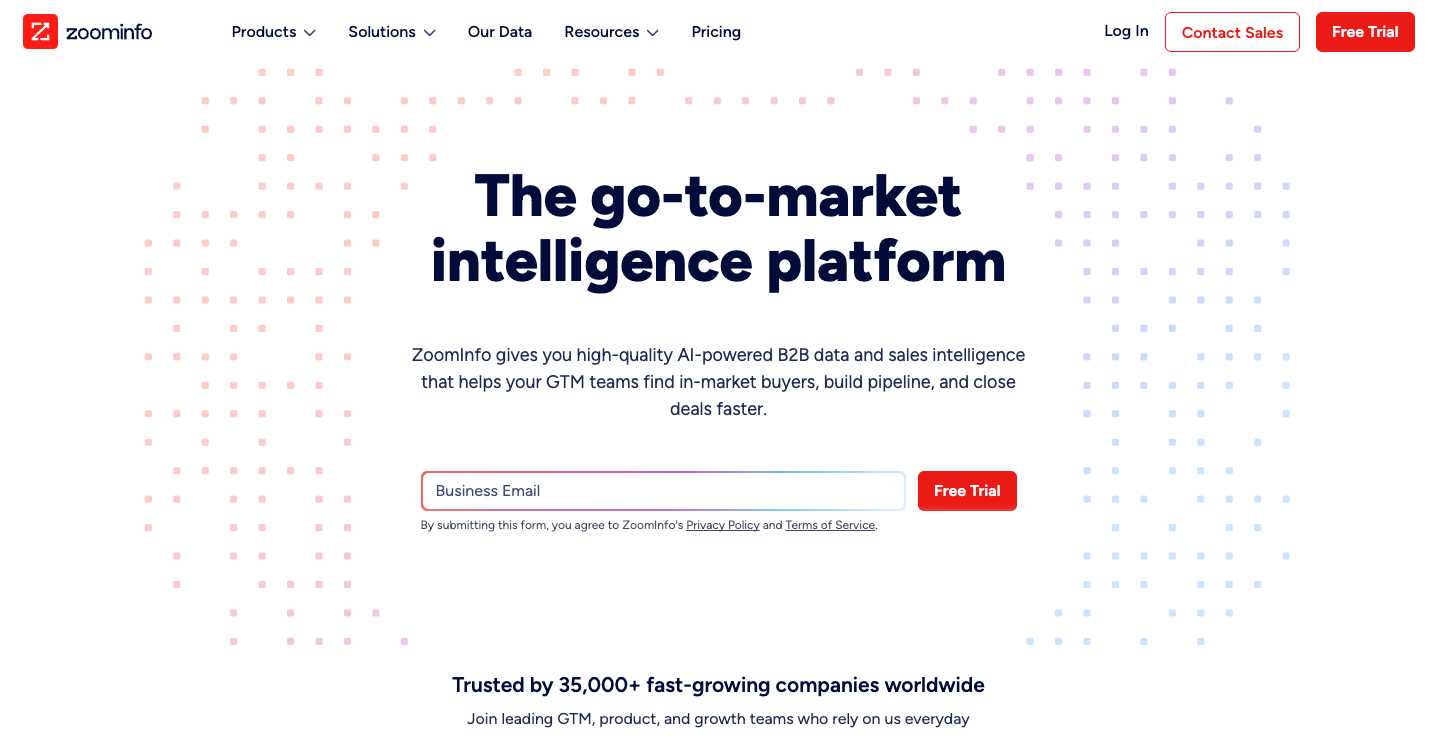
ZoomInfo represents the incumbent enterprise standard in B2B data enrichment, focusing on comprehensive, human-verified data quality and vast coverage.
Data Coverage: The platform provides access to over 100 million business contacts and 20 million companies, with extensive firmographic, technographic, and intent data.
Key Feature: ZoomInfo differentiates through its human-verified data quality processes and comprehensive intent data. It bundles enrichment with conversation intelligence and sales engagement tools in an all-in-one suite.
Pricing: Requires substantial annual contracts (typically $15,000–$50,000+) with per-seat pricing, making it expensive for smaller teams or specialized use cases. The database updates occur in monthly and quarterly cycles.
Integrations: Deep integrations with enterprise CRM and sales engagement platforms are a core strength.
6. Cognism
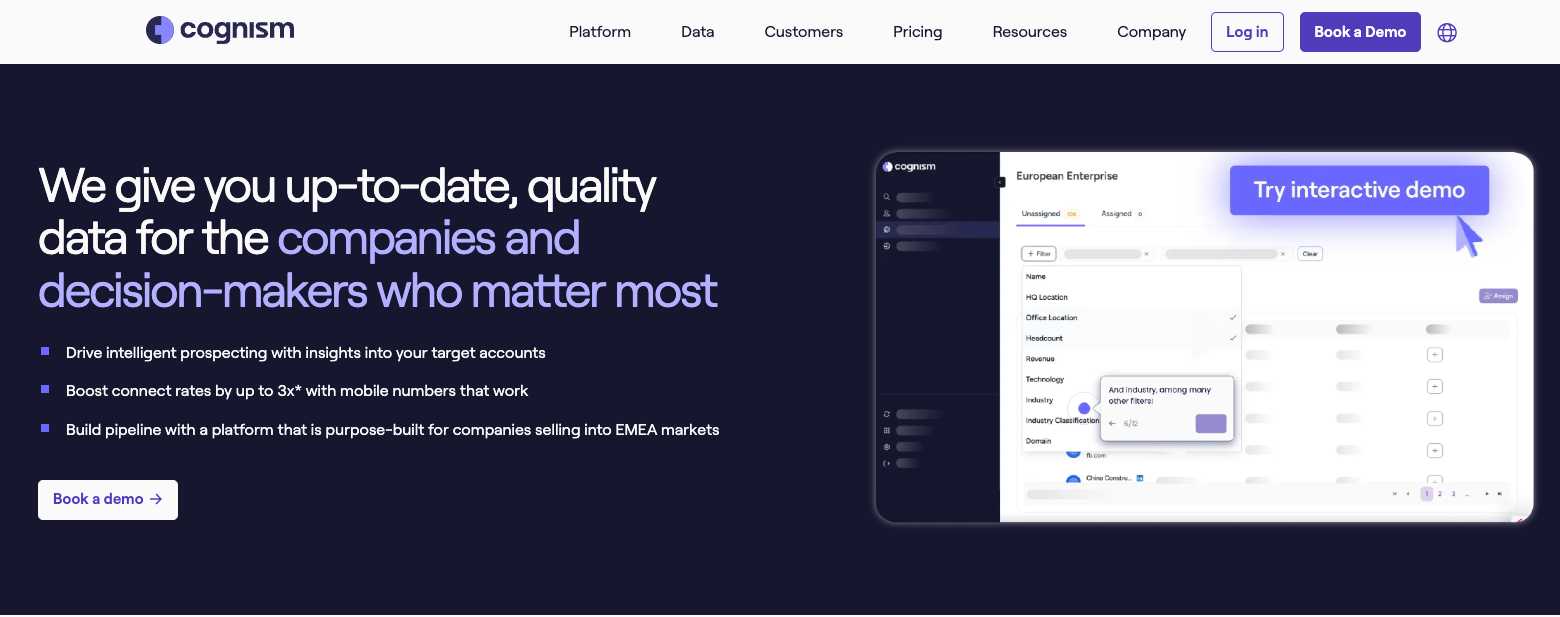
Cognism differentiates itself through its focus on GDPR-compliant data, with particular strength in phone-verified contact data and coverage in European markets.
Data Coverage: Cognism provides a full sales intelligence interface with phone-verified contact data, firmographics, and people data, specifically addressing compliance concerns.
Key Feature: Its focus on data compliance and European coverage addresses a key gap in US-centric competitors. It operates as a full sales intelligence interface rather than just an API.
Pricing: Pricing is typically on the higher end with enterprise contracts.
Integrations: It provides native CRM integrations and a Chrome extension for LinkedIn prospecting. Like most incumbents, it uses batch updates rather than real-time data.
Transform your data strategy with real-time enrichment
Data enrichment APIs are the critical infrastructure for solving your Go-to-Market (GTM) challenges, transforming incomplete lead data into comprehensive profiles and actionable intelligence.
However, as we've demonstrated, success depends on moving beyond generic vendors and choosing a partner with genuine real-time freshness, comprehensive coverage, and flexible implementation.
The winning strategy is not just about having more data; it's about having the right data at the right time. The ideal enrichment partner should offer:
True real-time data: Not month-old cached lookups that lead to embarrassing outreach, but data that is updated hourly or on demand.
Transparent pricing: Models that charge you for successful enrichments and predictable usage, not frustrating overages or hidden fees.
Flexible implementation: The power to integrate seamlessly with any existing tech stack, from CRMs like Salesforce to custom-built AI SDR platforms.
Crustdata delivers this optimal balance. We combine comprehensive data coverage with an architecture built for speed and automation.
Our platform offers 340+ real-time data points and credit-based pricing aligned to your success. Most importantly, our unique Watcher API monitors for crucial changes, like job switches or funding rounds, as they happen, turning enrichment from a necessary cost center into a tangible revenue accelerator.
Book a demo to see how Crustdata can transform your data enrichment strategy today!


Products
Popular Use Cases
Competitor Comparisons
95 Third Street, 2nd Floor, San Francisco,
California 94103, United States of America
© 2026 Crustdata Inc.
Products
Popular Use Cases
Competitor Comparisons
95 Third Street, 2nd Floor, San Francisco,
California 94103, United States of America
© 2026 CrustData Inc.
Products
Popular Use Cases
Competitor Comparisons
95 Third Street, 2nd Floor, San Francisco,
California 94103, United States of America
© 2026 Crustdata Inc.
🎉 We hit $10M ARR!
$600k to $10m in 1.5 years. Our entire GTM is powered by our own APIs.
🎉 We hit $10M ARR in 1.5 years!