8 Best B2B Data Enrichment Tools To Consider in 2026
Compare the best B2B data enrichment tools & see which platforms work best for CRM enrichment, lead scoring, and automated GTM workflows.
Published
Written by
Chris P.
Reviewed by
Nithish A.
Read time
7
minutes

Most B2B contact data starts incomplete. Forms capture email addresses but miss job titles, company sizes, and industries. CRMs create records with blank fields that routing rules and scoring models depend on to work. Manual enrichment doesn’t scale past a few dozen leads per week.
The problem gets worse over time. B2B data decays at rates up to 70.3% annually as people change jobs and companies evolve. Batch enrichment helps initially, but most teams only run it monthly or biweekly at best. Contact details can shift between refresh cycles, leaving you working with stale information by the time the next batch runs.
Data enrichment tools automate this by detecting incomplete records, matching them to external databases, and appending missing fields in seconds. This guide shares the best B2B data enrichment tools based on what they enrich, how they deliver data, and which workflows they fit best.
Why Data Enrichment Matters
Clean data keeps your CRM organized. Enriched data makes your systems work.
A clean record has no typos or duplicates. An enriched record has the fields your routing rules and scoring models need to execute. You can have perfectly clean data and still watch leads sit unassigned because the job title field is empty.
When a lead submits a form with just their email, your CRM creates a contact with 15 blank fields. Routing rules check for company size and industry to assign the lead. If both fields are missing, the rule stops and the lead goes nowhere.
You could fix this manually, but the numbers don't work. A rep can manually enrich about 10 contacts per day by researching job titles, company size, and other missing fields. When your team generates 200 new leads per week, that creates a backlog you can never close. You'd need 20 days of work just to process one week's leads.
Batch enrichment seems better until you factor in timing. By the time you export, process, and re-import a CSV, people have changed jobs and the data is already stale.
Enrichment tools automatically fill in missing fields like job title, company size, industry, and tech stack within seconds when records enter your system.. Your routing rule executes. Scoring assigns priority. The systems you built to run automatically can actually run automatically.
8 Best B2B Data Enrichment Tools Compared
Choosing an enrichment tool depends on whether you need contact details for outbound, firmographics for routing, or intent signals for timing. The table below compares the 8 best tools based on enrichment type, delivery model, and workflow fit.
Tool | Best For | Enrichment Type | Real-Time | API Access | Starting Price |
Crustdata | Event-driven GTM and recruiting workflows | Contact + Company + Intent | Yes | Yes | Custom (Free trial available) |
Apollo.io | All-in-one prospecting | Contact + Company + Intent | Yes | Yes | Free/$49/month |
ZoomInfo | Enterprise sales intelligence | Contact + Company + Intent | Yes | Yes | Custom (quote-based) |
FullContact | Identity resolution | Contact + Social + Demographic | Yes | Yes | $99/month |
People Data Labs | Developer infrastructure | Contact + Company | No (Monthly updates) | Yes | Free/$98/month |
RocketReach | Manual prospecting | Contact | Yes | Yes (Ultimate plan) | Free/$49/month |
Clearbit | HubSpot users | Contact + Company | Yes | Yes | Hubspot subscription required |
Cognism | GDPR-compliant prospecting | Contact + Company | Yes | Yes | Custom pricing |
1. Crustdata
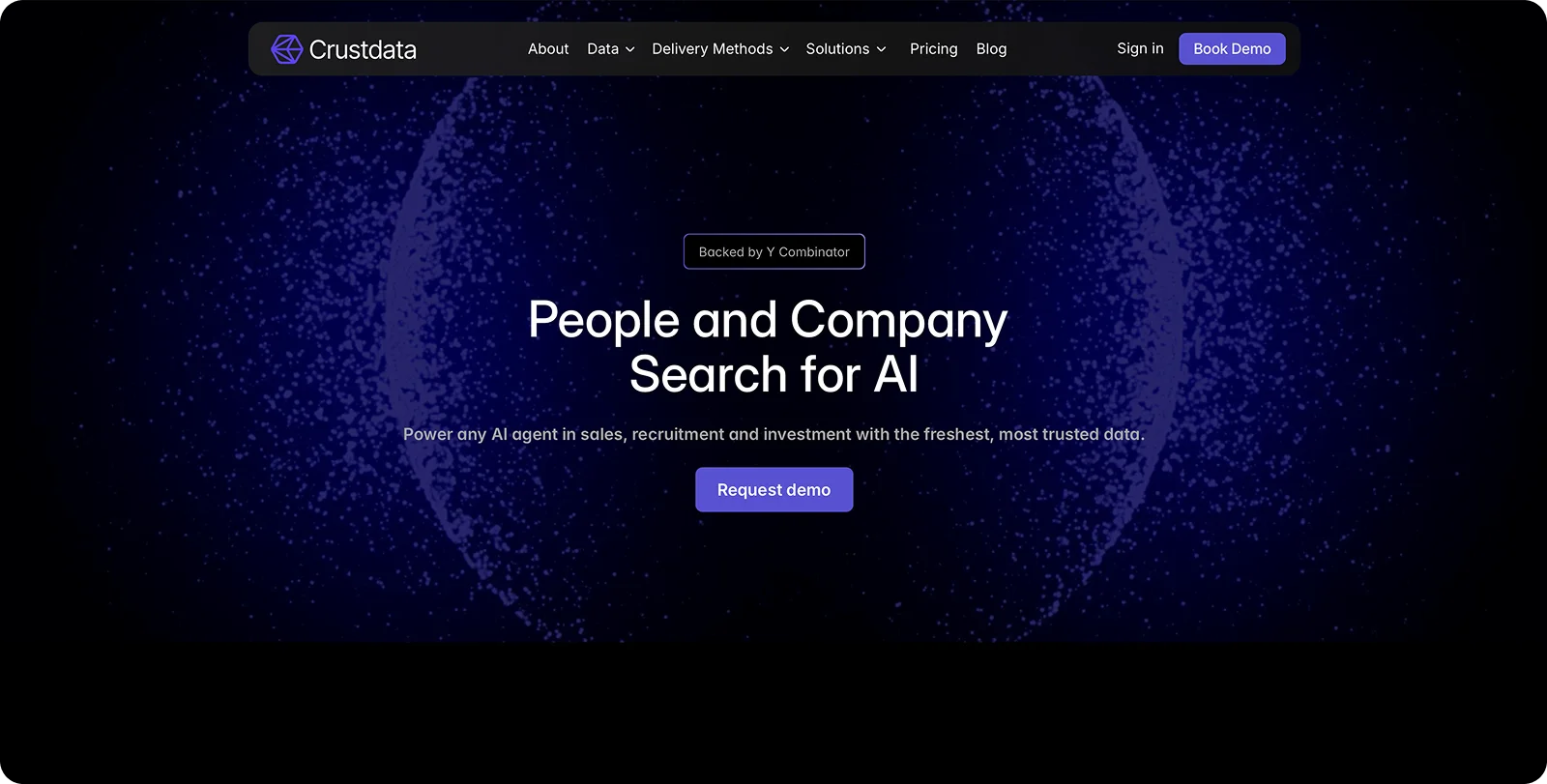
Crustdata is a real-time data infrastructure provider for AI agents, GTM teams, and sales automation platforms. The platform uses a live indexer approach that performs on-demand web crawling to fetch fresh data at the moment of request instead of relying on cached databases.
Key Features
Real-time data architecture: Live indexer performs on-demand web crawling to fetch the freshest data at request time instead of serving stale, cached databases
Watcher API and webhooks: Subscribe to specific events (job changes, funding rounds, headcount spikes, tech adoption shifts) and receive instant notifications via webhooks for proactive, event-driven workflows
Comprehensive data points: Aggregates data from 16+ public and proprietary sources (SEC filings, G2 reviews, web traffic analytics) to provide 250+ company and 90+ people data points
Granular filtering: Offers 95+ company filters and 20+ people filters to build hyper-targeted lists and perform precise discovery and enrichment
Flexible access: Data available through REST APIs, bulk flat file downloads, or webhooks for integration into CRMs (Salesforce, HubSpot) and custom applications
Pros
Deliver true real-time data via live crawling for maximum freshness and accuracy
Enable immediate action on key events through Watcher API with webhook notifications
Integrate effortlessly with fast performance and clean, well-documented APIs
Cons
Require development resources and technical expertise for API-first integration
Pricing
Crust data provides credit-based pricing with monthly and annual plans. There’s also a free trial available for testing.
2. Apollo.io
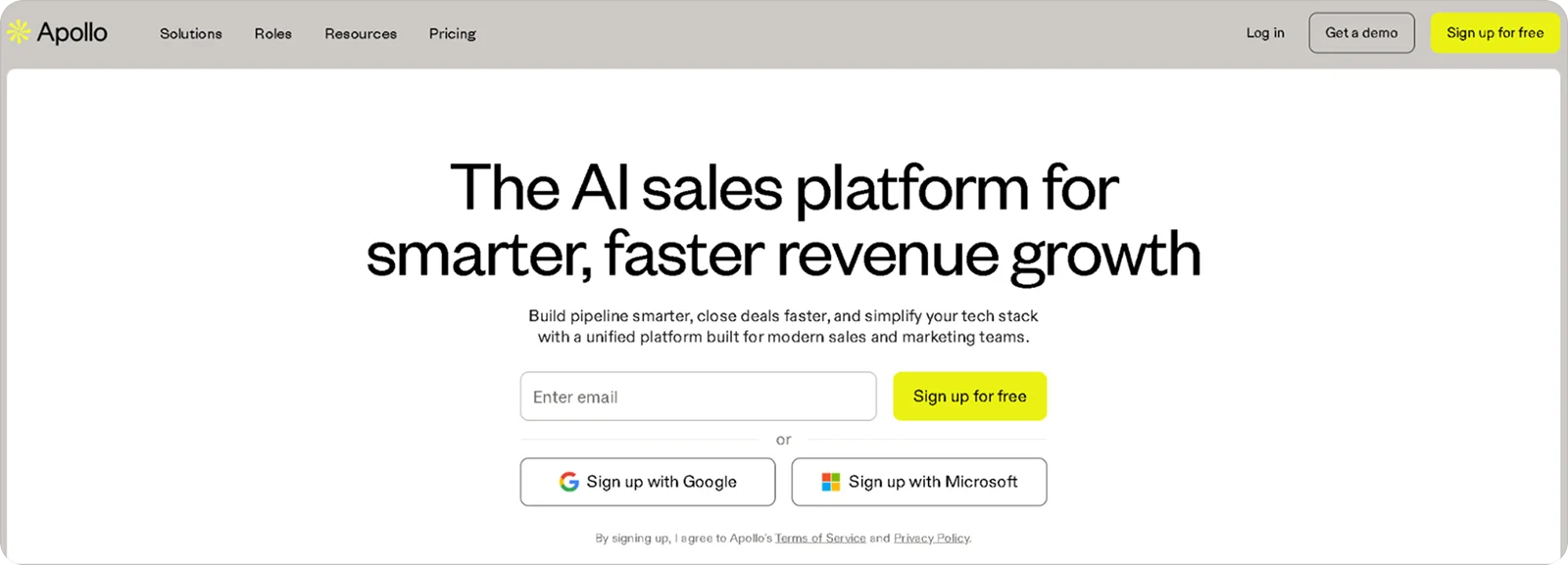
Apollo.io combines a large B2B database with built-in sales engagement tools, positioning itself as an all-in-one platform for prospecting and enrichment. The platform serves mid-market sales teams that want contact data, enrichment, and outreach in a single system instead of stitching together multiple vendors.
Key Features
Waterfall enrichment: Pulls data from multiple providers to find missing emails and phone numbers, providing verification scores for each contact
Data Health Center: Deduplication and data cleansing tools to maintain database quality
Advanced filtering: Targets prospects by job title, company size, tech stack, funding stage, and other specific criteria
Intent data: Filters leads based on buying signals to prioritize hot prospects
CRM and API integration: Syncs with Salesforce, HubSpot, and other platforms, with APIs available for custom workflows
Integrated outreach: Add enriched leads directly to email sequences and campaigns
Pros
Access a vast database with a huge contact and company pool for prospecting
Automate data finding to reduce manual research work
Target precisely with filters for very specific Ideal Customer Profiles
Cons
Delivers data inaccuracies with outdated contacts, high email bounce rates, and unreliable mobile numbers
Requires development effort for deep customization via API
Pricing
Free plan includes 1,200 credits per user per year. Paid plans start at $49/user/month for Basic, $79/user/month for Professional, and $119/user/month for Organization, all billed annually..
3. ZoomInfo
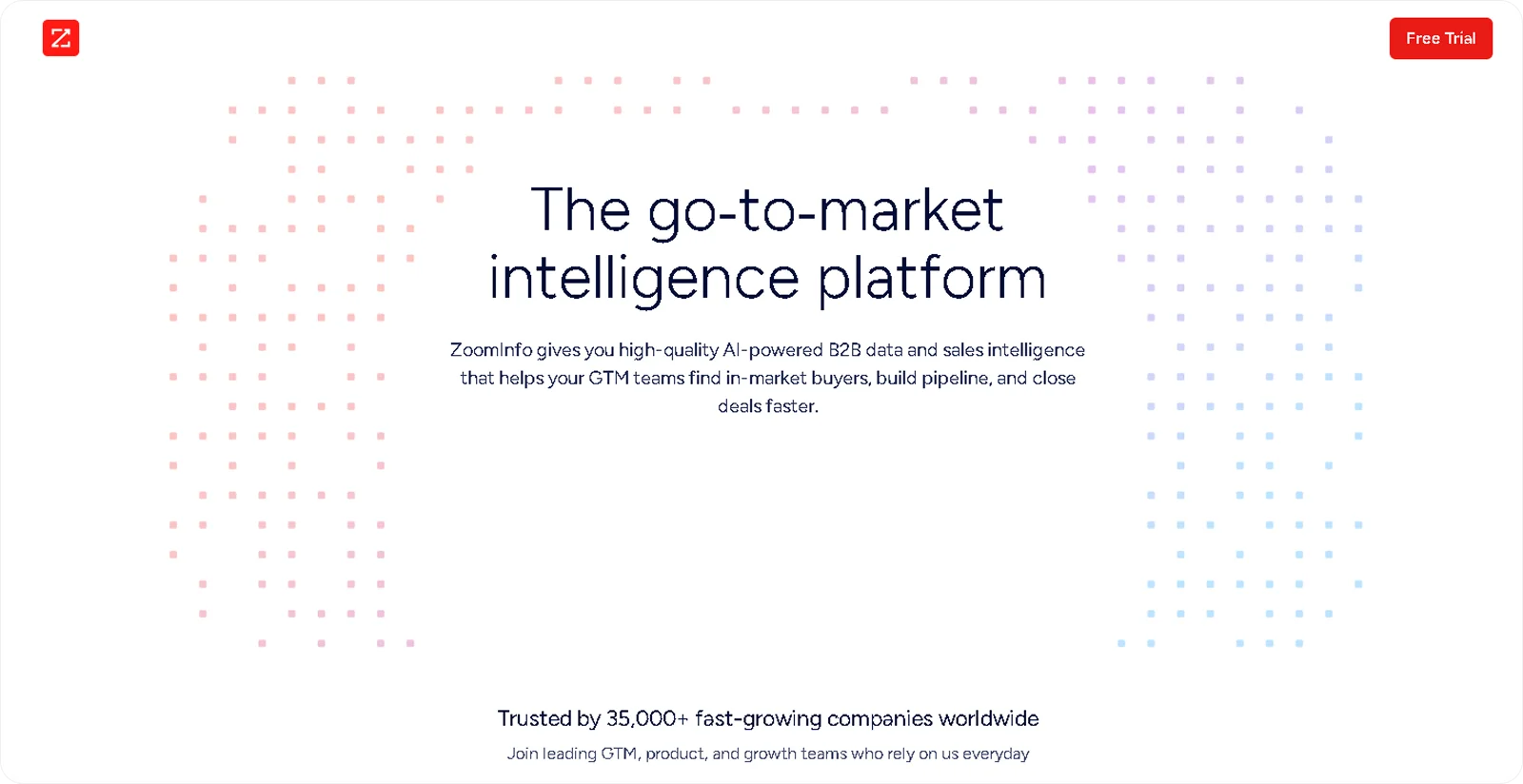
ZoomInfo targets large enterprises that need comprehensive B2B intelligence at scale. The platform serves sales, marketing, and recruiting teams with significant budgets who prioritize data breadth and volume over niche customization.
Key Features
Comprehensive database: Access millions of contacts with detailed firmographics (industry, company size, tech stack) and technographics
Real-time updates: Continuously refreshes data to keep contact and account information current
Intent data: Higher-tier plans offer buying signals and intent data to identify active prospects
Workflow automation: Integrates with CRMs like Salesforce to automate data appending, lead routing, and data hygiene maintenance
Advanced filtering: Granular search options by location, role, industry, and company attributes
Pros
Reduce manual research time for sales and marketing teams
Enable precise audience segmentation for better campaigns
Handle large volumes of data for enterprise-level needs
Cons
Lacks built-in email verification, leading to bounces without a separate tool
Requires steep learning curve with significant onboarding and training
Pricing
ZoomInfo uses custom quote-based pricing that varies by number of users, credit volume, and features required. Pricing is not publicly disclosed and requires contact with their sales team for quotes.
4. FullContact
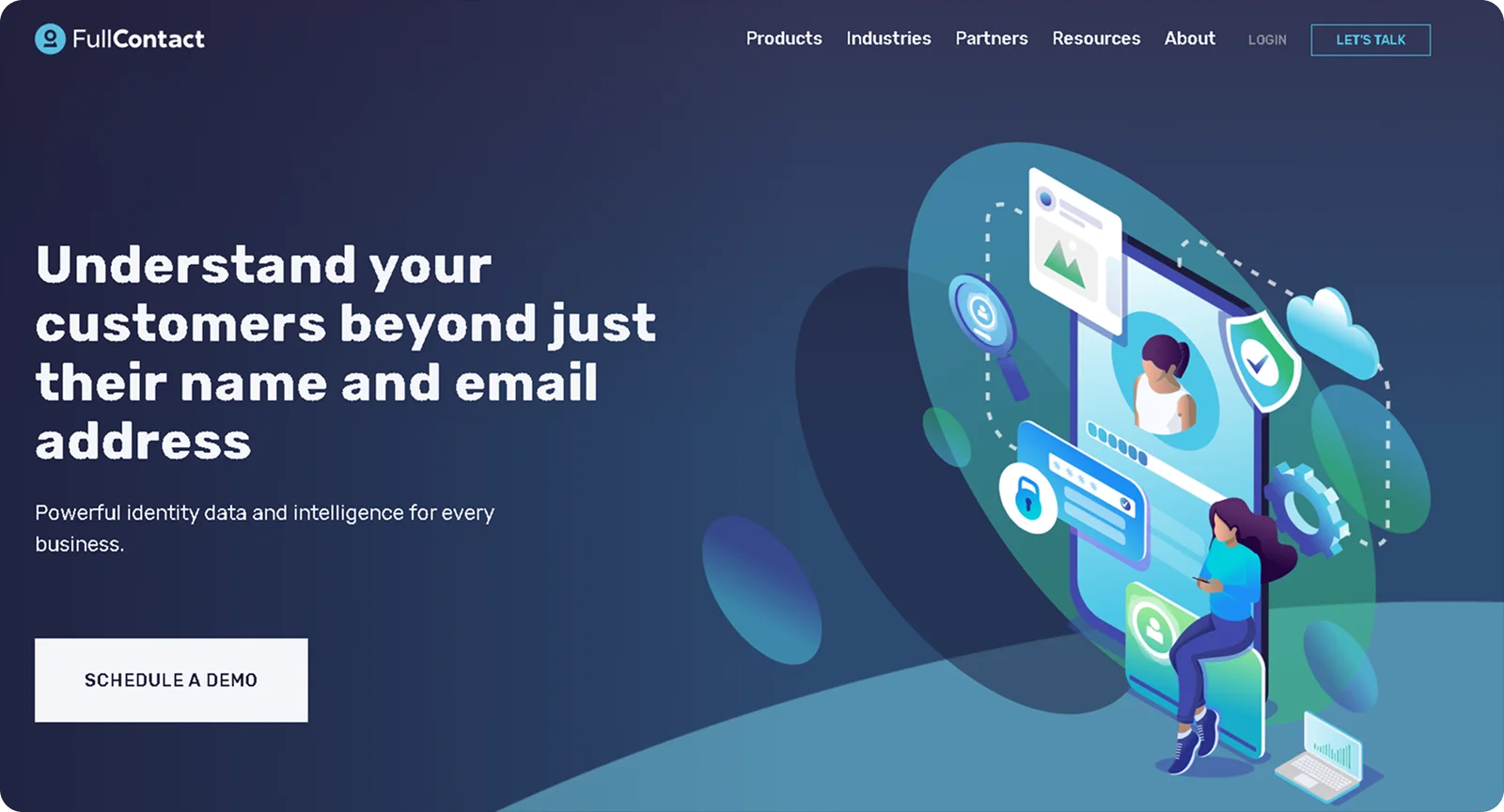
FullContact targets marketers and data teams dealing with fragmented customer records across multiple systems and channels. The platform emerged from the identity resolution space rather than the sales intelligence market, which is why it emphasizes unifying duplicate profiles and linking offline and online identities over simple contact append.
Key Features
Identity resolution: Links data points (email, name, phone, device identifiers) to create comprehensive profiles
Data enrichment: Adds social profiles, company info (size, industry), job titles, locations, and demographics
CRM integration: Syncs and refreshes data in platforms like Salesforce, keeping information current
Job change tracking: Detects when contacts change roles or companies
API and integrations: Robust APIs for developers to pull data and integrate with other systems
Contact management: Centralizes, organizes, and segments contacts
Pros
Provide accurate and detailed data for better targeting
Integrate easily with highly praised API and code quality
Reduce manual data entry with auto-enrichment
Cons
Uses complex and costly pricing, especially for high volumes or smaller businesses
Returns occasional outdated data or bugs
Pricing
FullContact offers a 14-day free trial with three plans available. Essential starts at $99/month, Core costs $300/month, and Plus offers custom pricing based on requirements.
5. People Data Labs
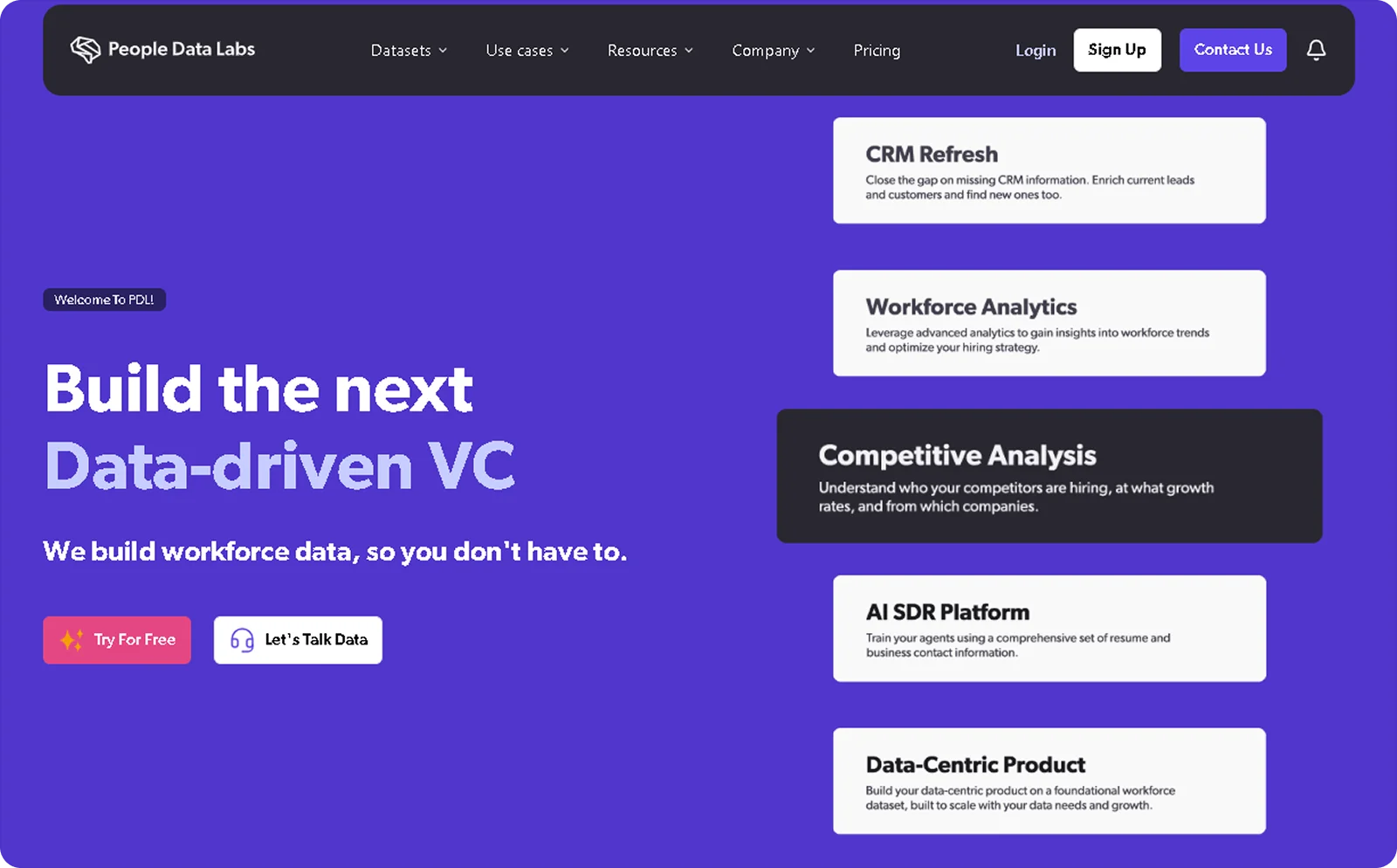
People Data Labs operates as a data infrastructure provider for developers and engineering teams rather than a finished sales tool. The tool serves technical buyers building their own applications, AI systems, or internal platforms who need raw data access instead of a UI-driven prospecting interface.
Key Features
Person enrichment: Adds location, work history, education, social profiles, and contact info (personal emails and phones) to existing records
Company enrichment: Enriches firmographic data including company size, industry, and location
Extensive data points: Huge database covering demographics, professional data, and social profiles
API access: Robust, well-documented API (REST and Bulk) for integration into existing workflows
Search and identify: Tools to find and match individuals across datasets
Pros
Access vast and granular data for deep customer understanding and segmentation
Integrate flexibly with user-friendly API for easy embedding into applications
Maintain high quality and compliance with data accuracy and privacy standards
Cons
Updates data monthly, causing freshness issues that can be weeks old
Presents technical complexity with granular fields and API structure
Pricing
People Data Labs offers a free plan with 100 person and company lookups per month. Pro plan starts at $98/month for 350 person enrichment credits and 1,000 company lookups. Enterprise pricing is available through custom quotes.
6. RocketReach
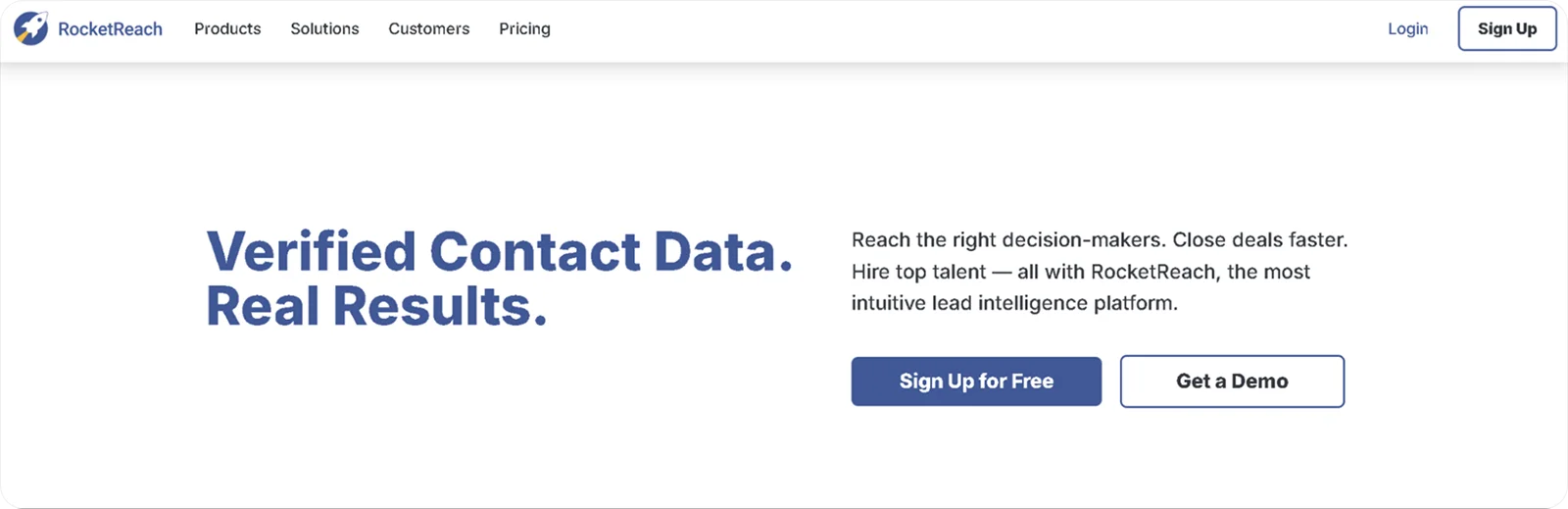
RocketReach is built for individual sales reps and recruiters doing manual prospecting rather than technical teams running automated systems. The platform serves users who look up contacts one at a time through a browser extension or web interface instead of building API-driven enrichment workflows.
Key Features
Bulk lookup and CSV upload: Upload lists of existing contacts and automatically enrich them with emails, phone numbers, and company details
Real-time email verification: Uses proprietary RocketVerify system to check email addresses in real-time, aiming for 90-98% deliverability for A-grade verified emails
API access: Provides API to pull data directly into CRMs or custom applications for automated enrichment
Technographics and firmographics: Advanced plans offer insights into company technology usage, size, industry, and location
Intent data: Higher-tier plans identify companies showing online signals of active product or service research
CRM integrations: Integrates with Salesforce, HubSpot, and Outreach to sync and enrich contact data automatically
Pros
Access massive database of 700+ million professionals and 60+ million companies
Find and enrich data quickly with intuitive interface and Chrome extension
Process entire CSV lists at once to save time over manual research
Cons
Delivers inconsistent data accuracy with outdated phone numbers and occasional field inaccuracies
Focuses on data provision over built-in outreach tools, limiting automation
Pricing
RocketReach offers three pricing tiers billed annually. Essentials starts at $49/month for email-only access. Pro costs $99/month and includes phone numbers. Ultimate is $209/month with API access and advanced features.
7. Clearbit (by HubSpot)
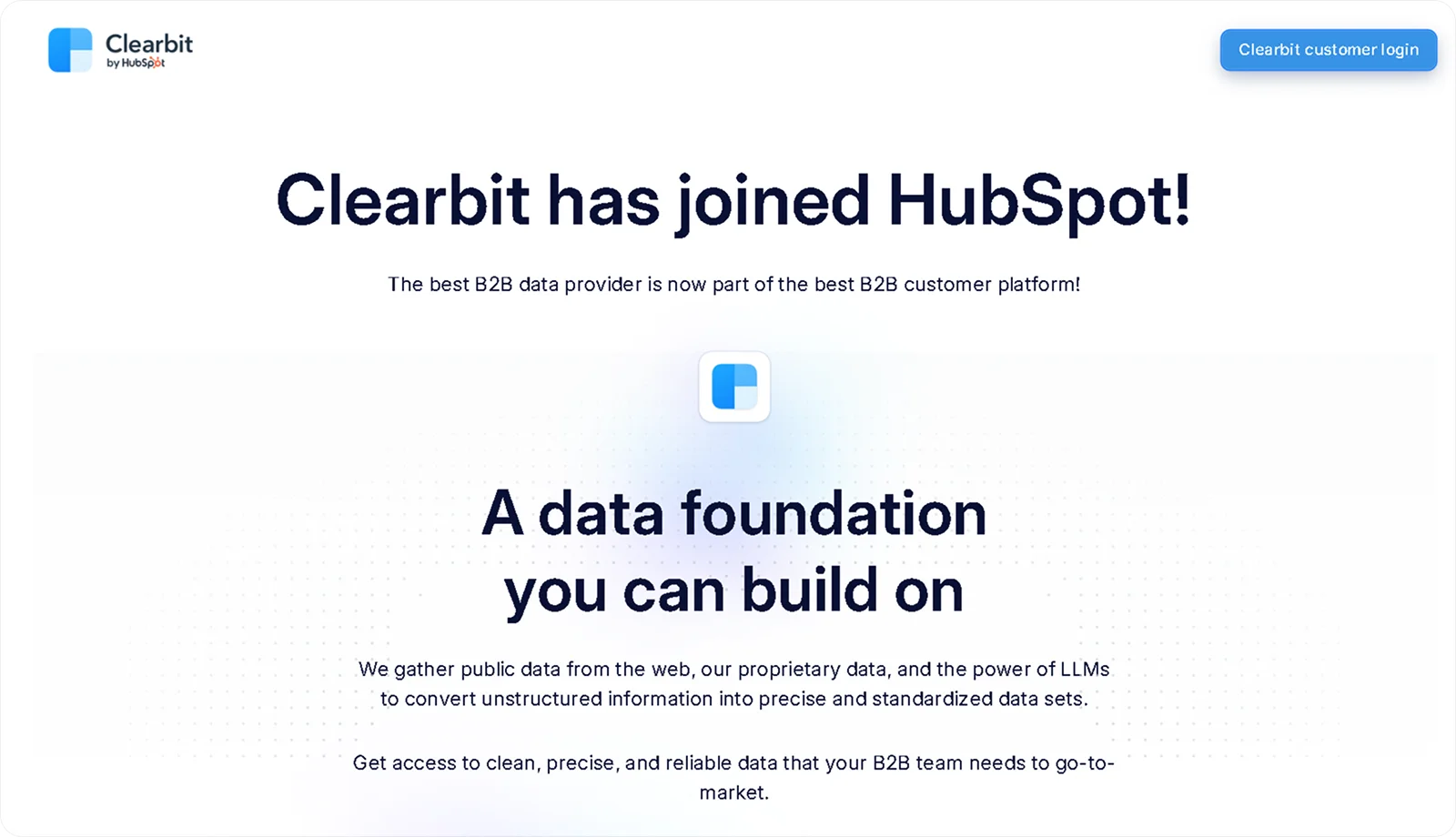
Clearbit was acquired by HubSpot in 2023 and rebranded as Breeze Intelligence, shifting from a standalone platform to a native HubSpot feature. The tool focuses on real-time B2B data enrichment for marketing and sales teams needing to qualify leads and personalize campaigns at scale, with particular strength in company-level intelligence and data accuracy.
Key Features
Real-time enrichment: Adds and updates missing company data (firmographics, technographics) and person data (job titles, contact info) instantly as records enter the system
Form shortening: Dynamically hides or auto-fills form fields to boost conversion rates while still capturing needed data
Strong integrations: Connects natively with major CRMs and marketing automation platforms like HubSpot and Salesforce
Global coverage: Provides data on over 250 million decision-makers worldwide
Lead scoring: Prioritizes leads based on enriched profile data for better routing and qualification
Pros
Keeps databases current with real-time updates as data changes
Integrates smoothly with existing tech stacks through strong CRM connections
Enables targeted outreach and personalization at scale
Cons
Focuses more on enriching existing records (inbound) than finding new contacts (outbound)
Delivers contact data gaps as contact enrichment is less reliable than company data
Pricing
Clearbit operates on HubSpot’s credit-based pricing model. Pricing requires a paid HubSpot subscription and is based on credit usage, with costs varying by plan tier and volume.
8. Cognism
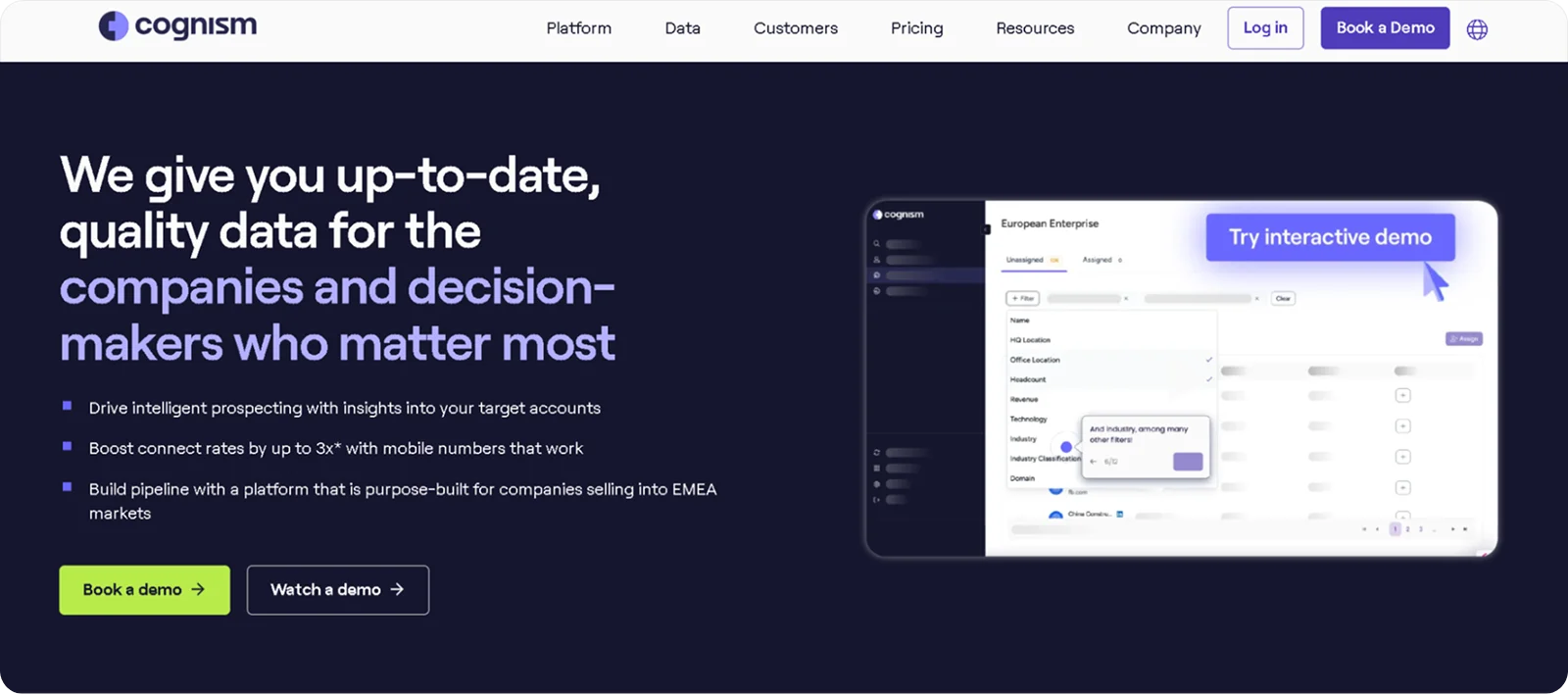
Cognism focuses on GDPR-compliant B2B data with particular strength in European markets. The platform serves enterprise teams needing phone-verified contact data and strong compliance frameworks, especially for prospecting in regulated regions.
Key Features
Diamond Data: Phone-verified contact data, especially mobile numbers, for higher accuracy and connection rates
CRM and Sales Navigator integration: Direct enrichment within Salesforce, HubSpot, and other platforms via browser extension or API
Real-time intent data: Signals on companies actively researching solutions to identify buying opportunities
Data cleansing: Updates existing contact records to prevent data decay
CSV enrichment: Bulk upload and enrichment for large contact lists
Compliance: Strong adherence to data privacy regulations like GDPR
Pros
Connect more effectively with phone-verified data for higher accuracy
Reduce manual work and tool switching with workflow integration
Access excellent data depth in European markets (EMEA)
Cons
Returns outdated information with inaccuracies in roles or company details over time
Requires layering with other tools for deep, niche data needs
Pricing
Custom pricing based on volume and features. Contact sales for quotes.
Which B2B Data Enrichment Tool Should You Choose?
The right enrichment tool depends on what you're enriching and how your workflows run.
UI-first platforms like ZoomInfo, Apollo.io, or RocketReach fit teams where reps build lists manually and prospecting happens inside the platform. Identity resolution tools like FullContact serve teams unifying fragmented customer records across multiple systems. Compliance-focused platforms like Cognism work for teams operating in regulated markets like EMEA.
For teams building AI agents, automation platforms, or event-driven workflows, Crustdata enriches when events happen that change whether outreach makes sense. The platform combines contact, company, and intent data in one API instead of stitching together separate vendors.
Enrichment triggers on specific events like when a VP joins a target account, enrichment fires and routes the contact; when a company raises funding, enrichment appends updated headcount and investors. This reduces wasted credits by enriching the 200 contacts where something changed instead of 10,000 upfront. Event-triggered routing like this is central to CRM enrichment.
Book a demo to see how event-driven enrichment works alongside company search, employee data, and SERP tracking.


Products
Popular Use Cases
Competitor Comparisons
95 Third Street, 2nd Floor, San Francisco,
California 94103, United States of America
© 2026 Crustdata Inc.
Products
Popular Use Cases
Competitor Comparisons
95 Third Street, 2nd Floor, San Francisco,
California 94103, United States of America
© 2026 CrustData Inc.
Products
Popular Use Cases
Competitor Comparisons
95 Third Street, 2nd Floor, San Francisco,
California 94103, United States of America
© 2026 Crustdata Inc.
🎉 We hit $10M ARR!
$600k to $10m in 1.5 years. Our entire GTM is powered by our own APIs.
🎉 We hit $10M ARR in 1.5 years!