Data Enrichment API Use Cases That Drive Revenue and Reduce Risk
Turn incomplete CRM records into revenue with data enrichment APIs. Auto-enrich leads, trigger AI agents on job changes, and reduce fraud. Code included.
Published
Written by
Chris P.
Reviewed by
Nithish A.
Read time
7
minutes

Say you crafted the perfect sales pitch, only to have your email bounce because the prospect left their company three months ago. This is the daily reality for many B2B teams operating on stale or incomplete data. The cost of missing context must be measured in lost revenue when sales reps waste cycles on unqualified leads, recruiters reach out to candidates who have just started new jobs, or investors spot funding news weeks too late.
Realtime data enrichment APIs solve this problem by programmatically filling the gaps in your records. These tools take a single input, such as a business email or website domain, and return a complete, verified profile, converting a partial lead into an actionable asset by adding:
Firmographics: Vital details like revenue, headcount growth, and funding rounds to help you score accounts accurately.
Demographics: Verified job titles, work history, and contact details that ensure your message reaches the right person.
Technographics: Insights into the software stack a company uses, revealing high-value integration opportunities.
Let’s take a more detailed look at data enrichment, from core definitions to the practical use cases that drive growth. We will also briefly cover how to evaluate data providers, so your teams and AI agents always have the fresh data they need to win.
What is data enrichment?
Data enrichment is the process of enhancing your existing records by adding verified information from external sources. Think of it as filling in the blanks: you start with a single piece of data, like an email address, a company domain, or a partial name, and the enrichment tool appends the missing context needed to make that record valuable.
The primary goal is to turn incomplete data into actionable intelligence without forcing your team to do manual research. In a practical business context, this transforms a lead that arrives as just "jane@acme.com" into a comprehensive profile. Suddenly, you know she is Jane Smith, the VP of Marketing at Acme Corp, a Series B-funded SaaS company with 500 employees, and she is based in Austin. This added context can have a fundamental impact on how sales, marketing, and operations teams prioritize and act on the record.
How data enrichment APIs work
The mechanics of these APIs are straightforward.
Your system sends a unique identifier, like an email address, website domain, or social profile URL, to the API endpoint.
The API then matches this input against massive datasets or live sources and returns a structured JSON response containing the requested data points, ready for integration into your tools.
There are two distinct modes of enrichment, each serving different needs:
Database enrichment: This method checks against a pre-compiled, cached database. It is typically faster and more cost-effective for bulk processing, making it ideal for backfilling large CRMs where data from last month is acceptable.
Real-time enrichment: This approach crawls the web immediately after your request. It ensures you receive the freshest possible signals, especially in the case of changes like a job switch or a funding round, which is critical for time-sensitive outreach.
⚠️ Note that enrichment is not the same as search. Enrichment APIs augment known records (you have a lead and want more data about them), whereas search or discovery APIs help you find new people or companies based on specific criteria like location or industry.
Types of data enrichment
In B2B contexts, two core enrichment types underpin most revenue, recruiting, and investment workflows: person enrichment and company enrichment.
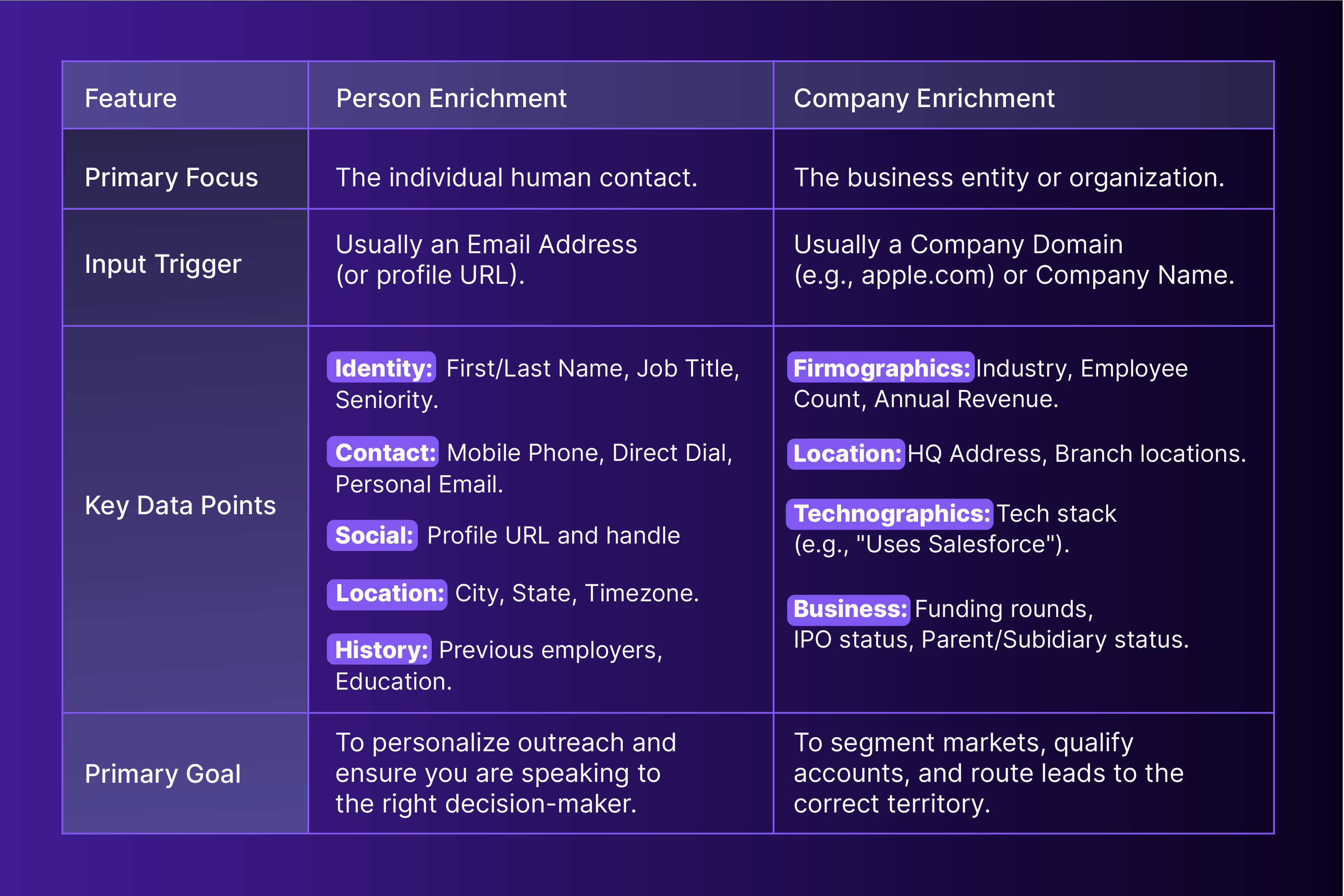
Person enrichment
A People Data Enrichment API adds professional background data to individual records. When you enter an email address or a social profile URL, you receive details such as current and past employment (with start and end dates), job titles, education history, skills, and verified contact information.
This enables recruiters to evaluate career trajectories, sales teams to personalize outreach, and marketers to segment audiences by seniority.
Company enrichment
A Company Data Enrichment API adds firmographic and signal data to company records using a domain or name. The API returns critical details such as headcount growth (by department), funding history, investors, technology stacks, web traffic trends, and employee reviews from public platforms. This data powers account prioritization, competitive intelligence, and investment research by revealing growth signals and risk factors.
Other enrichment types
Beyond standard B2B data, you can have specialized forms for specific industries. GeoEnrichment adds demographic, economic, or environmental attributes to specific location coordinates. This is different from standard address validation as it provides context about the location itself, such as crime statistics or weather patterns, which is essential for insurance risk assessment, site selection, and hyper-localized marketing.
Event enrichment is another specialized type that appends context to transaction data, often used to detect fraud by identifying behavioral anomalies.
Use cases that drive revenue and reduce risk
People often think that data enrichment is just about having cleaner records, but it is more about having data you can use. When done right, these APIs can automate critical decisions that directly impact your bottom line.
For instance, instead of manually researching prospects or guessing at risk factors, teams can build automated workflows that act instantly.
Let’s look at some specific, real-world examples of how sales, recruiting, investment, and compliance teams can use data enrichment to close more deals, hire better talent, and protect their businesses. We’ve provided real examples throughout, showing you how you can put these scenarios into practice with Crustdata as your data enrichment API.
Powering AI SDRs and sales automation
AI sales agents are only as intelligent as the data they access. If an AI Sales Development Representative operates on month-old information, it risks contacting people at companies they have already left or referencing outdated job titles. This not only wastes effort but also makes your outreach look robotic and out of touch.
Data enrichment for AI SDR agents ensures that they act on accurate, real-time information. When you connect your AI to an enrichment API, it can instantly:
Verify the prospect's current employment status to confirm they are still with the target company.
Pull verified contact emails to ensure high deliverability.
Access recent signals like funding rounds, hiring surges, or news mentions to make messages contextually relevant.
The agent queries the enrichment API with a prospect's identifier, such as the company domain. It receives a structured JSON response containing fresh company data points. The agent then uses this data to validate targeting criteria and generate a personalized message before hitting send.
For example, if you want company enrichment data for HubSpot, you can send the following input API:
curl -X GET "https://api.crustdata.com/screener/company?company_domain=hubspot.com&fields=headcount,decision_makers,funding_and_investment,job_openings,news_articles,taxonomy&enrich_realtime=false&exact_match=true" \
-H "Authorization: Token <YOUR_TOKEN>"
Example (illustrative) output:
Note: The example response uses placeholders ("...") to represent field groups returned by the API. Actual responses will populate these objects and arrays with company-specific data when available.
[
{
"company_id": 662397,
"company_name": "HubSpot",
"headcount": {
"...": "Headcount and growth-related fields returned by Crustdata"
},
"decision_makers": [
{
"...": "Decision maker fields returned by Crustdata"
}
],
"funding_and_investment": {
"...": "Funding/investment-related fields returned by Crustdata"
},
"job_openings": {
"...": "Job openings-related fields returned by Crustdata"
},
"news_articles": [
{
"...": "News article fields returned by Crustdata"
}
],
"taxonomy": {
"...": "Industry/category taxonomy fields returned by Crustdata"
}
}
]
Lead scoring and routing
Enrichment turns raw leads into prioritized opportunities. Without it, marketing teams often guess which leads are valuable based on just a name and an email address. Enrichment supplies the critical firmographic and demographic attributes that feed robust scoring models.
When you add details like company size, industry, job title, seniority, funding stage, and tech stack, you can automatically assign higher scores to leads that match your ideal customer profile and deprioritize those that do not.
This data also transforms lead routing with:
Real-time assignment: The moment a lead enters your system, the API appends location and industry data, allowing routing rules to send the lead to the correct territory manager immediately.
Speed-to-lead: Eliminating manual research allows sales reps to contact high-value prospects while their intent is still high.
Efficiency: Sales teams stop wasting time on unqualified prospects and focus their energy where it counts.
This alignment ensures that when a lead reaches a sales rep, it has already been verified, qualified, and correctly routed, creating a smoother handoff between marketing and sales.
Recruiting platforms
Most data providers only return a snapshot of a person’s current position, but effective candidate matching requires the full story. To truly understand a candidate's potential, you need to know if they spent three years at a major tech firm before their current role, when they graduated, or if they possess specific certifications. Current-role-only data simply cannot support this level of intelligent matching.
Person enrichment APIs solve this for recruiting platforms by returning full employment timelines with specific start and end dates for every past role, along with education history and skills. This comprehensive data allows recruiting platforms to score and rank candidates based on their entire career trajectory rather than just their current job title.
Key workflows can include:
Enriching inbound applicants: Adding complete background data to simple resume uploads, so no detail is missed.
Database hygiene: Filling gaps in existing candidate pools, such as missing graduation years or technical skills.
Verification: After searching for a broad pool of candidates, enriching them with detailed profile information, or validating candidate-provided information against authoritative public sources to ensure accuracy before an interview.
For instance, you can enrich data for one or more individuals using business email addresses with the following API request:
curl --location 'https://api.crustdata.com/screener/person/enrich?business_email=jane.doe@company.com&enrich_realtime=true&fields=name,location,email,business_email,title,last_updated,headline,summary,num_of_connections,skills,languages,all_employers,past_employers,current_employers,education_background,all_employers_company_id,all_titles,all_schools,all_degrees' \
--header 'Authorization: Token $auth' \
--header 'Accept: application/json'
Example (illustrative) output
[
{
"name": "string",
"location": "string",
"email": "hello@example.com",
"business_email": ["jane.doe@company.com"],
"title": "string",
"last_updated": "2025-12-19T10:45:23.982Z",
"headline": "string",
"summary": "string",
"num_of_connections": 1,
"skills": ["..."],
"languages": ["..."],
"all_employers": ["..."],
"past_employers": [
{
"...": "Past role fields (employer_name, employee_title, employee_location, start_date, end_date, ...)"
}
],
"current_employers": [
{
"...": "Current role fields (employer_name, employee_title, employee_location, start_date, end_date=null, ...)",
"business_emails": {
"jane.doe@company.com": {
"verification_status": "verified",
"last_validated_at": "2025-05-18"
}
}
}
],
"education_background": [
{
"...": "Education fields (institute_name, degree_name, field_of_study, start_date, end_date, ...)"
}
],
"all_employers_company_id": [123],
"all_titles": ["..."],
"all_schools": ["..."],
"all_degrees": ["..."],
"enriched_realtime": true,
"score": 0.9
}
]
AI recruiting agents
The primary advantage of AI recruiting agents is that they do not wait for candidates to apply. They proactively source, evaluate, and engage talent. This requires real-time data that goes far beyond what sits in a static database. These agents need to act instantly to beat competitors to top talent.
To succeed, agents must discover candidates matching specific criteria across the web and verify their employment status before sending a message. This prevents the embarrassment of contacting a prospect about a role they have already left. They also need to monitor passive candidates for signals that suggest they might be open to new opportunities, such as recent job changes or role tenure hitting a transition point.
Applications of this type of data enrichment include:
Real-time discovery: Finding candidates instantly based on granular skills, location, and experience filters.
Pre-outreach enrichment: Pulling fresh profile data to personalize messages with relevant details from a candidate's background.
Signal monitoring: Using watchers to track target candidates for trigger events, like leaving a current job, to time outreach perfectly. You can also use it to monitor companies that are laying off employees to target good-fit candidates from there to hire.
For instance, you could send the following in-database search API request to discover candidate profiles for a specific role:
curl -X POST 'https://api.crustdata.com/screener/persondb/search' \
-H 'Authorization: Token $auth_token' \
-H 'Content-Type: application/json' \
--data '{
"filters": {
"op": "and",
"conditions": [
{
"column": "current_employers.title",
"type": "(.)",
"value": "Machine Learning Engineer"
},
{
"column": "region",
"type": "=",
"value": "San Francisco Bay Area"
},
{
"column": "skills",
"type": "(.)",
"value": "Python"
},
{
"column": "years_of_experience_raw",
"type": "=>",
"value": 5
}
]
},
"limit": 100
}'
This would then give you the profiles of up to 100 people matching your search parameters, for your specified role and location.
Note that the following output truncates profiles to 1 item for readability; however, the API can return up to limit profiles per page, and next_cursor appears when another page exists.
{
"profiles": [
{
"person_id": 123456,
"name": "...",
"first_name": "...",
"last_name": "...",
"region": "San Francisco Bay Area",
"headline": "...",
"summary": "...",
"skills": ["Python", "..."],
"languages": ["..."],
"years_of_experience_raw": 7,
"recently_changed_jobs": false,
"num_of_connections": 500,
"last_updated": "2025-12-19T10:45:23.982Z",
"updated_at": "2025-12-19T10:45:23.982Z",
"current_employers": [
{
"company_id": 987654,
"name": "...",
"title": "Machine Learning Engineer",
"seniority_level": "...",
"start_date": "...",
"...": "additional current_employers fields returned by the API"
}
],
"past_employers": [
{
"company_id": 111222,
"name": "...",
"title": "...",
"...": "additional past_employers fields returned by the API"
}
],
"education_background": [
{
"institute_name": "...",
"degree_name": "...",
"field_of_study": "...",
"start_date": "...",
"end_date": "..."
}
],
"...": "additional profile fields returned by the API"
}
],
"next_cursor": "eJx1jjEOwjAMRe...",
"total_count": 842
}
Enterprise sales and CRM enrichment
Sales representatives often spend valuable time on administrative tasks rather than selling. Instead of manually piecing together prospect and account context across multiple browser tabs, enrichment APIs consolidate this research into a single call. For people, you get current and past employment, job descriptions, skills, education, and contact information. For companies, you receive headcount trends, funding history, tech stack details, recent news, and key decision-makers.
CRM auto-enrichment keeps both contact and account records current without manual updates. This allows for dynamic territory planning using live company signals, like headcount growth, rather than relying on static firmographics. Additionally, automated pre-call research surfaces full prospect and company context before every meeting.
Key workflows for enterprise data enrichment include:
Update stale contacts in minutes: Real-time enrichment returns current titles, companies, emails, and social links so you stop reaching out to people who no longer fit your Ideal Customer Profile (ICP).
Reclaim billable hours: Automate cleanup so sales teams spend time selling instead of fixing messy CRM data.
Merge and remove duplicates: Remove duplicate contacts and company profiles when data comes from mergers, acquisitions, or multiple source systems.
Catch buyer signals in real time: Push signals like job changes, headcount spikes, funding rounds, and news mentions into your CRM via webhooks so reps can act with context and not miss opportunities.
Venture capital and investment platforms
Early-stage deal sourcing requires data that traditional platforms often miss. While established tools track companies with long funding histories, the best opportunities, such as stealth founders or first-time entrepreneurs, often lack this data trail. Enrichment APIs fill this gap for venture capitalists by providing comprehensive founder profiles alongside company signals like hiring velocity and web traffic trends.
This enables thesis-driven sourcing and due diligence on team pedigrees before investing. For example, investors can identify companies building out early teams by spotting listings for roles like "Founding Engineer" or use historical data to track growth trajectories. They can also use the Watcher to identify individuals with specific skills, backgrounds, or experience who become founders, as well as discover 'stealth' startups – early-stage companies – which is particularly valuable for early-stage investment opportunities.
For example, you can send the following job listings API request to track which companies are recruiting for founding team members:
c
"tickers": [],
"dataset": {
"name": "job_listings",
"id": "joblisting"
},
"filters": {
"op": "and",
"conditions": [
{
"op": "or",
"conditions": [
{"column": "title", "type": "(.)", "value": "Founding Engineer"},
{"column": "title", "type": "(.)", "value": "Founding Account Executive"},
{"column": "title", "type": "(.)", "value": "Founding Designer"}
]
}
]
},
"offset": 0,
"limit": 100,
"sorts": []
This would give you details of the companies, including their location, website, company description, etc., as follows:
Note that this is an example illustrative output that uses placeholder company names/domains and may omit or simplify additional fields returned by the API.
{
"fields": [
{ "type": "number", "api_name": "company_id", "hidden": false },
{ "type": "string", "api_name": "company_name", "hidden": false },
{ "type": "string", "api_name": "company_website", "hidden": false },
{ "type": "string", "api_name": "company_website_domain", "hidden": false },
{ "type": "string", "api_name": "largest_headcount_country", "hidden": false },
{ "type": "number", "api_name": "company_id_count", "hidden": false },
{ "type": "number", "api_name": "total_rows", "hidden": true }
],
"rows": [
[631811, "Example Startup A", "https://example-a.com", "example-a.com", "USA", 3, 3],
[673947, "Example Startup B", "https://example-b.com", "example-b.com", "GBR", 2, 3],
[680992, "Example Startup C", "https://example-c.com", "example-c.com", "CAN", 1, 3]
],
"is_trial_user": false
}
Identity verification and risk reduction
Fintech, banking, ecommerce, and gig-economy platforms use people search APIs as part of Know Your Customer (KYC) and fraud prevention workflows. This process involves taking details provided by a user and verifying whether those details are real and linked to the same identity.
Unlike simple document verification, this data-driven approach helps catch synthetic identities that may have valid-looking fake IDs but lack a real historical footprint. This integrates with account signup data, ensuring a smooth experience for legitimate users while flagging potential fraudsters for review.
Get real-time data enrichment with Crustdata
Evaluating enrichment providers can be frustrating because "real-time" has become a meaningless marketing term. Everyone claims to offer it, yet most vendors deliver static database snapshots that are updated only monthly or quarterly.
Crustdata takes a different approach. When you request real-time enrichment, our engine pulls data fresh from the web at that exact moment, rather than serving a record that was cached weeks ago. For high-stakes use cases like outbound campaigns, AI agent workflows, or pre-meeting research, this freshness makes the difference between accurate outreach and embarrassing mistakes.
For cost-conscious projects where monthly freshness is acceptable, such as populating a large CRM or building massive lists, we also offer database enrichment, giving you the flexibility to choose the mode that fits your specific needs.
Beyond freshness, Crustdata offers three distinct technical advantages:
We unify data from over 10+ verified global sources rather than relying on a single platform, ensuring higher accuracy.
Our system intelligently handles name variations across different platforms to ensure you match the correct company or person every time.
We deliver data in a consistent, structured JSON format across all data types, making it easy for developers to integrate into any stack.
Our core philosophy is that the proper data infrastructure is what sets you apart, whether you are building the next generation of AI agents or simply need a cleaner CRM.
If that aligns with your expectations, book a demo to see how real-time enrichment can transform your revenue operations.


Products
Popular Use Cases
Competitor Comparisons
95 Third Street, 2nd Floor, San Francisco,
California 94103, United States of America
© 2026 Crustdata Inc.
Products
Popular Use Cases
Competitor Comparisons
95 Third Street, 2nd Floor, San Francisco,
California 94103, United States of America
© 2026 CrustData Inc.
Products
Popular Use Cases
Competitor Comparisons
95 Third Street, 2nd Floor, San Francisco,
California 94103, United States of America
© 2026 Crustdata Inc.
🎉 We hit $10M ARR!
$600k to $10m in 1.5 years. Our entire GTM is powered by our own APIs.
🎉 We hit $10M ARR in 1.5 years!