9 Best Clay Alternatives To Try in 2026 [Full Comparison]
Compare Clay alternatives for data enrichment in 2026 and explore real-time APIs, contact databases, and enrichment tools for scalable GTM workflows.
Published
Written by
Chris P.
Reviewed by
Nithish A.
Read time
7
minutes
Clay helped GTM teams connect enrichment tools and automate prospecting workflows inside a single interface. But as outreach scales, many teams hit the same friction: inconsistent data quality, unpredictable credit usage, and workflows that depend heavily on third-party databases.
If your enrichment results vary by provider, your costs increase with each chained lookup, or your automation relies on refresh cycles rather than live signals, it may be time to explore Clay alternatives.
This guide compares the 9 best Clay alternatives for data enrichment in 2026, focusing on data freshness, enrichment depth, API access, and infrastructure flexibility so you can choose a solution that fits how your team operates.
Why Look for Clay Alternatives?
Clay works well as a workflow orchestrator for manual list building. But certain limitations push teams to evaluate other options when building automated systems or AI-driven workflows. Common reasons teams consider alternatives include:
Table-based architecture limits automation: Spreadsheet-style workflows cannot respond to external events automatically or operate without human intervention, making them unsuitable for AI agents and automated systems
Aggregator model creates data quality issues: Clay sits on top of 100+ providers with cached databases, leading to 30-40% of enrichment results requiring re-verification according to customer reports
Unpredictable credit costs: Multi-step enrichment chains consume different credit amounts across providers, making it difficult to forecast monthly spend
Data freshness depends on underlying providers: Periodic database refresh cycles from third-party vendors may deliver data that is weeks or months old rather than current
Limited programmatic control: Pre-defined table filters and column configurations constrain custom logic compared to full API-first infrastructure
Cannot embed into products: Table-based UI cannot be natively integrated into customer-facing applications or internal platforms
For some teams, Clay remains a useful layer. For others, replacing it with a more direct enrichment provider offers greater control, reliability, and scalability.
9 Best Clay Alternatives For Data Enrichment
Each Clay alternative approaches enrichment differently. Some combine data and outreach on a single platform; others focus on signal detection, automation, or API-driven infrastructure.
The table below compares these tools by enrichment model, data freshness, and integration depth to help you evaluate fit at a glance.
Tool | Primary Focus | Data Freshness Model | API Access | Starting Price |
Crustdata | Real-time B2B enrichment infrastructure | Real-time crawling + batch enrichment | Yes (API-first) | Custom |
Databar | No-code enrichment aggregation | Waterfall enrichment across 100+ providers | Yes | From $39/month |
Persana AI | Signal-based prospecting & GTM orchestration | Database + signal-based triggers | Yes | Free plan; Paid from $85/month |
Airscale | High-volume data extraction & enrichment | Database + real-time scraping | Yes (API + MCP) | From $49/month |
FullEnrich | Waterfall contact enrichment | Vendor-cascaded database lookup | Yes | From $29/month |
Floqer | CRM enrichment + sales automation | Waterfall enrichment across 80+ providers | Yes | Custom |
Adapt.io | Contact database + prospecting | Database-based with ongoing updates | Yes | From $49/month |
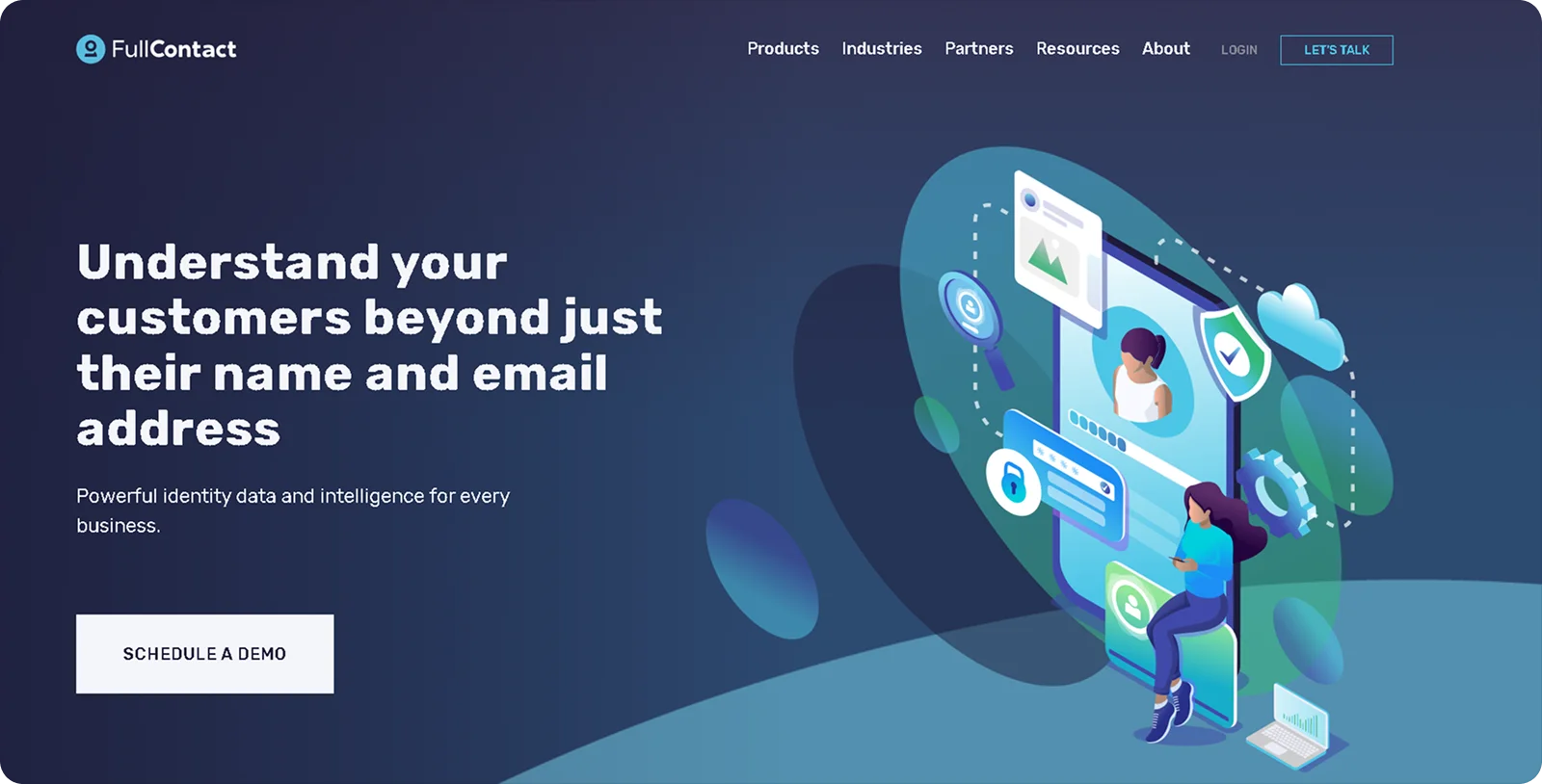
FullContact | Identity resolution & enrichment APIs | Periodic refresh cycles | Yes | From $99/month |
Signado | Warm-lead discovery from LinkedIn activity | Daily LinkedIn monitoring | Yes (MCP) | From $29/month |
1. Crustdata
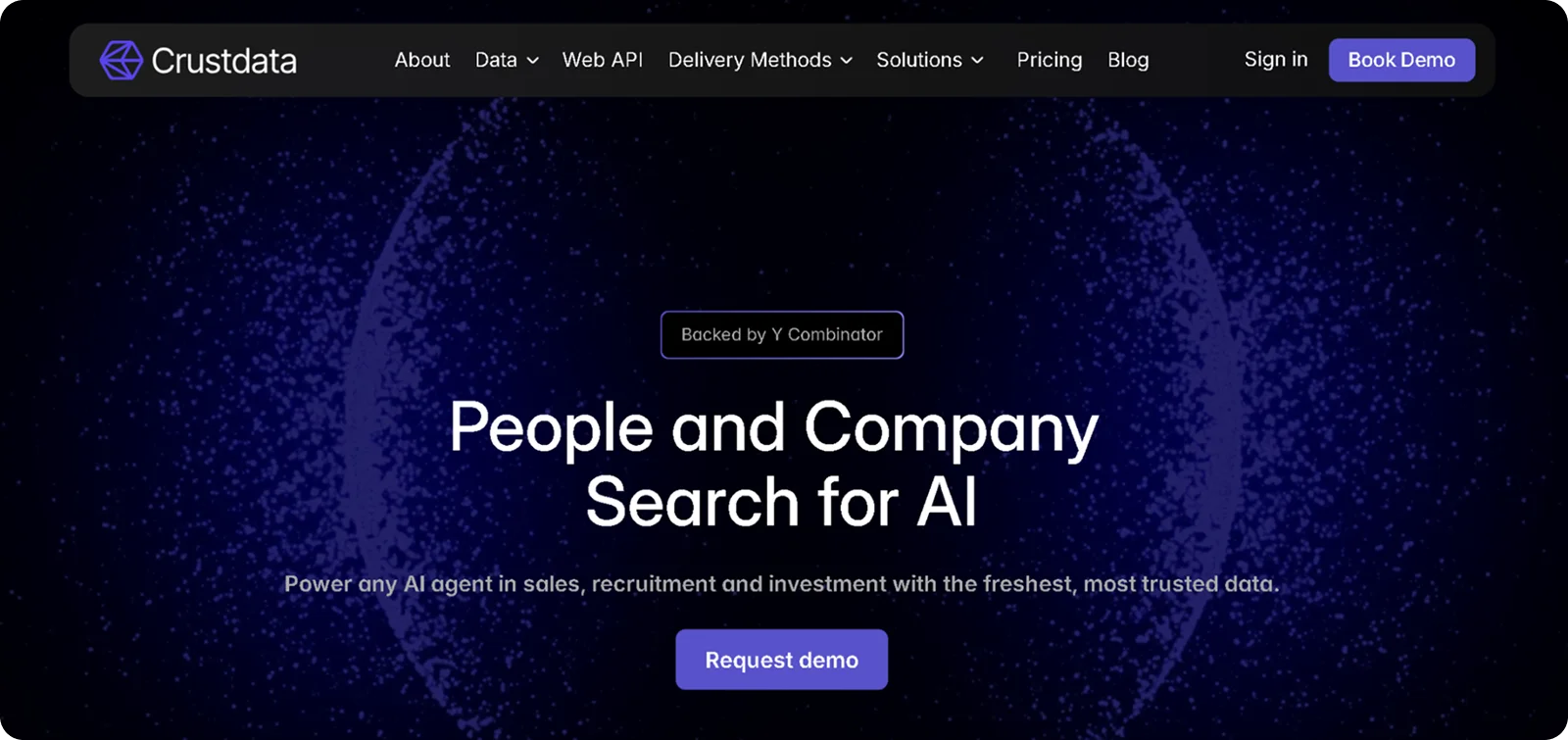
Crustdata is a real-time B2B intelligence layer that powers AI SDR products, internal sales tools, venture capital research, recruiting platforms, and marketing automation systems. Through batch and live enrichment APIs, it delivers structured company and people data exactly when workflows need it.
Key Features
WebSearch API for search intelligence: Converts live search results into structured JSON, pulling information from news articles, blogs, funding announcements, product launches, and executive mentions for direct integration into AI pipelines and automation workflows
Unified multi-source aggregation: Combines 250+ company data points and 95+ people data points from 15+ verified sources into a single structured JSON response.
Company API with deep firmographic and growth coverage: Provides structured access to firmographics such as revenue range, employee count, location, and funding history, alongside dynamic signals including job postings by department, headcount growth trends, and web traffic metrics
People API with structured professional records: Returns current role, seniority, department, full work history, education, business emails, and live role-change updates
Watcher API with event-based webhooks: Enables event-driven monitoring with webhook alerts for job changes, funding, executive hires, headcount spikes, and other tracked events
CRM and sales tool integration: Delivers enriched data directly into Salesforce, HubSpot, and sales engagement platforms through REST API connections for seamless workflow automation
Pros
Supports both baseline batch enrichment and time-sensitive live enrichment within one provider
Enables event-driven workflows through webhooks rather than polling for updates
Removes dependency on separate enrichment vendors
Provides developer-ready REST endpoints for direct system integration
Enables event-driven automation through API architecture rather than requiring manual table operations unsuitable for AI agents and autonomous systems
Cons
Requires API implementation rather than offering a no-code spreadsheet interface
Pricing
Crustdata offers custom enterprise pricing based on usage and API access.
2. Databar
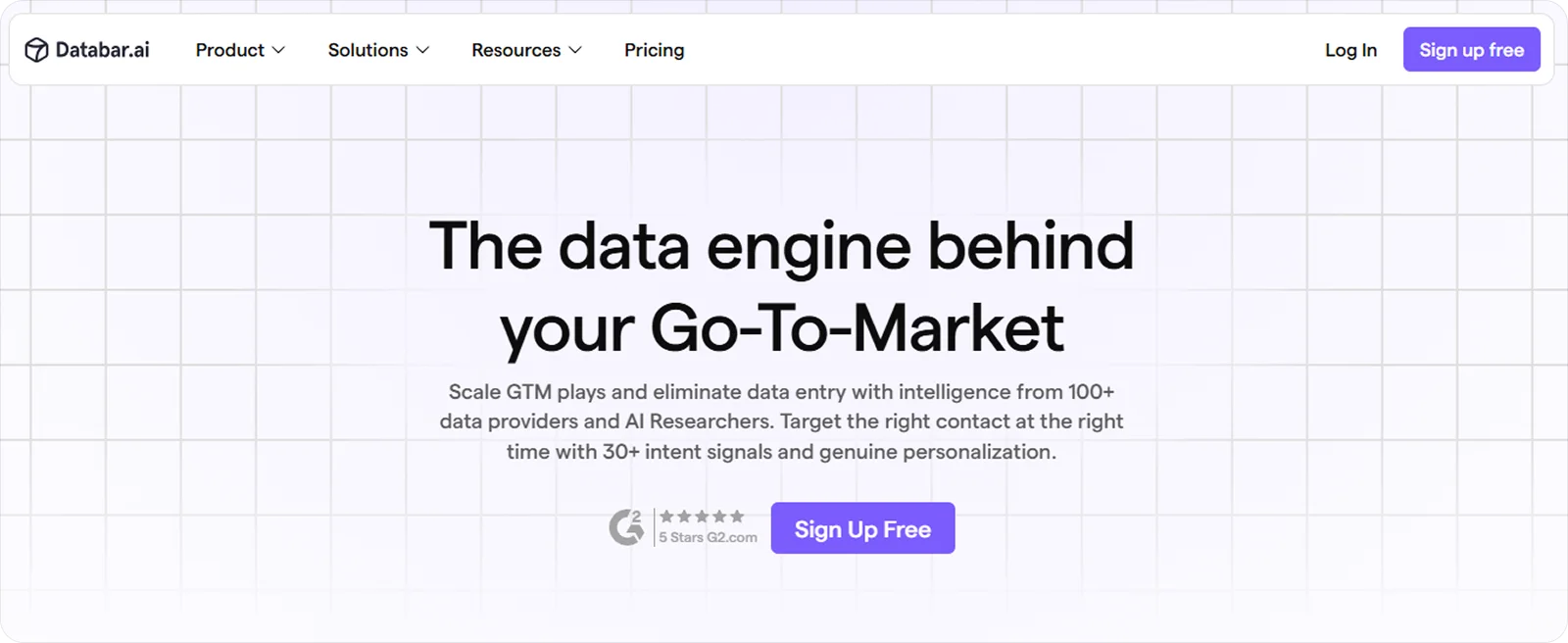
Databar is a no-code data enrichment and automation platform that aggregates contact and company data from 100+ providers through a spreadsheet-style interface. GTM teams use it to enrich CRM records, build prospect lists, and automate data workflows without managing individual vendor subscriptions.
Key Features
Waterfall enrichment across 100+ providers: Routes each data request through multiple providers sequentially until finding valid results, maximizing contact coverage without managing separate integrations
No-code spreadsheet interface: Provides familiar table-based workspace where users build enrichment workflows, apply formulas, and structure data without coding
AI-powered web scraping: Extracts structured data from any website using Chrome extension and AI, converting unstructured web pages into database records
Automated workflow builder: Creates recurring enrichment pipelines that run on schedules, triggers, or webhooks to keep CRM data current
Native CRM synchronization: Syncs enriched data directly into Salesforce, HubSpot, and other platforms with bi-directional updates
Pros
Aggregates multiple data providers through single interface
Eliminates need for separate vendor subscriptions
Provides AI assistance for data extraction and qualification Supports custom automation workflows without coding
Cons
Requires learning curve for advanced workflow features
Focuses on aggregation rather than proprietary data collection
Pricing
Databar offers usage-based pricing starting at $39 per month (Launch plan with 1,000 credits). Scale plan costs $129 per month, Expand plan costs $500 per month.
3. Persana AI
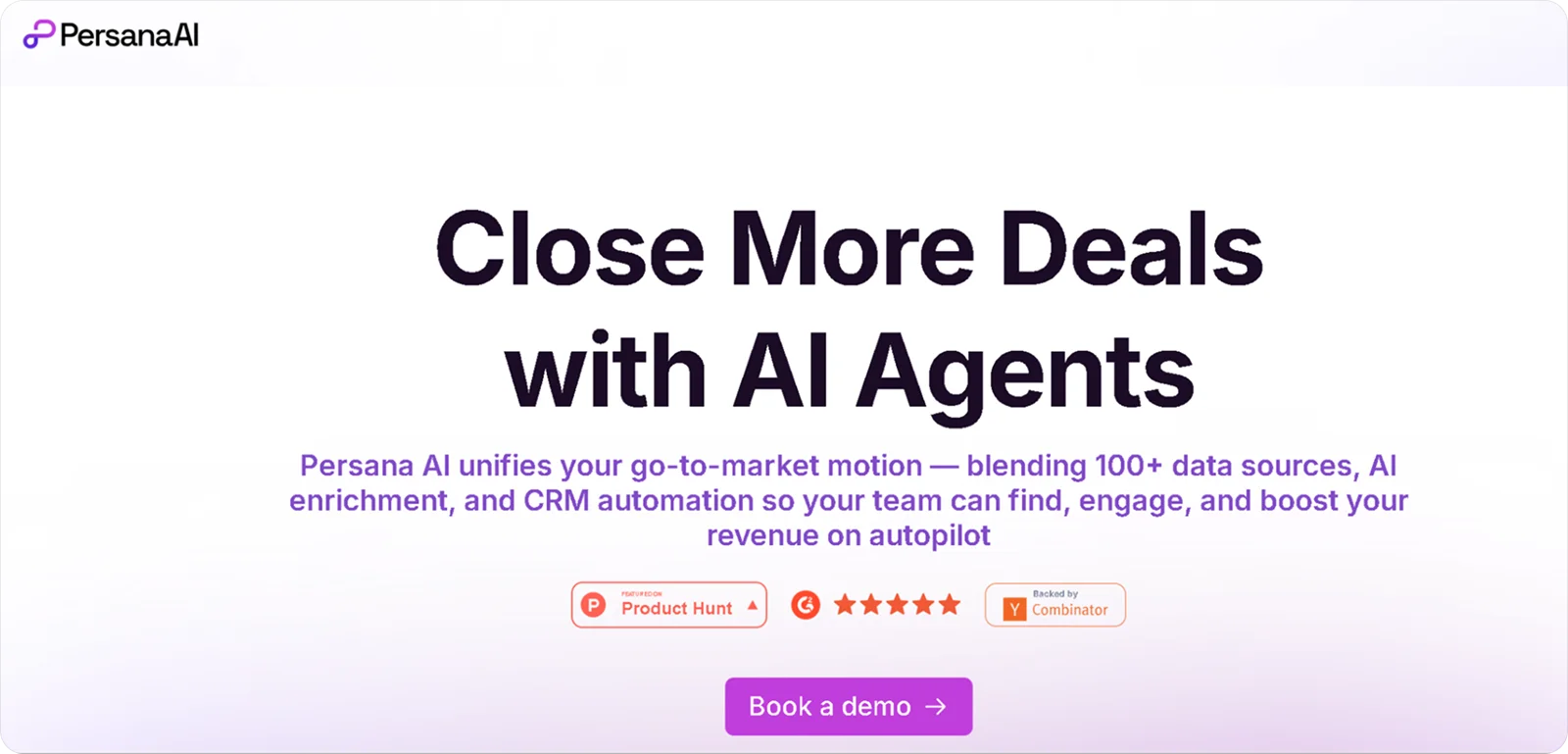
Persana AI is a GTM intelligence platform focused on signal-based prospecting and automated enrichment workflows. The platform emphasizes identifying accounts and contacts based on behavioral triggers, hiring signals, and contextual changes within the company.
Key Features
Signal-based prospect discovery: Identifies accounts and contacts based on hiring activity, product launches, funding announcements, leadership changes, and other external company signals
AI-assisted list building: Allows users to define ICP criteria in natural language, then generates prospect lists aligned with firmographic and contextual filters
Multi-source data enrichment: Enhances contact and company records with verified emails, firmographic attributes, and contextual company insights
Automated workflow triggers: Activates outbound sequences or task creation when predefined signals occur, reducing manual monitoring
CRM and outbound tool integrations: Syncs enriched data into platforms like Salesforce, HubSpot, and common sales engagement tools for execution
Pros
Surfaces contextual buying signals instead of relying only on static filters
Reduces manual list building through AI-assisted targeting
Connects signal detection directly to outbound workflows
Cons
Depends on third-party data sources for certain enrichment fields
Offers less historical dataset depth than large legacy databases
Pricing
Persana AI offers a free plan with 50 credits. Paid plans start at $85 per month or $68 per month when billed annually.
4. Airscale
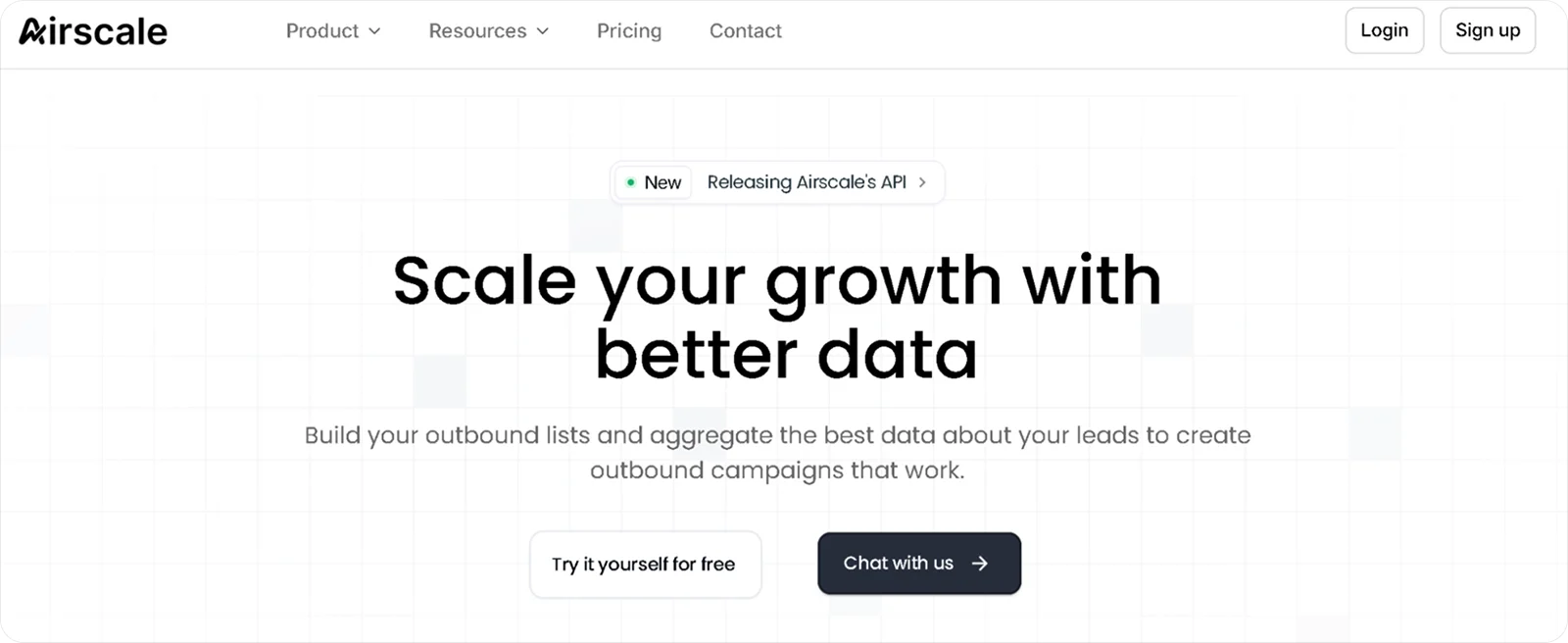
Airscale is a data enrichment and outbound automation platform built for high-volume prospecting workflows. It focuses on extracting and enriching contact and company data at scale, particularly for teams running outbound campaigns tied to professional profiles and local business research.
Key Features
High-volume profile extraction: Pulls professional profile data in bulk for large prospect lists across supported platforms
Google Maps business data collection: Extracts local business information, including company name, website, phone number, address, and category
Bulk contact enrichment: Enhances uploaded lead lists with emails, firmographic attributes, and additional company details
Workflow automation pipelines: Connects extraction, enrichment, and export steps into repeatable prospecting workflows
CSV and CRM export compatibility: Delivers enriched records in structured formats ready for import into CRMs or outbound tools
Pros
Supports large-scale data extraction workflows for agencies and outbound teams
Reduces per-lead cost when running high-volume enrichment
Automates repetitive list-building steps into structured pipelines
Enables local business prospecting beyond traditional B2B databases
Provides flexible export options for downstream outreach tools
Cons
Requires configuration to maintain extraction quality at scale
Focuses more on extraction workflows than deep firmographic intelligence
Pricing
Airscale does not have a free plan but does offer a 14-day free trial. Paid plans start at $49 per month or $490 per year.
5. FullEnrich
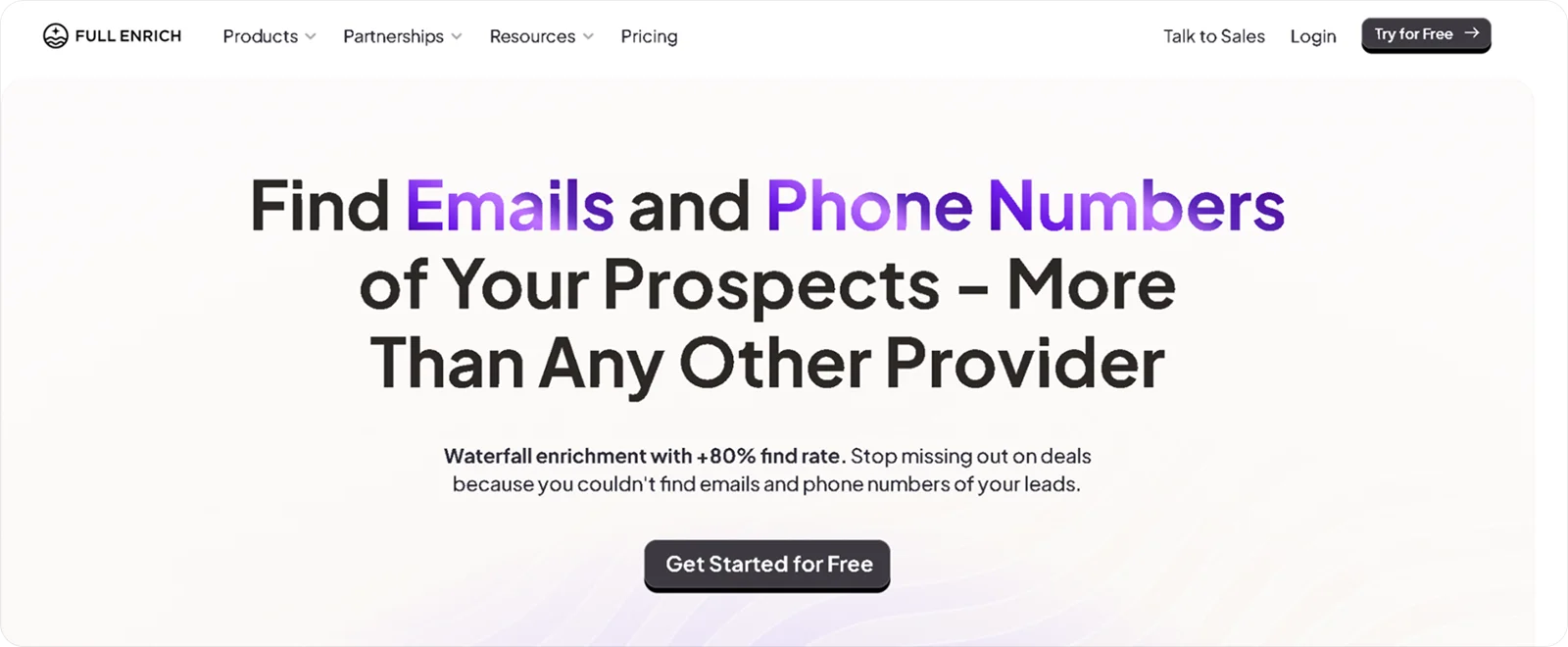
FullEnrich is a contact enrichment platform that maximizes email and phone coverage by cascading across multiple data vendors through a single API. The platform routes each lookup to several providers until it finds a valid result.
Key Features
Waterfall enrichment engine: Routes each contact request through multiple integrated data providers sequentially until a valid email or phone number is returned
Unified enrichment API: Sends a single request to retrieve contact data without managing separate vendor integrations
Bulk list processing: Accepts CSV uploads or batch API calls to enrich large prospect lists at scale
Credit-based usage model: Charges only for successful data retrieval rather than for every attempted lookup
CRM and outbound tool compatibility: Exports enriched contacts into structured formats for Salesforce, HubSpot, and sales engagement platforms
Pros
Improves contact coverage by querying multiple providers automatically
Reduces vendor management overhead through a single integration
Increases the likelihood of retrieving hard-to-find direct dials
Cons
Focuses primarily on contact data rather than deep firmographic intelligence
Does not provide real-time company monitoring or event-based alerts
Pricing
FullEnrich offers tiered plans based on monthly volume, starting from $29 per month or $26 per month when paid annually. It also offers a one-time payment oftion of $299.
6. Floqer
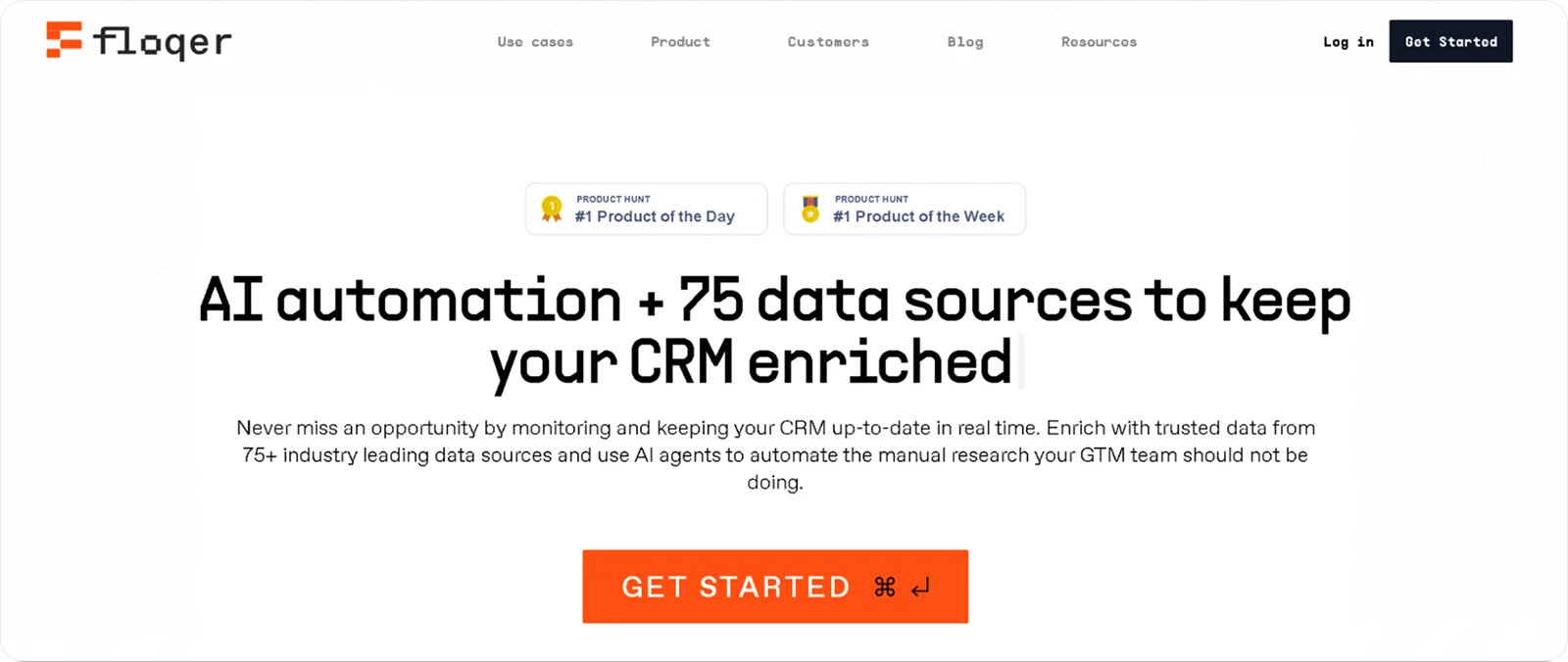
Floqer is an AI-powered CRM enrichment and sales automation platform that maintains clean, up-to-date contact and company data through waterfall enrichment across 80+ sources. RevOps, sales, and marketing teams use it to keep CRMs accurate, build prospect lists, and automate outbound workflows.
Key Features
Waterfall enrichment across 80+ sources: Queries multiple data providers sequentially to find verified emails, phone numbers, and firmographic details, delivering higher match rates than single-source tools
Native CRM integration: Connects directly with HubSpot, Salesforce, and Zoho CRM to automatically enrich records, deduplicate contacts, and maintain data hygiene
Chrome extension enrichment: Captures contact and company data while browsing professional networks or company websites, adding records directly to CRM
AI-powered workflow automation: Builds custom automation sequences for lead scoring, routing, outreach generation, and task assignment without coding
Auto-deduplication engine: Identifies and merges duplicate CRM records automatically to maintain database integrity
Pros
Delivers high contact coverage through multi-provider waterfall approach Keeps CRM data current with automatic enrichment and deduplication Enables custom workflows and AI agents for sales automation Provides hands-on implementation support
Cons
Requires CRM integration to access full functionality Uses custom pricing rather than transparent tiers
Pricing
Floqer uses custom pricing based on CRM size, enrichment volume, and feature requirements. Contact sales for quotes.
7. Adapt.io
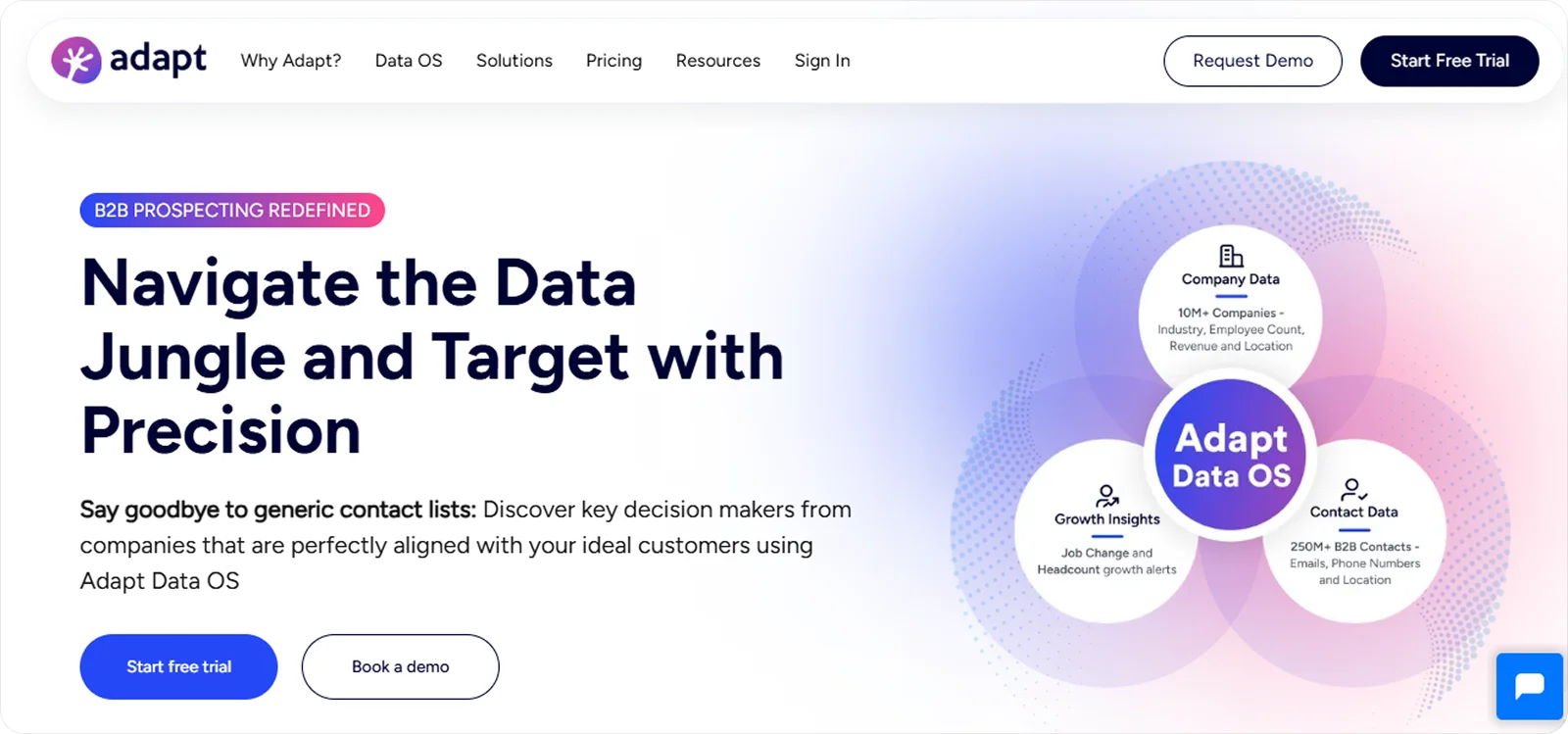
Adapt.io is a B2B contact database and sales acceleration platform that combines prospect discovery with verified contact data. Sales teams and recruiters use it to build targeted lists, find direct dials, and enrich CRM records with business emails and phone numbers.
Key Features
B2B contact and company database: Provides access to 250M+ business contacts and 10M+ company profiles with filtering by job title, seniority, industry, location, and employee count
Lead Builder with advanced filters: Creates targeted prospect lists using firmographic criteria, keywords, and real-time data validation to ensure contact accuracy
Prospector Chrome extension: Reveals email addresses and phone numbers directly on professional network profiles and company websites during manual research
CRM integration and data sync: Enriches existing CRM records and syncs new contacts directly into Salesforce, HubSpot, Zoho, Pipedrive, and other platforms
Automated lead alerts: Sends notifications when new contacts matching saved search criteria enter the database
Pros
Delivers verified business emails and direct phone numbers for cold calling
Provides browser extension for quick lookups during prospecting Integrates directly with major CRMs for automated data flow
Offers real-time contact validation to reduce bounce rates
Cons
Enforces daily contact limits even on paid plans
Uses fragmented credit system separating email, enrichment, and phone credits
Pricing
Adapt.io offers a free plan with up to 20 email credits and 25 enrichment credits monthly. Paid plans start at $49 per month (Starter) or $490 per year.
8. FullContact
Key Features
Identity resolution engine: Matches fragmented contact records across devices, emails, and data sources to create unified person profiles
Company and person enrichment APIs: Returns firmographic and demographic attributes to enhance existing CRM or CDP records
Persistent person identifiers: Assigns unique IDs to individuals to maintain continuity even when emails or attributes change
Privacy-forward data practices: Supports compliance requirements with consent frameworks and regional data controls
API-first integration model: Delivers enrichment and identity data directly into CRMs, CDPs, marketing automation tools, and internal systems
Pros
Strengthens cross-channel identity stitching for marketing and analytics
Reduces duplicate contact records through persistent identifiersSupports integration into data warehouses and CDPs
Enhances segmentation with enriched firmographic attributes
Maintains privacy compliance across regulated markets
Cons
Does not function as a primary outbound prospecting database
Requires technical integration for full capability
Pricing
FullContact offers a 14-day free trial after which you choose from 3 plans starting at $99 per month.
9. Signado
Signado finds people on LinkedIn who are already talking about the problems you solve. You give it keywords, creators, competitors, or even company pages to watch. Every day it pulls the people posting and commenting, enriches them, and qualifies them against your business. It drafts a message for each one based on what they actually said. Leads can be pushed to your own tools and you can even drive everything from Claude or ChatGPT.
Key Features
Warm-lead discovery: Watches keywords, creators, competitors, and company pages on LinkedIn, then surfaces the people posting and commenting as scored leads each day
Context-attached leads: Every lead arrives with the exact post or comment that qualified them, so the reason to reach out is built in
Enrichment and qualification: Enriches each discovered person and scores them against your business before they reach your list
AI-drafted messages: Writes a first message for each lead based on what they actually posted
Agent and tool delivery: Pushes leads into your own tools and runs end to end from Claude or ChatGPT via MCP
Pros
Starts upstream of enrichment by finding warm leads rather than only enriching cold lists
Fixed, published per-action credit costs instead of variable lookup pricing
Personalization context comes attached to every lead
Runs daily on autopilot from keywords, creators, or competitor pages
Cons
Not a data-enrichment waterfall, so it complements a dedicated enrichment tool rather than replacing it
No spreadsheet interface for arbitrary API work
Pricing
Signado starts with a 7-day free trial. Paid plans run $29/mo (Lite, 1,000 credits), $59 (Starter, 2,500), $99 (Growth, 5,000), and $349 (Scale, 20,000), with a warm lead costing 5 credits, an email 5, an AI-drafted message 3, and a Deep Dive 40. Cancel anytime.
How to Choose the Right Clay Alternative
Most Clay alternatives fall into one of three categories: contact databases, workflow automation tools, or enrichment infrastructure.
If your goal is manual prospecting, browser extensions and sequencing platforms may be enough. If you’re building automation, AI agents, or multi-system workflows, the underlying data layer becomes far more important than the interface.
Focus on three factors:
Data freshness: Does the provider rely on periodic refreshes, or does it retrieve current information when requested?
Signal depth: Are you limited to basic firmographics, or can you access growth signals, hiring trends, and executive changes?
Delivery model: Will this tool plug directly into your systems via an API, or will it require manual workflows to operate?
The more your team depends on timing, automation, or scale, the more critical the data infrastructure becomes.
Why Crustdata Is the Best Clay Alternative
Clay connects enrichment tools together. Crustdata eliminates the need to manage multiple enrichment vendors by serving as the underlying data infrastructure.
Instead of orchestrating third-party providers within chained workflows, you operate on a unified enrichment layer that supports both large-scale coverage and time-sensitive updates within a single system.
With Crustdata, you get:
API-first infrastructure for automation: Enables programmatic workflows, AI agents, and custom tools through REST endpoints rather than manual spreadsheet operations that require human intervention
Live enrichment at request time: Retrieves current company and people data when an API call is made, avoiding reliance on periodic database refresh cycles
Event-driven monitoring: Delivers webhook alerts when tracked changes occur, enabling workflows to react immediately without polling
Unified data layer: Aggregates structured company and people intelligence from 16+ verified sources into a single response
Production-ready APIs: Integrates directly into CRMs, internal tools, recruiting systems, and AI agents without spreadsheet-based orchestration
Dual enrichment model: Supports both batch data delivery for CRM-wide coverage and real-time enrichment for active accounts
Signal-rich company intelligence: Surfaces growth indicators such as hiring shifts, funding activity, leadership changes, and organizational movement
Structured people intelligence: Returns role, seniority, department, and career progression data designed for automation use cases
When workflows move from experimentation to production, the reliability of the data layer becomes more important than the interface managing it.
If your enrichment stack feels fragmented or dependent on refresh cycles, consolidating into a unified infrastructure can simplify operations and improve timing accuracy.
Ready to upgrade your data foundation?
Book a demo to see how Crustdata supports scalable, real-time enrichment in one system.


Products
Popular Use Cases
Competitor Comparisons
95 Third Street, 2nd Floor, San Francisco,
California 94103, United States of America
© 2026 Crustdata Inc.
Products
Popular Use Cases
Competitor Comparisons
95 Third Street, 2nd Floor, San Francisco,
California 94103, United States of America
© 2026 CrustData Inc.
Products
Popular Use Cases
Competitor Comparisons
95 Third Street, 2nd Floor, San Francisco,
California 94103, United States of America
© 2026 Crustdata Inc.
🎉 We hit $10M ARR!
$600k to $10m in 1.5 years. Our entire GTM is powered by our own APIs.
🎉 We hit $10M ARR in 1.5 years!