7 Best Web Search APIs for Real-Time Data & AI Apps
Compare the best web search APIs built for AI applications & find the right solution for your chatbot, RAG system, or research agent.
Published
Written by
Chris P.
Reviewed by
Nithish A.
Read time
7
minutes
Are you building an AI app that needs current web data? You're probably running into the same wall every developer hits: your large-language model (LLM) hallucinates outdated information, your retrieval-augmented generation (RAG) system pulls irrelevant results, or your agent takes forever to answer simple questions.
Traditional search APIs weren't designed for AI workflows. They return HTML-heavy results optimized for human readers, not structured data that language models can process efficiently. AI applications need real-time freshness, clean JSON outputs or markdown files that slot directly into prompts, and high-performance infrastructure with low latency, high throughput, and high rate limits to support AI agents searching at scale.
While web search APIs excel at query-based discovery, complex AI pipelines often require direct, uninterrupted access to specific target URLs that pre-indexed search engines might miss or truncate. If your autonomous agents need to dynamically extract full-page content, handle heavy JavaScript rendering, and navigate anti-bot protections at scale, integrating a dedicated web scraping api provides the reliability and structural control necessary to deliver raw, real-time web payloads directly into your vector databases or RAG pipelines.
This guide breaks down the 7 best web search APIs for real-time data and AI apps, covering what each does well, where they fall short, and how to pick the right one for your use case.
7 Best Web Search APIs to Consider for Real-Time Data & AI Apps
The table below compares eight APIs built specifically for AI workflows. Each tool takes a different approach to web search, from semantic understanding to speed optimization. Use this to quickly identify which APIs match your technical requirements before going into the detailed breakdowns.
API | Best For | Key Strength | Integration/Output Format | Starting Price |
Crustdata | B2B intelligence & AI agents | Web search and verified B2B data enrichment | Structured JSON with search results + company/people data | Custom pricing |
Exa | Semantic research & technical queries | Neural network-based semantic understanding with sub-350ms latency | JSON, Markdown; supports similarity search and multiple search modes | $5/1,000 requests |
Tavily | AI agent workflows with security | Multi-step research with PII/prompt injection protection | LangChain, LlamaIndex; JSON/Markdown with citations and relevance scores | $0.008/credit |
Brave | Privacy-first applications | Independent 30B+ page index with zero user tracking | JSON with web, image, video, news endpoints; Goggles for custom re-ranking | $3/1,000 requests |
Firecrawl | LLM-ready content extraction | Integrated search + scrape in single API call with sub-1 second response | LangChain, LlamaIndex, n8n, Zapier, MCP; Markdown/JSON optimized for LLMs | $19/month (3,000 credits) |
You.com | RAG workflows & real-time AI | Citation-backed results with 10B+ page index achieving 4x better freshness | OpenAI, Databricks, AWS Marketplace; JSON with contextual snippets and metadata | $6.25/1,000 calls |
Parallel Web Systems | Enterprise research agents | Structured outputs with citations, reasoning, and confidence scores | JSON with 9 processor tiers; Monitor API for real-time tracking | $5/1,000 requests (10 results) |
1. Crustdata
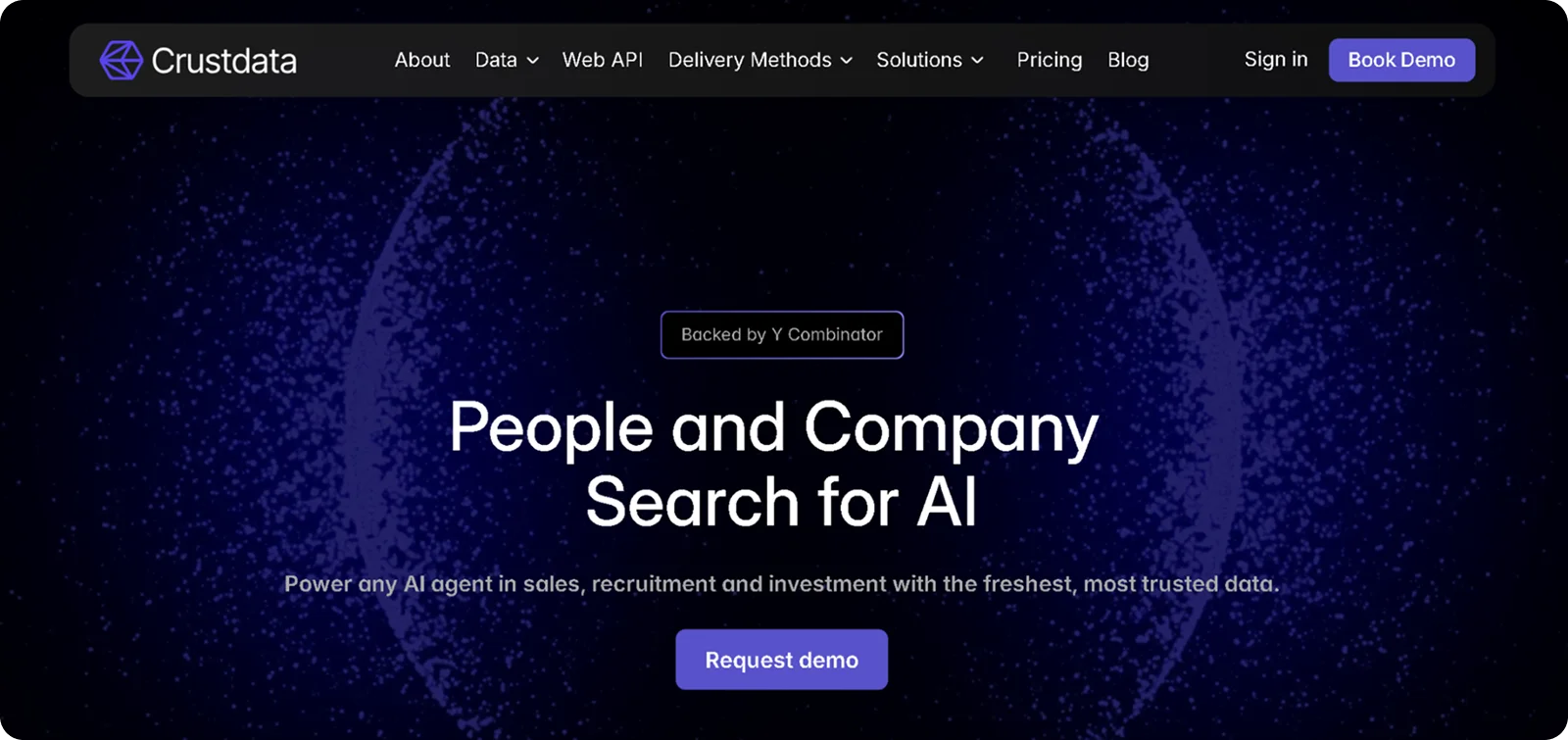
Crustdata’s Web search API is the gateway between AI agents and live web data on people and companies. Instead of limiting agents to static B2B databases, it delivers structured search results with titles, snippets, links, and ranking positions optimized for discovering accurate information about individuals and organizations.
Key Features
Customizable search parameters: Filters query text (up to 1,000 characters), geolocation for region-specific results, search result language, and specific sources like news or web
Structured JSON output: Returns clean data, including position, title, link, and source for organic results, local results, and news results
Combined intelligence approach: Pairs web search with structured B2B data that aggregate information from verified sources for comprehensive context
Live search results: Delivers current search results with ranking data and metadata without maintaining scraping infrastructure
Category-specific targeting: Filters search results by specialized categories including PDFs, research papers, news sources, social media sites, and AI sources
Search and content extraction: Combines web search with content extraction capabilities, providing both discovery and full-page content retrieval.
Pros
Delivers one of the the fastest web search APIs with sub-300ms latency for real-time AI applications
Provides the most accurate search results when finding information about people or companies
Eliminates the need to maintain brittle web scrapers or handle CAPTCHAs and proxy blocks
Surfaces qualitative insights like market perception, announcements, and founder interviews that traditional B2B data providers miss
Integrates seamlessly into AI pipelines with well-structured JSON responses
Combines web search breadth with verified B2B data depth for richer agent context
Cons
Requires pairing with Crustdata's Data APIs for complete B2B intelligence workflows
Pricing
Crustdata offers custom pricing based on usage needs. Contact the sales team for specific rates.
2. Exa
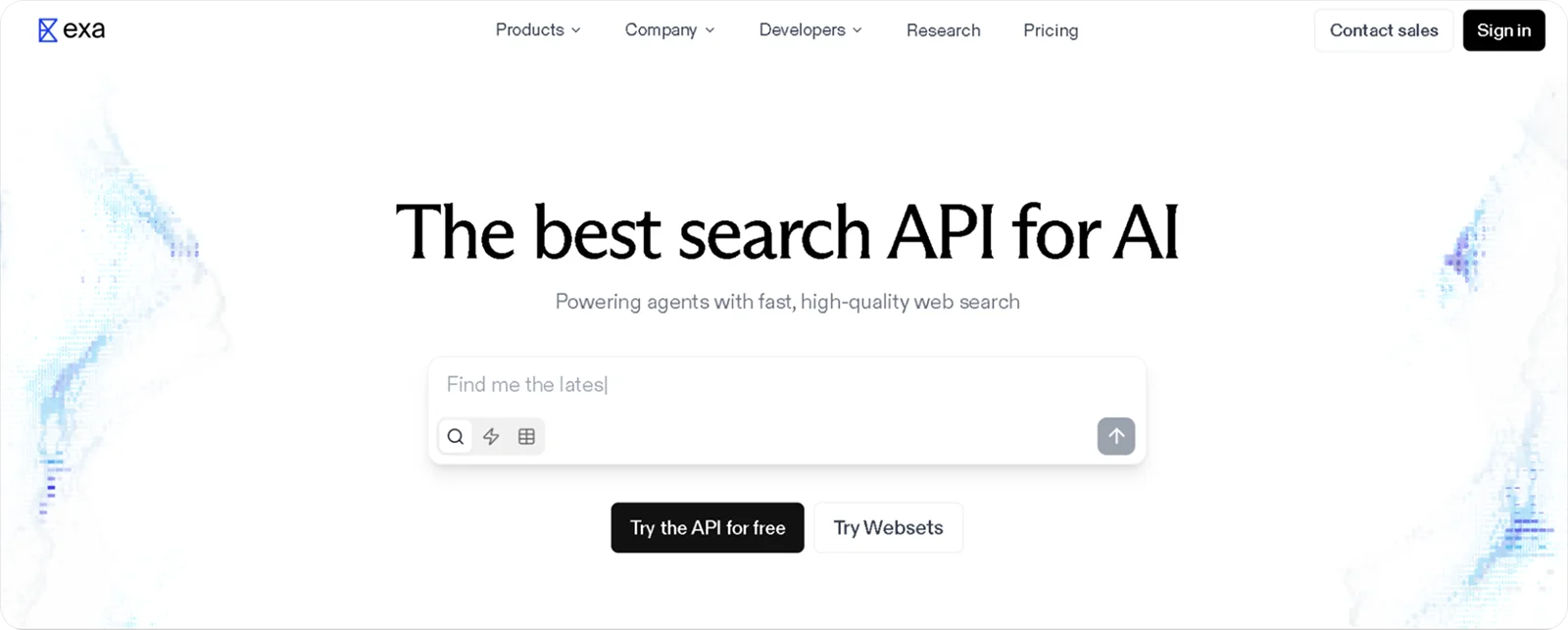
Exa (formerly Metaphor) operates its own independent web index trained on neural networks to understand semantic meaning rather than keyword matches. The API delivers search results based on how concepts connect across the web, using link-prediction training to surface content relevant and significant for research.
Key Features
Multiple search modes: Combines neural and keyword approaches (Auto), uses embeddings for semantic understanding (Neural), delivers sub-350ms responses (Fast), and performs agentic search with query expansion (Deep)
Similarity search: Finds pages semantically similar to a provided URL using embedding-level similarity retrieval
Category-specific optimization: Provides specialized search quality for people profiles, company pages, code repositories, and financial data
Real-time crawling: Refreshes index every minute with tens of billions of webpages for current information
Flexible content retrieval: Returns links, full text, highlights, or custom summaries in clean JSON or Markdown
Pros
Understands context and semantic relationships beyond keyword matching
Delivers sub-350ms latency with Fast mode for conversational AI interfaces
Provides specialized training on code, research papers, and financial data for technical queries
Formats outputs specifically for LLM consumption with structured JSON and Markdown
Cons
Uses a complex pricing structure with separate costs for search requests, content pages, and search modes
Focuses on research-oriented sources that may miss commercial or news content
Requires understanding semantic search principles to maximize API effectiveness
Returns inaccurate results when searching for people and company information
Pricing
Exa offers pay-as-you-go pricing starting with $10 in free credits. Search costs range from $5 to $25 per 1,000 requests, depending on mode and result count. Enterprise plans are available with volume discounts.
3. Tavily
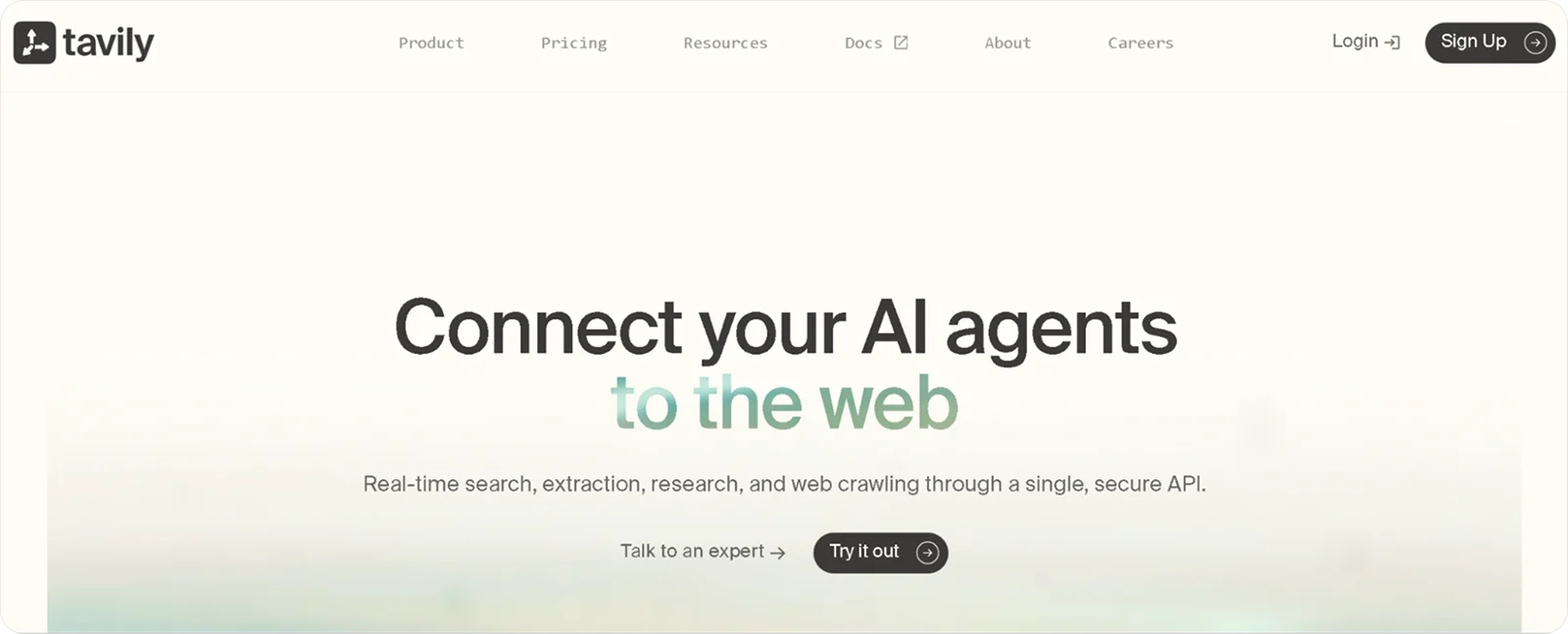
Tavily functions as the web access layer built specifically for AI agents, delivering real-time search, content extraction, and website crawling through a single API optimized for LLM consumption. The platform processes web data into clean, structured formats, with built-in safety filters that block prompt injection and malicious content before it reaches AI models.
Key Features
Multiple API endpoints: Provides Search for discovering relevant pages, Extract for pulling content from specific URLs, Map for understanding website structure, and Crawl for navigating entire sites with depth controls
Customizable search depth: Offers basic (1 credit) and advanced (2 credits) search modes with automatic parameter configuration based on query intent
Research endpoint: Performs automated multi-step web research with iterative searches, deduplication, reasoning over data, and structured JSON outputs, ranking #1 on DeepResearch Bench
Agent-native firewall: Scans retrieved content for PII leakage and prompt injection attempts, providing enterprise-grade security for autonomous workflows
LLM-ready formatting: Returns clean text, Markdown, or summaries with source citations, content highlights, and relevance scores optimized for AI pipelines
Pros
Consolidates search, extraction, and crawling into single API calls without custom scrapers
Provides SOC 2 certification with zero data retention for enterprise security requirements
Offers 1,000 free monthly credits for prototyping and small-scale applications
Includes production-grade caching and indexing that keeps latency predictable at scale
Cons
Uses variable credit consumption based on operation depth, making budgeting unpredictable
Prevents unused monthly credits from rolling over to the next month
Increases costs significantly at high volumes compared to flat-rate alternatives
Pricing
Tavily offers 1,000 free credits monthly. Pay-as-you-go costs $0.008 per credit. Monthly plans range from $30 (4,000 credits) to $500 (100,000 credits). Enterprise plans include custom rate limits and dedicated support.
4. Brave Search API
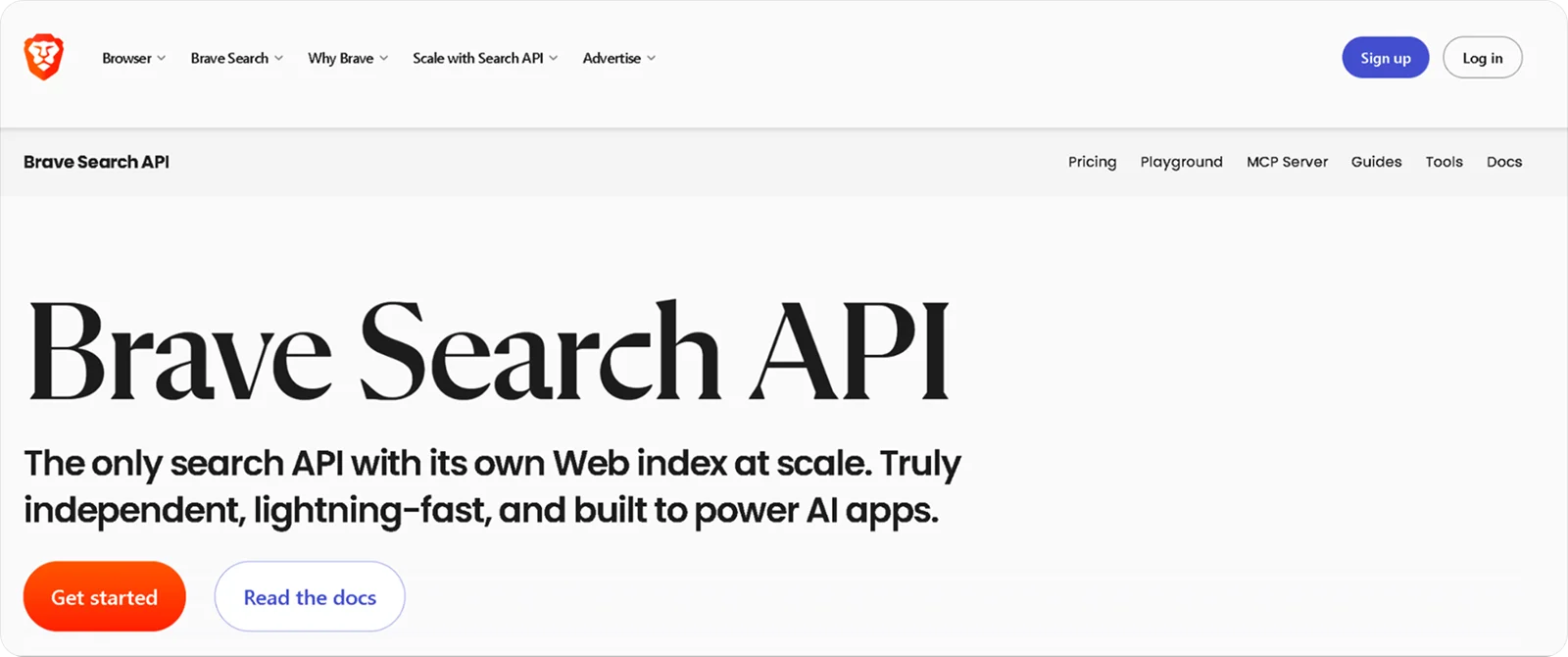
Brave Search API provides programmatic access to an independent web index containing over 30 billion pages, built entirely without relying on search engine infrastructure. The API delivers privacy-first search results with no user tracking, serving over 16 billion annual queries through the same index that powers Brave Search.
Key Features
Independent web index: Maintains its own crawling infrastructure with over 100 million page updates daily, avoiding dependency on Big Tech search providers
Goggles re-ranking system: Allows developers to apply custom rules and filters to reorder search results based on specific use cases or preferences
Multiple search endpoints: Supports web, image, video, and news search with rich responses including sports scores, calculations, stock widgets, and location data
Extra content snippets: Provides up to five additional context snippets per result selected in real-time for maximum relevance
AI Grounding endpoint: Delivers good performance with an F1-score of 94.1% on the SimpleQA benchmark for factual accuracy
Pros
Operates without user tracking or profiling, ideal for privacy-sensitive applications
Offers a generous free tier with 2,000 monthly queries for testing and prototyping
Returns clean, ad-free organic search results without promotional content
Cons
Maintains a small index scope for very niche or obscure content queries
Limits free tier to 1 request per second, causing potential rate limit errors
Returns structured snippets rather than full-page content extraction
Pricing
Brave Search API offers 2,000 free monthly queries. Data for Search plan costs $3 per 1,000 requests. Data for the AI plan (with usage rights) costs $5 per 1,000 requests. Autosuggest and spellcheck cost $0.50 per 1,000 requests. Enterprise plans are available with Zero Data Retention.
5. Firecrawl
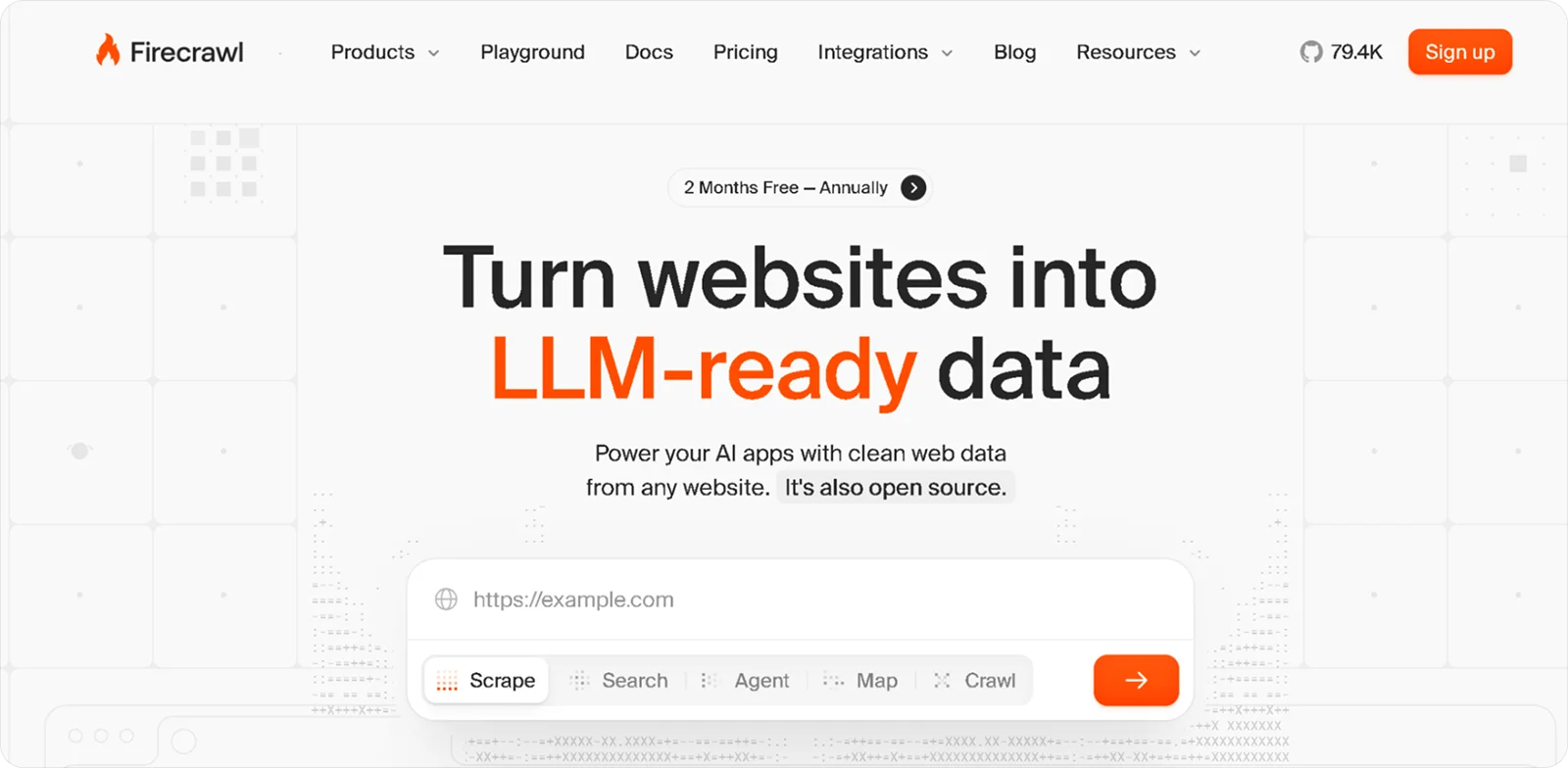
Firecrawl combines web search and content extraction into a single API call, returning LLM-ready data in clean Markdown or structured JSON formats. The platform handles JavaScript-heavy sites, manages proxy infrastructure automatically, and delivers results in under 1 second for real-time agent workflows.
Key Features
Integrated search and scrape: Searches the web and extracts full content from results within the same API request, eliminating need for separate discovery and extraction tools
Category-specific targeting: Filters search results by specialized categories including GitHub repositories, research papers, PDFs, news sources, and images
LLM-optimized outputs: Converts web content into clean Markdown that uses 67% fewer tokens than raw HTML, reducing LLM API costs significantly
Dynamic content handling: Waits for JavaScript-rendered content to load completely before extraction, supporting single-page applications and interactive elements
Advanced search parameters: Supports time-based searches, location targeting, language filtering, and custom timeout settings for complex queries
Pros
Combines search discovery with content extraction in one API call, simplifying workflows
Delivers results in under 1 second with production-ready infrastructure handling millions of requests
Integrates natively with LangChain, LlamaIndex, n8n, Zapier, and Model Context Protocol
Cons
Requires separate token-based subscription for AI-powered extraction endpoint, adding billing complexity
Provides less granular control over crawling logic compared to open-source alternatives
Limits free tier to 2 concurrent requests, which may limit testing phases
Pricing
Firecrawl offers 500 one-time free credits. Paid plan starts at $19/month pr $16/month when billed annually for 3,000 credits.
6. You.com API
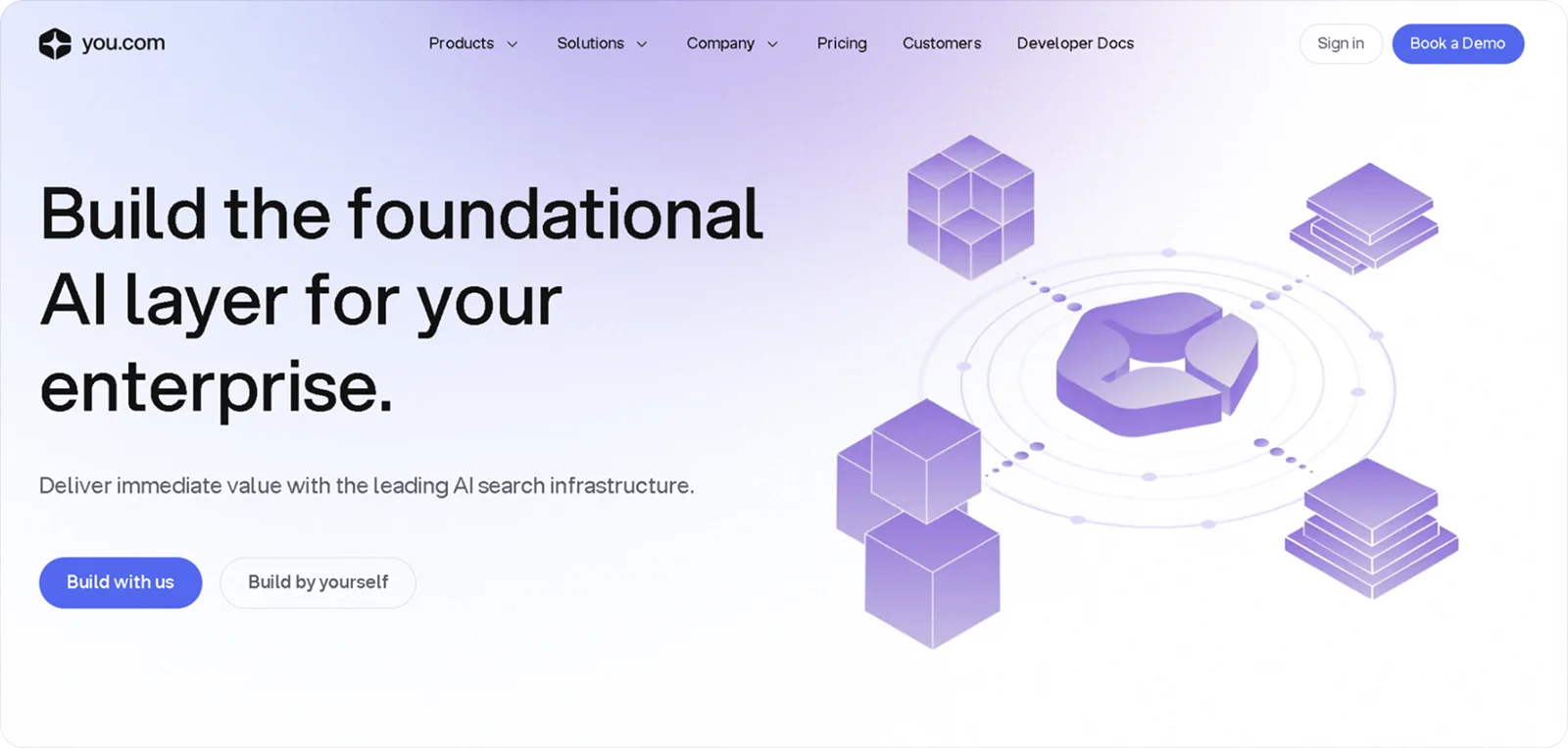
You.com Web Search API delivers real-time search results, built specifically for AI agents and RAG workflows with citation-backed outputs that ground LLM responses in verifiable sources. The API achieves state-of-the-art freshness scores, answering contemporary questions 4x more frequently than competitors while maintaining enterprise-grade security with no data retention.
Key Features
Real-time web index: Searches over 10 billion pages with updates optimized for recency, powering applications that need current information beyond LLM training data
AI-optimized output structure: Returns JSON-formatted results with contextual snippets, citations, and metadata designed for direct LLM consumption
Semantic search capabilities: Understands query intent beyond keyword matching, discovering information that traditional search APIs miss through neural network-based relevance
Vertical index specialization: Offers pre-built curated indexes for specific industries, including News, Healthcare, and Legal, with deeper domain-specific insights
Enterprise security controls: Provides automatic data purging, SOC 2 Type 2 compliance, and zero data retention policies with complete control over stored information
Pros
Reduces LLM hallucinations through citation-backed results grounded in verifiable web sources
Integrates with OpenAI, Databricks, and AWS Marketplace for rapid deployment within existing workflows
Delivers sub-second latency critical for real-time conversational AI interfaces
Cons
Requires developer expertise to integrate with LLMs, not suitable for non-technical users
Lacks built-in content extraction, returning snippets rather than full page content
Pricing
You.com offers $100 in free credits. Web Search API costs $6.25 per 1,000 calls for 1-50 results and $8.00 per 1,000 calls for 51-100 results.
7. Parallel Web Systems
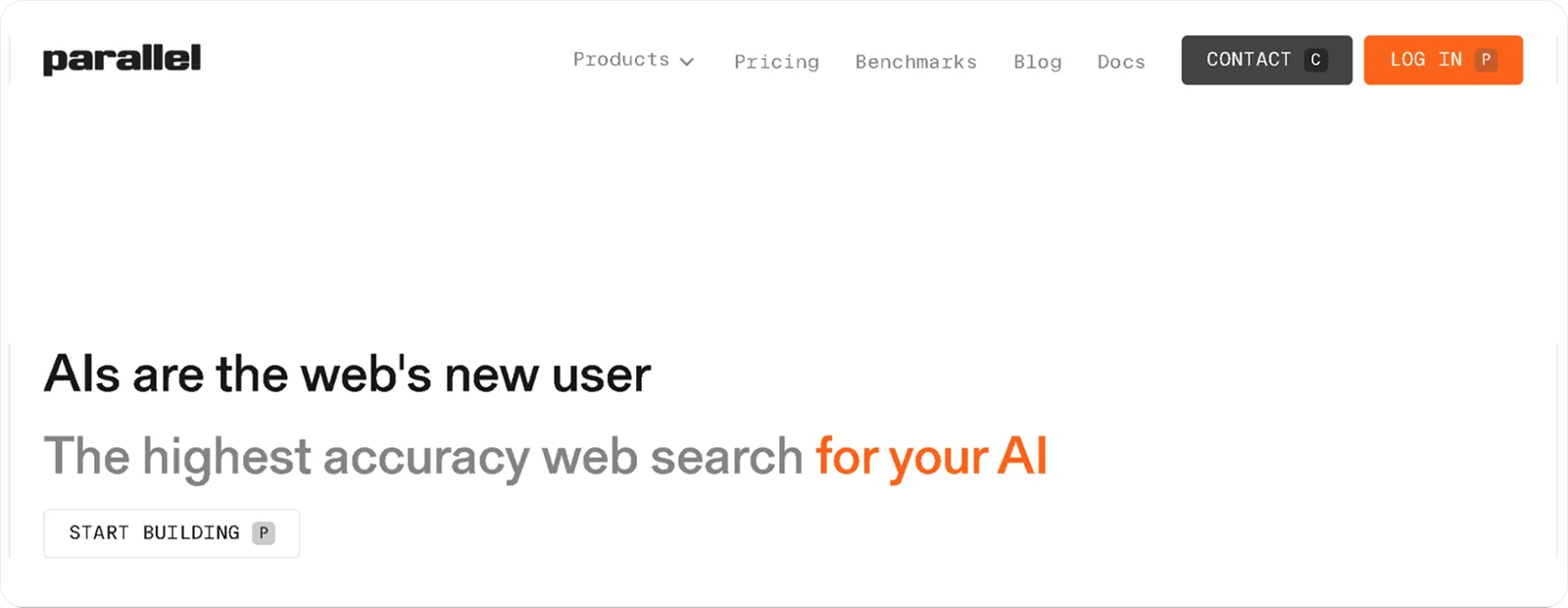
Parallel Web Systems provides enterprise-grade web search and deep research APIs built specifically for AI agents, delivering structured outputs with citations, reasoning, and confidence scores. The platform offers predictable per-request pricing across 9 processor tiers ranging from basic retrieval to advanced multi-hop research.
Key Features
Structured outputs with citations: Returns JSON-formatted results with comprehensive citations linking to source materials, detailed reasoning for every output field, and calibrated confidence scores
Deep research capabilities: Performs multi-hop query support across scattered sources with latency ranging from 5 seconds for basic tasks to 30 minutes for extensive research
Search API optimization: Delivers ranked URLs with token-dense compressed excerpts, achieving sub-5-second latency
Extract API functionality: Directly extracts webpage contents, including JavaScript-rendered sites and complex PDFs with 1-3 second cached latency
Enterprise security infrastructure: Provides SOC 2 Type 2 certification with custom data retention agreements and dedicated technical support for production workloads
Pros
Eliminates token-based billing uncertainty through transparent per-request pricing known before execution
Reduces hallucinations through cross-referenced facts with verifiable provenance and attribution
Supports real-time monitoring via the Monitor API, tracking web changes
Cons
Introduces latency variability from 5 seconds to 30 minutes, depending on processor and query complexity
Requires understanding 9 different processor tiers to optimize cost-performance tradeoffs effectively
Pricing
Parallel Web Systems offers 16,000 free requests. Search API costs $5 per 1,000 requests for 10 results, plus $1 per 1,000 additional results.
How to Choose the Right Web Search API
Choosing a web search API means matching its capabilities to your workflow. The API that powers a conversational chatbot needs fundamentally different strengths than one that feeds a financial analysis agent or enriches sales data. Here are the factors to check out befor making a decision:
Speed requirements: Real-time chatbots need sub-2-second responses, while research assistants can tolerate 10-30 second latencies for deeper analysis. Background enrichment workflows should prioritize accuracy over speed.
Cost structure: Base pricing tells only part of the story. Factor in multipliers for result counts, content extraction, and search depth to calculate real monthly spend. Map your specific workflow before committing.
Accuracy thresholds: Restaurant recommendations tolerate occasional misses. Medical, financial, or legal applications demand citation-backed results with confidence scores and verifiable sources.
Data freshness: Breaking news applications require minute-by-minute index updates. Historical research works fine with day-old data. Only pay for real-time freshness if your use case actually needs it.
Coverage scope: Broad indices cover everything, but surface more noise. Specialized indices deliver higher quality in specific domains. Comprehensive doesn't always mean better for your use case.
Validation process: Run 50-100 queries that match your actual use cases before committing. Measure latency, relevance, and structured output quality using free tiers.
The right API should work well, cost what you expect, and return results your AI can trust.
Why Choose Crustdata's Web Search for Real-Time Data
Most web search APIs deliver raw URLs and snippets. Crustdata takes a different approach by combining web search with structured B2B data that gives AI agents actionable context beyond what standalone search provides.
This distinction matters for teams building AI agents, sales automation, or research tools. Instead of getting search results, you still need to parse and enrich; you receive web intelligence that's immediately usable for decision-making.
Crustdata's Web Search API stands out through specific capabilities:
Fastest and most accurate API built for AI agents: Delivers high throughput with low latency and generous rate limits, ensuring your AI applications run without bottlenecks or performance degradation at scale.
Search results with built-in enrichment: Returns search results as clean JSON while providing instant access to 250+ company attributes and 90+ people datapoints from 16+ verified sources, eliminating the need for separate enrichment API calls.
Qualitative intelligence beyond keywords: Surfaces founder interviews, market perception, product announcements, and funding news that typical B2B enrichment and search tools results can't provide, giving AI agents the full context needed for accurate analysis.
Production-ready JSON for LLM consumption: Delivers structured outputs optimized for direct ingestion by AI applications, removing the parsing overhead that slows down agent workflows and increases token costs.
Crustdata eliminates the multi-step process of searching, scraping, parsing, and enriching by delivering intelligence-ready results in a single API call.
Ready to see how Crustdata's Web Search API performs on your queries?
Request a demo to test real-time search with built-in B2B intelligence.


Products
Popular Use Cases
Competitor Comparisons
95 Third Street, 2nd Floor, San Francisco,
California 94103, United States of America
© 2026 Crustdata Inc.
Products
Popular Use Cases
Competitor Comparisons
95 Third Street, 2nd Floor, San Francisco,
California 94103, United States of America
© 2026 CrustData Inc.
Products
Popular Use Cases
Competitor Comparisons
95 Third Street, 2nd Floor, San Francisco,
California 94103, United States of America
© 2026 Crustdata Inc.
🎉 We hit $10M ARR!
$600k to $10m in 1.5 years. Our entire GTM is powered by our own APIs.
🎉 We hit $10M ARR in 1.5 years!