Exa provides a Search API, Contents API, Answer API, and Websets for retrieving and structuring content from the open web through semantic search. It is built primarily as a retrieval layer for AI applications. Crustdata provides structured, entity-level data across people and companies, retrieved in real time through APIs designed for products that require continuously refreshed B2B intelligence rather than general web retrieval.
If you are evaluating Exa for B2B data workflows, this page explains where Exa stops and where Crustdata is purpose-built to take over.
Real-time semantic search vs structured entity data
Exa offers semantic web search powered by neural embeddings, returning ranked search results, content excerpts, and structured outputs derived from web pages. Its index covers a broad slice of the public web, including a company-focused vertical that Exa publicly references as covering 70M+ companies.
Crustdata provides structured profiles enriched across multiple verified sources and retrieved in real time through API calls. Instead of returning ranked search results, Crustdata returns normalized entity records with consistent schemas across people and companies.
| Feature | Crustdata | Exa |
|---|---|---|
| People profiles | 1B+ | Not a structured people database |
| Company profiles | 60M+ | 70M+ companies in web index |
| Real-time B2B search APIs | ✅ Yes | ❌ No |
| Structured entity schema | ✅ Yes | ⚠️ Via structured output extraction |
| Web Search API | ✅ Yes | ✅ Yes |
| Contents extraction | ⚠️ Limited | ✅ Yes |
| Feature | Crustdata | Exa |
|---|---|---|
| Structured JSON output | ✅ Yes | ✅ Yes |
| Semantic / neural search | ✅ Yes | ✅ Yes |
| Domain, date, language filtering | ✅ Yes | ✅ Yes |
| Content extraction from result pages | ⚠️ Limited | ✅ Yes |
| Structured entity enrichment beyond web search | ✅ Yes | ❌ No |
| Entity-level monitoring via webhooks | ✅ Yes | ❌ No |
Web Search API: structured entity intelligence vs semantic web retrieval
Both Crustdata and Exa provide Web Search APIs, but they are designed for different purposes.
Exa's Search API uses neural embeddings to interpret query intent and return semantically ranked web results. It supports filtering by domain, date, and language, and can return structured outputs by applying schemas at query time. Exa Instant returns results in under 180ms according to publicly published benchmarks.
Crustdata's Web Search API converts live search results into structured, machine-readable JSON, returning normalized fields including titles, URLs, snippets, ranking position, result type, and source.

Crustdata is built for B2B intelligence. Exa is built for AI retrieval
Exa is built as retrieval infrastructure for LLM applications, RAG pipelines, and AI agents that need fast, semantically relevant web content. Its core value is delivering high-quality search and content extraction with token-efficient outputs.
Crustdata is built as an intelligence layer for products that require structured, entity-level data on people and companies. Its core value is delivering normalized B2B records that can be queried, monitored, and integrated directly into sales, recruiting, investment, and internal data workflows.
Teams that need general-purpose semantic search across the web often choose Exa. Teams that need structured B2B intelligence with persistent entity profiles often choose Crustdata.
See our realtime enrichment
APIs in action
Teams that need general-purpose semantic search across the web often choose Exa. Teams that need structured B2B intelligence with persistent entity profiles often choose Crustdata.
People API coverage
Exa does not provide a structured people database. It can retrieve content about individuals from the web through search and extract structured outputs at query time, but it does not maintain enriched, normalized person profiles with persistent identifiers and historical career data.
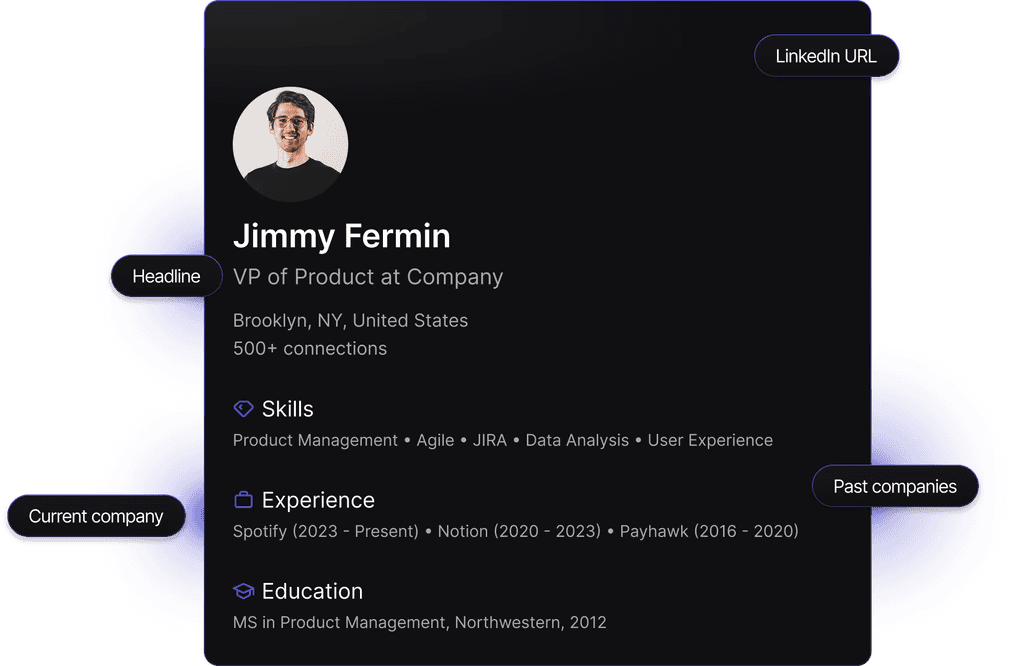
Crustdata's People API is structured around persistent person profiles with full historical career timelines, education, certifications, and other enriched professional fields.
| Category | Crustdata | Exa |
|---|---|---|
| Persistent person profiles | ✅ Yes | ❌ No |
| Current company | ✅ Yes | ⚠️ Via web extraction |
| Past work experience | ✅ Yes | ⚠️ Via web extraction |
| Job start & end dates | ✅ Yes | ❌ No |
| Education history | ✅ Yes | ⚠️ Via web extraction |
| Certifications | ✅ Yes | ❌ No |
| Business emails | ✅ Yes | ❌ No |
| Category | Crustdata | Exa |
|---|---|---|
| People search filters | ✅ Yes | ❌ No |
| Company search filters | ✅ Yes | ⚠️ Semantic search across company web index |
| ✅ Yes | ⚠️ Via filters and structured outputs | |
| ✅ Yes | ⚠️ Via Websets | |
| ✅ Yes | ❌ No | |
| ✅ Yes | ❌ No |
Discovery and list-building capabilities
Exa enables discovery through semantic queries and Websets, which allow users to define a search and return curated sets of results from the web. Websets is designed for agent-driven retrieval where the system explores the web to compile relevant content.
Crustdata enables structured discovery across people and companies through filterable APIs, with results returned as normalized entity records that can be saved as auto-updating lists.
Complete in-depth profiles with 350+ datapoints
All Crustdata company and people profiles are enriched with more than 350+ datapoints, including granular information such as job start and end dates, education history, job descriptions, skills, company growth signals, and public web presence.
Exa provides content extraction and structured outputs from web pages on demand, but does not maintain a fixed schema of datapoints across persistent entity profiles.
| Feature | Crustdata | Exa |
|---|---|---|
| Social media post tracking via webhooks | ✅ Yes | ❌ No |
| Entity-level event monitoring | ✅ Yes | ❌ No |
| Web content monitoring | ⚠️ Limited | ✅ Yes |
Social media monitoring
Crustdata monitors entities and triggers events when changes occur. Exa supports content discovery and curation through Websets but does not provide entity-level monitoring with webhooks.
Exa is the right choice if your primary need is general-purpose semantic web search, content retrieval for LLMs, RAG pipelines, or AI agents that need to ground responses in fresh web content. It is also a strong fit for research workflows, citation-grounded answers, and applications where token-efficient content extraction matters more than structured entity records.
Crustdata is the right choice if you need structured, real-time B2B intelligence with persistent profiles for people and companies. It is built for products that require entity-level enrichment, discovery, monitoring, and event tracking, not just web search and content extraction.
If your application depends on knowing who works where, when someone changed jobs, how a company is growing, or which signals are appearing across the web at the entity level, Crustdata is designed for that use case.
If you're evaluating an Enrich Layer alternative and need more than record-level enrichment, book a demo to see how Crustdata delivers real-time, structured intelligence built for AI agents and modern data products.