How to Build a Signal Stacking System That Combines First-Party and Third-Party Data into One Account Score
Step-by-step architecture for combining first-party signals (CRM, product analytics) with third-party signals (hiring, job changes, topic surge) into a single account scoring system, including signal weighting, conflict resolution, and CRM write-back.
Published
Written by
Abhilash Chowdhary
Reviewed by
Manmohit
Read time
7
minutes
How to Build a Signal Stacking System That Combines First-Party and Third-Party Data into One Account Score
Most B2B sales teams already collect more signals than they can use. The problem is that these signals live in different systems, update at different cadences, and the layer that combines them into a single account score does not exist yet. A GTM leader at an enterprise cybersecurity company described the problem in their workflow - LinkedIn Sales Navigator feeds person-level changes into Salesforce, 6sense provides topic-level intent scores, RB2B identifies website visitors, and Demand Farm maps org structures, but none of these four tools connect to each other. The scoring algorithm that was supposed to combine everything had not been built.
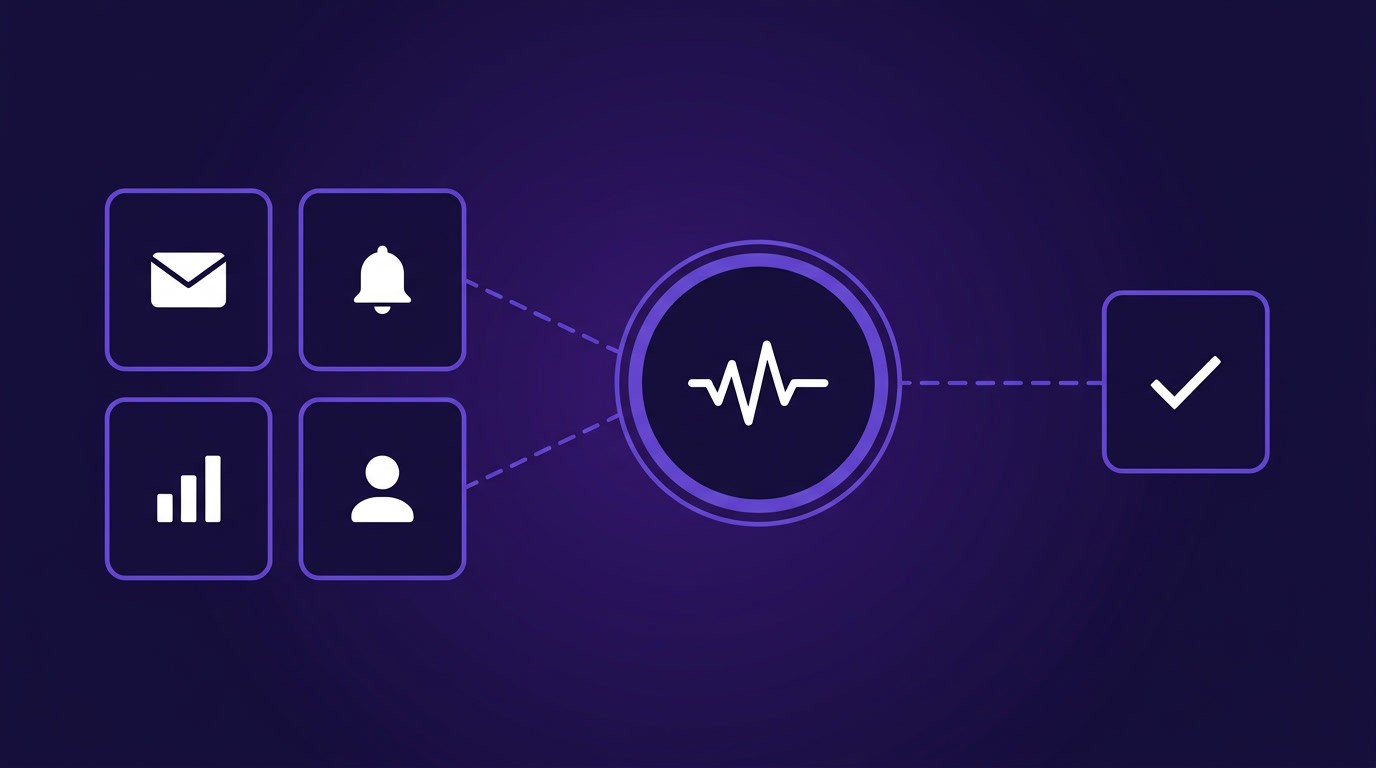
This guide walks through the four-layer architecture that solves that problem: signal sources, signal normalization, the scoring engine, and CRM write-back. By the end, you will have a framework for combining every signal your team collects into a single, weighted account score that updates automatically and tells reps which accounts to work and why.
What First-Party and Third-Party Signals Actually Are
First-party signals: what your own systems already capture
First-party signals come from systems you control. Your CRM records website visits, form fills, email opens, and meeting activity. Your product analytics layer (typically a warehouse like Redshift, BigQuery, or Snowflake fed by tools like Segment or Rudderstack) captures logins, feature usage, trial activity, and activation milestones. Your marketing automation platform tracks ad clicks, webinar attendance, and content downloads.
These signals are high-fidelity because they reflect direct engagement with your brand. A pricing page visit or a product trial activation leaves no ambiguity about interest. The limitation is coverage: first-party signals only capture accounts that have already found you. The Salesmotion intent signals guide cites research suggesting buyers are 70 to 80 percent through their evaluation before they engage a vendor directly, which means first-party signals alone miss the earliest and often most decisive phase of the buying process.
Third-party signals: what external sources reveal before a buyer reaches you
Third-party signals come from systems outside your ecosystem. Topic surge data from providers like Bombora tracks when an account is researching your category across publisher networks. Buyer intent feeds from G2 or TrustRadius notify you when someone at a target account views your profile, reads your reviews, or compares you against competitors on their platform. Hiring signals, job change alerts, funding announcements, and social engagement data from providers like Crustdata surface structural changes at an account that correlate with buying windows.
These signals are broad but noisy. Topic surge data is shared across every competitor subscribed to the same feed. Hiring signals require interpretation: a VP of Sales hire could mean expansion (good for you) or leadership instability (bad timing). The value of third-party signals increases when you combine them with first-party context, which is the core argument of this guide.
Signal Type | Source System | Example Signal | Typical Update Frequency |
|---|---|---|---|
First-party engagement | CRM (HubSpot, Salesforce) | Pricing page visit, demo request, email reply | Real-time to hourly |
First-party product | Warehouse (Redshift, BigQuery) | Trial activation, feature adoption, login frequency | Daily to hourly |
Third-party topic surge | Bombora, 6sense | Category research spike across publisher network | Weekly |
Third-party buyer intent | G2, TrustRadius | Profile view, competitor comparison on review site | Daily |
Third-party trigger | Crustdata Watcher API | Job posting, executive hire, funding round, LinkedIn post | Real-time via webhook |
Third-party social | Crustdata Posts API | Decision-maker posts about your category | Real-time |
Why Scoring on One Signal Type Fails
First-party scoring alone creates a coverage ceiling. You can only score accounts that have already engaged with your website, content, or product. Every account that is researching the category through analyst reports, peer conversations, or competitor evaluations is invisible until they arrive on your property, at which point they may already have a shortlist that does not include you.
Third-party scoring alone creates a different problem. Topic surge data tells you an account is researching "data enrichment," but that same signal fires for dozens or hundreds of accounts per week, many of which are poor fits. A go-to-market leader at an enterprise cybersecurity company told us his team was "not fully utilizing" their 6sense intent data because, without first-party engagement context, the intent signals alone could not tell reps which accounts warranted immediate outreach versus which ones were doing ambient research.
Confidence increases when both signal types converge. Accounts that show both first-party engagement (they visited your site, downloaded content, or started a trial) and third-party intent (they are actively researching the category, hiring for related roles, or posting about the problem you solve) convert at 25 to 35 percent higher rates than accounts showing only one signal type, according to Unify's analysis.
The Signal Stacking Architecture
This is the four-layer system that combines first-party and third-party signals into a single account score. Each layer has a specific job, and the layers are designed to be built incrementally. You do not need all four running perfectly to get value from the first two.
Layer 1: Signal sources and what each one contributes
The first layer is inventory. Map every system that generates a signal your team could use for account prioritization, and classify what type of signal it produces.
Most teams underestimate how many signal sources they already have. A GTM strategist at an enterprise SaaS company listed seven tools feeding data into their workflow: HubSpot, ZoomInfo, Clay, Apollo, Lusha, Harmonic, and HG Insights, all consolidated into Snowflake. While these tools provide great signals, the consolidation of these signals did not exist yet, making them less effective.
First-party sources:
CRM (HubSpot, Salesforce): website visits, form fills, email engagement, meeting activity, deal stage progression. These are your highest-fidelity engagement signals because they reflect direct interaction with your brand.
Product analytics (warehouse + event layer): trial starts, feature usage, activation milestones, login frequency, seats added. If you sell a product-led or hybrid motion, product signals are often more predictive than marketing signals.
Marketing automation (Marketo, Pardot, HubSpot Marketing): ad clicks, webinar registrations, content downloads, nurture email engagement.
Third-party sources:
Topic surge providers (Bombora, 6sense): weekly signals indicating an account is consuming content related to your category at above-baseline rates.
Buyer intent feeds (G2, TrustRadius): notifications when someone at a target account views your profile, reads your reviews, or compares you against competitors on their platform.
Trigger and monitoring APIs (Crustdata Watcher API): real-time webhook notifications for job postings matching specific titles or keywords, executive hires and departures, funding rounds, headcount growth thresholds, and LinkedIn posts from tracked decision-makers. These structural signals indicate an account's situation is changing in ways that create buying windows.
You do not need every source on day one. Start with one first-party source (your CRM) and one third-party source (whichever provides the signal type most relevant to your sales motion), and add sources as you validate that each one improves scoring accuracy.
Layer 2: Normalizing signals into a common format
Raw signals from different sources arrive in different formats, at different cadences, and at different levels of granularity. Before you can score them together, you need to normalize them into a common structure.
The normalization step resolves three problems:
Account-level roll-up. First-party signals are often contact-level (a specific person visited a page or opened an email). Third-party signals are usually account-level (a company is surging on a topic). Your scoring engine needs everything at the account level, so contact-level signals must be rolled up: count the distinct contacts engaged at an account, sum their engagement, and treat the account as the scoring unit.
Signal categorization. Every signal, regardless of source, falls into one of four categories:
Engagement: direct interaction with your brand (page visits, email opens, trial usage)
Intent: category-level research activity (topic surge, review site visits, competitor comparisons)
Trigger: structural change at the account (new hire, funding round, product launch, job posting)
Fit-change: a shift in the account's firmographic profile that moves it closer to or further from your ICP (headcount growth, new office, technology adoption)
Recency tagging. Every normalized signal gets a timestamp. Signals decay in value over time, and the scoring engine needs recency to apply decay functions. A pricing page visit from yesterday is worth far more than one from three weeks ago.
Layer 3: The scoring engine and where weights live
The scoring engine takes normalized, categorized, timestamped signals and produces a composite account score. This is where most teams stall, because they either overengineer the weighting model or skip it entirely and let reps interpret raw signals on their own.
The founder of an account-based sales platform described a middle path his team uses with enterprise clients. Rather than assigning point values to individual signals, his team defines client-specific trigger criteria at the category level: 25 percent headcount growth in a target function, a minimum number of employees in a specific department, a funding event above a certain threshold. Each criterion maps to one of the four signal categories, and each category gets a weight. The client's SDRs receive a graded account list without needing to understand the scoring logic underneath.
Start with category-level weights, not signal-level weights. Assigning a specific point value to every individual signal across all sources creates a maintenance burden that most teams abandon within a quarter.
Starting-point weights (adjust to your sales motion):
Signal Category | Weight | Rationale |
|---|---|---|
Engagement (first-party) | 35% | Highest fidelity, direct brand interaction |
Intent (third-party) | 25% | Broader coverage, but noisier |
Trigger (third-party) | 25% | High signal-to-noise for timing |
Fit-change | 15% | Slower-moving, validates long-term fit |
Within each category, signals contribute to the category score based on a simpler tier system:
Tier 1 signals (20-30 points): demo request, pricing page visit, trial activation, champion job change to a target account. These are high-confidence indicators that warrant same-day follow-up.
Tier 2 signals (8-15 points): job posting matching your category, funding round, Bombora topic surge above 70th percentile, G2 profile visit. These indicate the account's situation is changing, but they do not confirm purchase intent on their own.
Tier 3 signals (2-5 points): blog visit, email open, headcount growth, LinkedIn post engagement, webinar registration. These are directional and contribute to a pattern over time, but any single Tier 3 signal is too weak to trigger action.
Apply a decay multiplier based on signal age. A common approach starts with full weight for signals in the last 7 days, drops to 50% for 8-21 days, 25% for 22-45 days, and zero for anything older. The exact decay curve depends on your sales cycle length.
Layer 4: Writing scores back to your CRM
A score that lives outside your CRM does not get used. The final layer pushes the composite score and its supporting context back into the system where reps work.
Fields to write back:
Account score (numeric): the composite score, typically 0-100
Score tier (picklist): Hot / Warm / Cold, derived from score thresholds you set
Top signals (text): a summary of the 2-3 signals contributing most to the score, so the rep knows why the account is scoring high without opening a separate dashboard
Last signal date (date): when the most recent signal fired, so reps can distinguish actively-signaling accounts from ones coasting on old engagement data
Recommended action (text): route to sales, route to nurture, or route to CSM based on the signal conflict matrix (covered in the next section)
The write-back mechanism depends on your stack. A direct CRM API integration works for simple architectures. An iPaaS layer like Tray.io, n8n, or Make handles more complex routing where signals from multiple sources need to be orchestrated before the CRM write. A reverse ETL tool like Census or Hightouch is the right fit if your scoring logic lives in the warehouse (dbt models computing scores in SQL) and you need to sync results to the CRM on a schedule.
How to Weight Signals Without Overengineering
The starting weights above are a reasonable default. What makes them accurate for your business is validation against outcomes.
A starting-point weighting framework
If you are building this for the first time, set the category weights and tier point values above, let the system run for 30 days, and resist the urge to tune before you have data. Premature weight adjustment based on intuition is the most common reason scoring systems get abandoned. The cybersecurity go-to-market leader told us his team was "not fully utilizing" their intent data from 6sense, which meant the intent signal category was contributing almost nothing to their effective prioritization. The signal source was available and paid for, but underweighted in practice because nobody had validated whether it correlated with closed deals in their pipeline.
Validating weights against closed-won data
After 30 days, pull your last 50 closed-won opportunities and your last 50 closed-lost opportunities. For each, check which signals appeared in the 30 days before the opportunity was created. Look for patterns:
Which signal categories appeared most consistently in closed-won deals? Increase those weights.
Which signal categories appeared in closed-lost deals at similar rates to closed-won? Those signals are not differentiating. Decrease their weights or tighten the tier thresholds.
Were there closed-won deals that your scoring model would have missed entirely (scored low or not at all)? Those are false negatives. Check what signals those accounts did produce, and whether you are missing a source.
Run this validation quarterly to ensure your scoring reflects trends from actual customers.
Signal Conflict Resolution: When First-Party and Third-Party Disagree
In practice, signal types frequently point in different directions, and how you handle these conflicts determines whether reps trust the scoring system.
Four conflict patterns and what each one means:
High first-party + High third-party = Hot. The account is engaging with your brand directly and researching the category externally. This is your highest-confidence target. Route to sales for immediate follow-up. These accounts represent the convergence pattern that produces the highest conversion rates.
High third-party + Low first-party = Early research. The account is actively evaluating the category but has not engaged with you yet. They may not know you exist, or they may be evaluating competitors first. This is an outbound trigger: personalized outreach referencing the specific third-party signal (a relevant job posting, a funding round, a topic surge in your category) can introduce you during the evaluation window rather than after it closes.
High first-party + Low third-party = Relationship deepening. The account is engaging heavily with your content or product but is not showing external research signals. This often indicates an existing customer exploring expansion, a champion building an internal business case, or a renewal evaluation. Route to the account executive or customer success manager who owns the relationship rather than treating it as a net-new outbound opportunity.
This conflict pattern also exposes a common blind spot. The cybersecurity go-to-market leader described it: "If a current champion from a customer leaves, or a key person leaves that we're engaging with, there are times that we don't even get to know." When a champion who has been driving first-party engagement changes companies, the account's engagement signals drop suddenly with no explanation. Without people-movement tracking feeding into the scoring model, the account slips quietly from the hot list and nobody follows up with the new stakeholder or pursues the champion at their new company. Adding a people-movement signal source (Layer 1) and categorizing champion departures as Tier 1 triggers (Layer 3) prevents this failure mode.
Low first-party + Low third-party = Not in-market. No action needed. Do not route these accounts to reps. If the account is in your ICP based on firmographic fit, keep it in a long-term nurture track and re-evaluate when signals emerge.
Building this conflict matrix into your scoring system means encoding the routing rules alongside the score itself. The "recommended action" field in the CRM write-back (Layer 4) should reflect these four scenarios rather than the raw score number alone.
Where the Scoring Engine Should Live
The question of where the scoring logic runs is a practical architecture decision that depends on your team size, signal volume, and existing stack.
Teams we spoke with described three distinct approaches, each matching their existing infrastructure:
A GTM leader at a mid-market integration platform described how his team would use their own iPaaS product as the intermediary layer between signal sources and the CRM: detect a buying signal, programmatically find the right people at the account, enrich their data, and route to outbound sequences. Teams using Tray.io, n8n, or Make can replicate this pattern. The iPaaS layer orchestrates signals from multiple sources, computes scores, and writes results back to the CRM.
The GTM strategist at the security SaaS company built on a warehouse-first architecture, consolidating data from seven tools into Snowflake and building custom automation workflows on top to route signals to the appropriate reps based on specialization and territory. This approach works well for data teams with an existing warehouse and comfort with SQL-based modeling, using dbt for score computation and Census or Hightouch for reverse ETL into the CRM.
The founder of the account-based sales platform took the simplest approach: submit a batch of target accounts to an enrichment API, receive enriched data with trigger signals attached, apply a grading mechanism on the returned data, and deliver prioritized account lists to client SDRs. For teams under 50 accounts per month with signals already in the CRM, HubSpot's native lead scoring or Salesforce Einstein can handle this without any external infrastructure.
Option | Best For | Limitation |
|---|---|---|
CRM-native scoring | Teams under 50 accounts/month with signals already in the CRM | Limited to signals the CRM can see. Cannot easily incorporate external API triggers in real time. |
iPaaS / automation layer | Teams combining 3+ signal sources that update at different cadences | Requires someone to build and maintain the flows. Logic can become fragile at scale. |
Warehouse + reverse ETL | Data teams with an existing warehouse and comfort with SQL-based modeling | Higher setup cost. Score freshness depends on sync frequency (typically hourly or daily, not real-time). |
The right choice is the one your team will actually maintain. A CRM-native model that gets updated monthly is better than a warehouse model that runs once and gets abandoned.
Keeping the Model Honest: Feedback Loops
A scoring model without a feedback loop degrades over time. Buyer behavior changes, new competitors enter the market, your product evolves, and the signals that mattered six months ago may not matter today.
Run a monthly review with three checks:
False positive rate. What percentage of accounts scored Hot in the last 30 days resulted in zero pipeline? If this exceeds 40%, your Tier 1 signal definitions or your score threshold for "Hot" needs tightening.
False negative rate. What percentage of new opportunities came from accounts that were scored Cold or not scored at all? If this exceeds 20%, you are missing signal sources or your weights undercount a category that matters.
Signal source contribution. Which signal sources are contributing the most to accurate scores? If a source has been connected for three months and never appears in the top signals for closed-won deals, consider removing it to reduce noise.
Document the results and the weight adjustments you make. Over three to four cycles, you will converge on a model that reflects your actual buying patterns rather than theoretical assumptions about what signals should matter.
Building the System That Matters More Than Any Single Signal
Every team we spoke with described the same gap from a different angle. Some had seven tools feeding a warehouse with no scoring logic on top, others had 200 reps working 500 accounts with no way to prioritize, and one was scoring 70,000 profiles from a single signal source. The individual signals existed in multiple systems, but no layer combined, weighted, and routed them into a single account score.
The four layers described in this guide (signal sources, normalization, scoring engine, and CRM write-back) are the architecture that closes that gap. Start with two signal sources, build the scoring layer, validate against closed-won and closed-lost outcomes, and add sources as the model matures.
If your third-party signal layer is the missing piece, the Crustdata Watcher API provides real-time webhook notifications for job changes, executive hires, funding rounds, headcount growth, and decision-maker social activity across your target accounts. It handles Layer 1 for third-party triggers so your team can focus on building the scoring and routing layers that turn raw signals into closed revenue. Book a demo to see how it fits into your signal stacking architecture.



Products
Popular Use Cases
Competitor Comparisons
95 Third Street, 2nd Floor, San Francisco,
California 94103, United States of America
© 2026 Crustdata Inc.
Products
Popular Use Cases
Competitor Comparisons
95 Third Street, 2nd Floor, San Francisco,
California 94103, United States of America
© 2026 CrustData Inc.
Products
Popular Use Cases
Competitor Comparisons
95 Third Street, 2nd Floor, San Francisco,
California 94103, United States of America
© 2026 Crustdata Inc.
🎉 We hit $10M ARR!
$600k to $10m in 1.5 years. Our entire GTM is powered by our own APIs.
🎉 We hit $10M ARR in 1.5 years!