8 Best Scrapin.io Alternatives in 2026 [Full Comparison]
Discover Scrapin.io alternatives for B2B prospecting & compare real-time scraping tools, contact databases, and automation platforms with pricing.
Published
Written by
Chris P.
Reviewed by
Nithish A.
Read time
7
minutes
Teams looking for scrapin.io alternatives are often trying to answer a practical question: is real-time scraping the right fit for their prospecting workflow? Some use cases depend on live data pulled on demand, while others work better with contact databases or automation tools that require less technical setup.
Scrapin.io is one option for automating B2B data collection, but it’s not the only one. This guide breaks down 8 alternatives, each suited to different workflows, technical requirements, and budget constraints.
Why Look for Scrapin.io Alternatives?
Scrapin.io is designed for real-time access to publicly available B2B data through APIs, but not every prospecting workflow requires live scraping or API-level control. Teams often evaluate alternatives when their internal setup, pricing preferences, or go-to-market motion call for a different approach.
Here are the most common reasons teams consider Scrapin.io alternatives:
Using pre-built datasets instead of live scraping: Some teams are comfortable with scheduled data refreshes when immediacy isn’t critical.
Aligning tools with team structure: API-first platforms work best for product, data, and automation teams, while sales-led teams may prefer tools with built-in interfaces.
Seeking predictable pricing models: Usage-based pricing can be harder to forecast than flat subscriptions or seat-based plans.
Combining data with execution: Some platforms bundle enrichment with outreach, calling, or campaign management rather than focusing only on data delivery.
Optimizing for different data priorities: Certain workflows value direct contact details or account hierarchies more than raw or event-driven data
Needing more coverage: Scrapin’s dataset focuses on a narrower set of profiles and companies. Teams building at scale need confidence they can find any professional or company worldwide to support global hiring and prospecting workflows.
Understanding these differences helps teams choose between real-time data APIs, contact databases, and automation platforms based on how prospecting actually operates inside their organization.
8 Best Scrapin.io Alternatives for B2B Prospecting
The tools below approach B2B prospecting in different ways, from real-time data APIs to contact databases and automation platforms. The table compares Scrapin.io alternatives by data type, freshness, and pricing to help you quickly identify which option fits your workflow.
Tool | Primary Use Case | Access Method | Best For | Starting Price |
Crustdata | Real-time enrichment & monitoring | API + webhooks | AI agents, sales automation, recruiting platforms | Custom (free plan available) |
Apollo.io | Prospecting + outbound sequencing | Web app + API | Sales teams wanting all-in-one tooling | $59/user/month |
ZoomInfo | Enterprise prospecting & intent tracking | Web app + API | Large sales orgs with complex deals | Custom (annual contracts) |
Lusha | Quick contact lookup & enrichment | Browser extension + API | SMB sales teams & individual reps | $29.90/user/month |
PhantomBuster | Multi-platform automation | Cloud workflows | Growth teams & automation-heavy workflows | $69/month |
Hunter.io | Domain-based email prospecting | Web app + API | Email-first outbound campaigns | $49/month |
Apify | Custom scraping at scale | Cloud Actors + API | Developers building custom scrapers | $29/month |
1. Crustdata
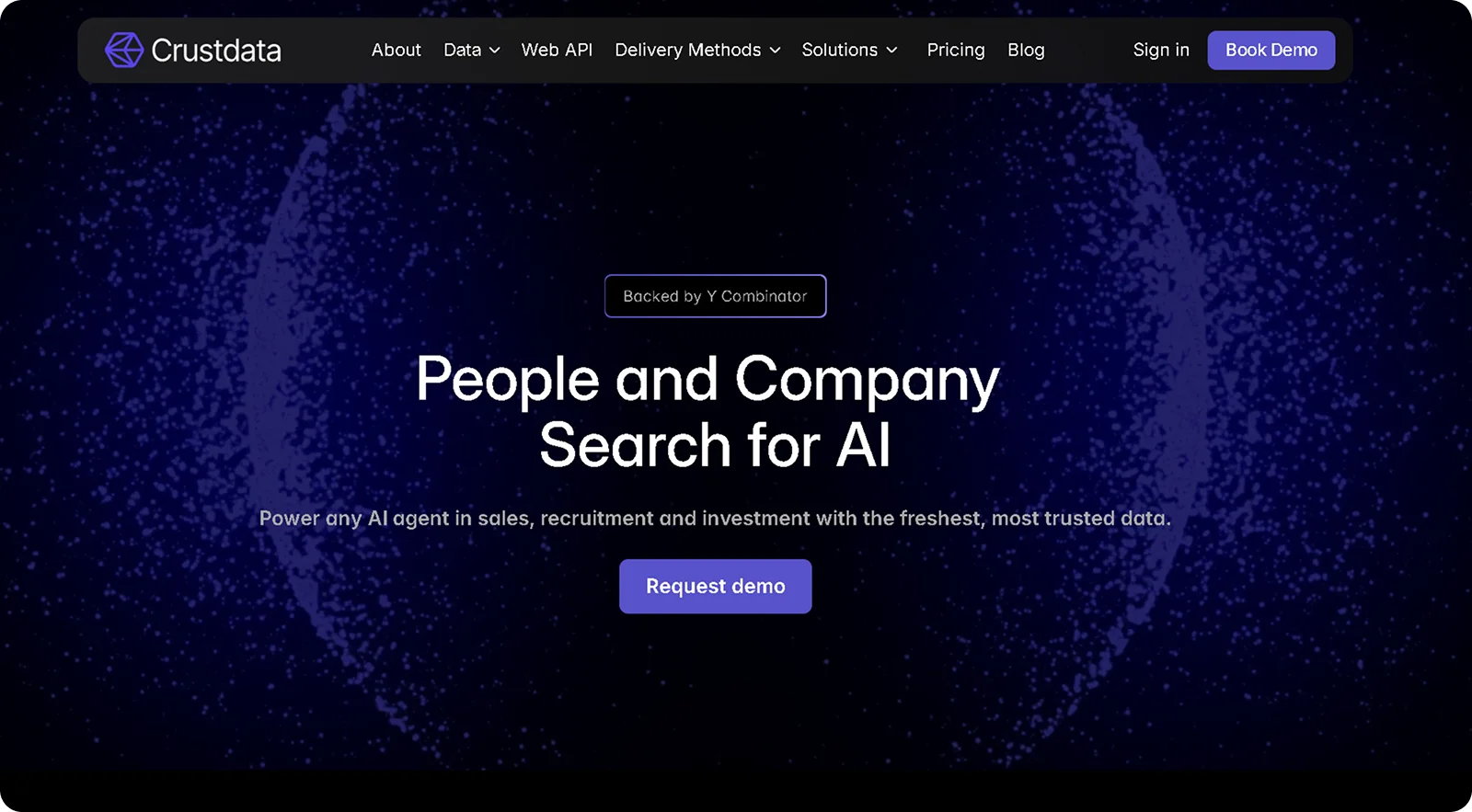
Crustdata aggregates B2B data from 10+ sources simultaneously and delivers it through APIs with real-time updates. Teams building AI-powered sales tools, recruiting platforms, or deal-sourcing systems use it to access current company and people information that updates at the moment of request rather than on monthly refresh cycles.
Key Features
Real-time crawling: Pulls data at the moment of request rather than from pre-built databases
Watcher API: Sends webhook alerts for job changes, funding rounds, headcount growth, and company signals
Unified data layer: Aggregates information from SEC filings, funding announcements, web traffic, and professional profiles into single API responses
Search capabilities: Filters companies and people by industry, location, size, funding stage, and growth metrics
Dataset delivery: Provides bulk downloads with monthly refreshes for teams that need offline access
Pros
Delivers 250+ company data points and 90+ people data points per record
Eliminates manual data stitching by combining multiple sources in one API call
Provides unlimited API requests with no rate limits for high-volume users
Cons
Requires technical implementation through APIs (no user interface for manual lookups)
Pricing
Crustdata provides custom pricing. Contact sales for specific rates.
2. Apollo.io
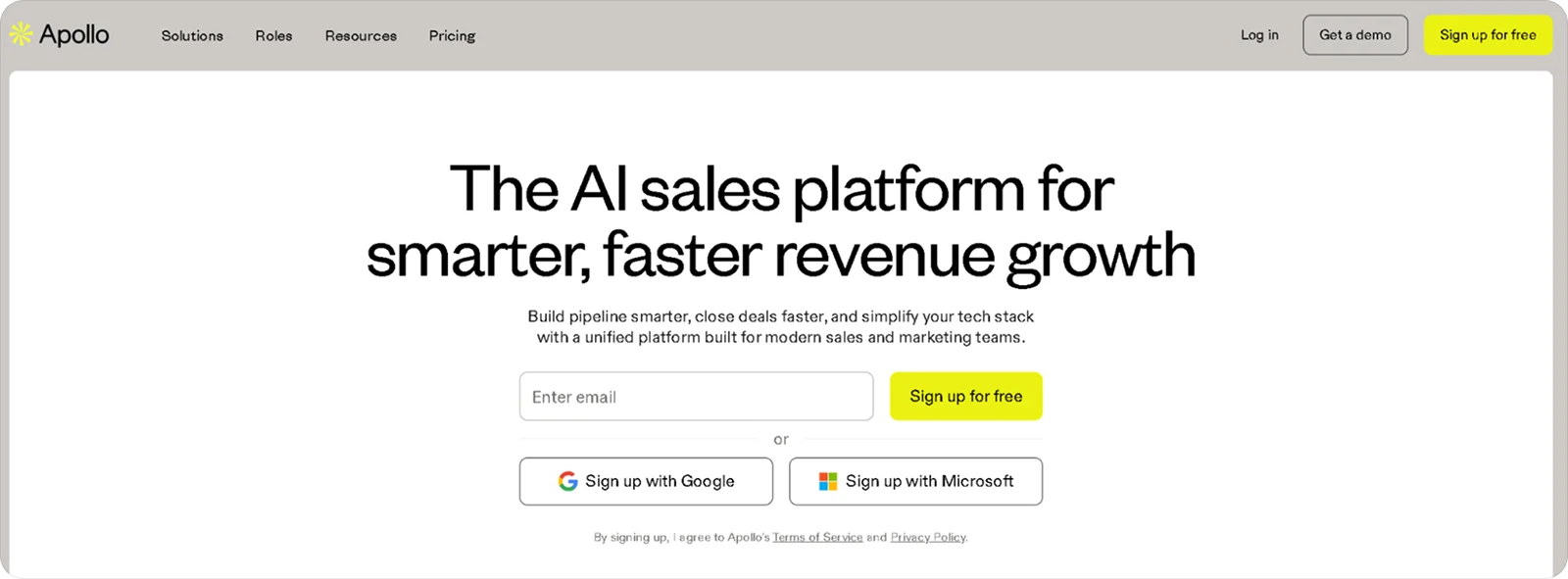
Apollo.io combines a B2B contact database with email sequencing and call automation in one platform. Sales teams use it to find contact information, build outreach campaigns, and track conversations without switching between separate prospecting and engagement tools.
Key Features
B2B database: Searches 210+ million verified contacts and 35 million companies with filters for job title, seniority, department, industry, location, and technographics
Email sequencing: Automates multi-step email campaigns with A/B testing and tracks opens and clicks
Built-in dialer: Places calls directly from the platform with automatic logging and call recording
CRM integration: Syncs contacts and activities with Salesforce, HubSpot, and other CRMs
AI email writer: Generates personalized email copy based on prospect data and engagement patterns
Pros
Combines lead generation and outreach in one subscription instead of paying for separate tools
Includes unlimited email sends on all plans
Provides a Chrome extension for capturing contacts while browsing
Cons
Uses a credit system that burns through quickly for mobile numbers (8 credits per phone number)
Experienced data compliance issues in 2025 with the removal of their page from a major platform
Pricing
Apollo.io offers a free plan with 5 mobile credits monthly. Paid plans start at $59/user/month or $49/month on annual billing.
3. ZoomInfo
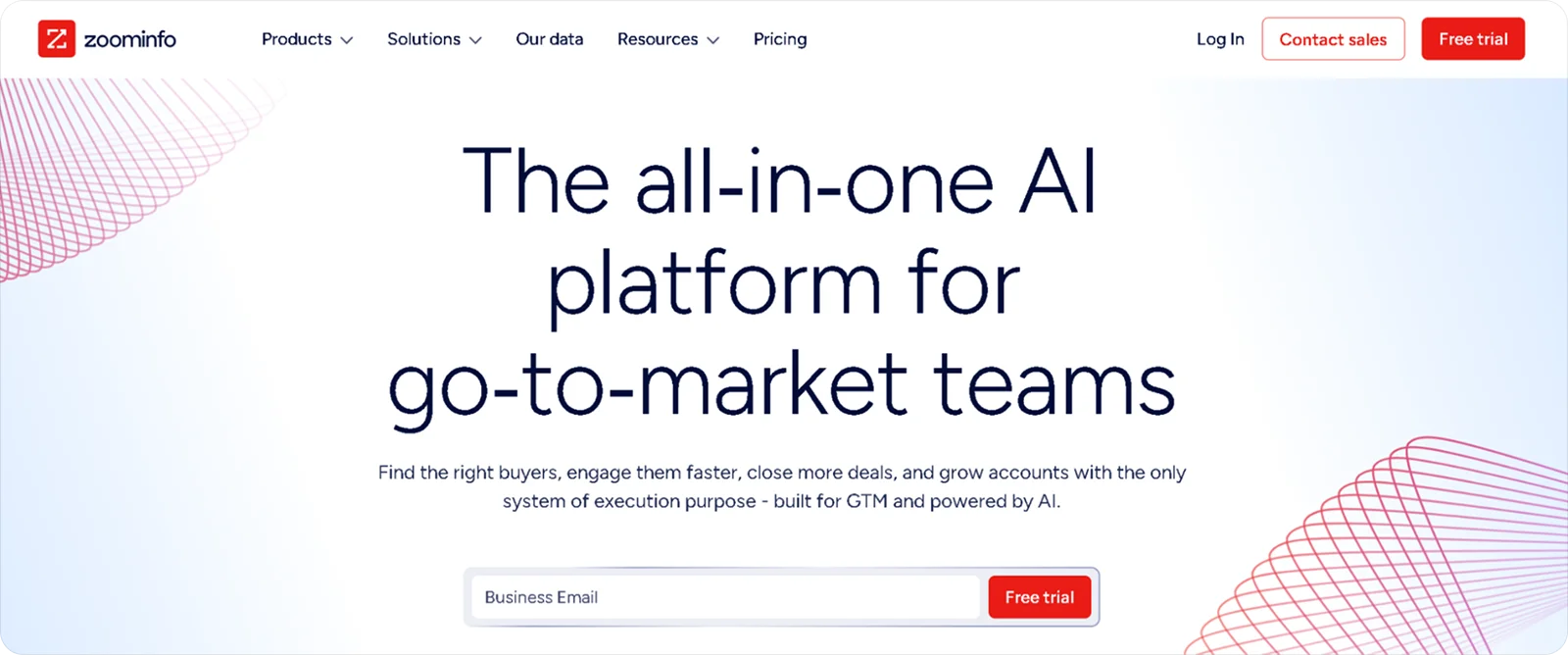
ZoomInfo provides access to a B2B database with verified contact and company information for sales, marketing, and recruiting teams. Enterprise sales organizations use it to identify decision-makers, track buying intent signals, and enrich CRM records with firmographic and technographic data.
Key Features
Contact database: Searches 321 million professional contacts and 104 million companies with filters for job title, seniority, department, industry, location, and company revenue
Intent data: Tracks online research behavior to identify companies actively looking for solutions in specific categories
Organizational charts: Maps company hierarchies to show reporting structures and identify multiple stakeholders within target accounts
Technographic data: Reveals which technologies companies use to help tailor sales pitches and identify integration opportunities
CRM integration: Syncs contact data and activity tracking with Salesforce, HubSpot, and other platforms through pre-built connectors
Pros
Includes conversation intelligence features for analyzing sales calls and identifying winning talk tracks
Provides website visitor tracking to identify companies browsing your site before they fill out forms
Offers dedicated account management and priority support for enterprise customers
Cons
Requires annual contracts with no monthly payment option available
Uses a credit system where costs increase significantly when purchasing additional credits mid-contract
Pricing
ZoomInfo offers a free Lite plan with 10 contact downloads monthly. Paid plans are custom, based on seats and features.
5. Lusha
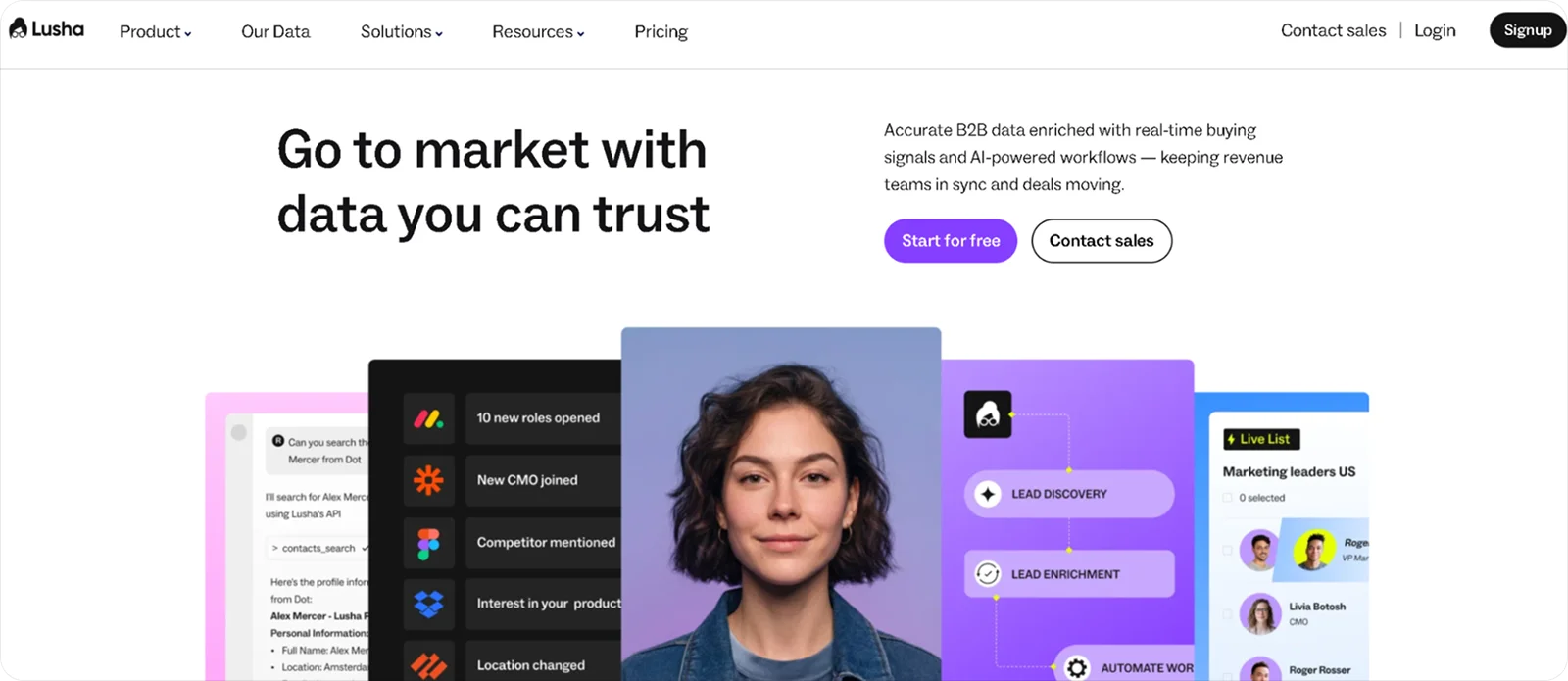
Lusha provides B2B contact information through a Chrome extension that reveals emails and phone numbers directly from professional networks and company websites. Individual sales reps and small teams use it for quick contact lookups without switching to a separate database platform.
Key Features
Chrome extension: Captures contact details while browsing professional networks with one-click reveal and export to CRM
Credit system: Uses 1 credit per email address and 5 credits per phone number to control data access costs
Job change alerts: Notifies users when contacts change companies or roles to identify new outreach opportunities
CSV enrichment: Uploads contact lists to fill missing email addresses and phone numbers through batch processing
Intent signals: Tracks up to 25 topics that prospects research to identify companies actively exploring solutions
Pros
Integrates directly with Gmail, Outlook, Salesforce, and HubSpot for instant contact syncing.
Provides bulk enrichment to reveal up to 150 contacts simultaneously from search results for faster list building.
Delivers job change alerts tracking when contacts switch companies or roles for timely outreach opportunities.
Cons
Limits CSV enrichment to 300 rows per file on Pro plan and 500 rows on Premium plan.
Caps fair usage at 2,000 to 5,000 contacts per month per seat despite unlimited access claims.
Pricing
Lusha offers a free plan which includes 40 credits monthly. Pro plan starts from $29.90 per user per month or $22.45 per month when billed annually.
6. PhantomBuster
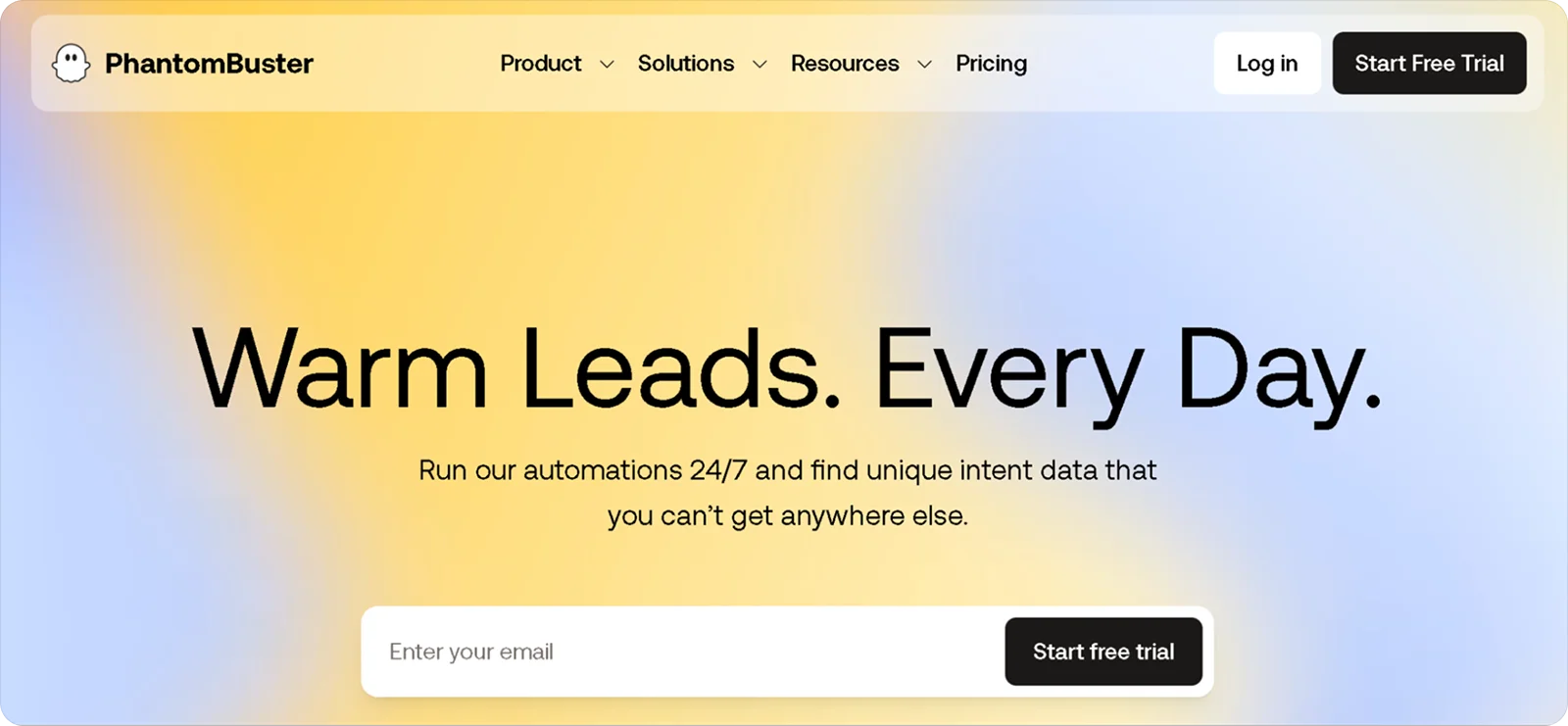
PhantomBuster automates data extraction and outreach actions across 150+ platforms using cloud-based workflows called “Phantoms.” Instead of manually scraping profiles or sending connection requests, teams configure pre-built automation recipes that run 24/7 without requiring a computer to stay on.
Key Features
Pre-built Phantoms: Access 130+ ready-made automation workflows for scraping searches, exporting Sales Navigator results, extracting Instagram followers, and capturing website visitor data
Multi-platform scraping: Extracts contact data from Instagram hashtags, Twitter followers, Facebook groups, Google Maps businesses, and Crunchbase companies
Workflow automation: Chains multiple Phantoms together to scrape leads, enrich emails, and trigger outreach sequences without manual intervention
Cloud execution: Runs automations 24/7 in the cloud with no browser extensions or local dependencies required
Unlimited exports: Downloads scraped data as CSV or JSON files with no caps on export volume across all paid plans
Pros
Integrates HubSpot, Salesforce, Pipedrive, Zapier, Make, lemlist, and Clay for seamless data syncing
Includes AI credits for generating personalized outreach messages and email credits for finding professional addresses
Allows multiple accounts to run automations within a single workspace
Cons
Uses complex resource system tracking execution hours, phantom slots, AI credits, email credits, and URL finder credits with no monthly rollover
Requires technical understanding of slot management where complex workflows consume 2 slots and exceeding limits pauses all automations
Pricing
PhantomBuster offers a free plan with 30 minutes of execution time. Paid plans start at $69/month or $56/month when paid annually.
7. Hunter.io
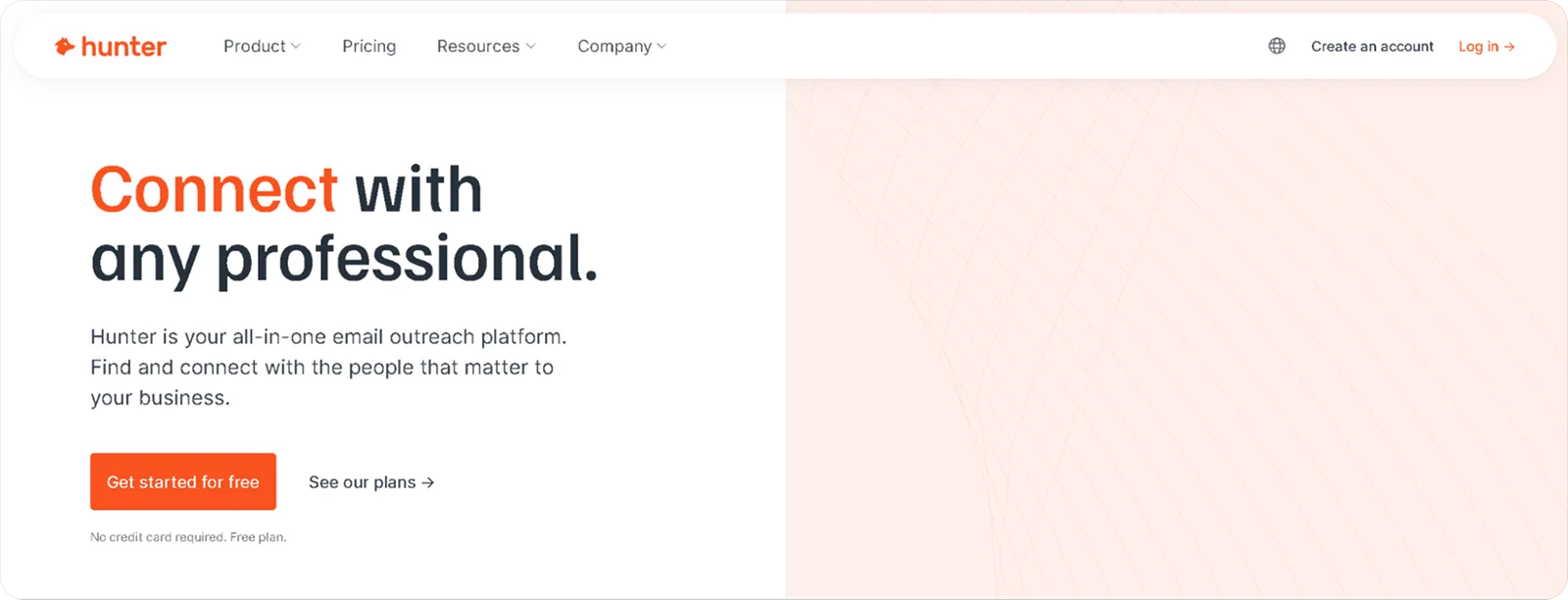
Hunter.io is a B2B email discovery and verification tool that helps sales teams find professional email addresses using company domains instead of profile scraping. It’s commonly used for outbound prospecting and list enrichment when email accuracy matters more than deep firmographic data.
Key Features
Domain Search: Returns email addresses associated with a company domain, along with names, roles (when available), and confidence scores
Email Finder: Generates professional email addresses using a person’s name and company domain, then verifies them before delivery
Email verification: Performs validity checks to identify invalid or risky addresses and reduce bounce rates
Bulk enrichment: Supports CSV uploads for finding and verifying large contact lists in batch
API access: Offers APIs for domain search, email finding, and verification that integrate with CRMs and outbound workflows.
Pros
Verifies email validity to reduce bounce rates and protect deliverability
Supports both individual lookups and bulk enrichment via CSV uploads
Integrates easily into automated workflows through a well-documented API
Cons
Provides limited firmographic and company-level intelligence
Does not include phone numbers or organizational charts
Pricing
Hunter.io offers a free plan with 25 searches per month. Paid plans start at $49/month, with higher tiers increasing monthly usage limits.
8. Apify
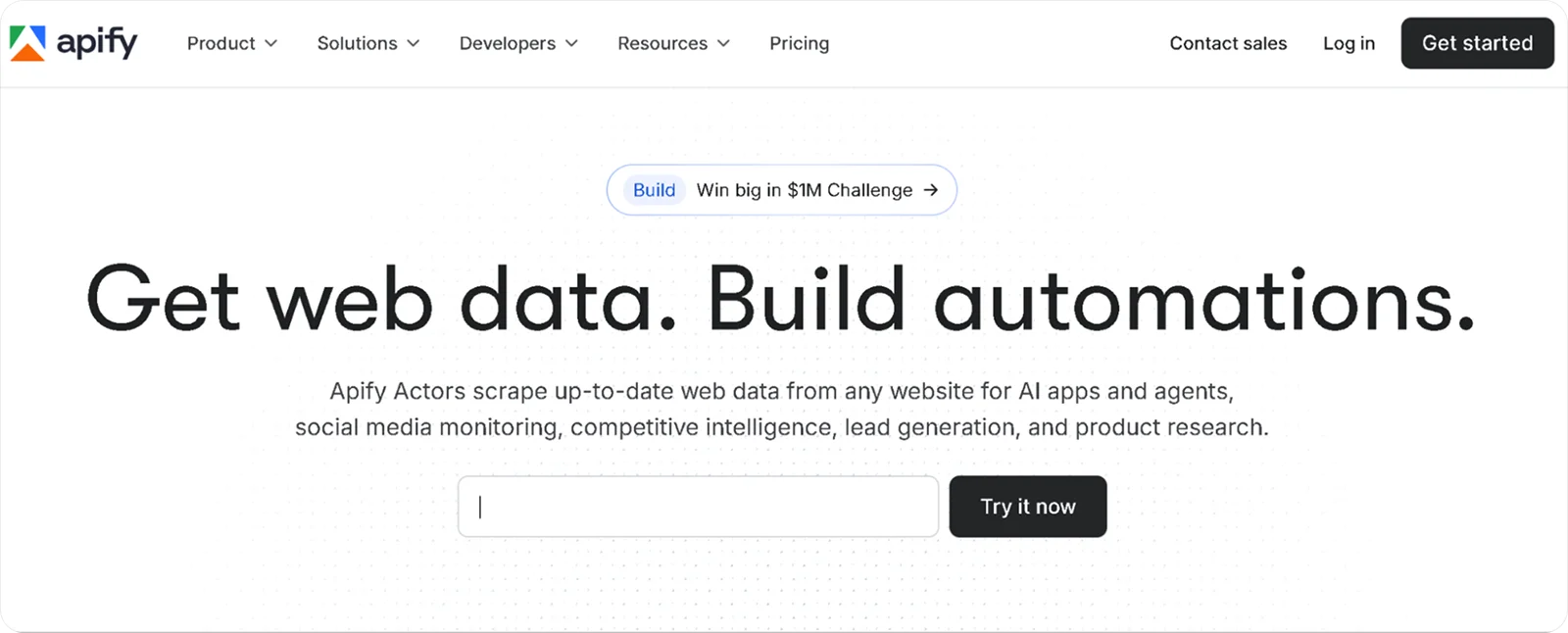
Apify transforms websites into APIs through cloud-based web scraping and browser automation using serverless programs called Actors that run data extraction workflows at scale. The platform offers 5,000+ pre-built Actors in its marketplace for scraping sites like Google Maps, Instagram, TikTok, and e-commerce platforms, or developers can build custom scrapers using JavaScript or Python SDKs.
Key Features
Actor marketplace: Offers 5,000+ ready-made scrapers for platforms with no coding required
Custom Actor development: Builds serverless scraping programs using Apify SDK in Node.js or Python, deploy to the cloud, and run on-demand or scheduled
Residential and datacenter proxies: Rotates proxies automatically with browser fingerprinting technology to avoid blocks and maintain scraping continuity
Cloud infrastructure: Runs scrapers on Apify’s servers with configurable memory allocation, concurrent execution, and automatic scaling for large datasets
Integration ecosystem: Connects with Zapier, Make, Google Sheets, Slack, and AI frameworks such as LangChain and Hugging Face to feed LLMs and vector databases
Pros
Provides SOC 2 Type II, GDPR, and CCPA compliance for enterprise security and legal consultation on enterprise plans
Includes unlimited data retention, unlimited team seats, and dedicated account managers on enterprise tier
Offers a developer affiliate program with 20% commission on customer spending and a certified partner program, keeping 100% of development revenue
Cons
Uses compute unit pricing, where 1 CU equals 1 GB of memory multiplied by 1 hour runtime
Requires technical knowledge to navigate the platform effectively, with a steep learning curve for beginners compared to no-code alternatives
Pricing
Apify offers a free plan with $5 monthly credits. Paid plans start at $29/month with $29 platform credits included.
Which Scrapin.io Alternative Should You Choose?
Choosing a Scrapin.io alternative comes down to how you actually use prospecting data day-to-day.
Teams with engineering resources often prefer API-first platforms that can trigger actions when data changes, such as routing leads or updating internal tools automatically. In these cases, webhook-based updates reduce the need for constant polling or manual refreshes.
Other teams prioritize speed of execution over customization. Platforms that combine data access with outreach or automation can simplify workflows, but they usually trade flexibility and data freshness for convenience.
Scraping and automation tools work well for gathering data from multiple platforms, but they require careful management of execution limits and ongoing maintenance as workflows scale.
The right choice depends on whether your priority is automation, data depth, real-time updates, or ease of use, and how much technical control your team needs.
Why Crustdata Stands Out as the Best Scrapin.io Alternative
Crustdata solves the biggest problem with traditional B2B data platforms: everything happens in real time.
While most alternatives pull from pre-built databases that update monthly or weekly, Crustdata crawls the web at the moment you make a request. You get current information, not records that could be weeks old.
Here’s what you get:
Watcher API with event-based webhooks: Sends alerts when specific changes occur, including role moves, funding rounds, hiring activity, executive changes, and company growth signals, without repeatedly querying the API
Company API: Firmographics, funding data, web traffic, and growth metrics from 16+ datasets
People Discovery: Contact details, job histories, and social profiles with live role change updates
WebSearch API: Find blog mentions, podcast appearances, articles, social media posts, and personal websites about prospects to personalize outreach beyond basic profile data
Webhook alerts: Immediate notifications for job changes, funding rounds, and headcount shifts
Unified data layer: Aggregates 10+ sources into clean records with unique identifiers
Social media integration: Captures posts and engagement data for personalized outreach
AI-ready infrastructure: Built to power internal GTM tools, AI SDRs, AI recruiters and all agentic workflows
Dedicated customer support: Provides responsive support to help teams implement APIs, troubleshoot issues, and maintain production workflows over time.
The real advantage shows up in your timing. When prospects change jobs or companies announce funding, you act immediately instead of finding out weeks later through database refreshes.
Ready to stop working with stale data?
Book a demo and see how real-time intelligence changes your prospecting results.


Products
Popular Use Cases
Competitor Comparisons
95 Third Street, 2nd Floor, San Francisco,
California 94103, United States of America
© 2026 Crustdata Inc.
Products
Popular Use Cases
Competitor Comparisons
95 Third Street, 2nd Floor, San Francisco,
California 94103, United States of America
© 2026 CrustData Inc.
Products
Popular Use Cases
Competitor Comparisons
95 Third Street, 2nd Floor, San Francisco,
California 94103, United States of America
© 2026 Crustdata Inc.
🎉 We hit $10M ARR!
$600k to $10m in 1.5 years. Our entire GTM is powered by our own APIs.
🎉 We hit $10M ARR in 1.5 years!