
Case Study
How a leading B2B SaaS platform uses Crustdata to power their internal AI SDR
Company
Fintech platform
use case
Buidling internal AI SDR
company overview
A leading B2B SaaS platform serving mid-market and enterprise companies. As their outbound motion matured and deal sizes grew, human SDRs became a bottleneck - costly to hire, slow to ramp, and hard to scale without proportional headcount increases.
The company wanted to scale pipeline generation without linearly growing their SDR team. Off-the-shelf AI SDR tools couldn't deliver, so they set out to build a custom internal AI SDR but existing data infrastructure couldn't support it.
Off-the-shelf AI SDRs couldn't match their sales motion
Generic AI SDR tools operated on rigid workflows and one-size-fits-all scoring. The company needed something different:
They wanted to prioritize accounts based on a custom blend of expansion signals - product usage patterns, contract renewal timing, and hiring velocity instead of relying on a fixed firmographic score
They needed outreach triggered by their buying signals, not the platform's generic intent data
Pre-built models kept surfacing low-fit accounts while missing high-value expansion opportunities within their existing install base
Data providers weren't built for automated workflows
Most data providers were designed for human sales teams, with APIs bolted on as an afterthought:
Couldn't get the granularity of signals needed - job changes in target departments, leadership turnover, hiring surges in specific functions
Data quality issues meant stitching together multiple providers and constantly deduplicating records
No infrastructure for real-time enrichment at the speed and volume their automated sequences demanded
Crustdata provided the data infrastructure layer for their internal AI SDR - structured, fresh data powering custom agentic workflows.
Raw data for custom logic, not black-box scoring
Unlike off-the-shelf tools with pre-defined logic, Crustdata gave them raw data to build their own scoring and routing:
Custom prioritization based on signals that actually correlate with their closed-won deals
Full control over which triggers initiate outreach sequences
A scoring model that improves only for them - every reply, booking, and no-show feeds back into their system
Comprehensive, signal-rich data
Their AI SDR needed more than basic firmographics:
Company enrichment: headcount trends, funding rounds, hiring signals, departmental growth
People enrichment: work history, job changes, social activity, verified emails
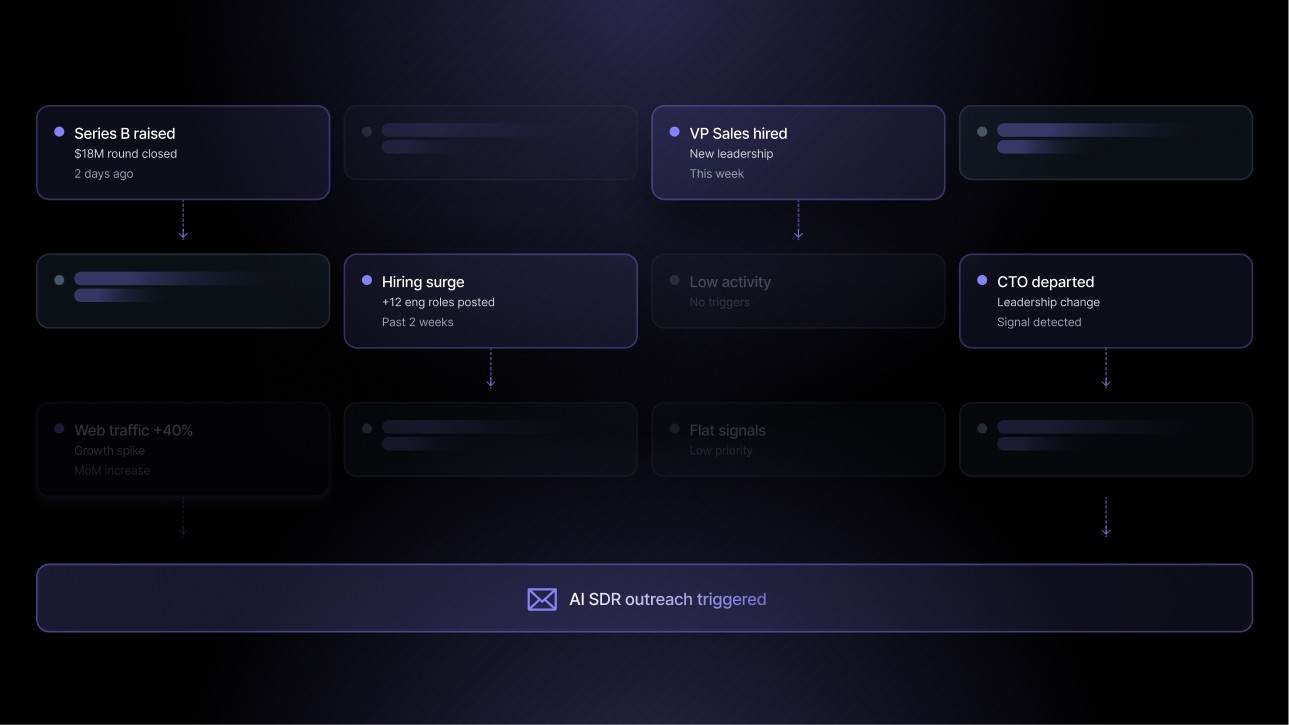
Watcher API for real-time signal notifications - live alerts when prospects hit key triggers, enabling outreach at the moment of relevance
High rate-limit APIs built for agentic workflows
Their system required large-scale real-time enrichment as prospects moved through automated sequences:
Rate limits designed for high-volume, automated use cases
Web crawlers spawned on demand for real-time person and company enrichment
Clean API integration into their existing CRM and orchestration stack
An AI SDR built on their terms
They built an internal system that reflects their exact qualification criteria and sales motion:
Full control over ICP definition and signal weighting
Outreach triggered by signals they define instead of a vendor's generic model
Scalable without adding headcount
Pipeline no longer bottlenecked by team size
Outbound volume scaled independently of SDR headcount:
More pipeline generated per dollar spent on sales
Faster revenue growth without proportional cost increase
Higher quality outreach
With richer signals feeding their agentic system, outreach became more targeted and better-timed:
Signal-driven prioritization based on hiring activity, leadership changes, and expansion indicators
Higher reply rates from reaching the right person at the right moment
Outreach triggered by real buying signals, not static lists