API-First Alternatives to PitchBook for Deal Sourcing
PitchBook's headcount data lags 12-18 months, its company database skews toward VC-backed firms, and API access requires a separate enterprise contract. These alternatives offer fresher data, broader coverage, and programmatic access for deal sourcing.
Published
Apr 11, 2026
Written by
Nithish
Reviewed by
Chris Pisarski
Read time
7
minutes
PitchBook is the default data platform for institutional investors. For deal comps, fund benchmarking, and LP intelligence, it earns that position. Deal sourcing has different data requirements, and PitchBook has specific gaps in freshness, coverage, and API accessibility that matter when the goal is reaching founders before competitors do.
Headcount and growth data in PitchBook lags 12-18 months behind actual figures. The company database covers roughly 5.3 million firms, heavily weighted toward those with existing VC backing, while bootstrapped and pre-funding companies are underrepresented. API access requires a separate enterprise contract with no public documentation or sandbox environment, making automated sourcing pipelines difficult to build.
Funds that build their own sourcing pipelines on APIs surface founders and signals earlier than those relying on PitchBook screens. A $2B+ growth equity fund replaced their PitchBook subscription after finding founders consistently appeared in the database only after multiple firms had already reached out.
This guide evaluates PitchBook alternatives built for programmatic deal sourcing: providers with real-time data, broader company coverage, and APIs you can integrate on day one.
Where PitchBook falls short for deal sourcing
PitchBook was designed for financial intelligence, where the requirements are depth on completed deals, fund performance, and valuations. Deal sourcing requires breadth across companies that may not have raised yet, freshness on signals like hiring velocity and leadership changes, and programmatic access for building automated workflows.
Growth signals lag 12-18 months behind
PitchBook's headcount data derives from events like funding announcements and annual filings. A company's employee count may reflect a figure reported at their last funding round and stay unchanged until the next event triggers an update. Private company valuations are delayed 45-60 days. For deal sourcing teams tracking hiring spikes as leading indicators, this means the signal arrives well after the company has attracted attention from funds with fresher data.
One user who works regularly with PitchBook data described the accuracy on Reddit: "Pitchbook only claims that their data is ~60% accurate and they are ok with this. The data isn't good. It's just all we have."
A $2B+ growth equity fund we worked with found the same pattern. By the time founders appeared in PitchBook's database, multiple firms had already reached out. The signals that mattered at the earliest stage, like a researcher leaving a university position or a technical lead updating a profile to "building something new," happened weeks before any traditional database registered them.
Coverage skews toward companies with existing VC backing
PitchBook tracks roughly 5.3 million companies, with strong depth on firms that have raised institutional capital. Bootstrapped companies, founder-owned businesses, and pre-funding startups are underrepresented. For a deal sourcing team whose thesis includes companies before they have raised, this is a structural gap in the database that additional filters cannot close.
A Director at a boutique investment bank ran the same search on PitchBook and Grata for mid-sized chemical manufacturers. PitchBook returned 200 results while Grata returned 1,000.
Contact data has similar gaps. G2 reviewers frequently note that PitchBook provides only C-suite contacts, usually just one to three per company. For sourcing teams that need to reach the right person quickly, thin contact coverage adds a manual research step to every outreach workflow.
Every fund with a license runs the same screens
When 50 funds search PitchBook for "Series B SaaS companies, 50-200 employees, US-based," they all get the same list sorted the same way. The database creates parity among subscribers rather than a competitive edge for any individual fund.
The fund that builds a custom pipeline combining headcount growth velocity, recent leadership hires, and social engagement signals into a proprietary scoring model sees a different, more refined list. Building that kind of model requires API access to raw data that you can filter, score, and route through your own logic.
The API requires a separate enterprise contract
PitchBook does offer an API, but accessing it requires a standalone contract agreement with additional fees on top of the platform license. The API has no public documentation, no sandbox environment, no OpenAPI spec, and no published rate limits. CRM integration through the Salesforce plugin syncs weekly on Sundays at 5 AM EST, rather than in real time. One user pointed out on Reddit that "there are barely any libraries for python to connect to the endpoints."
Without public documentation or client libraries, building production workflows against PitchBook's API is a significant engineering investment on top of the licensing cost. At a $30,000 median annual cost per seat (with some contracts reaching $124,500), the per-seat model compounds the cost for teams that need multiple people accessing the data.
How to evaluate PitchBook alternatives for API-first deal sourcing
Not every PitchBook alternative solves these problems. Some offer API access that is similarly restrictive, with harsh rate limits and incomplete field coverage. Use these six criteria to evaluate whether an alternative genuinely improves on PitchBook's limitations for deal sourcing or just repackages them at a lower price.
1. Data coverage
How many companies and people does the provider cover? PitchBook tracks roughly 5.3 million companies, heavily weighted toward venture-backed firms. Providers like Crustdata cover 60M+ companies and 1B+ people profiles, while Diffbot's Knowledge Graph indexes 10B+ entities from the public web. For deal sourcing, coverage of private, bootstrapped, and pre-funding companies matters more than depth on already-tracked VC-backed firms.
2. Freshness architecture
Does the provider offer real-time enrichment, or does data refresh on a monthly batch cycle? Real-time enrichment means when you query a company, the provider checks live sources and returns up-to-date data. Batch providers return whatever was in the database at the last refresh. For deal sourcing, the difference between learning about a competitor's hiring spike today versus 30 days from now can determine whether you reach the founder first.
3. API design and rate limits
Check the actual documentation before committing. What are the rate limits? Crunchbase's Enterprise API caps at 200 records per day on lower tiers, for example.
Beyond rate limits, look for REST-based endpoints with clear documentation, selective field retrieval to reduce payload size and cost, and batch request support for bulk operations.
4. Search and filter depth
Can you express your investment thesis as a query? A provider with 95+ company filters lets you search by headcount growth rate, funding stage, geography, industry, technology stack, hiring velocity, and web traffic trends in a single call. A provider with five dropdown filters forces you to do the rest of the filtering in your own code.
5. Signal delivery model
Polling an API every hour to check for changes is expensive and slow. Providers that support webhooks or watcher-style push notifications deliver signals to your system only when something meaningful changes, so you build a reactive pipeline instead of manually checking a dashboard.
6. Pricing transparency
PitchBook requires an annual contract with per-seat pricing and limited visibility into what you are actually paying for. API-first providers typically publish credit-based pricing, so you know the cost per enrichment call, per search query, and per webhook before you commit. Look for providers that do not charge when a query returns no results.
API-first PitchBook alternatives for deal sourcing
Here's a quick look at the 7 different data providers we have compared and how they stand against each other.
Provider | Coverage (companies) | Real-Time Enrichment | Webhooks/Push | Rate Limits (req/min) | Pricing Model | Starting Cost ($/mo) |
|---|---|---|---|---|---|---|
Crustdata | 60M+ | Yes | Yes (Watcher API) | 15 req/min | Credit-based | Custom |
Dealroom | 3M+ | No | No | Not published | Seat-based | ~$300 |
Crunchbase | 4M+ | No | No | Not published | Tiered | $49 (Pro) |
Diffbot | 250M+ | Yes (web crawl) | No | Not published | Credit-based | $299 |
Coresignal | 70M+ | Batch | No | Not published | Custom | Custom |
CB Insights | 10M+ | No | Snowflake share | Not published | Seat-based | ~$5,000 |
Harmonic.ai | 35M+ | Yes | Yes | 600 req/min | Seat-based | ~$500 |
Crustdata
Crustdata is a real-time B2B data platform built API-first from the ground up, combining company enrichment, people enrichment, search/discovery, and webhook-based signal monitoring in a single platform.
API capabilities: REST API with 95+ company search filters, 60+ people search filters, real-time enrichment, and a Watcher API that pushes webhook notifications on job changes, funding rounds, headcount growth, and leadership moves.
Data coverage: 60M+ companies and 1B+ people profiles sourced from 15+ live data sources, including web traffic, reviews, social activity, job postings, and funding data.
For deal sourcing specifically: The $2B+ growth equity fund mentioned earlier replaced their PitchBook subscription and two other vendors with Crustdata's APIs, automating founder discovery across 20+ universities and reaching stealth-stage founders before competitive rounds begin. They eliminated $20K/seat licensing costs and consolidated manual export workflows into a single API integration.
Pricing: Credit-based, pay-per-query. No charge when queries return no results. No annual seat-based contract.
Best for: Investment teams building internal deal sourcing tools and funds that want webhook-based signal monitoring without a per-seat dashboard license.
Dealroom
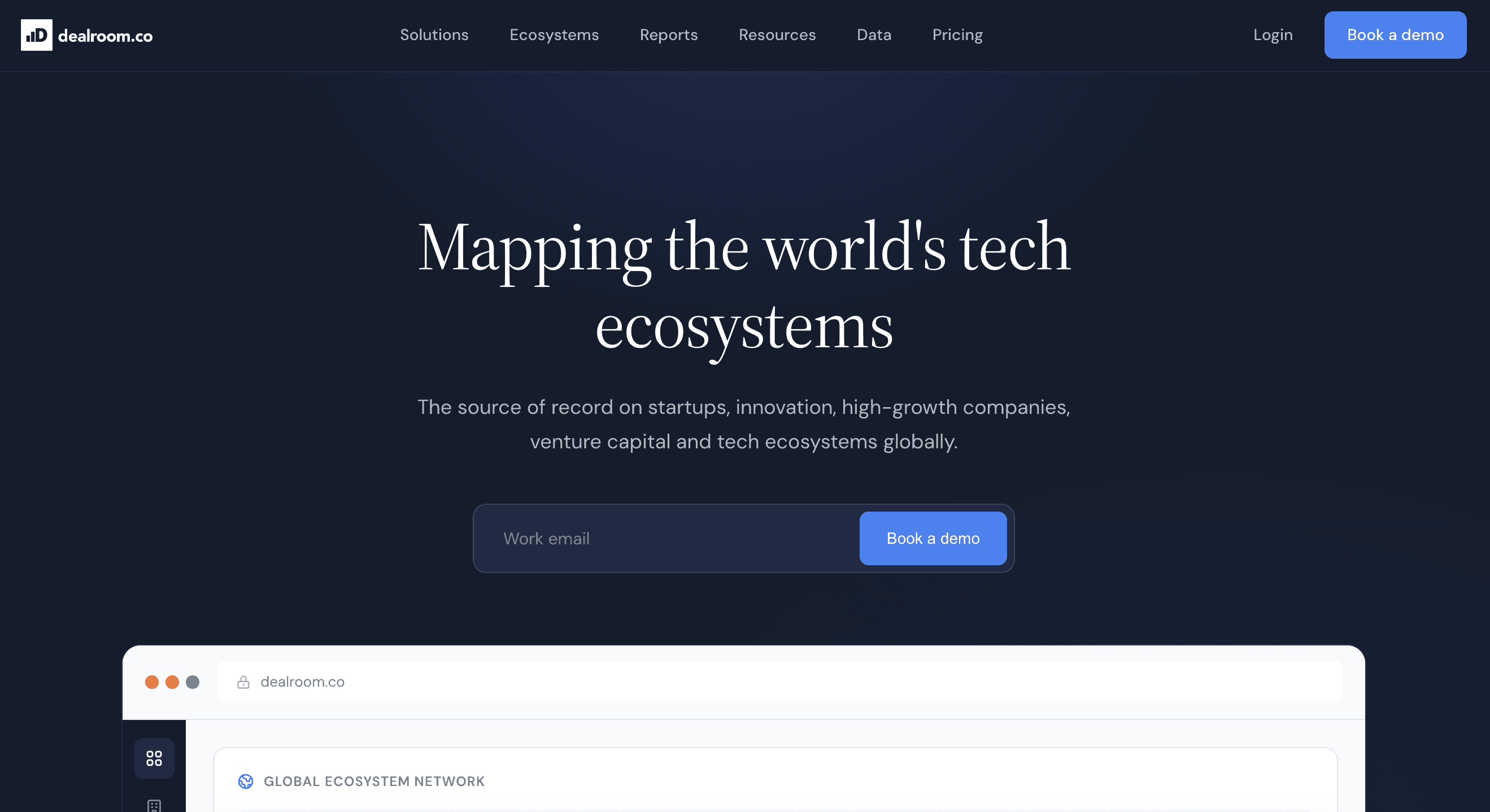
Dealroom is an API-first startup and scaleup intelligence platform with strong coverage of European tech ecosystems. Over 100 government innovation agencies and European VC firms use it as a primary data source.
API capabilities: REST API for data ingestion and analysis, with structured export capabilities. Dealroom positions itself as API-first, with integration support for custom workflows and internal tools.
Data coverage: 100+ data points on 2M+ startups and scaleups globally. Stronger in European markets than most US-centric competitors. Tracks ecosystems (cities, regions, industries) in addition to individual companies.
For deal sourcing specifically: Dealroom maps startup ecosystems and tracks funding rounds, investor networks, and growth signals. European-focused funds often prefer Dealroom for its deeper coverage of EMEA markets, where PitchBook's data is thinner.
Pricing: Ranges from roughly $300/month for basic access to $1,500+/month for enterprise plans with API access and custom reporting. Annual contracts typical.
Best for: European VC firms and ecosystem-focused investors who need API access to startup data with strong EMEA coverage.
Crunchbase
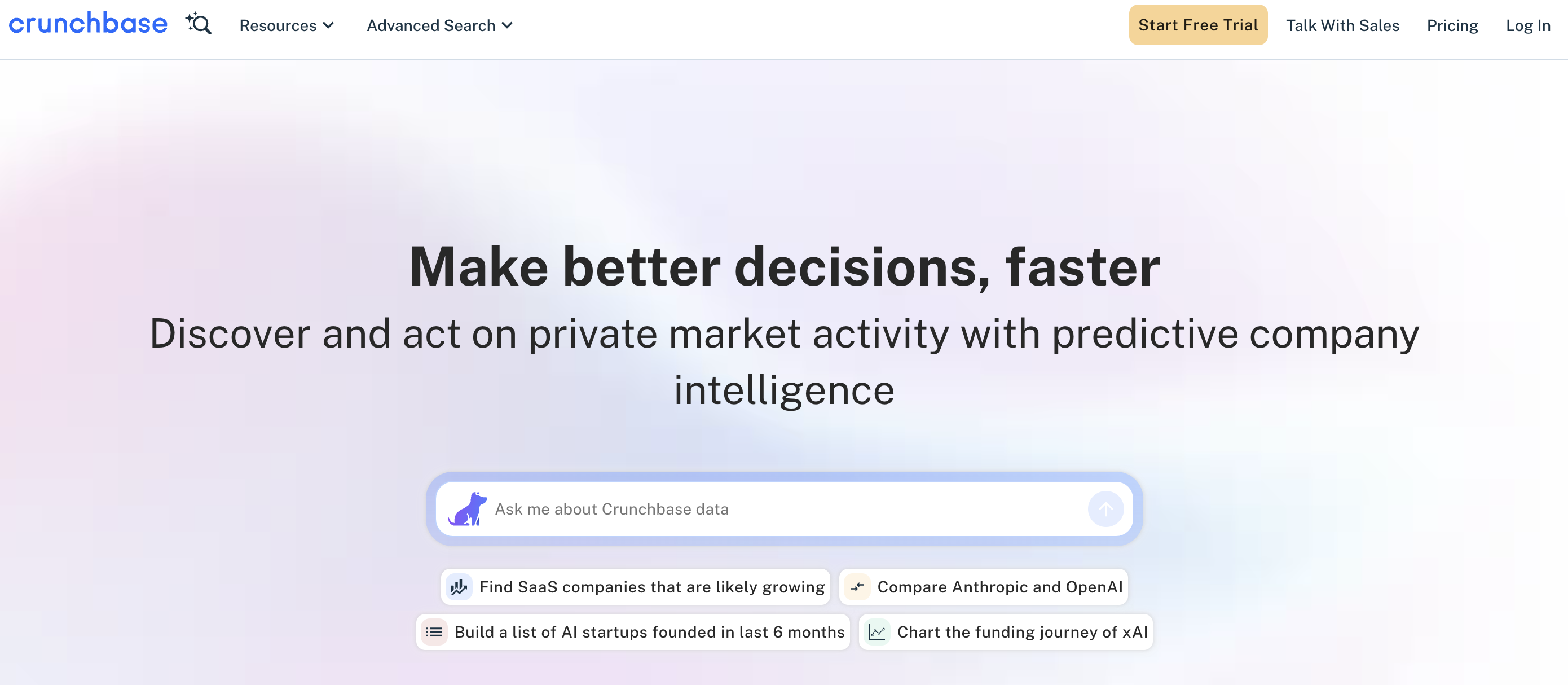
Crunchbase is the most widely used startup database, covering funding rounds, acquisitions, and company profiles. The Enterprise tier includes API access.
API capabilities: REST API and Salesforce/HubSpot integrations. However, lower-tier API plans cap exports at 200 records per day, which limits programmatic workflows. Enterprise pricing removes most restrictions but pushes costs significantly higher.
Data coverage: Broad startup and funding data, though much of it is self-reported and community-submitted, which creates reliability concerns for deal-critical decisions. Crunchbase Scout (AI research assistant) available on higher tiers.
For deal sourcing specifically: Good for initial company discovery and funding history tracking. The 200 records/day API cap on lower tiers makes it impractical for bulk screening or automated enrichment workflows. IPO likelihood scores and Mosaic health scores add predictive value for later-stage analysis.
Pricing: Pro starts at $49/month. Enterprise pricing (with full API access) is custom and significantly higher. The gap between Pro and Enterprise is wide enough that many teams stay on Pro and lose API capabilities.
Best for: Teams that need affordable startup/funding data for manual research, and Enterprise-budget teams that can afford full API access without rate limit constraints.
Diffbot
Diffbot is an AI-powered knowledge graph that extracts and structures data from the entire public web. Technical VC teams use it to build custom deal sourcing infrastructure.
API capabilities: Full REST API with knowledge graph queries, entity extraction, and custom crawling. The Natural Language API lets you query the knowledge graph conversationally. Diffbot integrates with Snowflake for data warehousing workflows.
Data coverage: 10B+ entities (companies, people, products, articles) extracted from the public web and updated continuously. Breadth is unmatched, though depth on private company financials (funding amounts, revenue estimates) is thinner than purpose-built investment data platforms.
For deal sourcing specifically: Diffbot shines when you need to discover companies that do not appear in traditional databases. Its web-crawling approach finds bootstrapped companies, recently launched startups, and niche players that PitchBook and Crunchbase miss entirely. One technical VC described building "company discovery tools, competitive intelligence monitors, and enrichment pipelines" on top of Diffbot's API.
Pricing: API access starts at $299/month. Knowledge Graph queries, entity extraction, and custom crawling are priced separately. Credit-based model.
Best for: Technical investment teams that want to build custom deal sourcing on top of raw web data. Less suitable for funds that need clean, structured funding data out of the box.
Coresignal
Coresignal is a B2B data provider that offers firmographic, employee, technographic, and job posting datasets through APIs and bulk data delivery.
API capabilities: REST APIs for company data, employee data, job postings, and tech stack detection. Also offers bulk data dumps for warehousing use cases. Coresignal positions itself as a raw data layer for building custom applications, not a finished product.
Data coverage: 35M+ companies with 300+ data points per record. Strong on employee-level data, hiring signals, and tech stack detection.
For deal sourcing specifically: Hiring velocity and job posting data are leading indicators of company growth that many deal sourcing teams track. Coresignal's employee and job data let you build custom growth scoring models. Less useful for funding data and investor networks than PitchBook.
Pricing: Custom pricing based on data volume and use case. Bulk data dumps available for teams that prefer batch workflows.
Best for: Teams building growth-signal-based sourcing models who need raw employee, hiring, and firmographic data at scale.
CB Insights
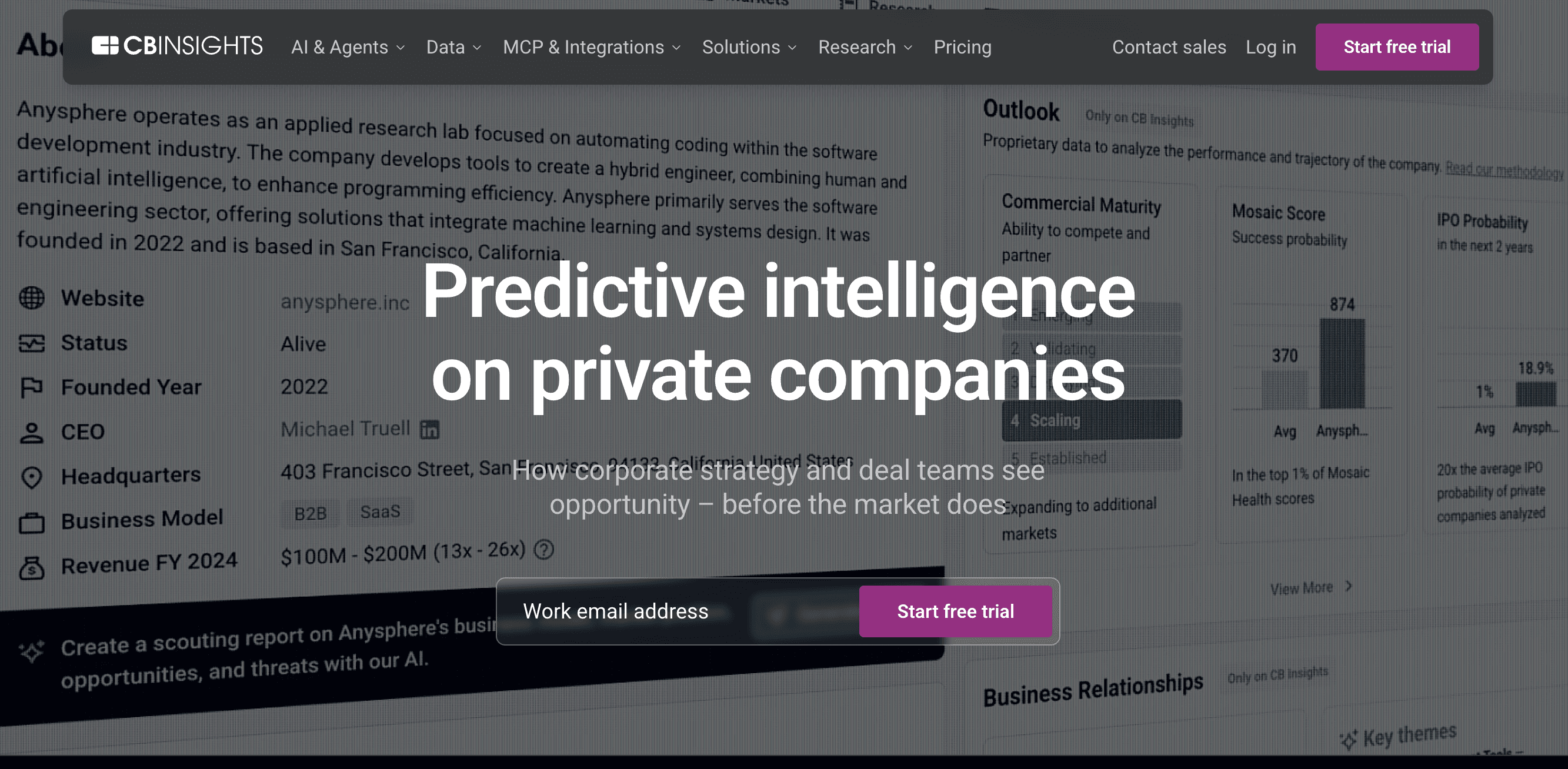
CB Insights combines startup intelligence with market analytics, offering predictive scoring, trend analysis, and competitive landscape mapping.
API capabilities: REST API and Snowflake Secure Data Share for data integration. API access is available on enterprise plans.
Data coverage: 10M+ companies across 1,500 markets. Strong on market analytics, patent data, and technology trend tracking. Mosaic Scores predict company health and growth trajectory.
For deal sourcing specifically: CB Insights is better suited for market landscaping and competitive analysis than for building automated sourcing pipelines. The data is structured for analysts, not for feeding into programmatic workflows. Pricing reportedly starts around $60,000/year, which positions it as a PitchBook-class investment, not a cost-saving alternative.
Pricing: Enterprise-only, reportedly ~$60,000/year. Annual contracts required.
Best for: Investment teams that need market analytics and trend intelligence alongside company data. Not ideal for teams looking for affordable API-first data infrastructure.
Harmonic.ai
Harmonic.ai focuses on early-stage startup discovery, tracking companies from founding through Series A with a focus on founder signals and early traction indicators.
API capabilities: API access available for integration into workflows. Harmonic focuses on serving the early-stage deal sourcing use case specifically, with structured data on founders, team composition, and early growth signals.
Data coverage: 20M+ companies, with deeper coverage of early-stage firms that other platforms miss. Tracks founder backgrounds, team changes, and early hiring patterns.
For deal sourcing specifically: Harmonic fills the gap that PitchBook has in pre-seed and seed-stage companies. If your thesis targets companies before they raise institutional capital, Harmonic surfaces them earlier than platforms that rely on funding announcements as a data trigger.
Pricing: Significantly less than PitchBook, typically under $1,000/month per user. Custom enterprise pricing.
Best for: Seed and pre-seed focused VCs who need early-stage company and founder data with API access.
How to build a deal sourcing stack with APIs
Moving from a dashboard to an API-first deal sourcing stack involves three workflows. Each one replaces a manual process with a programmatic pipeline.
Workflow 1: Thesis-driven company discovery
Instead of running a saved search in PitchBook and scrolling through results, you define your investment thesis as an API query with specific filters.
Here is an example using Crustdata's Company Search API to find Series A-B SaaS companies in the US with strong headcount growth:
curl -X POST 'https://api.crustdata.com/screener/companydb/search' \
 --header 'Authorization: Token $authToken' \
 --header 'Content-Type: application/json' \
 --data '{
 "filters": {
 "op": "and",
 "conditions": [
 {"filter_type": "hq_country", "type": "=", "value": "USA"},
 {"filter_type": "employee_metrics.latest_count", "type": ">", "value": 100},
 {"filter_type": "employee_metrics.latest_count", "type": "<", "value": 500},
 {"filter_type": "employee_metrics.growth_6m_percent", "type": ">", "value": 20},
 {"filter_type": "last_funding_round_type", "type": "in", "value": ["series_a", "series_b"]},
 {"filter_type": "industries", "type": "(.)", "value": "Software"}
 ]
 },
 "sorts": [{"column": "employee_metrics.growth_6m_percent", "order": "desc"}],
 "limit": 100
 }'
curl -X POST 'https://api.crustdata.com/screener/companydb/search' \
 --header 'Authorization: Token $authToken' \
 --header 'Content-Type: application/json' \
 --data '{
 "filters": {
 "op": "and",
 "conditions": [
 {"filter_type": "hq_country", "type": "=", "value": "USA"},
 {"filter_type": "employee_metrics.latest_count", "type": ">", "value": 100},
 {"filter_type": "employee_metrics.latest_count", "type": "<", "value": 500},
 {"filter_type": "employee_metrics.growth_6m_percent", "type": ">", "value": 20},
 {"filter_type": "last_funding_round_type", "type": "in", "value": ["series_a", "series_b"]},
 {"filter_type": "industries", "type": "(.)", "value": "Software"}
 ]
 },
 "sorts": [{"column": "employee_metrics.growth_6m_percent", "order": "desc"}],
 "limit": 100
 }'
curl -X POST 'https://api.crustdata.com/screener/companydb/search' \
 --header 'Authorization: Token $authToken' \
 --header 'Content-Type: application/json' \
 --data '{
 "filters": {
 "op": "and",
 "conditions": [
 {"filter_type": "hq_country", "type": "=", "value": "USA"},
 {"filter_type": "employee_metrics.latest_count", "type": ">", "value": 100},
 {"filter_type": "employee_metrics.latest_count", "type": "<", "value": 500},
 {"filter_type": "employee_metrics.growth_6m_percent", "type": ">", "value": 20},
 {"filter_type": "last_funding_round_type", "type": "in", "value": ["series_a", "series_b"]},
 {"filter_type": "industries", "type": "(.)", "value": "Software"}
 ]
 },
 "sorts": [{"column": "employee_metrics.growth_6m_percent", "order": "desc"}],
 "limit": 100
 }'
This returns a ranked list of companies matching your thesis, sorted by headcount growth velocity. Each result includes firmographics, funding history, growth metrics, and leadership data. From here, you can pipe results into your CRM, score them against your model, or trigger enrichment calls for deeper information.
Workflow 2: Signal-based monitoring with webhooks
Instead of logging into a dashboard to check what changed, set up a Crustdata Watcher that pushes notifications to your system when something meaningful happens across your target universe:
A portfolio-adjacent company crosses a headcount growth threshold
A tracked founder changes roles or starts a new company
A target company posts a leadership hire or announces funding
These signals arrive as webhook payloads within minutes of detection. Your system can auto-enrich the company, score the opportunity, and route it to the right partner without anyone opening a browser.
Workflow 3: Founder and executive tracking
People data matters as much as company data in deal sourcing. A people search API lets you find founders and executives by title, seniority, skills, education, prior employers, and recent job changes. Combine this with a watcher or webhook service to track stealth founders across your target universe. When a repeat founder leaves their role and starts something new, you want to be aware as soon as it happens so you can reach out, build a relationship much before the funding round starts.
Choosing the right PitchBook alternative for your sourcing workflow
Which alternative fits depends on what you are sourcing and how you plan to use the data.
If your team sources seed and pre-seed deals where companies have no funding history to track, Harmonic.ai and Crustdata covers that stage better than PitchBook or Crunchbase. If you need raw web-scale entity data to build custom discovery tools, Diffbot gives you 10B+ entities to query against. If your focus is European ecosystems, Dealroom has deeper EMEA coverage than any US-centric provider.
For teams that need real-time enrichment, webhook-based signal monitoring, and the filter depth to express a specific investment thesis as a single API call, Crustdata combines all three in one platform at a fraction of PitchBook's per-seat cost.
PitchBook still earns its price for fund performance benchmarks, LP intelligence, and deal comp databases. Most teams that move sourcing to API-first tools keep PitchBook or Preqin for that fund-level analysis and redirect the savings from dropped sourcing seats into their API data budget.
Start by auditing how your team actually uses PitchBook today. If 80% of the usage is saved searches, company screens, and contact lookups, an API-first provider handles all of that programmatically, and you can build the scoring and routing logic that a shared dashboard never will.



Products
Popular Use Cases
Competitor Comparisons
Use Cases
95 Third Street, 2nd Floor, San Francisco,
California 94103, United States of America
© 2026 Crustdata Inc.
Products
Popular Use Cases
Competitor Comparisons
Use Cases
95 Third Street, 2nd Floor, San Francisco,
California 94103, United States of America
© 2025 CrustData Inc.
Products
Popular Use Cases
Competitor Comparisons
Use Cases
95 Third Street, 2nd Floor, San Francisco,
California 94103, United States of America
© 2026 Crustdata Inc.