Coresignal vs People Data Labs: Data Coverage, Pricing & Use Cases
Coresignal vs People Data Labs on coverage, freshness, and pricing, and where Crustdata's real-time API beats both.
Published
Written by
Chris P.
Reviewed by
Nithish A.
Read time
7
minutes
The Coresignal vs People Data Labs comparison comes up frequently when businesses evaluate B2B data providers. Both supply professional and company data, but they differ significantly in their data collection methods, update frequencies, and pricing models.
This guide is a head-to-head of these two providers. If you're weighing the wider field, our full breakdown of Coresignal alternatives compares the options on pricing and coverage.
Understanding these differences matters when your workflows depend on accurate, current information. This article compares their data coverage, pricing, update frequency, and technical capabilities to help you choose the right provider.
Key Takeaways
Crustdata is the real-time alternative to both Coresignal and People Data Labs: Crustdata brings Coresignal's company and job-posting depth together with People Data Labs' person-level scale, pulled live from 15+ sources at the moment of the request. Its Watcher API fires a webhook the moment a tracked person changes jobs or a company raises funding.
Data coverage differs by focus area: Coresignal's strength is company records and job postings, and People Data Labs' is the size of its person database. Both refresh on a cycle. Crustdata pulls live at the moment of the request.
Batch updates create data freshness gaps: Both providers use scheduled refresh cycles rather than real-time updates. Coresignal refreshes daily to quarterly, depending on the dataset, while People Data Labs updates monthly.
Pricing structures vary in transparency: Coresignal shows upfront tier pricing with visible credit allocation. People Data Labs uses volume-based pricing that typically requires sales conversations to understand final costs.
Integration approaches target different teams: Coresignal offers multiple data formats and self-service playgrounds for testing. People Data Labs provides developer SDKs targeting technical teams building data products.
Coresignal Overview
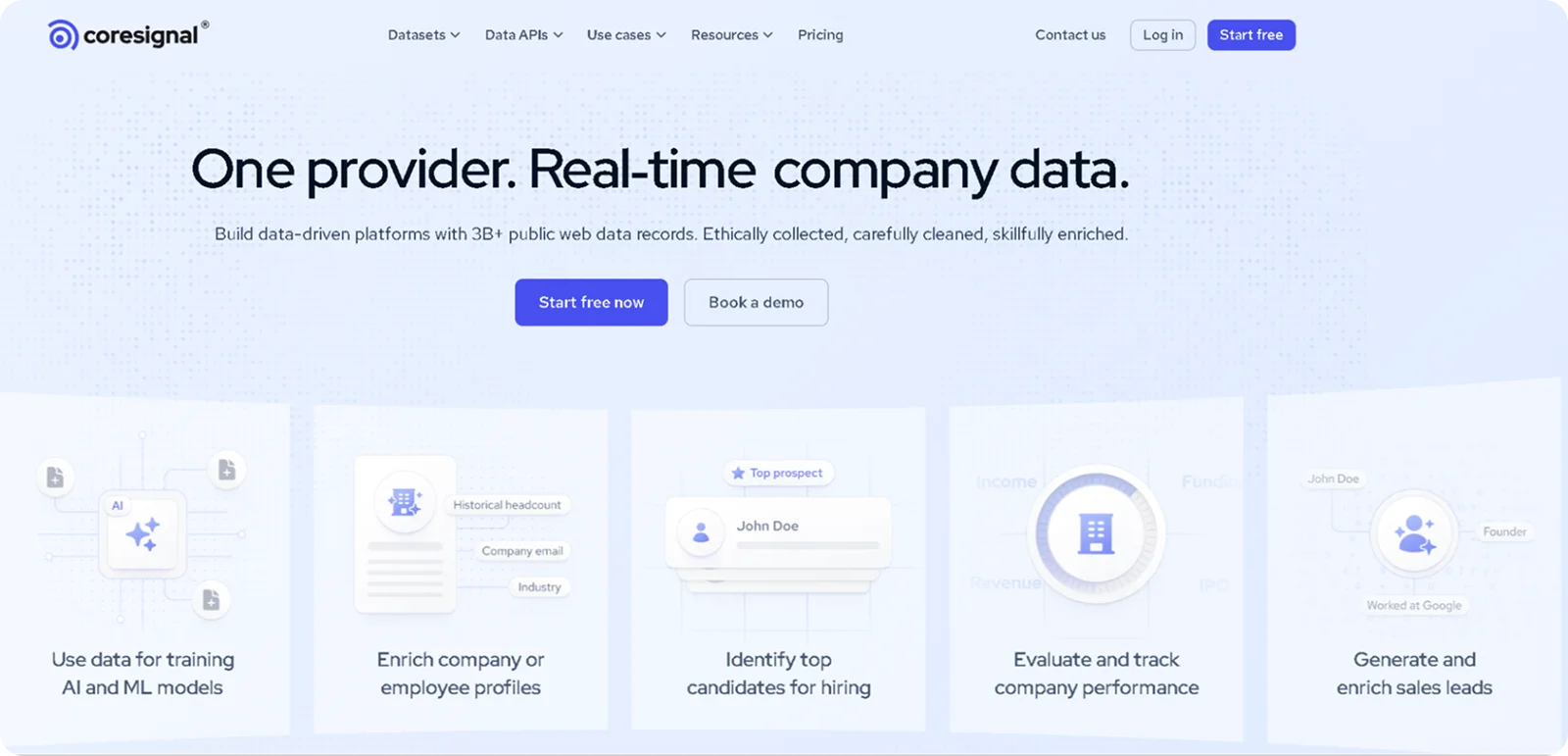
Coresignal is a public web data provider that collects structured information from 15+ sources covering companies, employees, and job postings. The platform scrapes publicly available business data and organizes it into datasets that customers access through APIs or bulk file downloads.
Their system processes professional information, including employment history, company firmographics, technographic data, and hiring activity. Data can be delivered as JSON, CSV, or Parquet files, with refresh cycles ranging from daily to monthly, depending on the dataset and customer needs.
Coresignal offers three dataset tiers, base, clean, and multi-source, letting teams choose between raw data, cleaned datasets, or fully enriched records combined from multiple sources. The tool serves over 700 organizations globally with datasets containing billions of records across companies, employees, and job postings.
Their approach emphasizes ethical data collection as a founding member of the Ethical Web Data Collection Initiative. However, the design relies on scheduled batch updates rather than live data crawling.
People Data Labs Overview
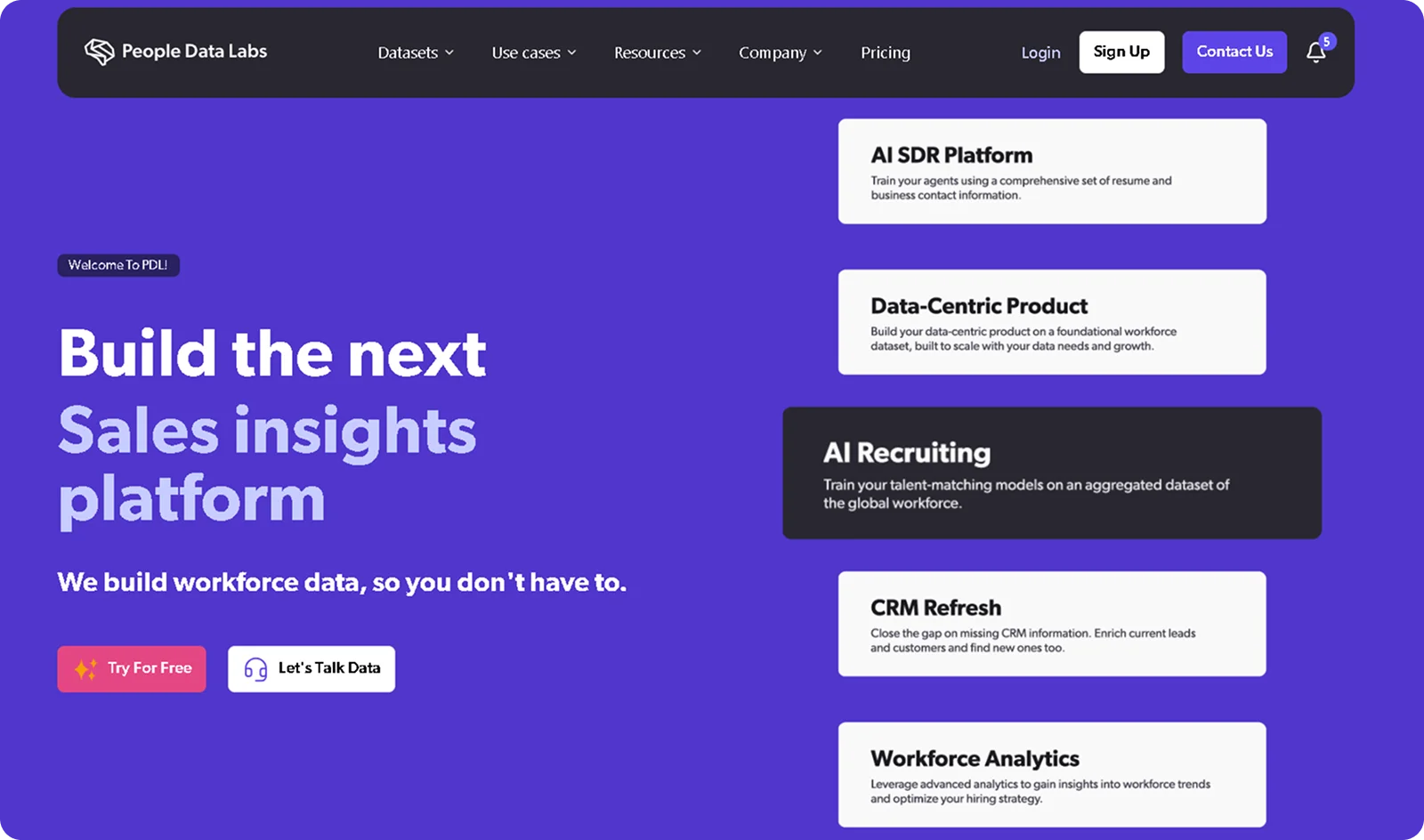
People Data Labs (PDL) is a B2B data provider that aggregates professional and company information through a data co-op model. Customers contribute their datasets in exchange for access to PDL's database of over 3 billion person profiles and 60 million companies.
Their platform combines purchased datasets from multiple vendors and organizes them into standardized schemas delivered through APIs. Data covers employment history, education, skills, contact information, social profiles, and company firmographics across global markets.
PDL's data can be accessed through multiple API endpoints for enrichment, search, and identification use cases. The service also provides data feeds for teams that prefer working with complete datasets.
The platform targets engineers, data scientists, and product teams building applications that need professional identity data. PDL supports use cases across HR technology, sales and marketing automation, investment research, fraud prevention, and AI model training.
Their approach prioritizes dataset breadth and standardization over real-time updates. PDL maintains pre-compiled datasets that refresh on monthly schedules, which creates a trade-off between data coverage and data freshness.
Data Coverage and Sources
Coresignal and People Data Labs built their datasets through different methods, creating distinct advantages across data categories.
Company Profiles
Coresignal offers 75+ million company records scraped from 15+ public sources. Their approach combines information from multiple platforms into unified records covering firmographics, technographics, and funding.
PDL provides 70+ million companies through vendor partnerships and data aggregation. PDL structures data into granular fields optimized for API enrichment.
Employee Profiles
Coresignal provides 839+ million employee records from 15+ sources with multi-source enrichment. Their profiles include employment history, education, and skills with 500+ data points per record.
People Data Labs dominates with 2.4+ billion professional profiles built through their data co-op model. Coverage excels in North America and Western Europe, where professional networking density is highest.
Job Postings
Coresignal leads significantly with 425+ million job records from company websites and multiple job boards. They track both active and historical listings with detailed requirements and posting dates. PDL offers 20.8+ million job postings as supplementary data to their person and company focus.
Update Frequency
Coresignal offers daily to quarterly refresh cycles depending on dataset. They add new records continuously across all data categories. PDL updates monthly across their entire database.
Here's how the two providers compare across key data metrics:
Data Type | Coresignal | People Data Labs |
Company Profiles | 75M+ | 70M+ |
Employee Profiles | 839M+ | 2.4B+ |
Job Postings | 425M+ | 20.8M+ |
Update Frequency | Daily to quarterly | Monthly |
Data Formats | JSON, JSONL, CSV, Parquet | JSON, CSV, Parquet |
Coresignal skews to company records and job postings, and People Data Labs to the size of its person database. Both refresh on a cycle, so a record can be weeks old by the time you use it. Crustdata pulls both live at the moment of the request.
Pricing Structure
Coresignal and PDL use credit-based pricing models, but their structures and entry points differ significantly.
Coresignal Pricing
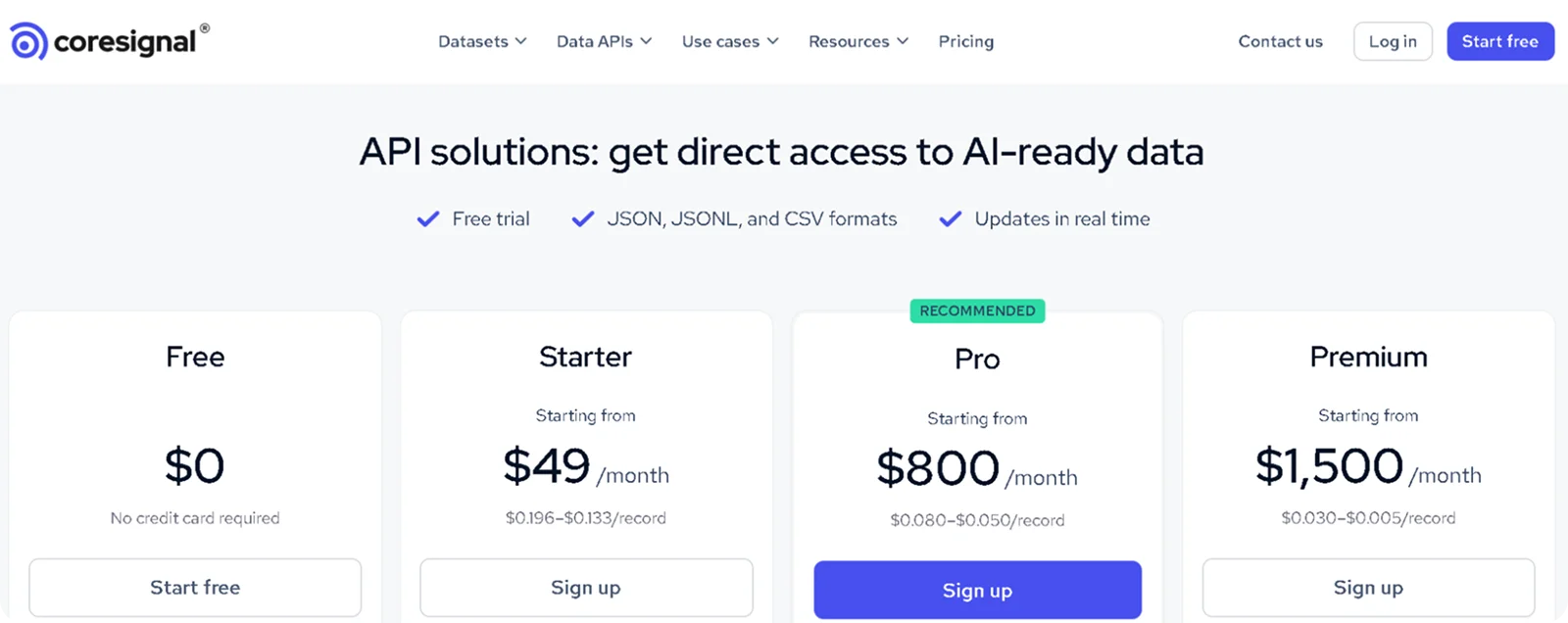
Coresignal offers separate pricing for APIs and bulk datasets with clear tiered plans.
API Plans:
Free Trial: $0 with 200 Collect credits and 400 Search credits (valid 14 days)
Starter: From $49/month with 250 Collect credits and 500 Search credits
Pro: From $800/month with 10,000 Collect credits and 20,000 Search credits
Premium: From $1,500/month with 50,000 Collect credits and 150,000 Search credits
One Collect credit retrieves one profile. Multi-source company data costs two Collect credits per record. Search credits come included at no additional cost, typically double or more the Collect credits. Annual plans provide credits upfront.
Dataset Pricing: Bulk datasets start at $1,000/month with monthly payments on yearly contracts. Final pricing depends on agreement length, source bundling, data scope, and refresh frequency.
People Data Labs Pricing
PDL uses a credit-based system where different APIs consume varying credits per request.
Plan Tiers:
Free Plan: $0 for up to 100 person/company lookups monthly
Pro Plan (Person Data): From $98/month for 350 person enrichment credits
Pro Plan (Company Data): From $100/month for 1,000 company lookups
Enterprise Plan: Custom pricing
Credits are consumed per successful API match. Person and Company Enrichment APIs typically consume one credit per request. Search APIs consume one credit per profile returned.
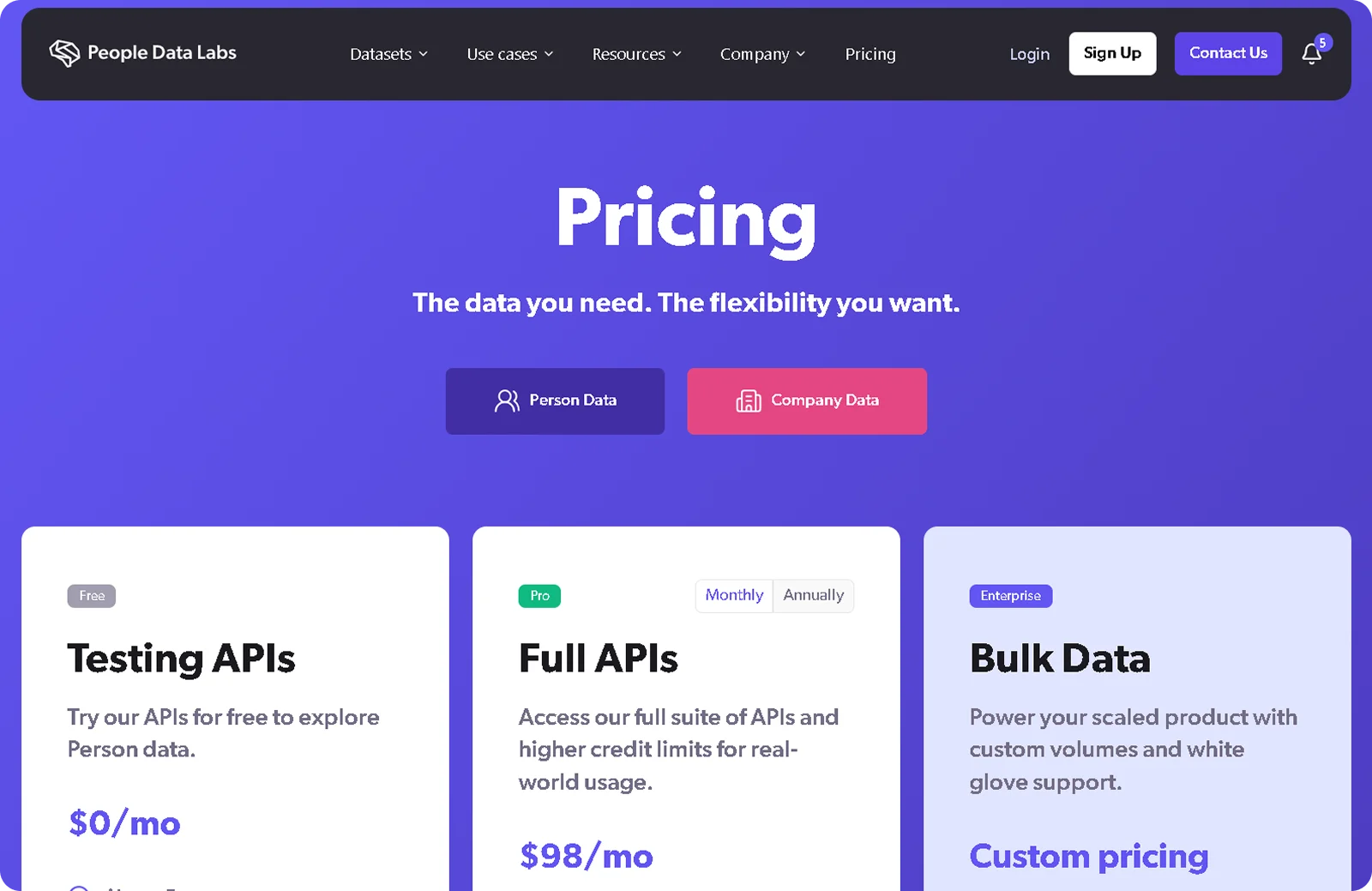
This table compares their pricing structure side-by-side:
Feature | Coresignal | People Data Labs |
Free Trial | 200 Collect + 400 Search credits (14 days) | 100 lookups/month (ongoing) |
Entry API Plan | $49/month (250 credits) | $98/month (350 credits) |
Mid-Tier Plan | $800/month (10,000 credits) | Custom pricing |
Dataset Access | From $1,000/month | Contact sales |
Data Formats | JSON, JSONL, CSV, Parquet | JSON only |
Coresignal provides upfront tier pricing with visible credit allocation through a self-service dashboard. PDL uses volume-based pricing that varies by credit consumption and API endpoint. Enterprise pricing and bulk dataset access require vendor contact for custom quotes.
Use Cases and Applications
Coresignal's strength in company profiles and job postings supports several workflows. Common use cases include:
Sales teams: Enrich leads with tech stack, funding data, and headcount to qualify prospects faster
Market researchers: Conduct competitive intelligence and track industry trends with comprehensive company data
Venture capital firms: Analyze workforce growth and leadership changes to spot investment opportunities early
Business analysts: Access multi-source firmographics for market research and competitive analysis
People Data Labs Use Cases
People Data Labs' massive person database powers technical teams across multiple industries, including:
Recruiting platforms: Source candidates by skills and employment history through Person Search API
Sales intelligence teams: Find decision-makers with specific job titles and contact information
Data scientists: Feed structured profiles into machine learning models for lead scoring and fraud detection
Product developers: Build data-driven applications with standardized person and company datasets for AI model training
Integration and Technical Implementation
Both providers offer REST APIs with API key authentication, but their integration approaches cater to different technical workflows.
Coresignal Integration
Coresignal prioritizes flexibility with multiple delivery methods and self-service testing tools:
Playgrounds: Test queries without writing code in their self-service platform
Data formats: JSON, JSONL, CSV, and Parquet for flexible delivery
Credit consumption: One credit per standard data request, two credits for multi-source records
Dataset downloads: Direct link, Google Cloud Storage, and AWS S3 delivery options
Delivery schedules: Daily, weekly, or monthly file deliveries for offline analysis
Pre-built connectors: Integrates with Clay, Pipedream, and Cargo
People Data Labs Integration
PDL focuses on developer-friendly tools designed for real-time API workflows:
SDKs: Python, JavaScript, Go, Ruby, and Rust for faster integration
Data format: JSON, CSV, and Parquet exclusively through their APIs
Search capabilities: Elasticsearch query syntax for complex filtering
Enrichment endpoints: Accept simpler parameters like email address
Request handling: SDKs handle request formatting automatically
API focus: Primarily designed for real-time enrichment workflows
Pre-built connectors: Connects with Salesforce, HubSpot, Databricks, Snowflake, and AWS Data Exchange
Implementation follows the same pattern for both providers: send requests to specific endpoints, parse responses, and load results into CRM systems or databases.
Which Provider Should You Choose?
When decision-makers change roles between scheduled updates, you miss the window to reach them at the right time. By the time batch data refreshes, your outreach references outdated information.
Crustdata is the better choice when the data has to be right at the moment you use it. It gives you real-time enrichment, 60+ people filters, and Watcher webhooks on job changes and funding. Coresignal fits teams that want a fixed company and job-postings dataset to research against. People Data Labs fits teams building on a large, static person database.
Both providers use batch processing with scheduled refresh cycles. This creates timing gaps between when changes occur and when you access the data. Crustdata addresses this limitation through real-time data crawling instead of batch updates.
Why Crustdata Is the Better Alternative
When decision-makers change roles between scheduled updates, you miss the window to reach them. Crustdata crawls the web live at the moment of the request. When you query a profile or company, it pulls fresh data from 15+ verified sources.
Here's how Crustdata solves the batch processing limitations:
Real-time webhooks: The Watcher API provides real-time webhooks for multiple datapoints and sends instant notifications when events occur, such as job changes, promotions, funding rounds, social posts, and hiring activity
Multiple signal tracking: Monitor hundreds of datapoints across companies and people, not just basic job changes
Unified data sources: Access SEC filings, company news, product reviews, employee ratings, and web traffic through a single API
No integration overhead: Get comprehensive profiles without managing separate vendor integrations
Live crawling: Every query returns current data pulled at request time
Ready to see how real-time data transforms your workflows?
Book a demo to learn how Crustdata delivers the current, accurate intelligence your team needs.
FAQs
Can I Combine Multiple Data Providers To Get Better Coverage?
Yes, but managing multiple vendors creates integration complexity, higher costs, and inconsistent data formats. You'll spend engineering time reconciling conflicting information and building custom pipelines. A unified provider with real-time crawling eliminates these headaches.
Do Coresignal And People Data Labs Offer Refunds For Incorrect Data?
Both providers charge credits for successful API matches, not accuracy guarantees. If enriched data contains errors or outdated information, you typically don’t get credits back. Review their data quality policies and test with free trials before committing to paid plans.
Can I Track Competitors’ Hiring Patterns With These Data Providers?
Yes, but only retrospectively with batch updates. You learn about competitor hiring after positions have been filled for weeks. This limits strategic response time. Crustdata’s Watcher API monitors competitor job postings and headcount changes in real time, giving you actionable intelligence when it matters.


Products
Popular Use Cases
Competitor Comparisons
95 Third Street, 2nd Floor, San Francisco,
California 94103, United States of America
© 2026 Crustdata Inc.
Products
Popular Use Cases
Competitor Comparisons
95 Third Street, 2nd Floor, San Francisco,
California 94103, United States of America
© 2026 CrustData Inc.
Products
Popular Use Cases
Competitor Comparisons
95 Third Street, 2nd Floor, San Francisco,
California 94103, United States of America
© 2026 Crustdata Inc.
🎉 We hit $10M ARR!
$600k to $10m in 1.5 years. Our entire GTM is powered by our own APIs.
🎉 We hit $10M ARR in 1.5 years!