People Data Labs Alternatives and Competitors, Compared Across 6 Critical Factors
Compare People Data Labs alternatives and competitors on data freshness, coverage, accuracy, pricing, and support, plus which options fit real-time workflows.
Published
Written by
Chris P.
Reviewed by
Nithish A.
Read time
7
minutes
People Data Labs has built one of the largest aggregated B2B datasets available. We're talking about 3+ billion person profiles, 60+ million companies, and over 200 data fields per record, all accessible through a developer-friendly API. For years, PDL solved the access problem: one integration point for massive coverage across industries and geographies.
Today, however, demand has shifted from ease of access to information freshness.
Teams running AI agents, automated SDRs, and event-driven workflows need data that reflects current reality, not last month's. PDL's monthly batch update model means information can be weeks old by the time you query it.
This guide evaluates eight PDL alternatives across six critical factors: freshness, coverage, accuracy, ease of use, pricing, and support. We will also discuss providers suitable for specific use cases, such as webhook-driven workflows, high-volume enrichment, and all-in-one sales platforms. If Enrichlayer is also on your shortlist, we weigh up Enrichlayer alternatives the same way.
Why teams look for alternatives to People Data Labs
PDL does a lot of things right. But for certain use cases, its limitations become deal-breakers. Here's why teams start exploring other B2B data API providers.
Data freshness concerns
PDL updates its datasets monthly. That sounds reasonable until you realize what it means in practice: information can be weeks old by the time you query it. For teams running AI-driven outreach or real-time workflows, this creates a frustrating gap between what your system thinks is true and what's actually happening in the world.
No real-time event triggers
PDL offers job-change tracking, but it operates on that same monthly cycle. What it doesn't offer: instant notifications for funding rounds, social media activity, or hiring surges. If your sales motion depends on catching moments as they happen, you're stuck watching the rearview mirror instead of the road ahead.
Restrictive API and rate limits
Scaling with PDL can get tricky. Rate limits are defined on a per-key basis using a fixed-window strategy. Free customers are limited to 100 requests per minute, while paying customers receive 1,000 per minute for enrichment. But here's where it gets complicated: the Search API has a default rate limit of just 10 requests per minute. For AI applications that need high-volume enrichment or rapid-fire queries, these limits can become a serious bottleneck.
Complex integration
PDL's schema is incredibly detailed, which is great for data richness but challenging for implementation. Location data, for example, splits into multiple subfields: name, locality, region, metro, country, continent, street_address, address_line_2, postal_code, and geo coordinates. This granularity increases implementation time and creates more opportunities for mapping errors when you're building integrations.
Coverage gaps
PDL pulls from aggregated datasets, but it lacks some signals that modern sales teams need. You won't find social media post content, real-time company activity signals, or multi-source verification in a single query. The platform relies heavily on resume-style data rather than live behavioral signals.
Customer support frustration
On Trustpilot, PDL holds an average rating of 2.8 out of 5 with some pointed criticism. Users mention that they do not offer any kind of answers or support, just generic, random emails, and that the platform is hard to leave once you have signed up. When you're paying premium prices, responsive support shouldn't be optional.
People Data Labs Pricing Structure
People Data Labs offers a variety of pricing tiers, starting with a Free Plan at $0 for basic access, the Pro Plan begins at $98 per month designed for more intensive usage, while the Enterprise Plan, customized for extensive business needs, varies in pricing based on custom requirements.
The Free Plan provides access to up to 100 monthly records for both person and company data with ISO & SOC 2 Type 2 compliance, while the Enterprise Plan offers custom pricing for both person and company data, customized for large-scale needs with premium fields, dedicated support, and advanced security features.
The final price for People Data Labs services is influenced by several factors. Annual contracts offer a 20% discount providing major savings over month-to-month billing, higher volumes of data records come with custom pricing especially under the Enterprise plan, and access to premium fields and specific API features can affect pricing particularly for Enterprise customers.
The pricing structure uses a credit-based system where different APIs consume varying amounts of credits per request. This complexity can make it hard for users to predict costs accurately, especially when using multiple APIs or handling variable query volumes.
PDL Feature Comparison Table
Feature | People Data Labs | Crustdata | Apollo.io | ZoomInfo |
|---|---|---|---|---|
Data Updates | Monthly | Real-time | Real-time | Weekly/Monthly |
Webhooks | Job changes only | Multiple signals & custom | Job changes | Limited |
Social Media Data | Basic (Links only) | Links, Posts, reactions, comments | Basic | No |
API Response Time | Standard | Live crawling | Standard | Standard |
Data Sources | 3-5 sources | 10+ sources | Multiple | Proprietary |
Pricing Model | Credit-based | Usage-based | Subscription | Subscription |
This comparison shows the key differentiators between PDL and its alternatives. The real-time data updates and multiple signal webhooks offer major advantages for businesses that need current information for their operations.
When evaluating vendors, access to accurate B2B data is essential for organizations running automated workflows
Top People Data Labs alternatives compared
Now let's put the framework into action. Below, we evaluate eight PDL alternatives across our six criteria: data freshness, coverage, accuracy, ease of use, pricing, and support.
Each provider occupies a different niche. Some prioritize real-time data for trigger-based workflows. Others bundle enrichment with outreach tools. A few focus exclusively on compliance or specific geographies.
We'll start with developer-focused platforms built for API-first teams, then move to enterprise sales intelligence suites, and finish with mid-market options that balance features against budget constraints.
Provider | Data Freshness | Coverage | Accuracy | Ease of Use |
Crustdata | Real-time: Live indexer with crawl-on-demand for untracked companies. | 10+ diverse sources, 1B+ profiles: Includes firmographics, social signals, and product reviews. | Verified: Real-time web-indexing at the moment filters are applied. | Developer-first: API and Webhook-centric; includes a unique Watcher API. |
Coresignal | Moderate: API DB refreshed every 6 hours; datasets on daily/monthly cycles. | 780M+ profiles: Massive historical data covering 74M+ companies. | Variable: Tiers range from raw "Base" data to cleaned "Multi-source" data. | Technical: Delivered via API, Snowflake, GCS, or flat files. |
Clearbit | High: Continuous background refresh; real-time API responses for enrichment. | 200M+ profiles: Strong focus on SaaS, tech, and North American B2B sectors. | High-fidelity: Strongest for de-anonymizing IP traffic (Reveal API). | Native: Seamlessly integrated as HubSpot "Breeze Intelligence". |
ZoomInfo | Moderate: Standard data updated in monthly cycles; intent is more current. | 321M+ profiles: Dominates US mid-market and enterprise firmographics. | High (US): High accuracy for direct dials via the contributory network. | Platform-first: Heavy learning curve; designed for manual sales reps. |
Dropcontact | Absolute: No database; generates and verifies emails in real-time via algorithms. | Enrichment-only: Requires existing names to find emails; no search/discovery. | 98% valid: Guaranteed email validity via live SMTP verification. | Zero-admin: Native CRM integrations; Google Sheets add-on available. |
Cognism | High: "Diamond Data" phone-verified; refreshed every 30 days. | 400M+ profiles: Market leader for EMEA and DACH region compliance. | 87% connect rate: High connect rates due to manual phone verification. | Manual focus: Designed for SDR phone outreach; no webhook automation. |
Bright Data | Variable: Real-time Scraping APIs; monthly marketplace datasets. | 1B+ records: Structured datasets from LinkedIn, Crunchbase, and Indeed. | Infrastructure-grade: 99.99% uptime for data extraction reliability. | Complex: Requires engineering work to manage extraction pipelines. |
Apollo.io | Moderate: Contributory network with waterfall enrichment cycles. | 275M+ contacts: Large global reach across 73M companies. | 80–90%: Good for volume prospecting; higher bounce rates than premium tools. | Excellent: All-in-one engagement suite (sequences, dialer, CRM). |
1. Crustdata
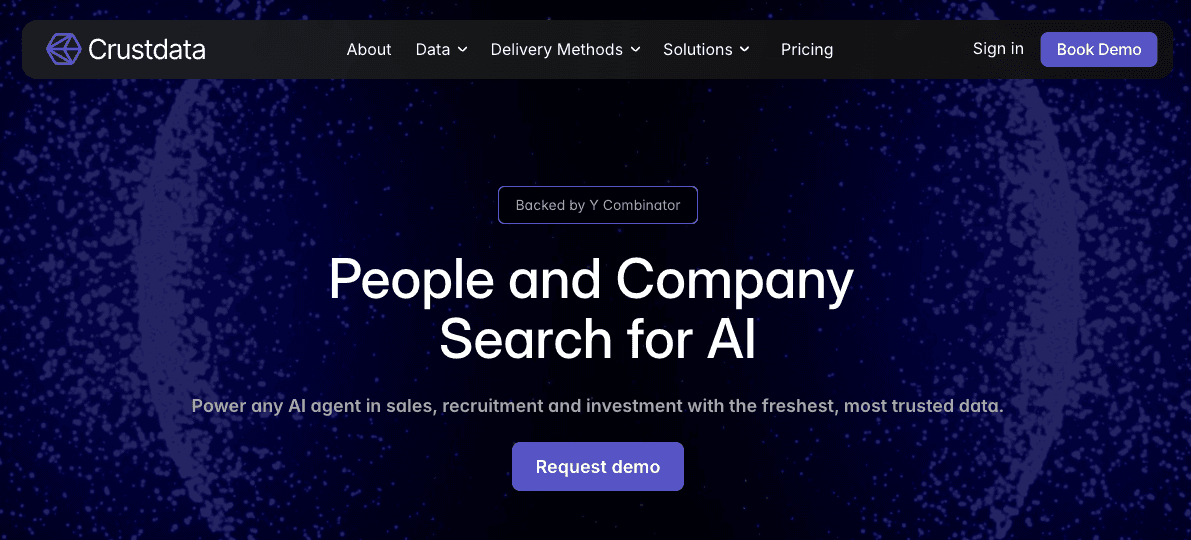
Crustdata is a real-time data infrastructure platform engineered for AI agents and event-driven sales workflows. Unlike legacy providers that serve cached, month-old database exports, Crustdata utilizes a live indexing architecture to provide instantaneous data access.
Freshness: Best-in-class. While competitors rely on monthly or quarterly batch data enrichment, Crustdata operates as a live indexer. It performs on-demand web crawling to enrich profiles for untracked companies within minutes, ensuring data reflects real-world changes immediately.
Coverage: Extensive data coverage: 60M+ companies and 1B+ people profiles, with verified business emails, social profiles, and signals, work history, funding, and hiring. It aggregates data from over 10 diverse sources, including traditional firmographics and non-traditional signals like app store reviews, social media metrics, and web traffic analytics.
Each company profile includes over 200 fields covering structural, financial, and operational metrics. Data points include name, industry, HQ location, description, category, revenue, and web traffic trends. Headcount is broken down by department and geography, with growth tracked quarter-over-quarter, month-over-month, and year-over-year.
The platform's entity resolution system automatically handles naming variations such as "OpenAI" and "Open AI", consolidating records correctly regardless of how entities appear across sources.
Accuracy: Verified through a real-time search and enrichment option that indexes the web as filters are applied. This multi-source consolidation eliminates the staleness common in static databases.
Ease of use: Developer-first design with a clean, well-documented API. For known targets, the Enrichment API returns 200+ data points per company and 90+ per person and supports both real-time crawling and cached database responses depending on freshness requirements.
The Search API has 60+ search filters with nesting capabilities, which let you build virtually unlimited filters to find the exact person or company you need. The unique Watcher API eliminates polling by pushing real-time webhook notifications for specific triggers like job changes, funding rounds, or hiring surges.
The platform also offers data delivery via flat files, delivered via Amazon S3 as Parquet files.
Pricing: Transparent, credit-based, self-serve pricing model. It avoids the "platform taxes" or mandatory enterprise seat licenses required by legacy vendors, making it viable for high-volume AI automation.
Support: High-touch engineering support. Every customer receives a dedicated Slack channel staffed by 4-5 technical team members for immediate request resolution.
Best for: AI SDR platforms, VC deal-sourcing tools, and GTM teams requiring instant, event-driven triggers where data velocity is a competitive requirement.
2. Coresignal
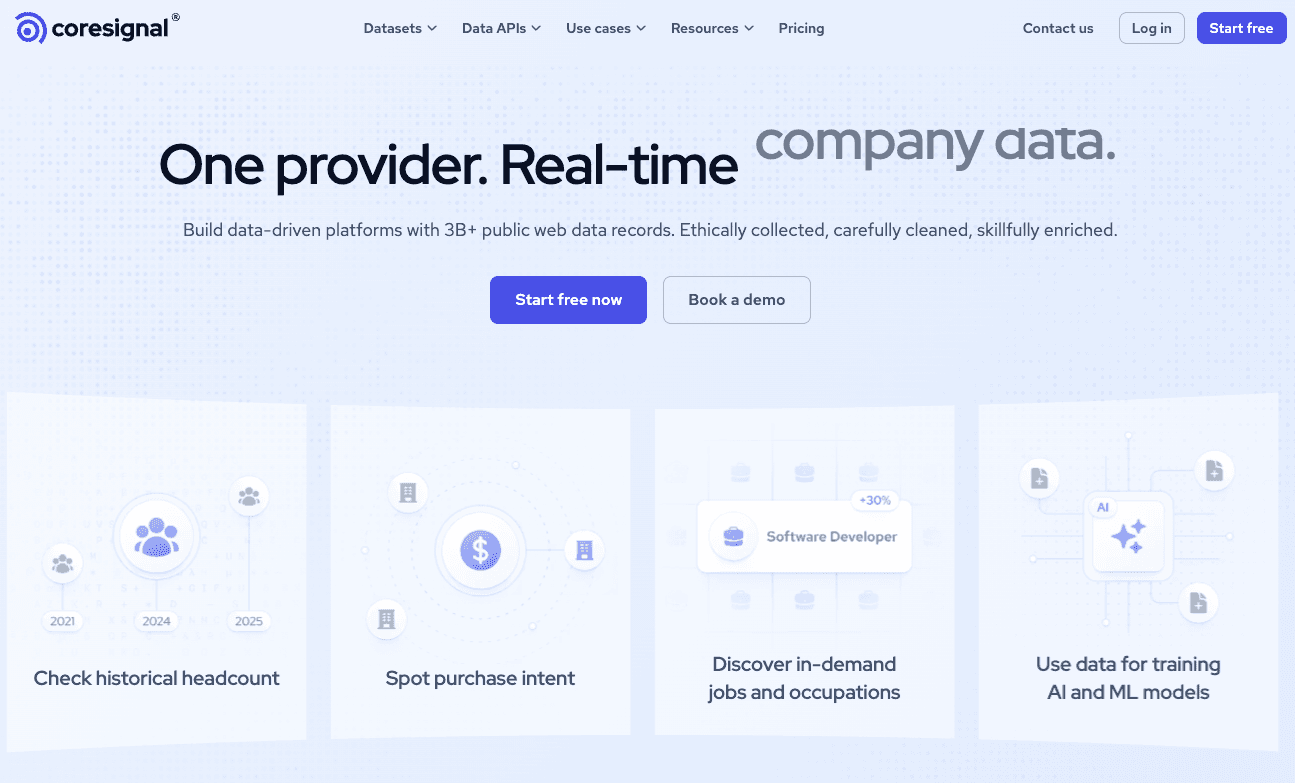
Coresignal is a public web data vendor specializing in large-scale B2B alternative datasets for investment research, HR tech, and AI/ML training. It focuses on providing raw and enriched data points rather than a finished outbound sales platform.
Freshness: Moderate. While the database connected to its API updates in real-time, most underlying datasets follow daily, weekly, or monthly refresh cycles. It lacks a real-time search API, meaning users can only query existing database entries and cannot discover new profiles on demand.
Coverage: Massive and historical. Features over 839 million person profiles and 75 million enriched company records. Data points extend beyond standard firmographics to include salary data, technographics, historical headcount, and social media metrics.
Accuracy: High for structured analysis. Data is aggregated from multiple public web sources, cleaned, and offered in multiple tiers (Base, Clean, Multi-source) to match specific processing needs.
Ease of Use: High technical flexibility. Offers data delivery via APIs, flat files, and cloud integrations like Snowflake, S3, GCS, and BigQuery. However, it lacks extensive custom event automation for outbound sales.
Pricing: Accessible and transparent for mid-market users. Entry-level plans start at $49/month for dataset access.
Support: Technical and structured. Provides dedicated account management, engineering support, and an interactive API playground for developers.
Best for: Investment firms, recruiters, and market analysts who require deep historical company data and salary insights but do not need real-time prospect discovery for outbound sales.
3. Clearbit (now Breeze Intelligence)
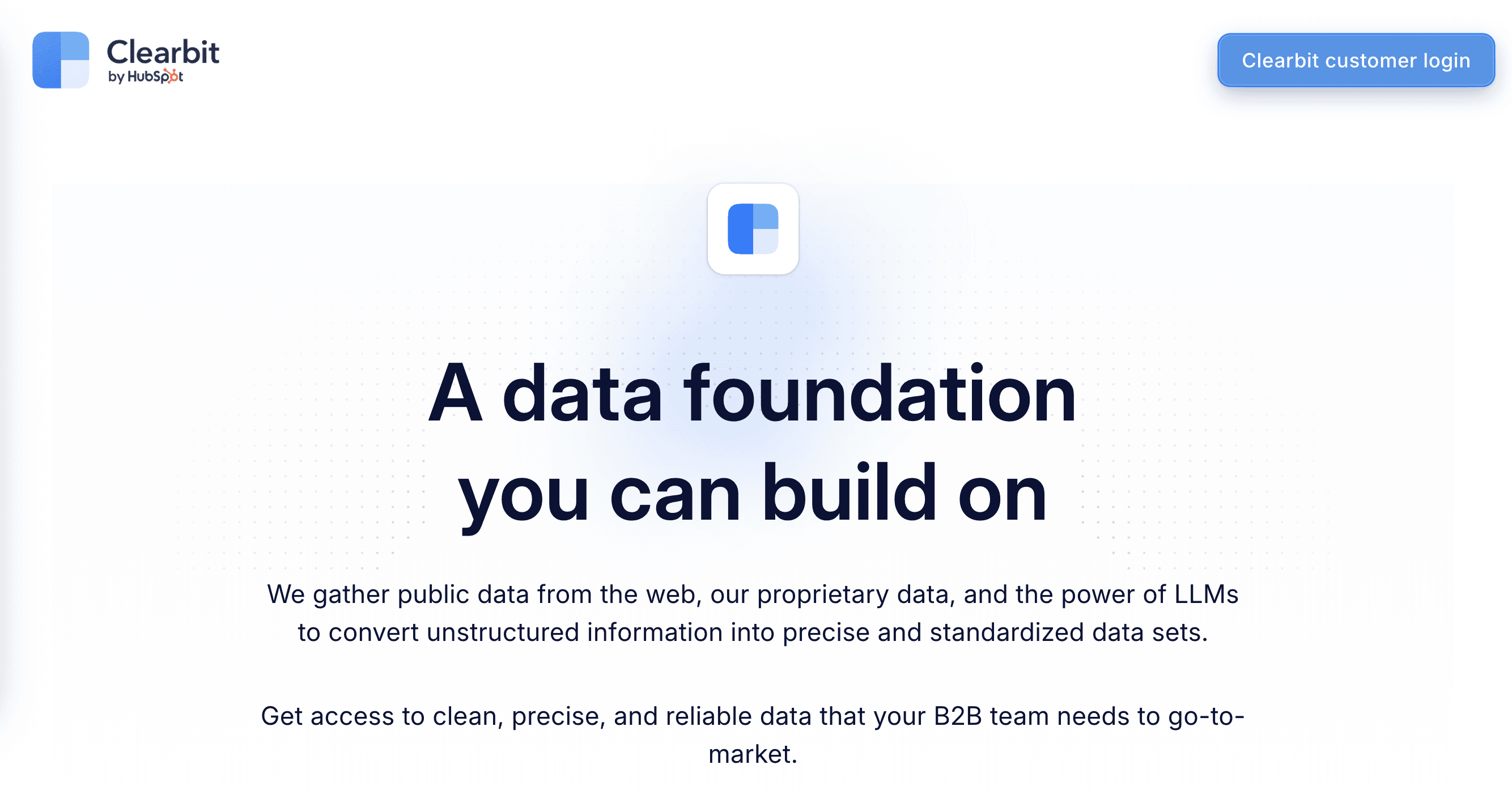
Clearbit, acquired by HubSpot, has transitioned from a standalone developer-first data API into the data engine powering HubSpot’s Breeze Intelligence. While it still offers enrichment services, its primary value proposition has shifted to being the Smart CRM layer for HubSpot users. It differentiates itself with just-in-time data enrichment, meaning it appends data the moment a lead enters your system (via form or signup) rather than waiting for a batch update.
Freshness: High for enrichment. Delivers data instantly upon record creation or manual request. Continuous enrichment allows existing records to be updated automatically every 30 days without consuming additional credits.
Coverage: Accesses over 200 million buyer and company profiles with 100+ B2B attributes. Coverage is strongest in tech, SaaS, and North American B2B sectors.
Accuracy: High-fidelity data. Combines public web data, proprietary sets, and LLMs to standardize unstructured information. It is particularly valued for its Reveal IP intelligence, which matches anonymous traffic to specific companies.
Ease of Use: Exceptional for HubSpot users. It operates natively within CRM records and workflows. Features like Form Shortening dynamically hide known fields to improve conversion rates. Maintains a rate limit of 600 requests per minute for its standard endpoints (like Name-to-Domain), offering high throughput for developers.
Pricing: Credit-based model using unified HubSpot Credits. Limits are tied to your HubSpot tier, with Enterprise tiers supporting high-volume programmatic access.
Support: Leverages HubSpot’s enterprise-grade infrastructure, including premium account management, extensive documentation, and active community forums.
Best for: B2B sales and marketing teams already operating within the HubSpot ecosystem who require seamless CRM enrichment, automated lead scoring, and account-based intent tracking without managing external APIs.
4. ZoomInfo
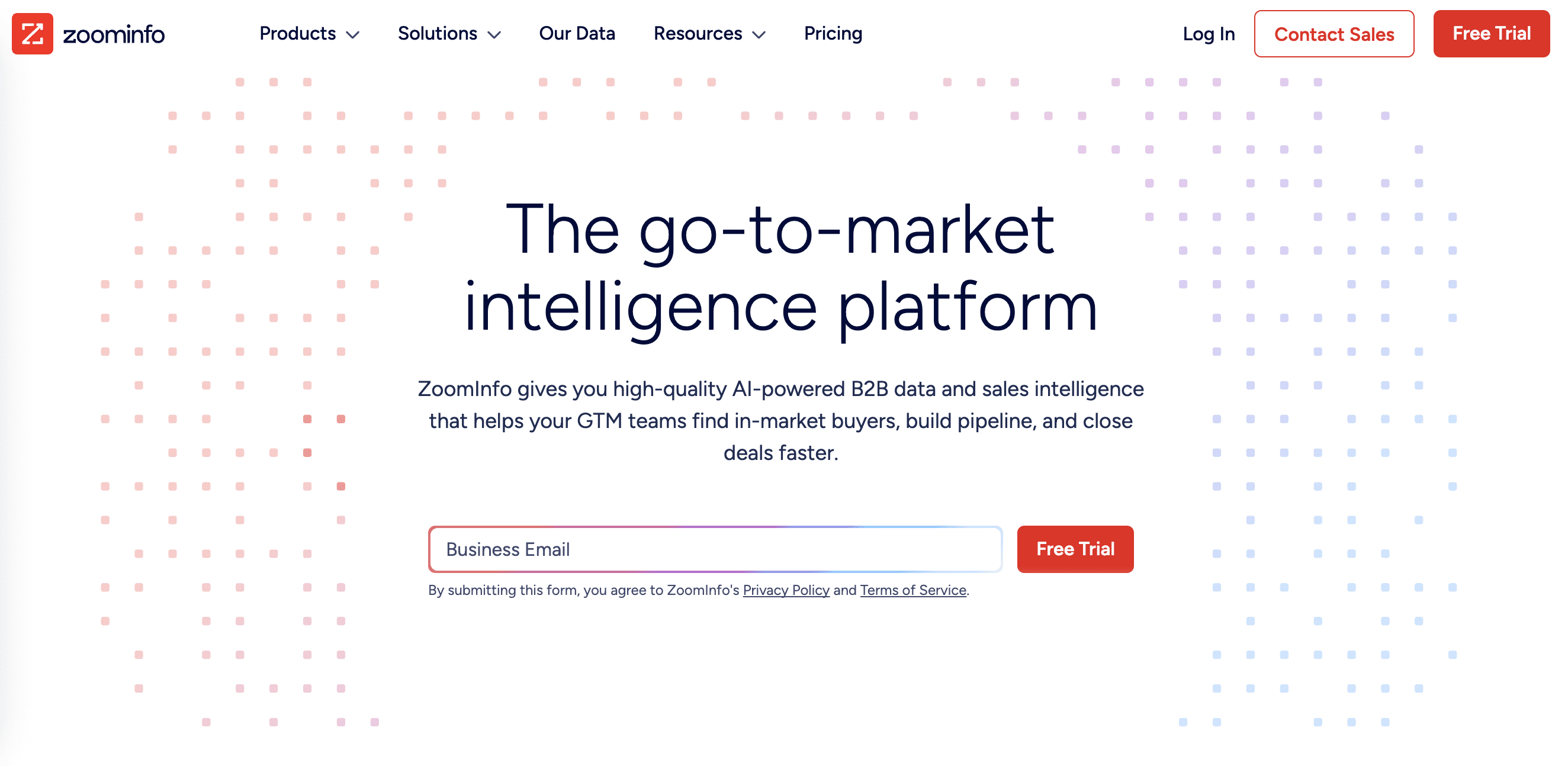
ZoomInfo is an enterprise-grade go-to-market (GTM) intelligence platform that combines an expansive B2B database with workflow automation tools. It functions as an all-in-one ecosystem for sales, marketing, and recruiting teams.
Freshness: Moderate. While intent signals approach real-time, the base contact and company data are primarily updated in monthly cycles. Some users report delays in reflecting recent job changes or funding events.
Coverage: Industry-leading in North America. It features over 260–320M+ professional contacts and 100M+ company profiles, including deep firmographic, technographic, and departmental hierarchy data.
Accuracy: High for core US markets, though variable internationally. The platform utilizes a contributory network and manual research to maintain high connection rates for direct dials. However, accuracy for SMB and global data can be inconsistent.
Ease of Use: High for sales reps but complex for technical teams. It offers deep native integrations with Salesforce and HubSpot. Because it is "platform-first," programmatic API access can be cumbersome compared to API-first alternatives.
Pricing: Premium and opaque. Entry-level packages typically do not include location and hierarchy data or social link tracking, requiring multi-year commitments and direct sales negotiations.
Support: Enterprise-grade. It provides extensive documentation, dedicated account managers, and robust training resources for large-scale deployments.
Best for: Large enterprise sales teams with significant budgets who require a comprehensive, US-centric GTM platform and can accommodate monthly data refresh rates.
5. Dropcontact
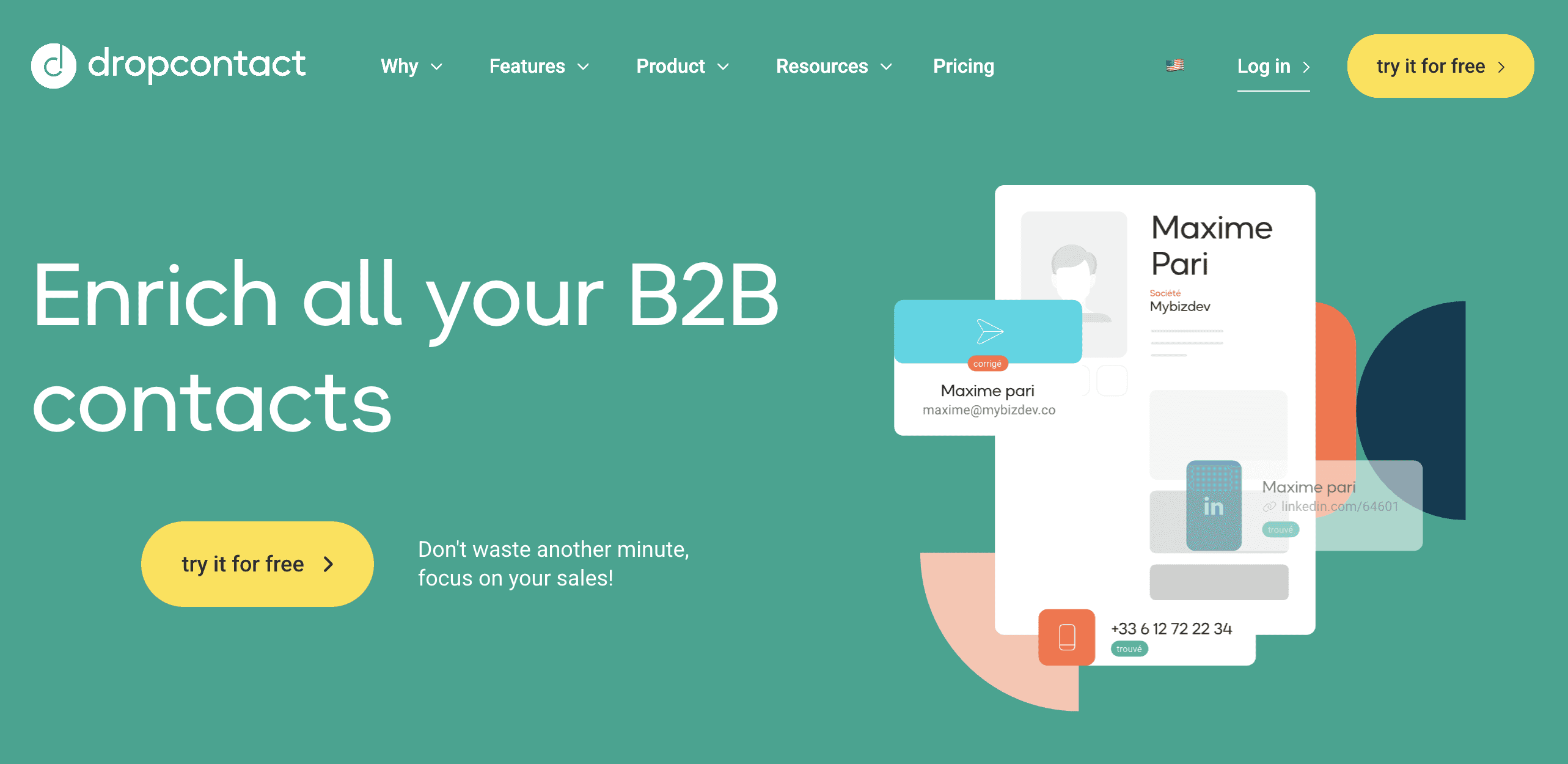
Dropcontact is a specialized enrichment solution that utilizes proprietary algorithms to generate and verify B2B contact data in real-time rather than serving a static database. It is architected specifically for CRM hygiene and email deliverability.
Freshness: Absolute. Because Dropcontact does not store a database, it computes and verifies business email addresses via SMTP at the moment of request, eliminating the risk of stale data common in monthly update models.
Coverage: Enrichment-focused. It requires a name and company/domain to function and provides verified nominative emails, LinkedIn URLs, and standardized company legal data (SIREN/SIRET for France). It does not support prospect discovery or list building.
Accuracy: Industry-leading for email. A company and a first and last name are enough to find an updated and verified email address. All the email addresses enriched by Dropcontact are 98% valid.
Dropcontact won't return an email address unless confident it will actually reach someone's inbox. Each email is checked and guaranteed to be 98% valid (or 85% for catch-alls) by Dropcontact algorithms. Email verification comes included with the email finder service, not as an add-on cost.
The system goes beyond basic validation:
Emails are qualified as @pro, @personal, nominative@, generic@.
If there's an error in a professional e-mail address, Dropcontact detects it and corrects it automatically.
From syntax checks to domain validation and live SMTP tests, Dropcontact ensures that only fully verified, reliable emails make it into your workflows.
All duplicate contact records are detected, even if they have no fields in common, and automatically merged without any data loss. This deduplication happens intelligently across your entire database.
Ease of Use: High flexibility. It offers native integrations for HubSpot and Pipedrive, a Google Sheets add-on, and a drag-and-drop CSV uploader for non-technical users.
Pricing: Transparent and credit-based. Subscriptions start at €29/month for 500 searches (for just the email finder), and users only pay for successful results; if an email is not found, the credit is returned. Getting pricing for full CRM integration requires contacting their sales team.
Support: Lean and personalized. It provides a detailed knowledge base and direct email support with high responsiveness from the engineering and success teams.
Best for: European-based sales teams prioritizing GDPR compliance, CRM data cleansing, and organizations that need accurate email verification for existing leads rather than cold prospect discovery.
6. Cognism
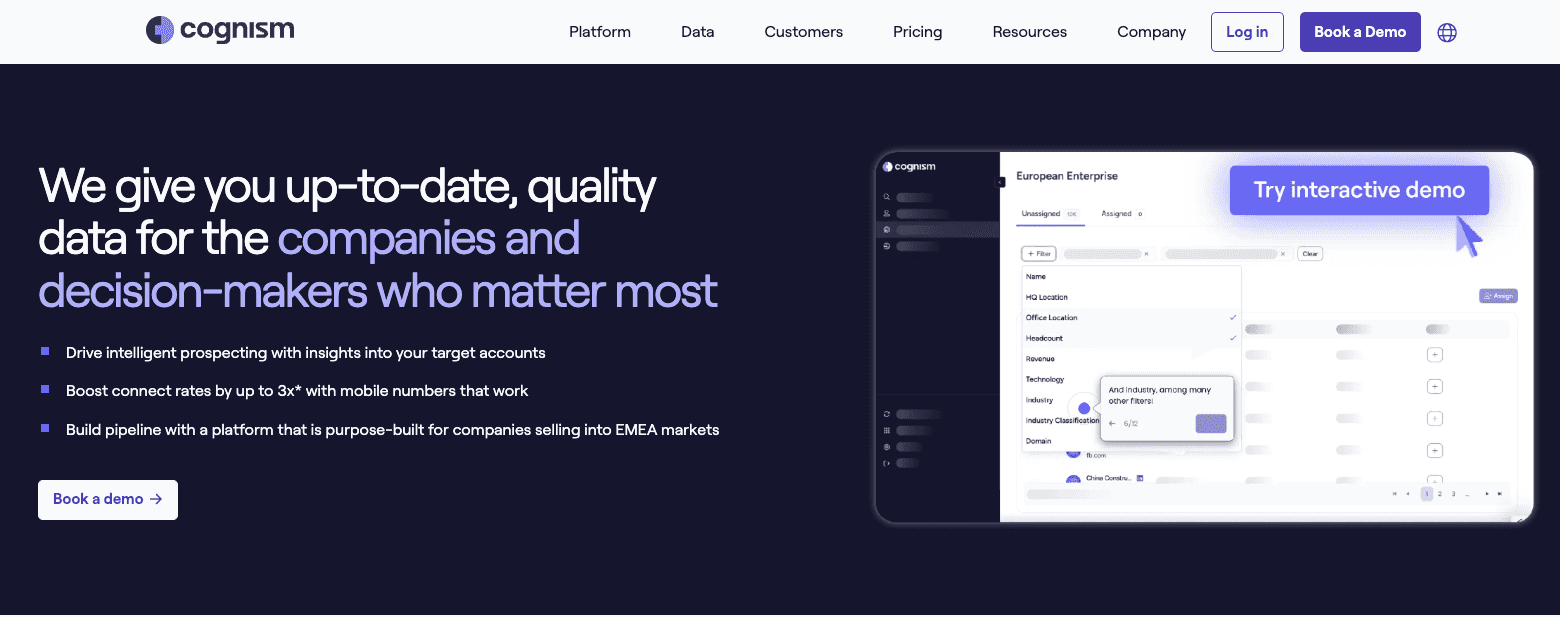
Cognism has built its reputation on one thing sales teams desperately need: phone numbers that actually work. Headquartered in London, the company dominates EMEA markets with its compliance-first approach and phone-verified contact data.
Freshness: Cognism's phone-verified Diamond Data® is tested, verified, and validated by our team to ensure freshness and accuracy. Director-level and above data is continually refreshed on a 30-day basis. Intent signals through the Bombora integration approach.
Coverage: Global database of 400 million people, with exceptional depth in the EMEA and DACH regions. It claims to offer double the volume of mobile numbers compared to standard competitors.
Accuracy: Diamond Data® claims to achieve a 3x better connection rate with prospects, compared to industry averages. Cognism cross-checks data against 14 Do Not Call lists internationally.
Ease of use: Sales Companion browser extension enables prospecting across LinkedIn and corporate websites. Native integrations with Salesforce, HubSpot, and Pipedrive.
Pricing: Cognism offers two pricing packages – Grow and Elevate. Both include verified Diamond Data contacts, CRM integrations, and onboarding and platform training support. However, the exact cost for the packages is not publicly available.
Support: In addition to detailed documentation and an extensive knowledge base, Cognisma also offers live chat and email support.
Best for: Teams selling into European markets where phone outreach and GDPR compliance are priorities.
7. Bright Data
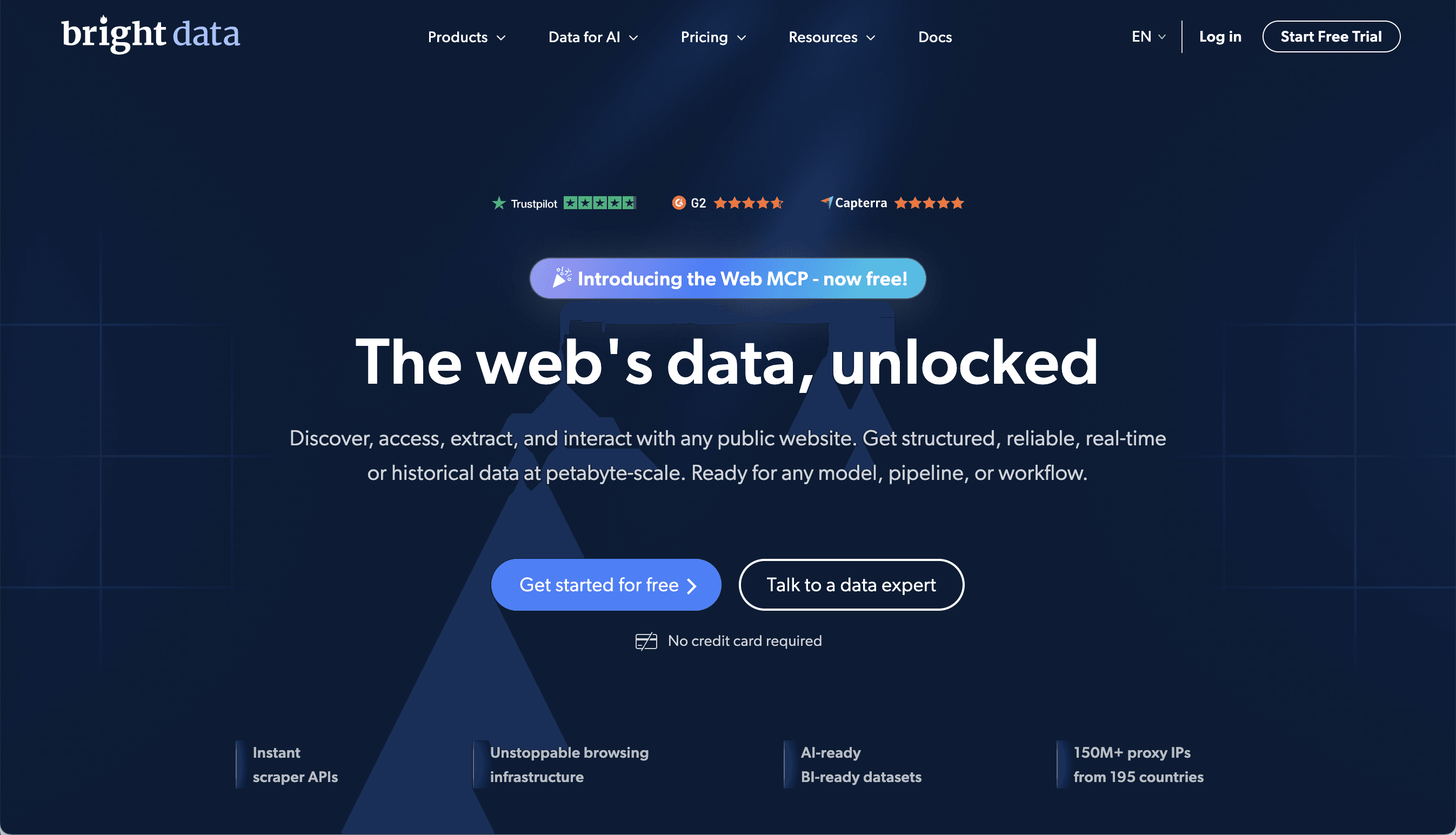
Bright Data is a leading web data infrastructure provider that offers technical teams the tools to build custom extraction pipelines or purchase structured datasets. It operates as an infrastructure layer rather than a turnkey sales database.
Freshness: Variable by product. Its Web Scraping API enables real-time extraction directly from target sites, while marketplace datasets typically refresh on a monthly cadence.
Coverage: Industry-leading scale with access to 120+ domains and 190+ datasets, including deep repositories for LinkedIn, Crunchbase, and Indeed. Its network spans 150M+ real user IPs across 195 countries.
Accuracy: High for data collection, scoring 10.0 on G2 for extraction capabilities. Managed data services offer 95–99% accuracy SLAs, though raw data accuracy depends on the user’s parsing logic.
Ease of use: Moderate to High technical complexity. While it offers no-code scrapers for 120+ sites, full utilization requires engineering resources, such as setting up scraping infrastructure using proxy IPs, to manage JSON/CSV outputs and API integrations. This increases platform complexity for companies that simply want access to the data.
Pricing: Transparent and flexible. Pay-as-you-go starts at $1 per 1,000 results, with monthly dataset subscriptions starting at $250 for 100k records.
Support: Enterprise-grade. Provides 24/7 global technical assistance and dedicated account managers. The company recently solidified its legal standing by winning landmark court cases against Meta and X regarding public data scraping.
Best for: Engineering-heavy teams building custom AI/ML training sets or proprietary competitive intelligence tools that require raw, high-volume web data.
8. Apollo.io
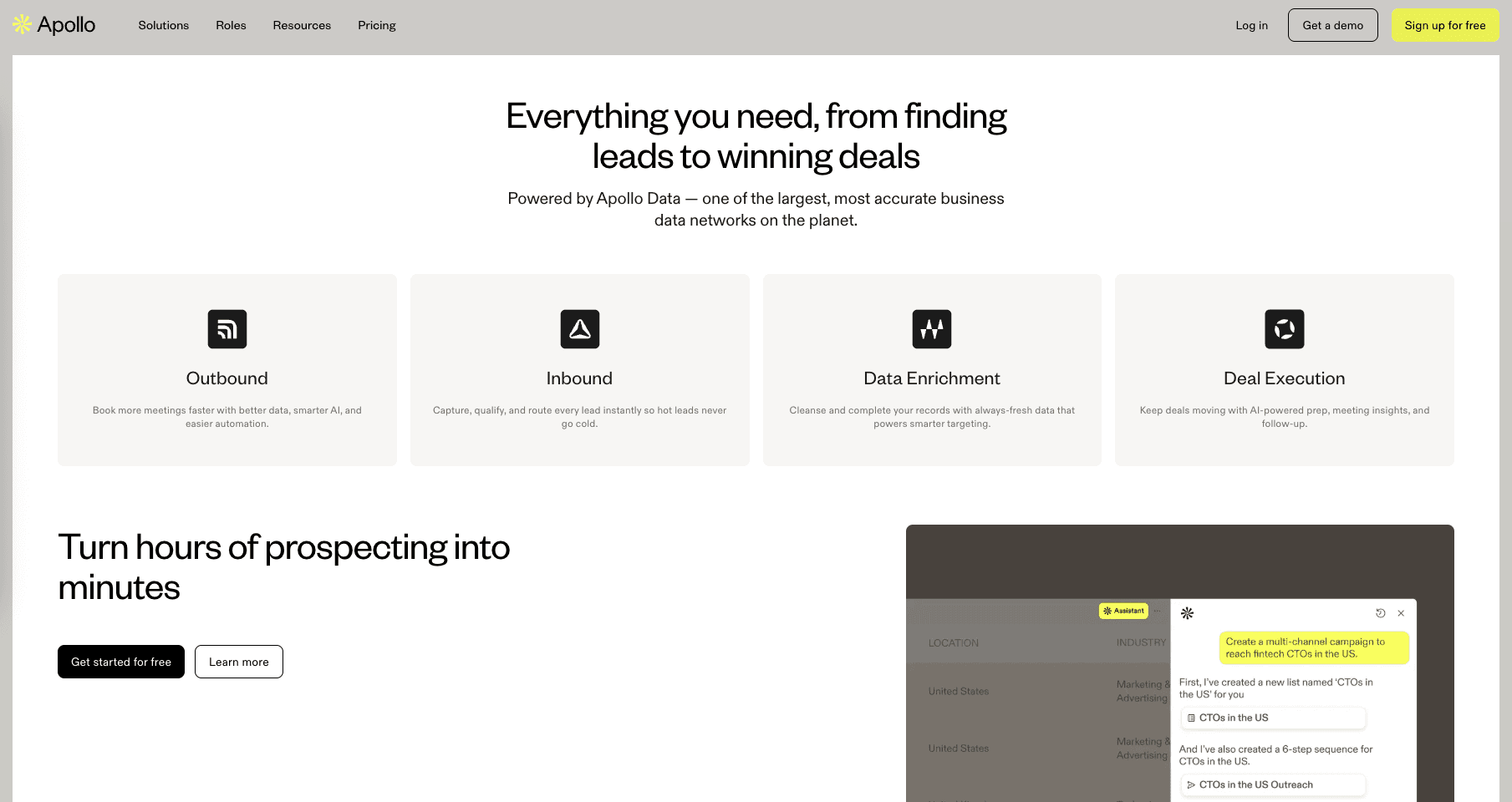
Apollo.io is a high-velocity sales platform that integrates a 275M+ contact database with a built-in engagement suite. It is widely used by startups and mid-market teams for its all-in-one prospecting and sequence automation.
Freshness: High. Uses a "Living Data Network" for continuous updates and provides real-time CRM enrichment. It includes native job-change alerts and AI-driven intent signals to track active buyers.
Coverage: Extensive, featuring over 275 million contacts and 73 million companies. Its Waterfall Enrichment feature allows it to pull from multiple third-party vendors sequentially to maximize match rates.
Accuracy: Reported at 91% by internal metrics, though independent user reviews often estimate effective accuracy between 75–85% depending on the region.
Ease of use: Combines lead search, email sequencing, and a dialer in a single interface. Its Chrome extension is a popular tool for extracting contacts directly from browser sessions.
Pricing: Strong value. Offers a comprehensive free tier. Paid plans range from $49 to $119 per user/month (billed annually), utilizing a credit-based system where unused credits expire monthly.
Support: Reliable for paid tiers. Offers email and chat support, while the free tier relies on a broad community knowledge base.
Best for: Startups and SMBs seeking a cost-effective, unified stack for prospecting and outreach, who value features like sequence automation over premium-verified data.
Crustdata: The best PDL alternative for real-time data
When you put Crustdata vs People Data Labs side by side, three differences decide it: live indexing, multi-source consolidation, and event triggers via the Watcher API. After evaluating all eight alternatives, one pattern becomes clear: most providers still operate on the same batch-update model that makes PDL frustrating for modern sales and AI workflows. They've solved for coverage, but not for currency.
While legacy providers compete on database scale, Crustdata wins on data velocity. Our live indexing architecture performs on-demand web crawling, ensuring your workflows are powered by current reality, not month-old snapshots.
Intelligent multi-source unification: Crustdata consolidates data from over 10 diverse sources, including non-traditional signals like social media metrics and web traffic, into a single record. Its system resolves naming variations automatically, delivering richer and more reliable profiles than single-source databases.
Unmatched event triggers: The Watcher API sets Crustdata apart by pushing instant webhook notifications for job changes, funding rounds, and hiring surges the moment they are detected. This eliminates the need for manual polling and provides a critical first-mover advantage that PDL cannot match.
Architected for AI automation: Purpose-built for technical teams, the platform offers over 60 filter options and near-zero latency. It provides the event-driven infrastructure necessary to keep AI agents and automated SDRs grounded in real-time truth.
For GTM teams building the future of automated sales, Crustdata is the only provider equipped for modern, real-time workflows.
Book a demo with Crustdata to transform your GTM strategy with genuine B2B intelligence.
Frequently Asked Questions
How often does People Data Labs update their data compared to alternatives?
People Data Labs updates their datasets monthly, which means you could be working with information that's weeks old. Real-time alternatives like Crustdata provide live data crawling at the moment of request, so you always have the most current information available.
What should I expect to pay for People Data Labs services?
PDL pricing starts at $98/month for the Pro Plan for 350 records per month with a complex credit-based system where each API call consumes a fixed number of credits depending on the endpoint. The cost per profile averages $0.28. For any startup or business looking to purchase data, the realistic plan would be the Enterprise plan where you will need to talk to their sales team for pricing.
When should I consider switching from People Data Labs to an alternative?
Consider switching if you're experiencing data freshness issues, finding the credit system too complex to predict costs, or need real-time webhooks beyond just job changes. Teams running AI SDRs or time-sensitive outreach campaigns particularly benefit from real-time data providers.
Can I get social media data and advanced webhooks with PDL alternatives?
Yes, alternatives like Crustdata provide complete social media data integration and advanced webhook features across multiple data points with updates delivered in real-time, while PDL only offers basic webhooks that deliver updates monthly. This makes alternatives better suited for personalized outreach and automated workflows.


Products
Popular Use Cases
Competitor Comparisons
95 Third Street, 2nd Floor, San Francisco,
California 94103, United States of America
© 2026 Crustdata Inc.
Products
Popular Use Cases
Competitor Comparisons
95 Third Street, 2nd Floor, San Francisco,
California 94103, United States of America
© 2026 CrustData Inc.
Products
Popular Use Cases
Competitor Comparisons
95 Third Street, 2nd Floor, San Francisco,
California 94103, United States of America
© 2026 Crustdata Inc.
🎉 We hit $10M ARR!
$600k to $10m in 1.5 years. Our entire GTM is powered by our own APIs.
🎉 We hit $10M ARR in 1.5 years!