Why Developer Teams Are Moving From Clay to Direct Data APIs
Clay's UI-first architecture, credit-based pricing, and lack of public API block teams building custom data workflows. Here's what 150+ buyer calls revealed.
Published
Written by
Manmohit Grewal
Reviewed by
Abhilash Chowdhary
Read time
7
minutes
Why Developer Teams Are Moving From Clay to Direct Data APIs
Clay works well for a specific use case: a RevOps team enriching a list of 500 leads before loading them into a sequencer. Where it falls apart is the moment you try to build something programmatic on top of it. Over the last year, we've talked to 150+ companies whose workflows broke at that exact point, and the pattern is consistent across sales teams, recruiting platforms, VC funds, and product builders. Clay's architecture assumes you want a spreadsheet interface, a credit-based enrichment marketplace, and manual column-by-column workflows. Teams building custom data workflows need raw API access, predictable pricing, and data they can pipe into their own code.
This article breaks down the five structural reasons Clay breaks for custom workflows, drawn from those 150+ conversations, and what to use instead.
Sign up for Crustdata's free tier (100 credits included) to test a Clay alternative built for API-first workflows.
The UI trap: when a spreadsheet interface blocks your engineering workflow
Clay's spreadsheet interface is the product, and for non-technical enrichment tasks, it works. The problem surfaces when a technical team tries to make Clay part of an automated pipeline. The interface becomes the bottleneck because every action requires clicking through columns, configuring enrichment providers one at a time, and waiting for row-by-row processing.
One B2B SaaS GTM team we spoke with described the friction: they wanted to run enrichment from a terminal, pipe results into their own scoring model, and trigger outreach without opening a browser. Instead, they were clicking through columns, dragging providers, and watching rows process one at a time. "I wish I could just do things from the terminal instead of going into the UI, clicking the column to enrich and all that stuff," they said. "The UI cannot be fully customized to your particular business. You have to work within their framework."
The same friction shows up in deal sourcing. A venture capital partner building founder enrichment workflows called Clay "super janky" and wanted to move to an LLM-native alternative that could enrich directly from LinkedIn URLs without clicking through a spreadsheet.
This frustration is accelerating as more teams adopt AI coding agents for GTM workflows. A devtools growth consultant building enrichment workflows in Claude Code told us his clients "are more comfortable using coding agents and would probably prefer something that wasn't based around a UI." Another team building an automated outbound platform put it more bluntly: their attempts to use browser automation on top of Clay kept breaking because the platform was never designed for programmatic access. "It's not reliable for running campaigns perpetually," they said.
The learning curve compounds this. G2 reviewers cite "steep learning curve" as the most common complaint (16 mentions across reviews). The pattern in review data is consistent: teams with dedicated RevOps staff who climb the learning curve rate Clay highly, while teams without that resource stall out.
Clay is designed for people who think in spreadsheets, and if your workflow lives in code, the spreadsheet becomes the constraint.
No real API means you can't build Clay into your product
Clay does not offer a public REST API. The HTTP API integration that exists inside the platform is designed for in-platform use only, calling external APIs from within a Clay table. You cannot call Clay's endpoints from your own application, embed Clay's enrichment into a product you're building, or trigger Clay workflows from an external system without workarounds.
This is an architectural limitation that goes deeper than a missing feature on a roadmap. As one technical analysis noted, Clay's processing model is scoped to a table instance and relies on implicit information about each cell. Making that stateless and externally callable would require rethinking the product's core data model.
This limitation was the dealbreaker for the product-building companies we spoke with who needed to embed enrichment into their own platforms. A conversational AI platform building a bring-your-own-API-key system for their users said: "I just need the data, and Clay doesn't provide API endpoint access." The same problem blocks investment teams. One firm manually stitching PitchBook, Apollo, and LinkedIn data into HubSpot wanted to call enrichment on-demand through Claude's MCP integration, but Clay's lack of API meant they couldn't connect their deal sourcing workflow to any enrichment layer programmatically.
In practice, teams that need to call an enrichment endpoint from Python, pipe results into a database, or let an AI agent query company data on demand cannot use Clay for this. They need a REST API they can call directly, with structured JSON responses they can parse and route through their own logic.
For teams in this position, Crustdata's Company Enrichment API and People Enrichment API return structured JSON over standard REST endpoints. A Claude Code agent with Crustdata's MCP server configured can query company and people data directly from a terminal session, or you can call the REST API from any language:
curl 'https://api.crustdata.com/screener/company?company_domain=example.com&fields=headcount,funding_and_investment' \
  --header 'Authorization: Token $auth_token'
curl 'https://api.crustdata.com/screener/company?company_domain=example.com&fields=headcount,funding_and_investment' \
  --header 'Authorization: Token $auth_token'
curl 'https://api.crustdata.com/screener/company?company_domain=example.com&fields=headcount,funding_and_investment' \
  --header 'Authorization: Token $auth_token'
Both paths (MCP for low-code, REST for full control) return the same data, and unlike Clay, you control the orchestration layer.
Token pricing that punishes scale
Clay's credit system is straightforward at small volumes. A single enrichment lookup costs 2-5 credits, a phone number lookup costs 5-10, and a waterfall enrichment across multiple providers runs 10-25 credits per row. At 100 contacts the math is manageable, but at 1,000 it starts to break.
Amplemarket's full-cost analysis found that the advertised annual cost for a 25-user team on Clay's Launch plan ($185/month) works out to $5,940 per year. Actual annual spend, once credit top-ups, required add-on tools (sequencers, dialers, deliverability monitoring), and RevOps time are factored in, typically lands between $75,000 and $120,000. That is a 12x to 20x gap between the listed price and the loaded cost.
The credit economics get worse at scale. When you exhaust your monthly allocation, Clay charges a 50% premium on top-up credits. Failed lookups still consume credits. Multi-step AI workflows can burn up to 25 credits per action. Users on review sites describe burning through plan allocations in days, upgrading to larger plans, and exhausting those within weeks.
A solo recruiter automating market mapping called Clay "extremely expensive because it's token based." A growth equity firm tracking their Clay costs noticed the recent pricing restructuring was actually more expensive because every action now consumes credits.
The deeper problem is that costs become unpredictable. API-first pricing (pay per call, know the cost per endpoint) lets you model costs before you scale a workflow. Credit-based pricing where different actions consume different amounts of an opaque currency makes cost modeling difficult, especially when you're building automated workflows that run without supervision.
Crustdata's pricing charges per API call with published rates per endpoint. Company enrichment and people enrichment each cost 1 credit, and company search costs 1 credit per 100 results, with no waterfall markup, action-based multipliers, or overage premiums.
Enrichment data that bounces, lags, or never arrives
Clay aggregates data from over 100 third-party providers through a waterfall model: if the first provider doesn't return a result, it tries the next, then the next. In theory, this maximizes coverage. In practice, Clay doesn't control the freshness, accuracy, or coverage of any of those underlying sources.
Teams we spoke with reported concrete quality gaps. One outbound agency described the find-people coverage as "horrible" after testing on their target accounts, estimating that 30-40% of Find People results needed re-verification before they could use them in outreach. Another team that had previously used Clay found it "very complicated" and the results inconsistent enough that they stopped relying on it for outreach.
The waterfall approach also creates a compounding cost problem. Each failed lookup in the cascade still burns credits before moving to the next provider. If the first three providers return nothing and the fourth returns a result, you've paid for four lookups. If that fourth result is out of date, you've paid four times for data you can't use.
The root issue is that Clay is a routing layer that doesn't own the underlying data. It doesn't scrape, validate, or refresh any of those sources itself. When a provider's coverage drops or their data goes out of date, Clay's output degrades, and you're paying Clay's markup on top of that degraded data.
For teams that need reliable enrichment, the question is whether to pay a middleman for access to providers you could query directly, or go to a data company that owns the enrichment pipeline. Crustdata enriches from 15+ sources with real-time enrichment for records not already in the database, returning 250+ company datapoints and 90+ people datapoints per query.
You're paying Clay to resell someone else's API
This is the structural problem underneath the pricing and data quality issues. Clay's business model is to aggregate third-party data providers, wrap them in a spreadsheet UI, and charge credits on top of whatever those providers charge. The credit you spend on a Clay enrichment includes Clay's margin on top of the provider's actual cost.
A data product builder told us that "people are just circumventing the Clay abstraction and going directly to their sub-processors and just purchasing using API credits." A growth equity firm described the same trend, with teams "getting their list of sub-processors, all the underlying data providers, and then just going directly to those data providers."
A vertical SaaS company building prospecting into their platform put it plainly: "Clay is not a primary data provider. They are a data aggregator, and that's always going to be more expensive than having a primary data provider, just by nature." They were still paying for ZoomInfo on top of Clay because Clay alone couldn't cover their data needs.
A martech agency running AI-powered outreach workflows crystallized it: "They're a wrapper for APIs. If I can go to the source, then why not?"
The economics of this are straightforward. If a data provider charges $0.01 per enrichment via their API, and Clay charges 5 credits (worth roughly $0.15-$0.30 depending on your plan) for the same enrichment routed through their waterfall, you're paying a 15-30x markup for the convenience of a spreadsheet interface. For a team running 10,000 enrichments per month, that's the difference between $100 and $1,500-$3,000.
This markup is defensible when the UI provides genuine value, when a non-technical user needs the spreadsheet interface to do work they couldn't do otherwise. It stops being defensible the moment the user can write a curl command or configure an MCP server. At that point, the UI is overhead, and the credit markup is a tax on a routing layer you don't need.
The alternative is going direct to data providers via their APIs. Crustdata's API documentation gives you the same search, enrichment, and monitoring capabilities that a platform like Clay would route through, without the intermediary markup. You call the endpoint, get structured JSON, and build your workflow in whatever tool fits: Python, Claude Code, n8n, or your own application.
What to use instead: API-first data for custom workflows
The teams we spoke with who moved past Clay followed a consistent pattern. They identified which data providers Clay was routing them through, evaluated those providers directly, and built their workflows in code or through AI coding agents rather than through a spreadsheet UI.
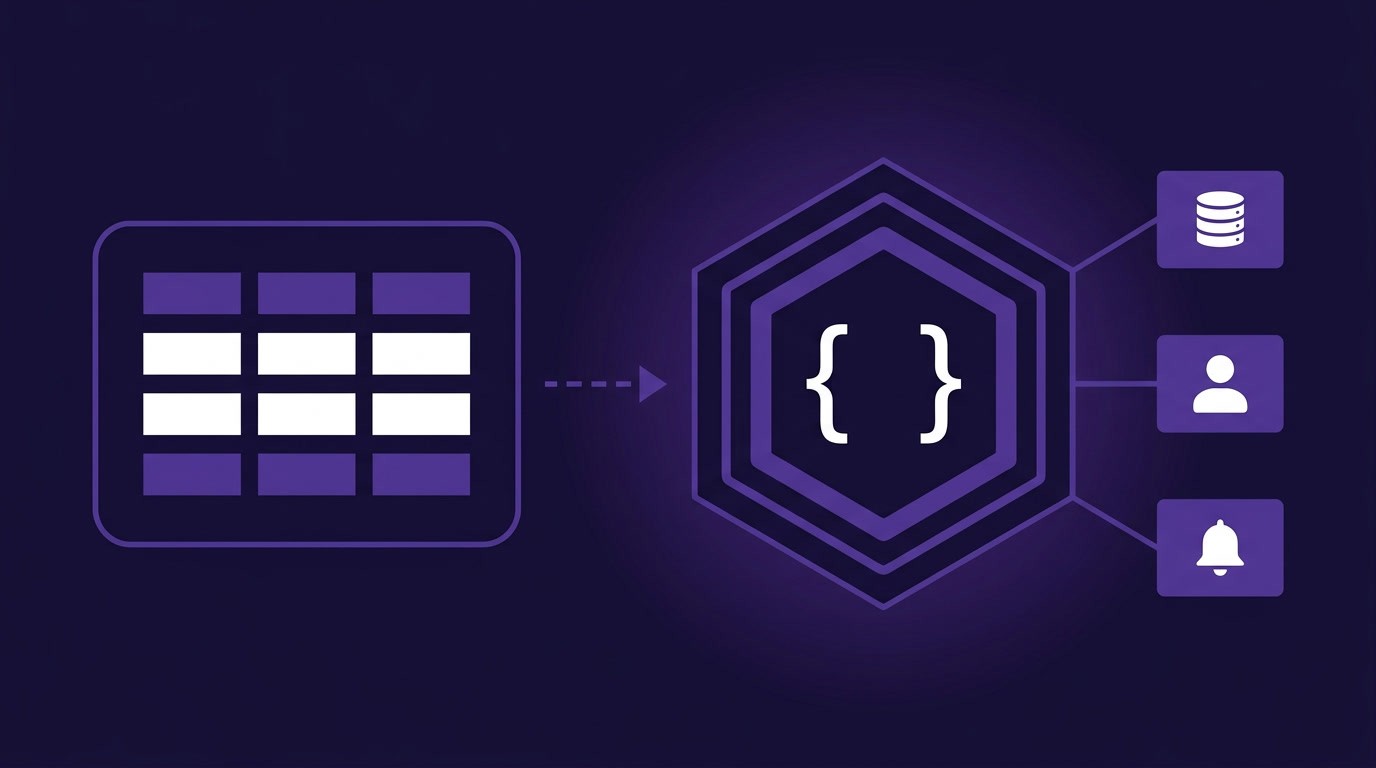
The architecture that works for custom data workflows has three layers:
Data layer: A B2B data API that gives you search, enrichment, and monitoring through REST endpoints. You need company search (filter by headcount, funding, geography, industry), people search (filter by title, skills, company, seniority), enrichment (turn a domain or profile URL into structured data), and monitoring (get notified when a tracked company or person changes).
Orchestration layer: Your own code, a Claude Code agent with MCP server access, n8n, or any workflow tool that can make HTTP requests. The key requirement is that your orchestration layer calls APIs directly rather than operating through a third-party UI.
Destination layer: Your CRM, data warehouse, Slack, or internal tool where the enriched data lands and triggers downstream actions.
Several data APIs can fill the data layer depending on what you need:
Crustdata covers company search (95+ filters across 60M+ companies), people search (60+ filters across 1B+ profiles), enrichment, and change monitoring through the Watcher API, which pushes webhook notifications when tracked companies or people change. The full stack is also accessible through a Claude Code MCP server for agentic workflows. Best for teams that need search, enrichment, and monitoring in a single API with MCP support.
People Data Labs provides raw person and company records through a REST API, with an MCP server available for Claude workflows. PDL's strength is bulk data access for infrastructure-level builds where you're processing hundreds of thousands of records and need raw data at scale, though records are updated on a monthly cycle.
Hunter.io focuses specifically on email finding and verification, with an official MCP server for agentic workflows. If your workflow only needs email addresses and doesn't require company firmographics, headcount data, or people search, Hunter covers that one slice well.
Apollo offers both a platform and a REST API, with a large contact database, built-in sequencing tools, and a native MCP connector for Claude. Apollo's API works well for teams that also want outbound engagement features alongside enrichment, though teams we spoke with reported job change data lagging by up to 90 days on some records.
Cognism provides contact and company enrichment through a REST API with strong coverage in EMEA and phone-verified mobile numbers. If your workflow depends on direct dials, especially for European contacts, Cognism's phone verification is a differentiator that most other data APIs don't match.
The right choice depends on your workflow. If you need a single API for search, enrichment, and monitoring with MCP support, sign up for Crustdata's free tier (100 credits included) or book a demo.
Conclusion
Clay solves a real problem for a specific buyer: a non-technical user who needs to enrich a lead list without writing code. For that use case, the spreadsheet interface, the waterfall enrichment, and the 100+ provider marketplace all make sense.
The problem is that Clay's architecture doesn't stretch to cover teams building custom, programmatic, or agentic data workflows. Without a public API, you can't embed it into your own product. Credit-based pricing makes costs unpredictable once you scale past a few hundred enrichments. The waterfall model adds a markup on data providers you could query directly, and the UI-first design forces every workflow through a spreadsheet when it should run through code.
The 150 teams we spoke with who ran into these limitations followed a consistent path, identifying the data they actually needed, finding a provider with direct API access, and building their workflow outside Clay. If you're building custom data workflows, you probably need the same.



Products
Popular Use Cases
Competitor Comparisons
95 Third Street, 2nd Floor, San Francisco,
California 94103, United States of America
© 2026 Crustdata Inc.
Products
Popular Use Cases
Competitor Comparisons
95 Third Street, 2nd Floor, San Francisco,
California 94103, United States of America
© 2026 CrustData Inc.
Products
Popular Use Cases
Competitor Comparisons
95 Third Street, 2nd Floor, San Francisco,
California 94103, United States of America
© 2026 Crustdata Inc.
🎉 We hit $10M ARR!
$600k to $10m in 1.5 years. Our entire GTM is powered by our own APIs.
🎉 We hit $10M ARR in 1.5 years!