Best AI Sales Tools for B2B Teams in 2026 (Ranked by Sales Cycle Stage)
Published
Apr 3, 2026
Written by
Chris Pisarski
Reviewed by
Nithish
Read time
7
minutes
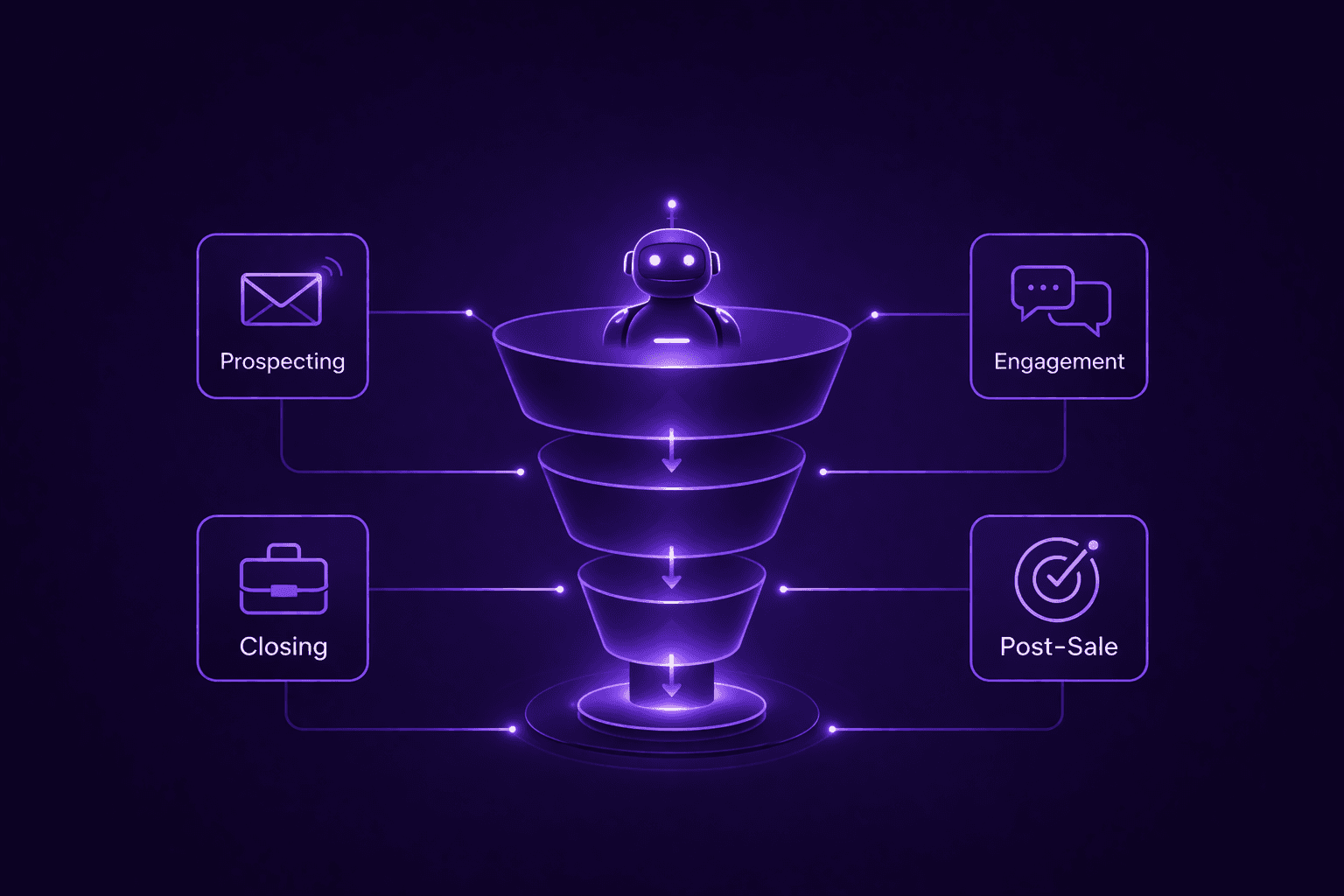
Best AI Sales Tools for B2B Teams in 2026 (Ranked by Sales Cycle Stage)
The average B2B sales team juggles seven to twelve tools, and pipeline still leaks. Adding more software has not fixed the problem because most teams evaluate tools by feature count or vendor category, not by where each tool sits in the sales cycle.
That ordering matters. 67% of Salesforce Agentforce deployments fail because the CRM data underneath is dirty, according to an Oliv.ai analysis of 100+ platforms. The engagement layer cannot outperform the enrichment layer feeding it. An AI SDR sending outreach from out-of-date contact records produces more bad emails faster, not better pipeline.
This article evaluates twelve AI sales tools by the stage where they actually move a metric: find, enrich, engage, qualify, and close. Every tool here is AI-native, built from the ground up on generative AI and autonomous agents, not a legacy platform with AI features bolted on after the fact.
Quick-Reference Comparison Table
Before the deep dives, here is every tool at a glance.
Tool | Stage | What It Does | Starting Price | Best For |
|---|---|---|---|---|
Find | AI agents search 50+ live web sources for contacts databases miss | Free / $29/mo | Teams targeting local businesses and niche roles | |
Find | AI agent Nia automates prospecting with 75+ intent signals | $68/mo | High-volume outbound with intent-based targeting | |
Enrich | AI Duo copilot with 3 specialized agents for research + sequencing | ~$267/user/mo | Mid-market teams wanting research + outreach in one platform | |
Enrich | AI agents build account plans from 1,000+ data points per account | $200/mo (Pro) | Enterprise AEs running consultative sales cycles | |
Engage | AI parallel dialer with virtual salesfloor and coaching | ~$5K/user/yr | Phone-first outbound teams scaling call volume | |
Engage | Fully autonomous AI BDR across email, phone, and social | $2K-$5K/mo | Teams scaling outbound without adding headcount | |
Engage | Autonomous AI SDR with multilingual, 24/7 outreach | Contact sales | Enterprise teams needing global, round-the-clock prospecting | |
Qualify | AI call analysis with deal risk scoring and coaching | Contact sales | Sales orgs with 20+ reps needing revenue intelligence | |
Qualify | AI meeting transcription with CRM sync and searchable archive | Free / $19/user/mo | Teams needing transcription without full revenue platform | |
Close | 30+ autonomous AI agents for deal execution and forecasting | $19-89/user/mo | Teams replacing legacy Gong + Clari stacks | |
Close | AI revenue forecasting with 98% accuracy claim and scenario modeling | ~$50/user/mo | Revenue leaders running $5M+ pipelines |
Every tool on this list was built after 2020 with AI as the core mechanism, not as a feature added to an existing product. That architectural distinction matters because AI-native tools can redesign workflows around what models do well, while legacy platforms are constrained by their original architecture.
For a broader look at how these tools fit into the sales intelligence landscape, see our guide to sales intelligence tools.
Stage 1: Find (Who to Target)
Most AI sales tool lists start with legacy databases and treat "AI" as a label for predictive lead scoring or smart filters on a static index. The tools below take a different approach: AI agents that search the live web in real time to find contacts and companies that traditional databases have never indexed.
Origami
Origami sends AI agents across 50+ real-time sources, including Google Maps, business directories, job boards, and company websites, to build prospect lists from scratch. You describe your ICP in plain language and the AI finds matching businesses and contacts, many of which have no presence in standard B2B databases.
Contact enrichment runs through a waterfall of nine data providers for phone verification and five for email, stopping at the first verified match. Origami reports 95%+ email accuracy through this multi-source approach.
Key AI features: Natural language ICP input, autonomous multi-source search agents, buying signal tracking (funding, hiring, growth indicators), waterfall verification across providers.
Pricing: Free tier (1,000 credits), Starter $29/mo, Pro $129/mo, Max $499/mo. No per-seat pricing.
Limitations: Newer tool with a smaller integration ecosystem than established platforms. Users on Product Hunt have noted that some niche data sources are still being added.
Best for: Sales teams, agencies, and franchise operators whose ICP includes local service businesses, niche geographic targets, or companies below the standard database scrape threshold, where Apollo and ZoomInfo have structural coverage gaps.
Persana AI
Persana AI provides an AI agent called Nia that handles lead sourcing, enrichment, and outreach sequencing. Nia monitors 75+ intent signals across a database of 700M+ contacts and uses waterfall enrichment from 75+ data sources to verify contact information before outreach.
The platform generates personalized email sequences based on prospect context, runs automated follow-ups, and scores leads based on real-time buying signals rather than static firmographic filters.
Key AI features: AI agent Nia automates 90% of SDR workflow, 75+ intent signal tracking, AI-generated personalized sequences, automated lead scoring from live signals.
Pricing: Starter $68/mo, Growth $151/mo, Pro $400/mo, Enterprise custom.
Limitations: G2 reviewers report a steep learning curve when setting up complex workflows, and some users note that pricing can scale quickly with bulk enrichment credits. Feature changes sometimes roll out without advance notice.
Best for: SDR teams running high-volume outbound who want AI-driven intent signals and automated sequencing in a single platform, particularly when targeting well-defined ICPs across large contact databases.
Stage 2: Enrich (What You Know About Them)
This is the stage most AI sales tool lists skip entirely, and it is the one that determines whether everything downstream works. If the enrichment layer is shallow or out of date, engagement tools send generic outreach, conversation intelligence analyzes calls that should not have happened, and forecasting predicts revenue from accounts with wrong firmographics.
"We have Apollo for like low quality, lots of data. We don't really trust it," said Jai Toor, Head of Growth at Aero, during a sales call. That sentiment is common among teams that have discovered the gap between database size and data accuracy.
The tools in this section use AI agents to do what human reps used to spend 30 to 60 minutes doing per account: reading company websites, identifying decision-makers, mapping pain points, and building the context that makes outreach relevant.
Amplemarket Duo
Amplemarket built Duo, an AI copilot that runs three specialized agents working together. The Signal agent monitors intent data, competitor reviews, and decision-maker website activity. The Research agent analyzes company websites and CRM data to build account context. The Sequence agent generates personalized email, call, and social sequences, including AI-generated voice notes.
What separates Duo from a standard sequence tool is that it learns from rep behavior. It observes which outreach approaches get replies for each rep, adapts its recommendations, and keeps a human in the loop for approval before sending. Amplemarket reports that its AI voice messages generate 2.5x more meetings than email-only sequences.
Key AI features: 3 coordinated AI agents (Signal, Research, Sequence), learns from individual rep patterns, human-in-loop approval, AI voice note generation, multichannel execution.
Pricing: Approximately $267/user/month. Custom enterprise pricing available.
Limitations: Pricing puts it out of reach for small teams. The platform consolidates functions that some teams prefer to keep separate for flexibility. No free tier or self-serve trial.
Best for: Mid-market and enterprise sales teams that want AI-powered research, intent monitoring, and multichannel sequencing in a single platform, particularly where account research quality directly affects conversion rates.
Aomni
Aomni takes a different approach by focusing entirely on deep account research. You train an AI agent on your ICP and product, and it autonomously builds detailed account plans: company positioning, decision-maker profiles, pain point mapping, competitive landscape, and personalized outreach materials. Aomni aggregates over 1,000 data points per account from 20+ sources with waterfall enrichment.
The depth here is the differentiator. While most tools give you a contact's name, title, and email, Aomni gives you the context to write outreach that shows you understand the prospect's business. The company reports saving 3 hours of research per prospect and improving close rates by 40%.
Key AI features: Autonomous account research agents, trains on your product/ICP for personalized output, 1,000+ data points per account from 20+ sources, AI-generated account plans and outreach materials.
Pricing: Starter $100/mo, Pro $200/mo, Enterprise custom.
Limitations: Built for complex, consultative sales cycles. Teams running high-volume, low-touch outbound will not see the same return on the depth of research Aomni provides. Some G2 reviewers note occasional inaccuracies in AI-generated company summaries that require manual review.
Best for: Enterprise and mid-market AEs running consultative sales cycles where generic outreach falls flat, and where the time saved on manual account research justifies the subscription cost.
What Powers the Enrich Stage: Real-Time Data Infrastructure
AI research agents like Duo and Aomni are only as good as the data sources they pull from. The distinction between tools that perform well and tools that produce outdated output often comes down to the data infrastructure underneath.
This is where real-time enrichment APIs matter. Crustdata, for example, provides the data layer that AI sales tools consume: 60M+ companies with 250+ live datapoints and 1B+ people profiles with 90+ datapoints, refreshed continuously rather than on quarterly batch cycles. Its Watcher API pushes webhook notifications when tracked changes occur, such as funding events, headcount growth, job changes, or new social posts, so AI agents can trigger outreach based on timing signals rather than static schedules.
When evaluating any tool in the Enrich stage, ask how frequently its underlying data is refreshed and whether it pulls from a single source or aggregates across multiple providers. The answers determine whether the AI-generated research your team acts on reflects what is actually happening at target accounts today.
Stage 3: Engage (First Touch)
Engagement tools are where most B2B teams start building their AI stack. The tools below represent three distinct AI approaches to first touch: parallel dialing, fully autonomous email and social outreach, and 24/7 multilingual SDR agents.
The critical point from the Enrich section applies here directly. AI SDRs amplify whatever data feeds them. Autonomous outreach running on out-of-date contact records sends more messages faster to the wrong people at the wrong time. Fix the data layer before scaling the engagement layer.
Nooks
Nooks is an AI-powered parallel dialer that lets reps connect with 150 to 200 prospects per day compared to 50 to 60 with manual dialing. The platform includes a virtual salesfloor where distributed teams can work together in real time, with AI providing live coaching prompts during calls based on conversation context.
Nooks uses AI to detect voicemails and gatekeepers, route live connections to reps, and analyze call patterns to optimize dial timing. After each call, it generates automated summaries and logs activity to CRM.
Key AI features: AI parallel dialing with voicemail/gatekeeper detection, real-time AI coaching during calls, virtual salesfloor for distributed teams, automated call summaries and CRM logging.
Pricing: Approximately $5,000 per user per year.
Limitations: Phone-only. Nooks does not handle email or social outreach, so teams running multichannel sequences need a separate tool for those channels. The value proposition depends heavily on how much of your outbound motion is phone-based.
Best for: Phone-first outbound teams that want to triple call volume per rep without hiring, particularly SDR teams where live conversation is the primary channel and cold calling makes up the majority of daily activity.
Artisan (Ava)
Artisan provides Ava, a fully autonomous AI BDR that handles outbound from prospecting through follow-up without human intervention. Ava accesses a B2B database of 300M+ contacts across 200+ countries, researches intent signals (funding events, hiring news, technology adoption), and writes personalized email sequences using what Artisan calls a "Personalization Waterfall," a system that selects the most effective personalization angle for each lead.
Ava operates across email, phone, and social channels. The platform consolidates data sourcing, research, sequencing, and deliverability optimization into a single autonomous agent.
Key AI features: Fully autonomous outbound BDR, Personalization Waterfall for angle selection, multichannel execution (email, phone, social), intent signal monitoring, deliverability optimization.
Pricing: $2,000 to $5,000 per month depending on volume and features.
Limitations: Full autonomy is a trade-off. Some teams report that Ava's personalization, while competent, lacks the nuance of a trained human rep on complex enterprise accounts. Earlier in 2026, Artisan lost access to certain social automation features, which limited its multichannel reach temporarily. At $2K-5K/month, Ava is priced similarly to a junior SDR's loaded cost.
Best for: B2B teams that want to scale outbound without scaling headcount, particularly those running high-volume, repeatable prospecting motions where speed and coverage matter more than deeply customized messaging.
11x (Alice)
11x offers Alice, an autonomous AI SDR that identifies prospects, researches them across social and engagement channels, personalizes messaging to match each prospect's communication style, and executes multichannel outreach. Alice operates 24/7 across time zones and languages.
11x reports that customers generate 1.5x more qualified meetings and have built $1M+ in pipeline within three months. The company also offers Julian, an AI phone agent that handles inbound qualification, meeting scheduling, and speed-to-lead response.
Key AI features: Autonomous prospect identification and research, communication style matching, multilingual 24/7 operation, AI phone agent (Julian) for inbound, multichannel execution.
Pricing: Contact sales for pricing. Enterprise-oriented.
Limitations: Enterprise pricing and sales-led buying process put 11x out of reach for smaller teams. As with all autonomous SDRs, output quality depends entirely on the data sources feeding Alice. Limited public review data makes independent validation of performance claims difficult.
Best for: Enterprise sales teams needing global, round-the-clock prospecting across multiple languages and time zones, where the volume of target accounts exceeds what a human SDR team can cover.
Stage 4: Qualify (Who's Real)
Conversation intelligence is one of the few stages where data freshness is not the bottleneck. These tools analyze live calls as they happen, so their accuracy depends on AI model quality rather than upstream data. They improve outcomes after the conversation, not before it.
Gong
Gong records and analyzes sales calls using AI to surface deal risk, coaching opportunities, and competitive mentions. It tracks talk-to-listen ratios, question patterns, next steps, and competitor references across every customer interaction.
Gong's AI goes beyond transcription. It scores deal health based on conversation patterns, flags at-risk deals before they stall, and provides coaching insights that help managers scale their impact across larger teams.
Two data points from Oliv.ai's analysis of the conversation intelligence market are worth noting: 40% of Gong customers also purchase a separate forecasting tool (typically Clari) because Gong's native forecasting is insufficient for pipeline management. Additionally, Salesloft's conversation intelligence only captures calls made through its built-in dialer, missing an estimated 60-80% of customer interactions that happen on Zoom, Teams, or other platforms. Gong captures across all channels.
Key AI features: AI deal risk scoring, competitive mention tracking, coaching insights, conversation pattern analysis, cross-channel recording (not limited to built-in dialer).
Pricing: Contact sales. Enterprise pricing, typically $100+/user/month for large teams.
Limitations: Expensive for smaller teams. Forecasting capabilities exist but are not strong enough to replace a dedicated forecasting tool for many teams, which means Gong becomes one piece of a larger (and more expensive) stack.
Best for: Sales organizations with 20+ reps that need AI-powered conversation analysis, coaching at scale, and deal risk visibility across all communication channels.
Fireflies.ai
Fireflies.ai provides AI meeting transcription, automated summaries, action item extraction, and a searchable archive of every conversation. It integrates with Zoom, Google Meet, Teams, and most major conferencing platforms, and syncs meeting notes directly to CRM.
Where Gong aims to be a full revenue intelligence platform, Fireflies focuses on doing transcription and meeting intelligence well at a fraction of the cost. Its AI generates topic-tagged summaries, tracks sentiment, and lets teams search across their entire call history by keyword or topic.
Key AI features: AI transcription across all major platforms, automated summaries with topic tagging, sentiment analysis, searchable call archive, CRM auto-sync.
Pricing: Free tier available. Pro $19/user/month, Business $39/user/month, Enterprise $69/user/month.
Limitations: Fireflies is a meeting intelligence tool, not a revenue intelligence platform. It does not offer deal scoring, pipeline analytics, or the depth of coaching features that Gong provides. Teams needing those capabilities will still need additional tools.
Best for: Teams that need reliable AI transcription and meeting notes with CRM integration, without the cost and complexity of a full revenue intelligence platform. Particularly useful as a starting point for teams that may graduate to Gong later.
Stage 5: Close (Deal Execution)
Legacy forecasting relied on reps manually updating pipeline stages in CRM. The AI-native tools below observe deal activity directly, through emails, calls, CRM updates, and calendar patterns, and forecast from behavior rather than self-reported status.
Oliv AI
Oliv AI runs 30+ autonomous AI agents that handle different aspects of deal execution. The Deal Driver agent monitors deal momentum and flags when action is needed. The Forecaster agent builds revenue projections from observed deal activity rather than rep-submitted pipeline data. The Coach agent provides real-time guidance during calls. The CRM Manager agent keeps records up to date by extracting data from conversations and emails automatically.
The cost comparison is stark. Oliv AI runs approximately $53,000 per year for 50 users. A Gong plus Clari stack for 75 to 100 users costs approximately $495,000 per year, according to Oliv.ai's own analysis. Even accounting for vendor bias in that comparison, the architectural advantage of a unified AI-native platform over two bolted-together legacy tools is real.
Key AI features: 30+ autonomous agents (Deal Driver, Forecaster, Coach, CRM Manager), behavior-based forecasting, auto-CRM updates from conversations, real-time call coaching.
Pricing: Starter $19/user/month, Pro $59/user/month, Enterprise $89/user/month.
Limitations: Oliv AI is newer and has limited reviews on G2 compared to established players like Gong and Clari. Teams evaluating it should run a pilot alongside their existing tools before committing to a full replacement. The breadth of 30+ agents means some capabilities are deeper than others.
Best for: Revenue teams looking to consolidate conversation intelligence, forecasting, coaching, and CRM management into a single AI-native platform at a fraction of the legacy stack cost.
Aviso
Aviso focuses on AI-driven revenue forecasting and pipeline management. The platform claims 98% forecast accuracy through AI models that analyze deal activity patterns, buyer engagement signals, and historical close rates to predict revenue outcomes.
Aviso's AI runs scenario modeling that shows how different pipeline changes affect quarterly forecasts, helping revenue leaders make decisions about where to allocate rep time and management attention. The platform also includes pipeline health scoring and deal prioritization.
Key AI features: AI revenue forecasting with claimed 98% accuracy, scenario modeling, pipeline health scoring, deal prioritization, buyer engagement signal analysis.
Pricing: Starting at approximately $50/user/month. Enterprise custom.
Limitations: G2 reviewers report a steep learning curve when configuring the platform, occasional UI bugs, and integration challenges with some CRM setups. The 98% accuracy claim is vendor-reported and difficult to verify independently.
Best for: Revenue leaders and RevOps teams running pipelines of $5M or more who need AI-powered forecasting that goes beyond what CRM-native tools provide, particularly when accurate quarterly projections directly affect board reporting and resource allocation.
How to Choose: Build Your Stack by Stage, Not by Feature List
The twelve tools above cover five distinct stages. Here is how to evaluate which ones your team actually needs.
1. Map your current tools to the five stages. List every sales tool your team uses and assign it to Find, Enrich, Engage, Qualify, or Close. Most teams will find two or three stages well covered and one or two with nothing, or with a legacy tool that predates AI entirely.
2. Fix the enrichment layer first. If your data infrastructure is out of date or relies on a single source, improving it will make every tool downstream more effective. An AI SDR sending outreach based on accurate, real-time data outperforms one running on a quarterly data dump, regardless of how sophisticated the AI model is. Tools like Crustdata provide the real-time enrichment APIs and signal webhooks that keep the data layer current.
3. Evaluate AI-native vs AI-bolted-on. A tool built on generative AI after 2022 can structure its entire workflow around what AI does well. A tool that started as a manual workflow platform and added AI features later is constrained by its original architecture. This does not mean legacy tools are bad, but the AI capabilities they offer will be narrower.
4. Start with one tool per gap. The SaaStr team runs 6+ AI agents alongside a single CRM, but they built that stack deliberately over time. Adding five tools at once creates integration debt. Fill the most critical gap first, prove ROI, and expand from there.
For a deeper framework on evaluating AI sales intelligence tools, see our AI sales intelligence guide.
FAQ
How many AI sales tools does a B2B team need?
There is no universal number, but a practical starting point is one CRM plus purpose-built AI tools for each stage where your current process has a gap. The SaaStr team runs one CRM alongside 6+ AI agents. Most teams will get more value from two or three well-integrated AI tools than from a dozen that do not share data.
Are autonomous AI SDRs worth the cost?
Autonomous AI SDRs like Artisan and 11x are priced between $2,000 and $5,000 per month, which is comparable to a junior SDR's loaded cost. For high-volume, repeatable outbound motions, they can generate qualified meetings around the clock. For complex enterprise accounts, human-in-the-loop workflows like Amplemarket's Duo consistently outperform fully autonomous agents because those deals require nuance that current AI models handle less reliably.
What is the difference between AI-native and AI-bolted-on sales tools?
AI-native tools were built after 2020 with generative AI and autonomous agents as the core architecture. They design workflows around what AI does well. AI-bolted-on tools started as manual workflow platforms (CRMs, dialers, sequence tools) and added AI features later. The bolted-on tools can still be effective, but their AI capabilities tend to be narrower because they are constrained by the original product design.
Why do AI sales tool deployments fail?
The most common cause is dirty data. According to Oliv.ai's analysis, 67% of Salesforce Agentforce implementations fail because the CRM data underneath is inaccurate, representing $500K to $2M in sunk investment. AI tools amplify whatever data feeds them. If the enrichment layer is out of date, every tool built on top of it underperforms.
Where This Leaves You
The AI sales tool market is consolidating around a clear pattern: purpose-built AI agents at each stage of the sales cycle, connected by a real-time data layer that keeps them all working from accurate information.
Teams that build from the data layer up, fixing enrichment before adding engagement and forecasting, will spend less and convert more than teams that keep stacking tools on top of incomplete foundations. The $53K AI-native stack that handles conversation intelligence, forecasting, and coaching in one platform is already outcompeting the $495K legacy setup that requires three separate vendors.
Start by mapping your current tools to the five stages. Find the gap. Fill it with something built for AI from day one.
If your data layer needs upgrading, see how Crustdata powers AI sales tools with real-time enrichment.



Products
Popular Use Cases
Competitor Comparisons
Use Cases
95 Third Street, 2nd Floor, San Francisco,
California 94103, United States of America
© 2026 Crustdata Inc.
Products
Popular Use Cases
Competitor Comparisons
Use Cases
95 Third Street, 2nd Floor, San Francisco,
California 94103, United States of America
© 2025 CrustData Inc.
Products
Popular Use Cases
Competitor Comparisons
Use Cases
95 Third Street, 2nd Floor, San Francisco,
California 94103, United States of America
© 2026 Crustdata Inc.