Exa Alternatives for RAG, Search, and B2B Data
Honest comparison of Exa.ai alternatives for RAG, search, and B2B data. Normalized pricing, category breakdowns, and use-case routing for AI agent teams.
Published
Written by
Chris P.
Reviewed by
Nithish A.
Read time
7
minutes
Every article currently comparing "Exa alternatives" is written by a vendor that places itself at the top of the list. After reading three of these back-to-back, you stop trusting any of them, and reasonably so.
The ranked list format is also just the wrong frame for this question. Exa alternatives fall into five distinct categories, and which one belongs in your stack depends entirely on what your agent actually does. Most production stacks use tools from two or three of them together.
Quick note: if you landed here looking for the deprecated exa command-line replacement, you want eza – it's drop-in compatible and actively maintained. Everything below is about Exa.ai, the search API.
What Exa.ai does and why developers switch
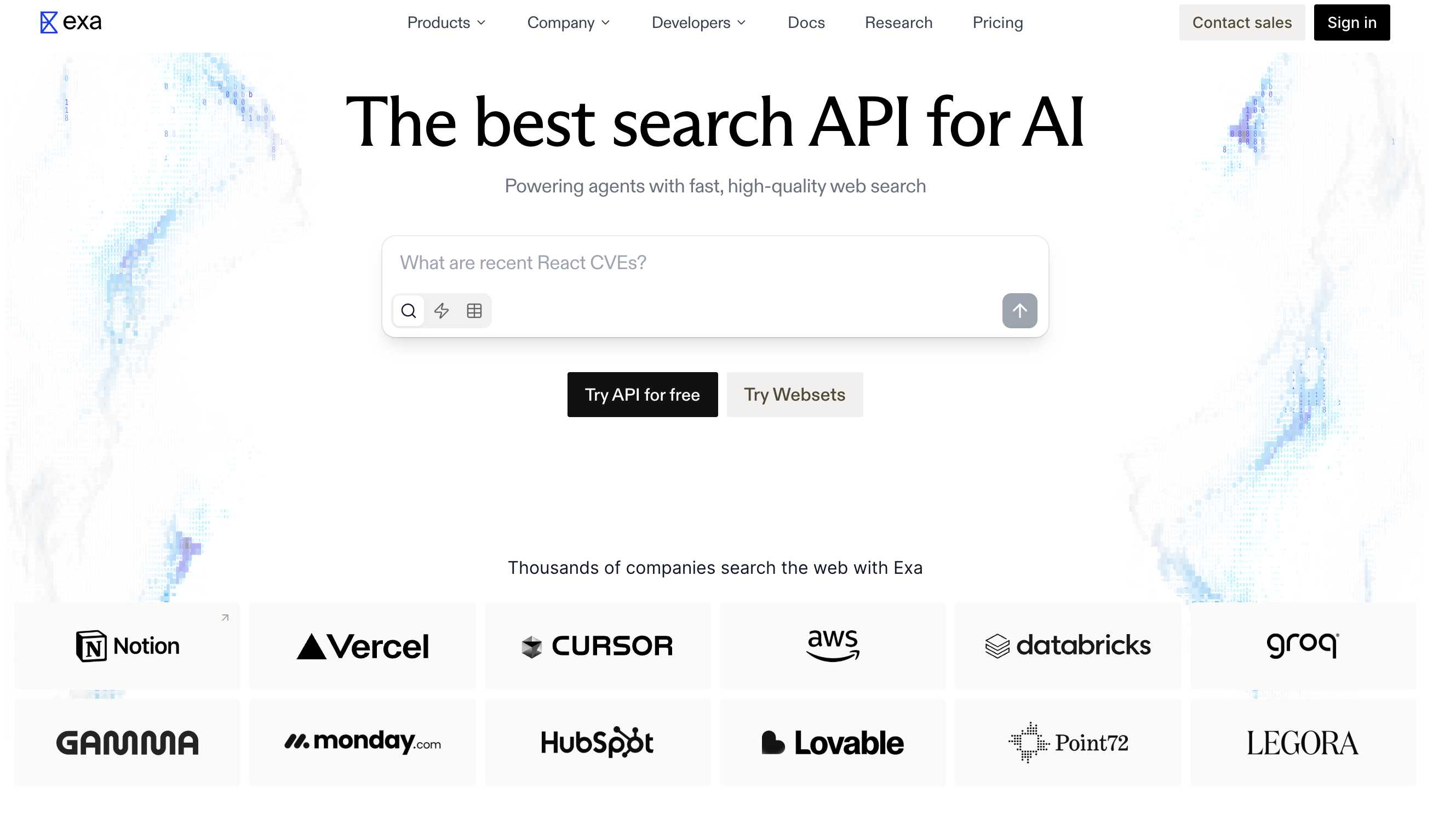
Exa.ai is a neural search API built from the ground up for AI agents. Its architecture combines deep embeddings that capture semantic intent with transformer-based retrieval that ranks results by meaning rather than surface text. A query like "startups using computer vision for agriculture" returns relevant pages even if those exact words never appear on them. Exa calls this "neural search," and it's the core architectural difference between Exa and every keyword-based or web search alternative on this list.
In February 2026, Exa launched Exa Instant, which returns results in under 180ms, outperforming competitors by up to 15x in FRAMES and Tip-of-Tongue retrieval benchmark tests. Exa Deep adds agentic research capabilities, using query expansion and LLM reasoning to return structured JSON outputs with field-level citations and confidence scores. The platform also supports multiple search modes (neural, fast, deep, crawling, answer, research, and websets), language-aware search that automatically matches results to query language, and real-time content indexing with minute-level refreshes.
Exa.ai has four unique features in particular:
Find Similar lets you pass a URL instead of a query and receive semantically similar pages from Exa's index.
Websets lets users describe an ideal customer profile in natural language and receive a curated, verified lead list enriched with AI. Each result includes structured properties, webpage content, and reasoning that explains why it matched your criteria.
Exa Deep acts as an autonomous research agent that decomposes complex queries, searches iteratively, and delivers structured outputs with citations grounded directly to sources.
Content extraction returns clean, structured text, highlights, or summaries without traditional web scraping.
These are the stickiest parts of Exa's offering. If your workflow depends on any of them, no alternative listed below is a drop-in swap.
That said, there are a few recurring friction points that push production teams to evaluate other options.
Rate limits at production scale. Agent workflows running continuous queries hit Exa's per-second caps quickly. Custom QPS is only available on the enterprise tier, which means early-stage teams scaling up face a hard ceiling before they can negotiate higher limits.
Incomplete extraction on JS-heavy sites. Exa's Contents endpoint can return partial data when pages rely heavily on JavaScript rendering. Teams that need fully rendered page content for their pipelines tend to move toward extraction-first tools like Firecrawl.
People data accuracy. Exa's people data has known reliability issues. Roughly 25% of candidate location data is inaccurate, which forces teams to build additional AI scoring agents on top of Exa's output just to filter out bad results, adding both complexity and cost. Finding decision-makers at a specific company is particularly frustrating: the process is slow enough to be impractical for time-sensitive outreach.
Websets limitations at scale. Despite strong benchmark numbers, professional network data through Websets lacks depth and coverage in practice. Exa caps results at 100 per search, so building a full total addressable market of around 6,000 profiles means running the same query roughly 60 times with variations. After deduplication, that collapses to about 2,500 unique people. Over half the fetched data is redundant, making the real cost per actionable profile significantly higher than the headline number suggests.
Because Exa relies on embedding-based search over unstructured web content rather than structured databases, results can be misleading. A person might get associated with a company simply because both appeared in the same article, not because they actually work there.
How the top Exa alternatives compare
The tools below fall into distinct categories, and that distinction matters more than any ranked list. Semantic search APIs (Exa, Tavily) find conceptually relevant pages across the web. Extraction crawlers (Firecrawl) convert known URLs into clean, structured content. Scraping and data collection platforms (Bright Data) pull raw search engine results at a massive scale. Synthesized answer engines (Perplexity Sonar) skip the retrieval step entirely and hand you a cited summary. B2B data providers (Crustdata) return structured company and people data alongside web search results. Exa also serves B2B use cases through Websets, though its approach differs from structured database providers.
As these are composable building blocks rather than competing products, most production AI agent stacks use tools from two or three of these categories together. A recruiting agent might pair Firecrawl for content extraction with Crustdata for structured candidate data. A RAG pipeline might combine Tavily for web retrieval with Perplexity Sonar for pre-synthesized answers on specific subtopics.
Tavily
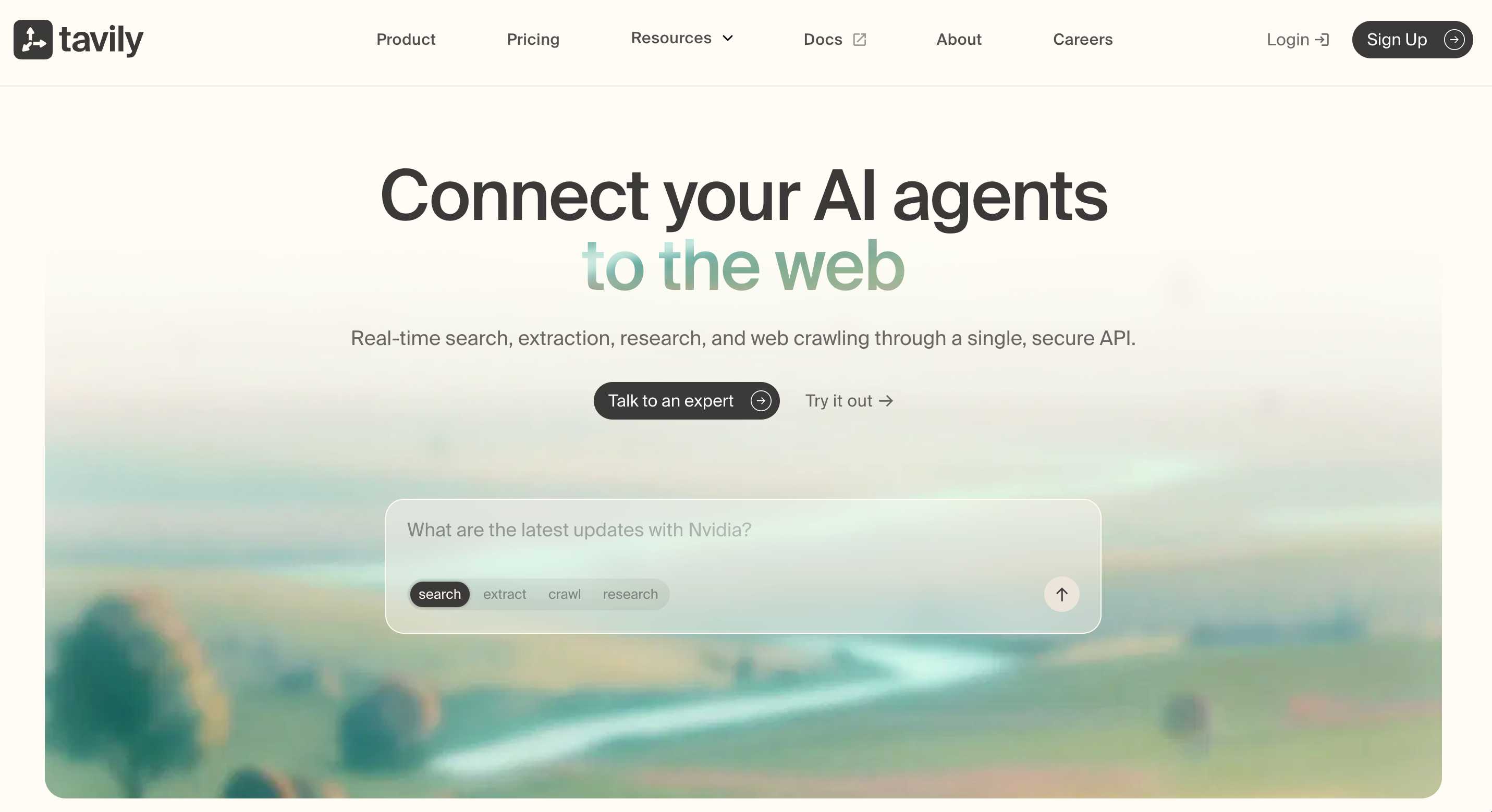
Tavily is a search API built for RAG pipelines and AI agent workflows. It's the default search tool in LangChain and most RAG starter templates, giving it the widest out-of-the-box framework support of any option on this list.
Tavily was acquired by Nebius (NASDAQ: NBIS) on February 10, 2026. The announcement confirms that the API will remain unchanged in the short term and that the product team will remain intact. But medium-term pricing and roadmap uncertainty are real. Developer tool acquisitions often result in pricing changes 12–24 months post-close, and teams evaluating Tavily today should factor that timeline into their decision.
Key characteristics:
Bundles search and content retrieval into a single credit, with no separate fee for pulling page contents like Exa requires.
Tightest LangChain and LlamaIndex integration of any tool here, with minimal setup needed to get a working pipeline.
Free tier of 1,000 credits per month for testing and prototyping.
Limitations:
Lacks neural search, Find Similar, and Websets, which are three of Exa's stickiest capabilities. If your pipeline depends on any of those, Tavily won't fill the gap.
Acquired by Nebius (NASDAQ: NBIS) in February 2026. The API and product team remain intact for now, but vendor stability questions exist today that didn't exist six months ago.
Pricing:
Researcher plan: Free; 1000 API credits/month.
Pay as you go: $0.008 per credit.
Project plan: Starting at $30/month for 4000 API credits/month, up to $500/month for 100,000 API credits/month.
Firecrawl
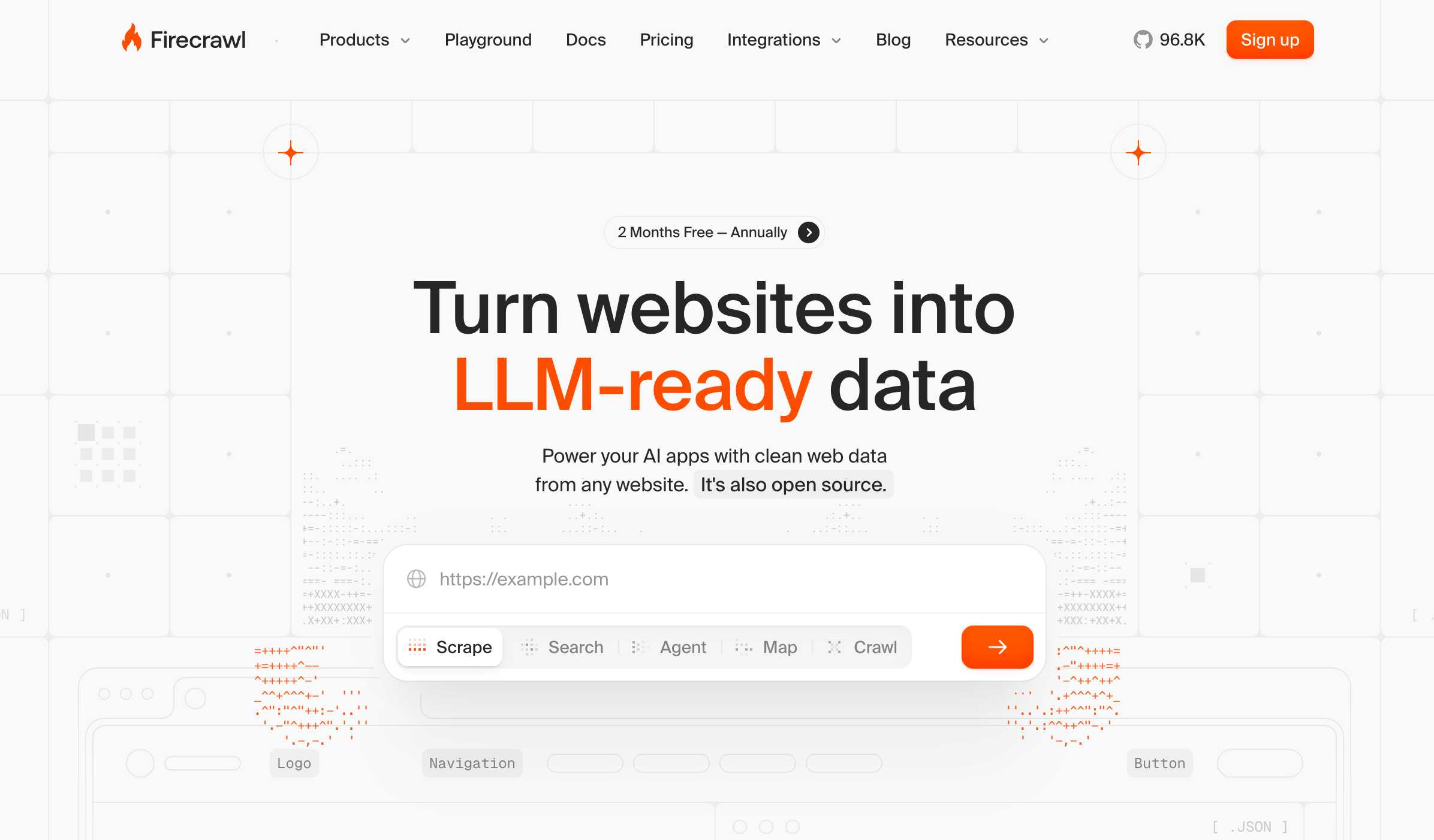
Firecrawl is an extraction-first tool that converts websites into clean Markdown with full JavaScript rendering and batch crawling support. If your use case is "scraping web pages into structured Markdown for LLMs," Firecrawl is the most direct answer available.
Key characteristics:
Outputs clean Markdown from JS-heavy pages that are purpose-built for feeding content into LLM pipelines.
Open-source and self-hostable via GitHub, making it the primary option for teams that need a self-hosted or open-source Exa alternative.
Search functionality costs 2 credits per 10 results on managed plans.
Limitations:
Self-hosting at scale requires headless Chromium infrastructure, proxy management, and ongoing engineering maintenance. For teams processing under roughly 100K pages per month, the managed plans are likely cheaper once you factor in engineering time.
Not a search API in the Exa or Tavily sense, as Firecrawl excels at extracting content from URLs you already have, not at discovering new ones.
Pricing:
Free plan: 500 credits, one-time.
Hobby plan: 3000 credits/month, $19/month.
Standard plan: 100,000 credits/month, $99/month.
Growth: 500,000 credits/month, $399/month.
Crustdata
Crustdata sits in a different category from the other tools on this list – and is the most direct alternative for teams using Exa's Websets for people and company data, but hitting its accuracy and scale limitations. It combines a Web Search API, B2B data enrichment, and event-driven monitoring in a single provider, built specifically for AI agent workloads that need structured business data alongside web context.
Key characteristics:
The Web Search API hits the
/screener/web-searchendpoint and returns structured JSON (title, URL, snippet, position) with geolocation and source filters. Beyond web results, Crustdata can also fetch full content from a website or webpage.The dual-input model is the differentiator. The Web Search API provides qualitative live context, such as product launches, founder blog posts, podcast appearances, and funding news. The B2B Data APIs provide structured quantitative data, such as firmographics, headcount, and verified contacts.
Beyond the Web Search endpoint: Discovery APIs with 95+ company filters and 60+ person filters, an Enrichment API with entity resolution across 10+ sources, and a Watcher API that sends push alerts on funding rounds, hiring surges, and job changes.
For teams currently using Exa's Websets for lead discovery: Crustdata's Discovery APIs query a structured database of 200M+ companies with entity resolution across 10+ sources, rather than running embedding-based search over unstructured web content. This means a person is matched to a company because verified records confirm it — not because both appeared in the same article. The result is higher data accuracy with no 100-result cap per search and no deduplication overhead.
Limitations:
Designed for targeted, filter-driven queries rather than open-ended web crawling. The Web Search API performs best with specific site-scoped, geo-filtered, or date-ranged searches – the kind AI agents run when acting on a known signal. Teams needing broad, unfiltered web-scale retrieval may want to pair it with a general-purpose search API.
Not a drop-in replacement for Exa's neural search or Find Similar. Crustdata's web search is optimized for targeted, signal-driven queries, not open-ended semantic discovery. Teams that rely on those Exa features for non-B2B use cases will still need a semantic search layer.
Requires API integration with no user-facing interface. Teams without developer resources will need to plan for implementation time.
Pricing: Credit-based with usage tiers – and because results come from a structured database rather than embedding search with a 100-result cap, there's no deduplication tax inflating the effective cost per profile. See current pricing here.
Perplexity Sonar
Perplexity Sonar returns cited, synthesized answers rather than lists of URLs, which is a fundamentally different output model from Exa or Tavily. Instead of retrieving pages and running your own RAG synthesis, Sonar handles both steps in a single API call.
Key characteristics:
Offloads the entire search-and-synthesize pipeline to one request, reducing the number of components your agent needs to manage.
Every response includes source citations, so downstream applications can surface attribution without additional processing.
Offers both raw search results (no synthesis) and full Sonar synthesis, depending on what your workflow needs.
Limitations:
You give up control over source selection and retrieval logic. The model decides what to search and how to synthesize the output. This works well for end-user-facing answers but is less suited to pipelines that need deterministic, reproducible retrieval.
No neural search, or any equivalent to Exa's discovery features.
Pricing:
Search API (raw results only): $5 per 1,000 requests, no token costs.
Sonar API pricing: $1/$1 per 1M input/output tokens, plus request fees of $5–$12 per 1,000 requests, depending on search context size (low, medium, or high).
Sonar Pro: $3/$15 per 1M input/output tokens, plus request fees of $6-$14 per 1000 requests, depending on search context size.
Sonar Reasoning Pro: $2-$8 per 1M input/output tokens,
Linkup
Linkup is an EU-headquartered search API with built-in GDPR compliance and a straightforward option for teams that need regulatory alignment without extra legal review.
Key characteristics:
Provides access to premium content sources alongside standard web results, expanding coverage beyond what typical SERP APIs return.
Offers an MCP server for Claude Desktop integration, making it a convenient choice for teams building on Claude-based stacks.
Free tier of €5/month in queries for testing.
Limitations:
No neural search, Find Similar, or Websets equivalents. This is a lighter search API for teams that don't need Exa's discovery architecture.
Smaller developer community and fewer framework integrations compared to Tavily or Exa.
Pricing:
Free plan: Queries worth upto €5 per month. Equal to 1000 standard queries OR 100 deep queries.
Pay-as-you-go: Includes access to their Discord community and integration support.
Standard search at €5/1000 queries.
Deep search at €50/1000 queries
Custom plan: Custom pricing for enterprise-grade, high-volume users.
Bright Data
Bright Data is primarily known as a scraping and data collection platform, which is a different category entirely from Exa or Tavily. Its SERP API is one piece of a larger infrastructure built for pulling web data at a massive scale, not specifically for semantic discovery or RAG grounding.
Key characteristics:
150M+ IPs across residential, datacenter, and ISP types, with built-in CAPTCHA solving.
Multi-engine coverage spanning Google, Bing, and Yandex in a single platform.
99.9% uptime SLA claimed, with the cheapest per-result cost at high volume among all tools on this list.
Limitations:
Not a search API in the semantic or AI-agent sense. No neural retrieval, no content synthesis, no framework integrations with LangChain or LlamaIndex.
Monthly plans start at $499/month, making it a poor fit for smaller teams or early-stage prototyping.
Pricing:
$1.50 per 1,000 results on pay-as-you-go, dropping to roughly $1.3 per 1,000 on monthly plans starting at $499/month.
Why B2B agent teams need more than a search API
General-purpose search APIs return web results. That's exactly what they're designed to do, and for RAG pipelines or conversational AI grounding, tools like Tavily, Firecrawl, and Perplexity Sonar handle the job well. But B2B AI agent workflows need something these tools weren't built to provide: structured company and people data sitting right alongside web context.
Consider what a sales agent built on Tavily actually requires in production. The search API covers web retrieval, but you still need a separate enrichment provider for firmographics and verified emails, plus a separate monitoring tool to track funding rounds and hiring signals. That's three vendors, three data schemas, and three billing relationships, all stitched together with custom integration code your team has to maintain.
This is where the problem shifts from "which search API is best" to "how many tools does my agent stack actually need."
Here's how this plays out across three common B2B AI agent workflows:
AI SDR agent. The Web Search API detects buying signals in real time, such as product launch blog posts, funding announcements, or founder podcast appearances. The Data API then enriches those accounts with firmographics, headcount data, and verified contact details for prioritization. One provider handles both signal detection and account enrichment.
Recruiting agent. Web search discovers passive talent through GitHub repos, conference talks, and published research. The Data API enriches each candidate profile with structured work history, current role, and location data with no manual profile-by-profile lookups required.
Investment research agent. An investment research agent tracks pitch decks and press releases through web search queries, paired with structured company data (headcount trends, funding stage, hiring velocity) from the same provider – feeding directly into due diligence workflows.
In each of these cases, the agent needs both qualitative web context (what a prospect just published, launched, or announced) and quantitative structured data (who they are, where they work, how fast the company is growing). General search APIs only cover the first half.
Replacing a search API, an enrichment tool, and manual monitoring with one provider and one consistent JSON schema reduces integration complexity significantly. For teams already juggling multiple vendors and dealing with schema mismatches among them, consolidation can be an engineering decision that directly affects build speed and maintenance overhead.
Building B2B AI agents? Start with the right data layer
For teams building general RAG pipelines or conversational AI, the tools covered above handle the search layer well. Pick the one that fits your architecture and budget, and you're in good shape.
But if you're building AI agents that need to qualify leads, track hiring signals, or enrich CRM data in real time, the bottleneck isn't web search. It's structured B2B data.
Crustdata combines web search, company and people enrichment (200M+ companies, entity resolution across 10+ sources), and event-driven monitoring via the Watcher API, all through one provider with one consistent JSON schema. Your agent gets qualitative web context (what a prospect just published or launched) alongside quantitative B2B data (firmographics, verified contacts, hiring velocity) from a single integration.
Teams already using Crustdata's Web Search API and Watcher API together are detecting buying signals and acting on them within hours, not days or weeks.
Book a demo to see how the Web Search API and Watcher API work together for B2B agent workflows. Bring your current stack, your pain points, and your questions, and our team will walk you through exactly how it maps to your use case.


Products
Popular Use Cases
Competitor Comparisons
95 Third Street, 2nd Floor, San Francisco,
California 94103, United States of America
© 2026 Crustdata Inc.
Products
Popular Use Cases
Competitor Comparisons
95 Third Street, 2nd Floor, San Francisco,
California 94103, United States of America
© 2026 CrustData Inc.
Products
Popular Use Cases
Competitor Comparisons
95 Third Street, 2nd Floor, San Francisco,
California 94103, United States of America
© 2026 Crustdata Inc.
🎉 We hit $10M ARR!
$600k to $10m in 1.5 years. Our entire GTM is powered by our own APIs.
🎉 We hit $10M ARR in 1.5 years!