Top 9 Job Posting Data APIs for Hiring & Market Insights
Compare job posting data APIs for real-time hiring signals, workforce analytics, and sales workflows & find the right provider for your use case.
Published
Written by
Chris P.
Reviewed by
Nithish A.
Read time
7
minutes

Job postings are one of the earliest and most reliable public signals of company growth, business strategy, and product direction. Long before press releases or funding announcements, hiring data reveals intent.
The challenge is accessing that data when it matters and in a clean, structured format ready to be analyzed.
In this guide, we break down the 9 best job posting APIs, what they do best, where they fall short, and which one makes the most sense for your specific hiring, sales, or investment use case.
What to Look for in a Job Posting API
Picking the wrong provider creates technical debt fast. Here are the four factors that separate useful APIs from ones you'll rebuild around in six months:
Data freshness: Providers that refresh monthly or quarterly work fine for trend analysis, but miss the outbound window that opens when a company posts its first sales hire. Real-time crawling or webhook-based delivery is the only way to act on signals before they go stale.
Filter depth and data points per listing: Broad coverage with shallow filters forces post-processing on your end. Look for APIs that let you query by job category, department, location, workplace type, and company attributes in a single request, returning structured data you can use immediately.
Source coverage: Providers that pull exclusively from LinkedIn miss companies that post only on their own career pages. Multi-source APIs reduce blind spots but vary widely in how well they deduplicate overlapping records across sources.
API architecture: Pull-based APIs require you to poll on a schedule and diff results yourself to find what changed. Push-based architectures using webhooks eliminate that overhead and let you build event-driven workflows that fire the moment a relevant posting goes live.
9 Best Job Posting APIs to Consider for Hiring & Market Insights
The APIs below vary in data depth, refresh frequency, and the extent to which you need to build around them. Some are better for bulk research, while others are better for event-driven workflows. Here's a breakdown of each to help you find the right fit.
Tool | Best For | Data Source | Refresh Rate | Webhook/Push | Pricing Model |
Crustdata | GTM workflows, AI agents, recruiting platforms | Multi-source, direct crawl | Real-time | Yes | Custom |
Fantastic.jobs | Job boards, resume products | 200k+ career sites, 54 ATS platforms, LinkedIn | Hourly | No | From $1 per 1,000 jobs |
Coresignal | HR tech, job boards, investment research | LinkedIn, Indeed, Glassdoor, Wellfound | Every 6 hours | No | Credit-based, from $49/month |
Bright Data | Enterprise data teams, market researchers | LinkedIn, Indeed, Glassdoor | Daily to monthly | Yes | From $250/dataset |
Lightcast | Workforce analytics, government, HR strategy | Multi-source + government data | Daily | No | Custom |
Bloomberry | GTM teams, niche job boards, low-volume use cases | Company career pages | 3 - 7 days | No | Per-job, from $199/month |
TheirStack | B2B sales, technographic prospecting | LinkedIn + 16 job boards | Hourly | No | $59/month |
LinkUp | Investment research, labor market analysis | Employer career pages, ATS | Daily | No | Custom |
Techmap | Job boards, data engineers, international coverage | ATS pages, job boards, aggregators | Hourly | No | Per country, from $4,800/year for US users |
1. Crustdata
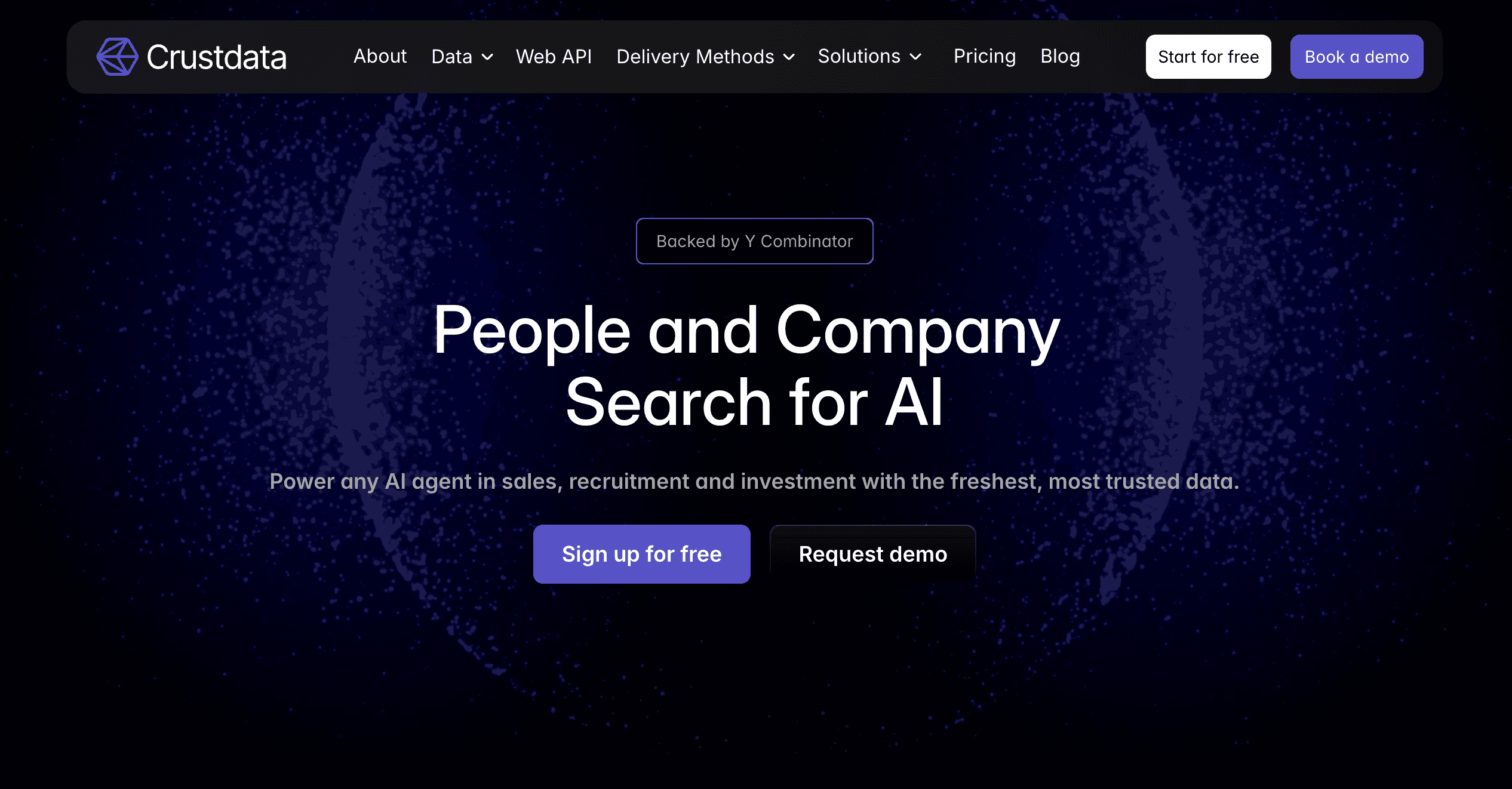
Crustdata is a real-time B2B data provider that offers a job listing API for teams that need job posting intelligence as input for automated workflows. Sales teams, recruiting platforms, and investors use it to track hiring signals and trigger outreach or analysis when relevant postings go live.
Key Features
Real-time job data with 30+ data points per listing: Returns full job descriptions, job category, openings count, workplace type, reposted flag, and company context, including industry, size, investment stage, and acquisition status
35 search filters in a single API call: Queries by job title, category, location, workplace type, department, and company attributes, returning structured JSON
Webhook-based alerts via Watcher API: Subscribes to event triggers such as new listings by keyword or location and companies hiring in new countries, pushing notifications instead of requiring scheduled polling
Expansion and early team formation signals: Flags roles appearing in new cities, states, or countries for geographic expansion detection, and surfaces titles like "Founding Product Designer" or "First AE" for early-stage targeting
Technology signals extracted from job descriptions: Parses job posting text to identify tools, programming languages, and SaaS products a company currently uses, previously used, or is actively hiring for
Pros
Delivers webhook-based push notifications the moment a relevant posting goes live, eliminating the polling and manual diffing required by pull-based APIs
Combines job data with company context, including funding stage, headcount, and acquisition status, in a single API response
Supports event-driven workflow automation for AI agents, recruiting platforms, and GTM tools, making it usable as a trigger layer rather than just a data source
Pulls structured job postings from major job boards via the Jobs API, and users can access the websearch API to surface roles posted directly on specific company career pages that never make it to job boards
Cons
Requires technical expertise to integrate and maintain the API
Pricing
Crustdata offers custom pricing. Contact sales for rates based on usage volume and data requirements.
2. Fantastic.jobs
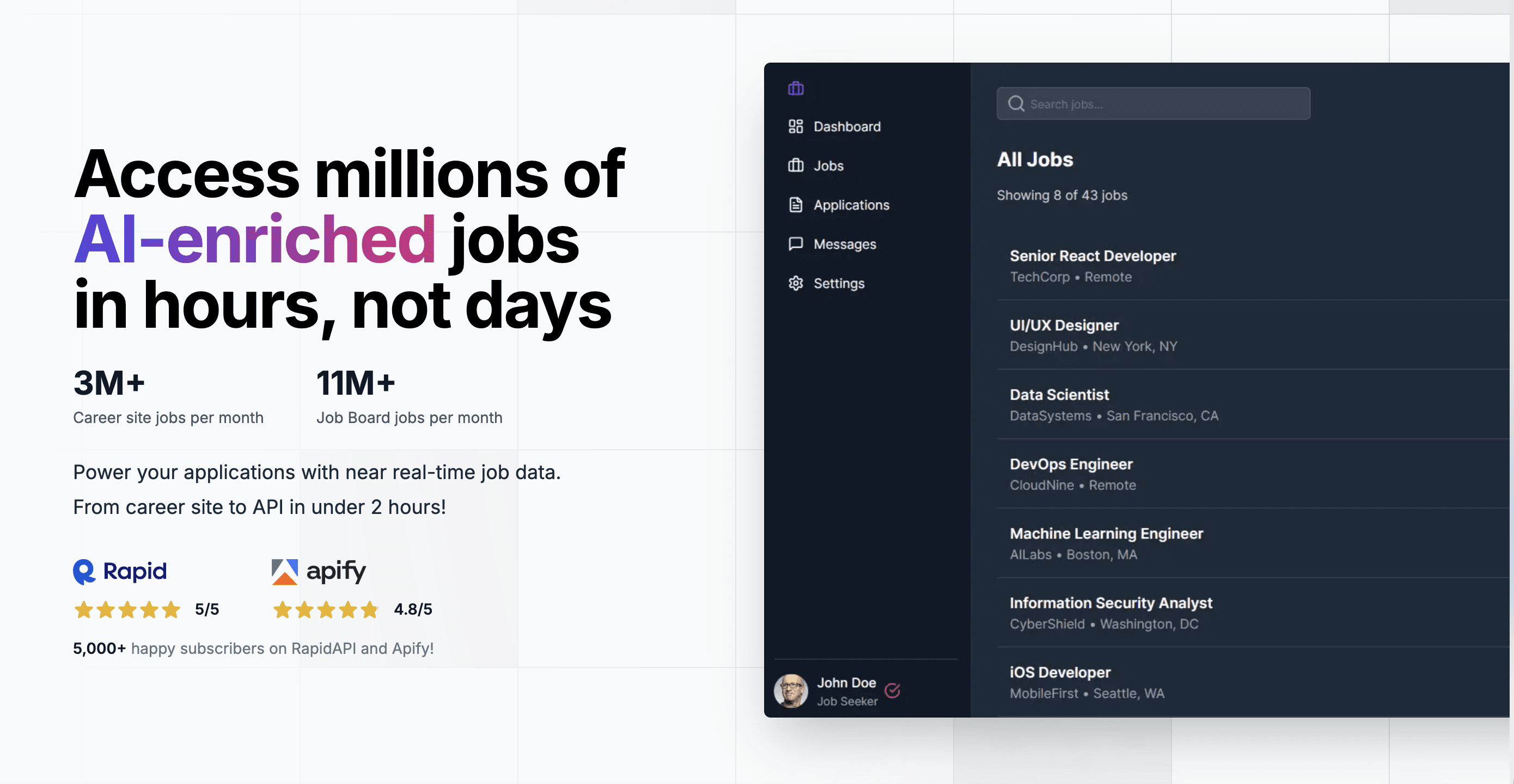
Fantastic.jobs is an AI-enriched job posting data provider built for job boards, job search and resume products, and AI startups that need to display fresh listings to end users. It aggregates jobs from 200,000+ career sites and 54 ATS platforms, moving jobs from career site to API in under two hours.
Key Features
10 million+ jobs per month across ATS career sites and LinkedIn: Covers 54 ATS platforms including Workday, Greenhouse, Lever, and BambooHR, with hourly refresh keeping listings current as postings are created or updated
AI-enriched data fields on every job record: Augments raw listings with normalized fields and AI-matched LinkedIn company data, so each record is ready for display without a second enrichment call
Dedicated endpoints for new, modified, and expired jobs: Splits the firehose into purpose-built endpoints, including an hourly firehose, modified jobs, expired jobs, and a 6-month backfill endpoint, so database syncs require no diffing logic
Self-serve access via RapidAPI and Apify: Supports no-code workflows through Zapier, n8n, MCP, and XML feeds, alongside developer access for custom integrations
Pros
Offers volume pricing starting at $1 per 1,000 jobs with a free trial, making it cost-accessible for early-stage job board builders
Provides a 6-month backfill API that lets new applications populate a full inventory on day one without waiting for organic job flow to build up
Separates new, modified, and expired job endpoints, reducing the engineering work needed to keep a live job board accurate without manual diffing
Cons
Does not include company context fields like funding stage, headcount trajectory, or tech stack alongside job data, so teams building hiring-signal workflows for sales, recruiting, or investment use cases need a separate enrichment layer
Pricing
Fantastic.jobs pricing starts at $1 per 1,000 jobs through RapidAPI and Apify, with a free trial and volume-based plans that scale with usage.
3. Coresignal
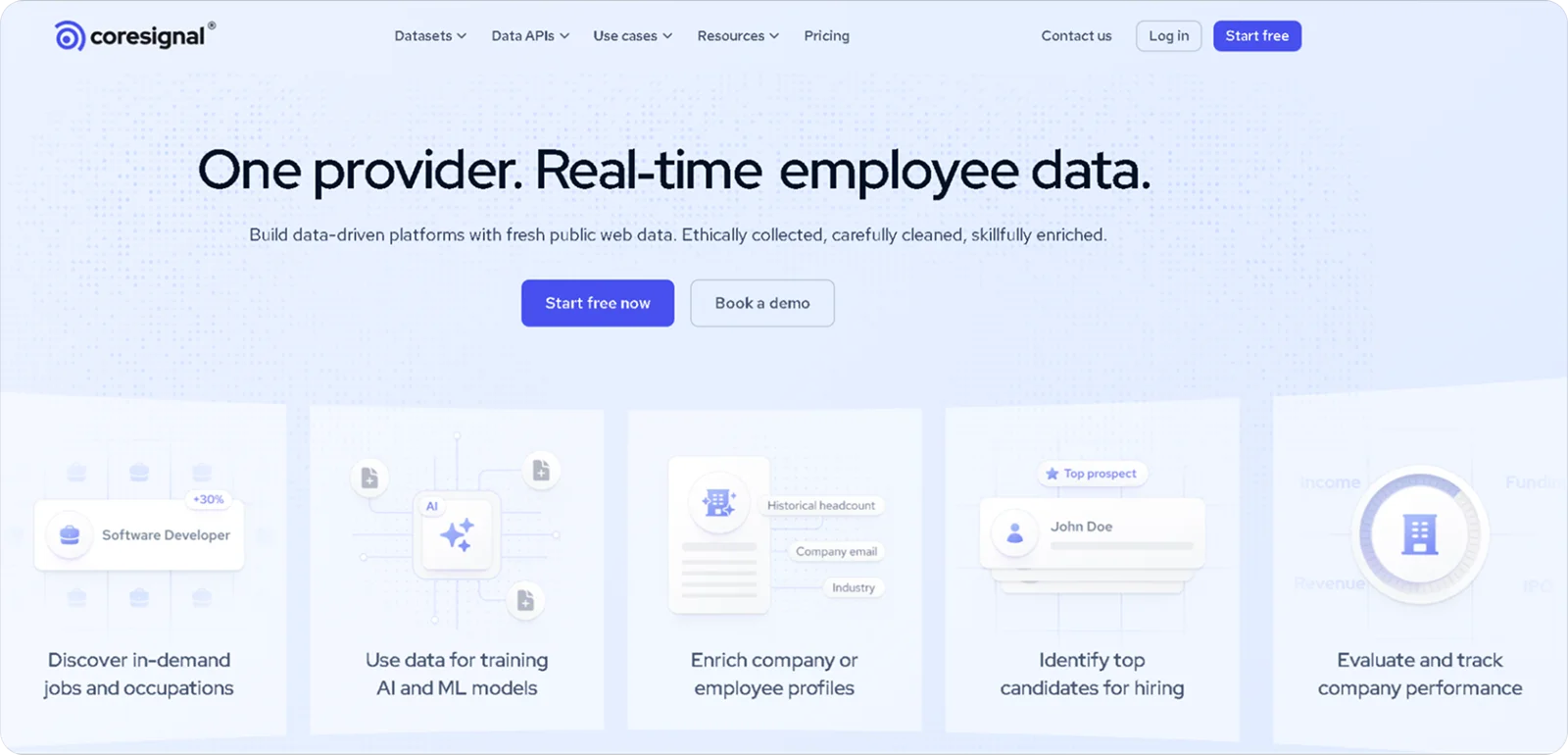
Coresignal is a job posting data provider built for HR tech, job boards, and investment and market research teams needing job listings at scale. It offers two API tiers: Base for in-house processing and Multi-Source for enriched, deduplicated, ready-to-use data.
Key Features
400M+ job posting records queryable via Elasticsearch: Covers active and historical listings with bulk downloads up to 10,000 records per request
Two API tiers with different data depth: Base returns 23 data points from a single source; Multi-Source returns 85+ fields, including seniority, management level, urgency flag, and shift schedule from deduplicated sources
Response field selection: Retrieves only specific fields needed per request rather than full records, reducing payload size and downstream processing overhead
Webhook delivery on bulk requests: Accepts an optional webhook URL on bulk collect calls, sending a callback to your endpoint when results are ready, rather than requiring you to poll for job completion
Pros
Offers self-serve access with no demo required, removing the bottleneck common with enterprise providers
Covers active and expired job listings, useful for trend and investment research requiring historical depth
Supports JSON, JSONL, CSV, and Parquet exports for flexible pipeline integration
Cons
Lacks native webhook or push delivery, requiring scheduled polling and manual diffing to detect new postings
Returns only 23 data points from a single source on the Base tier, limiting depth without upgrading to Multi-Source
Pricing
Coresignal offers credit-based subscriptions starting at $49/month (Starter). Pro starts at $800/month and Premium at $1,500/month, with credits scaling based on search and collect usage.
4. Bright Data
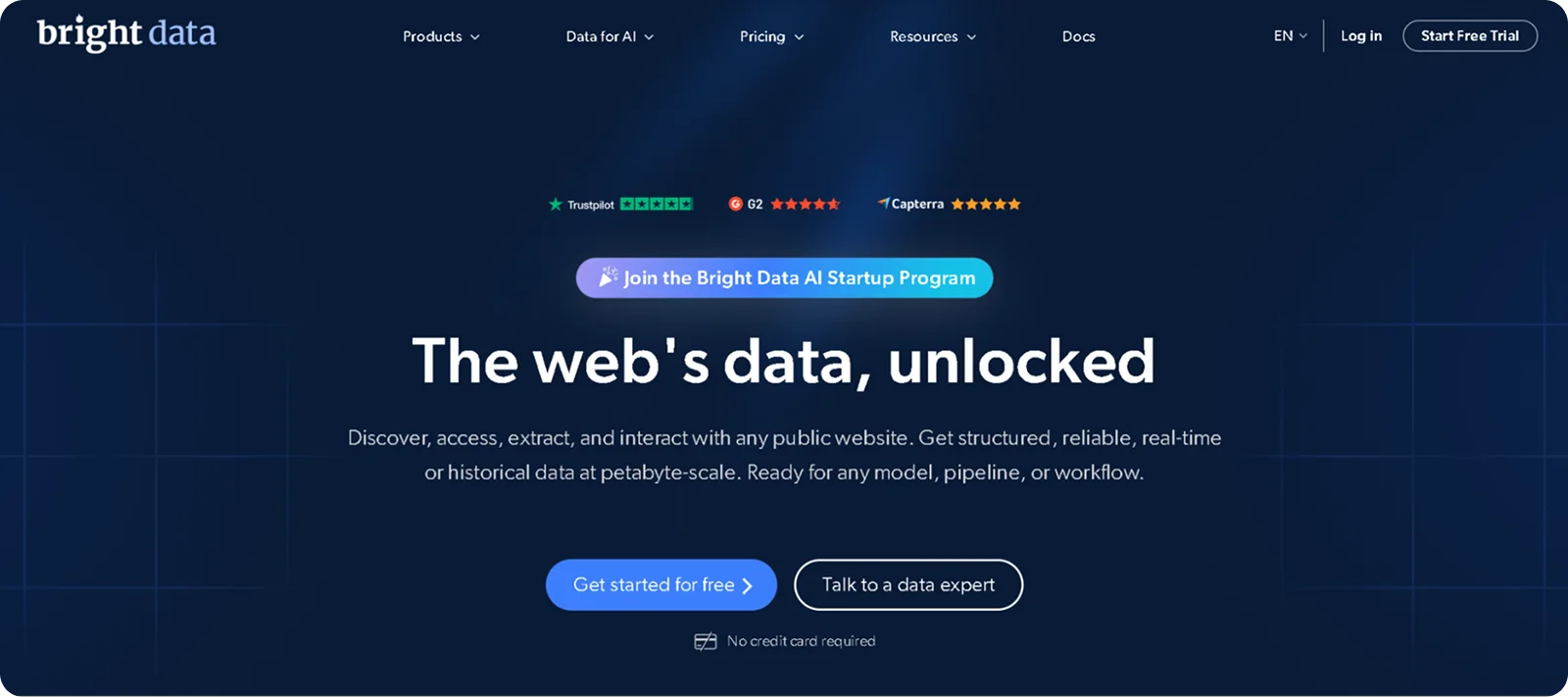
Bright Data is a data infrastructure provider with a marketplace of pre-collected job posting datasets. Market researchers, recruitment platforms, and enterprise data teams use it for large-scale structured job data without building or maintaining scraping infrastructure.
Key Features
Pre-collected datasets covering 109.6M+ records: Includes multisource listings, each with source-specific fields such as seniority level, company rating, and application links
Scraper APIs for real-time collection: Web Scraper APIs to retrieve fresh listings on demand, separate from the pre-collected marketplace datasets
Flexible delivery to cloud storage: Supports API download, webhook, Amazon S3, Google Cloud, Azure, Snowflake, and SFTP with daily to monthly or custom update intervals
Multiple output formats: Delivers data in JSON, NDJSON, JSON Lines, CSV, and Parquet with optional gzip compression
Pros
Delivers pre-validated datasets ready for immediate use with free samples available before purchase
Supports direct delivery to Snowflake, AWS S3, and Google Cloud, reducing ingestion overhead for data engineering teams
Maintains GDPR and CCPA compliance with ethically sourced public data
Cons
Operates primarily as a dataset marketplace, not a purpose-built job intelligence API with filters for department, headcount, or company growth signals
Refresh cycles ranging from daily to monthly mean data may not reflect the last few hours, limiting time-sensitive outreach workflows
Pricing
Bright Data datasets pricing starts at $250 for 100,000 records.
5. Lightcast

Lightcast is a labor market intelligence platform built for workforce analysts, HR strategists, government agencies, and researchers. Its job postings API covers US data going back to 2010, making it suited for long-range trend analysis and workforce planning at scale.
Key Features
2.5 billion total job postings across 40+ countries: Covers US data from January 2010 with daily scraping, deduplication, and enrichment of new postings.
Enriched occupational and skills data: Standardizes postings against occupation taxonomies including O*NET and NOC codes, extracting normalized skills, salary ranges, and geography from raw posting text
Multiple specialized API endpoints: Separate endpoints for US, Canada, and UK job postings, plus compensation and wages, role pricing, and occupation benchmarks
Government and census data integration: Combines job posting signals with BLS, census, and other government labor datasets to produce modeled workforce supply, demand, and compensation insights not available from job board scraping alone
Pros
Provides US job posting coverage back to 2010, one of the deepest historical timelines on this list
Combines job posting data with government labor statistics, enabling workforce supply and demand modeling unavailable from scraping-only providers
Covers 160+ countries with standardized occupation and skills taxonomies across regions
Cons
Requires a demo for core enterprise products with no self-serve access or public pricing for the main API
Primarily built for workforce research and HR strategy, not GTM workflows or event-driven sales use cases
Pricing
Lightcast does not publish pricing for its core Developer API or enterprise products. Access requires a demo request.
6. Bloomberry

Bloomberry is a self-serve job postings API from Revealera, a data provider that has supplied job posting data to institutional clients since 2020. GTM teams, sales platforms, and niche job boards use it to query job postings directly from company career pages by domain or keyword without committing to enterprise contracts.
Key Features
Company career page crawling by domain or keyword: Offers access to job postings sorted by most recent first, including job title, URL, salary range where public, normalized job title, region, company domain, and full-text description.
Historical data from 2019 to present: Covers job postings going back to 2019 for most companies, useful for multi-year trend analysis and GTM signal tracking.
JSON and CSV output via REST API: Returns structured data in both formats with self-serve access, and no signup required to test initial API responses.
Per-job pricing model: Charges per job posting retrieved rather than a flat monthly subscription, making it cost-effective for teams with variable or low-volume query needs.
Pros
Offers fully self-serve with a free account and sample data available, no sales conversation required to start
Crawls directly from company career pages, capturing postings that never appear on job boards
Integrates with Clay, n8n, Make, and other workflow automation tools via simple REST API
Cons
Excludes job board data entirely, missing companies that post jobs exclusively on LinkedIn rather than their own career pages
Requires manual parsing or LLM processing to extract structured skills from job descriptions, as skills enrichment is not available out of the box
Pricing
Bloomberry's paid plans start at $199/month, with per-job pricing starting at $0.006 at the lowest volume tier. A free account with sample data is available without a credit card.
7. TheirStack
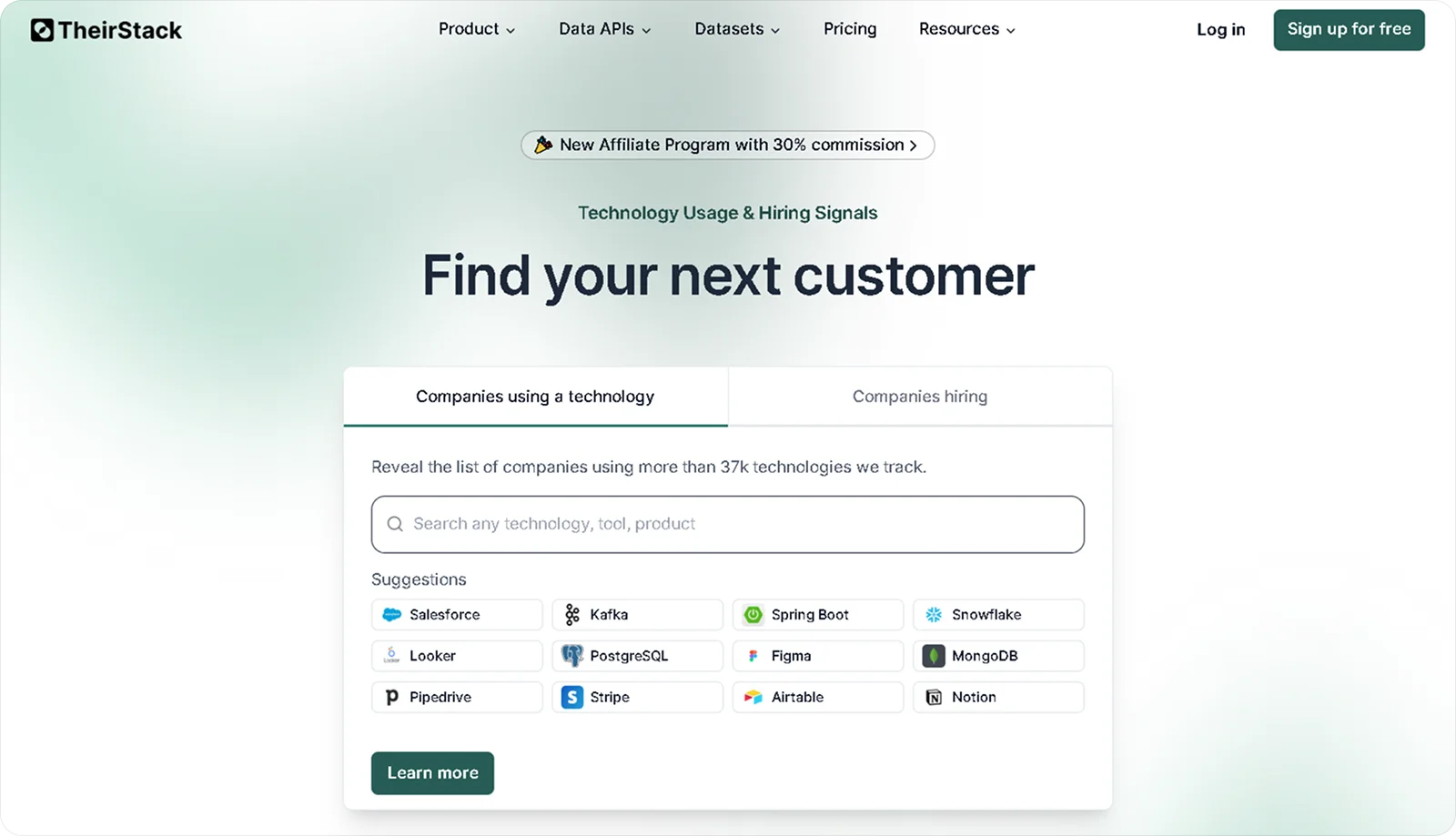
TheirStack is a sales intelligence platform that uses job posting data as a signal layer for identifying companies by technology usage and hiring patterns. SaaS companies, recruiting agencies, and consulting firms use it to find prospects by filtering job postings against tracked technologies and hiring signals.
Key Features
171 million job postings from 195+ countries updated hourly: Aggregates job data from job boards with historical data
Technology signals extracted from job descriptions: Identifies technologies mentioned in postings to surface companies using or evaluating specific tools, programming languages, CRMs, databases, and SaaS products
Keyword search across job descriptions: Searches for specific words or phrases within job description text, letting you filter postings where a particular tool, skill, or workflow is explicitly mentioned
Company-level search filters: Narrows job posting results by company size, industry, name, description, and company type, so you can pull postings only from direct employers and exclude recruiting or staffing firms without additional filtering on your end
Pros
Aggregates postings from applicant tracking system platforms such as Greenhouse, Lever, and Workable, with automatic deduplication across all sources
Offers a free plan with monthly credits and no time limit
Automatically excludes recruiting and consulting firms from results, reducing noise in outbound lists
Cons
Depends heavily on what companies choose to post on job boards, meaning roles filled through direct outreach or internal referrals will not appear in results
Lacks webhook or push delivery, requiring you to poll the API on a schedule and diff results manually to detect new postings
Pricing
TheirStack offers a free plan with monthly credits. Paid plans use a credit-based system starting at $59 per month for 1,500 credits.
8. LinkUp
LinkUp is a job market data provider that has indexed job postings directly from employer career pages and ATS systems since 2007. Investment analysts, labor market researchers, and workforce intelligence teams use it for employer-sourced job data with daily delivery and a long historical archive.
Key Features
315 million+ global job postings indexed daily since 2007: Sources all data directly from employer websites, avoiding the duplicate and fraudulent listings common in aggregator-based datasets.
LinkUp Raw dataset with daily delivery: Delivers full job records daily, including job descriptions, core analytics, company reference data, occupation and sector codes, ticker symbols, title, URL, company name, location, and salary where available.
Customizable data feeds by geography, industry, or company: Provides full global coverage or filtered feeds tailored to specific parameters, delivered daily to match analyst and research workflows.
LinkUp Compass visualization dashboard: Visual analytics tool for rendering presentation-grade job market charts and trend reports at the macro, regional, industry, or company level without custom data processing.
Pros
Sources all data directly from employer websites, eliminating duplicates and fraudulent listings that affect job board scrapers
Includes ticker symbols and company identifiers, making the dataset directly usable for investment and financial research without additional enrichment
Provides historical US employer data going back to 2007, covering nearly two decades of hiring trends
Cons
Requires a demo for pricing with no self-serve access or public pricing page
Misses postings that companies list exclusively on third-party job boards, as only direct employer sources are crawled
Pricing
LinkUp does not publish pricing publicly. Access requires a demo request.
9. Techmap

Techmap is a global job posting data provider built for job boards, market intelligence teams, and data engineers that need enterprise-scale coverage with transparent per-country pricing. Its crawlers collect postings from company ATS career pages, job boards, aggregators, and employment offices across 250 countries and territories, including Remote.
Key Features
Hourly-updated postings from 250 countries and territories: Collects data from 185 sources, including 120 ATS platforms, major job boards, aggregators, and 7 public employment offices, with new postings synced to the API and data feeds every hour.
Historical job postings from January 2020: Enables trend analysis, AI model training, and labor market research with 451M+ job postings collected since January 2020.
Enriched job fields beyond raw scrape data: Appends industry, department, occupation, geo-coordinates, timezone, career level, workplace type, contract type, and skills identified from job description text.
Delivery via AWS Data Exchange and S3: Supports bulk daily and hourly delivery directly to AWS infrastructure across multiple output formats, including JSON, CSV, RSS, XML, and Parquet.
Pros
Provides transparent per-country pricing with a free API tier and free data feed trial, no credit card required
Covers 250 countries and territories, supporting teams that need global job data beyond US and European markets
Fully GDPR-compliant with EU-based data storage, relevant for teams with cross-border data requirements
Cons
Built primarily for job boards and data engineering teams, not purpose-built for GTM signal workflows or event-driven outreach
Historical coverage starts from January 2020, shorter than providers like LinkUp or Lightcast for teams needing earlier data
Pricing
Techmap offers structured pricing per country, starting at $1 per 1,000 job postings. The US dataset is priced at $4,800/year, with lower rates for smaller markets.
Which Job Posting Data API Should You Choose?
The right choice comes down to what you're building and how your team uses the data.
Labor market researchers and workforce planners need deep historical archives and government data integration more than real-time updates. Job board builders and data engineers need broad international coverage, predictable pricing, and enterprise-grade delivery options such as AWS S3.
For sales teams, recruiters, and anyone building automated workflows, the API architecture matters as much as the data itself. Pull-based APIs put the burden of scheduling and diffing on you. Push-based APIs with webhook delivery remove that overhead entirely, firing the moment a relevant posting goes live so your workflow moves without manual intervention.
Why Crustdata Is the Right Job Posting Data API for Hiring & Market Insights
Most job posting APIs were built for research. They deliver data on a schedule, require you to diff results manually, and return job records without the company context needed to act on them.
Crustdata is built for teams that already need sales, recruiting, and investment data in one place. Where other job posting APIs return listings and stop there, Crustdata combines job signals with company context, people data, and real-time alerts, so you get everything your workflow needs without stitching together multiple providers. Its capabilities cover the full hiring signal stack:
Jobs API with 30+ data points per listing: Returns structured job records in real time, including job category, workplace type, openings count, reposted flag, and full job descriptions, with company context embedded in every response.
35 search filters in a single API call: Queries by job title, category, location, workplace type, department, and company attributes simultaneously, returning pre-filtered structured JSON without post-processing.
Watcher API with webhook-based push alerts: Pushes notifications the moment a defined trigger fires, such as a target account opening roles in a new country or a new department forming, without scheduled polling.
Expansion and early team signals: Surfaces geographic hiring patterns and founding-role titles automatically, turning raw job data into outreach triggers without additional processing.
If your sales, recruiting, or investment workflows run on fresh data and signals, Crustdata gives you everything you need in one place.
Book a demo to see how Crustdata fits into your hiring intelligence or GTM workflow.


Products
Popular Use Cases
Competitor Comparisons
95 Third Street, 2nd Floor, San Francisco,
California 94103, United States of America
© 2026 Crustdata Inc.
Products
Popular Use Cases
Competitor Comparisons
95 Third Street, 2nd Floor, San Francisco,
California 94103, United States of America
© 2026 CrustData Inc.
Products
Popular Use Cases
Competitor Comparisons
95 Third Street, 2nd Floor, San Francisco,
California 94103, United States of America
© 2026 Crustdata Inc.
🎉 We hit $10M ARR!
$600k to $10m in 1.5 years. Our entire GTM is powered by our own APIs.
🎉 We hit $10M ARR in 1.5 years!