Top 8 Enrichlayer Alternatives for Data Enrichment APIs in 2026
Explore the best Enrichlayer alternatives to access real-time B2B data event-driven APIs and scalable enrichment built for modern workflows.
Published
Feb 26, 2026
Written by
Chris P.
Reviewed by
Nithish A.
Read time
7
minutes
Enrichlayer provides B2B data enrichment through APIs that scrape professional profiles and company information. But teams run into limitations when workflows require real-time data crawling, webhook-based monitoring, or infrastructure that supports autonomous agents rather than batch database queries.
If your enrichment relies on monthly-cached databases, your API lacks event-driven capabilities, or you need technology signals beyond basic firmographics, it may be time to consider alternatives to Enrichlayer.
This guide compares 8 Enrichlayer alternatives for data enrichment APIs in 2026, focusing on data freshness, API architecture, coverage depth, and pricing models to help you choose a platform that fits your technical requirements.
Why Look for Enrichlayer Alternatives?
Enrichlayer delivers reliable API endpoints for professional profile enrichment. However, teams face constraints when workflows require live data synchronization, continuous monitoring infrastructure, or enrichment beyond cached profile snapshots.
Here are some reasons you might consider Enrichlayer alternatives:
Limited event-driven capabilities: No webhook infrastructure for monitoring changes or triggering workflows when profiles update, requiring manual polling or scheduled batch jobs
Cache-first architecture: Default responses pull from cached databases rather than live scraping unless explicitly requested at a higher credit cost
Narrow data source focus: Primarily scrapes professional network profiles with limited coverage of company websites, job boards, news sources, or social media platforms
No multi-source aggregation: Returns data from single sources rather than combining multiple verified sources into unified records
No Web Search API: Lacks ability to retrieve real-time information about people or companies from news articles, blogs, announcements, or general web sources, limiting enrichment to structured profile data only
Limited search capability: Provides only 3 company search filters and 5 people search filters compared to alternatives offering 60-95+ granular filtering options for discovery workflows
For teams building AI agents, developing event-driven systems, or requiring guaranteed real-time data, replacing Enrichlayer with platforms that offer live crawling infrastructure and webhook capabilities provides greater reliability and control.
8 Best Enrichlayer Alternatives for Data Enrichment APIs
The table below compares these platforms by data source, freshness model, and API architecture to help you identify the best fit at a glance.
Tool | Best For | Data Source | Freshness Model | API Architecture | Pricing |
Crustdata | Real-time B2B intelligence | 15+ sources (live crawling) | Real-time on request | REST API + webhooks | Custom |
ZoomInfo | Enterprise contact intelligence | Database aggregation | Database updates | REST API + browser extension | Custom |
Lusha | Contact data for sales prospecting | Database aggregation | Database updates | REST API | From $37.45/month |
Apollo.io | All-in-one sales platform | Database aggregation | Database updates | REST API | From $49 |
Hunter.io | Email discovery and verification | Web scraping + pattern recognition | Web scraping | REST API | From $49/month |
Brightdata | Web scraping infrastructure | Web scraping | Real-time scraping | REST API + browser API | From $499/month |
Cognism | Phone-verified B2B contacts | Database aggregation | Database updates | REST API | Custom pricing |
RocketReach | Contact database search | Database aggregation (700M profiles) | Database updates | REST API | From $69/month (annual) |
1. Crustdata
Crustdata provides real-time B2B intelligence infrastructure through APIs that crawl live data from 15+ sources rather than querying pre-compiled databases. Teams building AI agents, sales automation platforms, and internal sales tools use it to access current company and people data with webhook notifications for tracked events.
Key Features
WebSearch API for search intelligence: Converts live search results into structured JSON, pulling information from multiple sources for direct integration into AI pipelines and automation workflows
Company Discovery API with 250+ data points: Filters companies by firmographics (revenue, headcount, location, funding), technographics (tech stack from job postings), and growth signals (hiring velocity, web traffic, headcount trends)
People Discovery API across 1B+ profiles: Returns current role, seniority, department, complete work history, education, skills, and detects real-time role changes across professional profiles
Watcher API with webhook notifications: Sends instant alerts when tracked companies or people trigger events, including job changes, funding announcements, executive hires, hiring spikes, new job postings, or social media activity
Unified multi-source aggregation: Combines data from 15+ verified sources into single structured JSON responses offering 250+ company datapoints and 90+ people datapoints
CRM and sales tool integration: Delivers enriched data directly into Salesforce, HubSpot, and sales engagement platforms through REST API connections
Pros
Crawls data in real-time at the moment of API request rather than querying static databases
Sends webhook notifications for tracked events without requiring manual polling
Supports autonomous agents and AI-driven workflows through programmable REST endpoints
Provides dedicated technical support for API implementation and production workflows
Cons
Requires API integration rather than offering a no-code interface
Pricing
Crustdata uses custom pricing based on API usage volume and feature requirements.
2. ZoomInfo

ZoomInfo provides B2B contact and company intelligence through a database of 321 million professionals at 104 million companies. The platform combines contact data, technographic intelligence, and intent signals for enterprise sales and marketing teams.
Key Features
Contact and company database: Searches 321 million professional profiles and 104 million companies using filters including job title, department, seniority, company size, industry, and revenue
Technographic and intent data: Tracks technology installations across 30,000+ applications, monitoring software usage, cloud platforms, and IT systems
API and CRM enrichment: Provides REST API for programmatic data access and automated enrichment workflows
Credit-based access system: Operates on credit model where each contact export, API call, or CRM sync consumes credits
Pros
Offers extensive database coverage across global markets
Integrates natively with major CRM and marketing automation systems
Provides organizational charts and corporate hierarchy mapping
Cons
Operates complex credit system separating lookups from exports causing budget unpredictability
Features automatic price increases of 10-20% at renewal without renegotiation
Pricing
ZoomInfo offers custom pricing based on users, credits, and features.
3. Lusha
Lusha provides contact data enrichment through browser extension and API, focusing on business emails and phone numbers for sales prospecting. Sales teams and recruiters use it to quickly reveal contact information while browsing professional networks or company websites.
Key Features
Chrome extension for instant lookup: Reveals email addresses and phone numbers directly on professional network profiles and company websites
Contact enrichment API: Returns verified business emails, direct dials, and mobile numbers through programmatic requests
CSV bulk enrichment: Accepts uploaded contact lists to enrich missing email addresses and phone numbers in batch
CRM integration: Syncs enriched contacts directly into Salesforce, HubSpot, Pipedrive, and other platforms
Job change alerts: Notifies users when tracked contacts change companies or roles for timely outreach
Pros
Provides a browser extension for quick contact lookups during manual research
Integrates directly with major CRMs for automated contact syncing
Offers job change tracking for identifying new opportunities
Cons
Focuses primarily on contact data with limited firmographic intelligence
Caps CSV enrichment at 300-500 rows per file, depending on plan tier
Pricing
Lusha offers a free plan with 40 credits monthly. Pro plan starts at $49.90 per user per month or $37.45 monthly when billed annually.
4. Apollo.io
Apollo.io combines B2B contact database with sales engagement automation in a single platform. The platform provides access to 275 million contacts and 30 million companies with integrated email sequencing, dialer, and CRM functionality.
Key Features
Contact and company database: Returns business emails, mobile numbers, and firmographic attributes
Waterfall enrichment: Queries multiple data sources sequentially until valid contact information is found, with credit consumption varying based on which source provides successful results
Sales engagement automation: Includes email sequencing with A/B testing, built-in dialer for Professional and Organization tiers, and meeting intelligence
Credit-based access system: Operates on consumption model where revealing emails costs 1 credit, mobile numbers cost 8 credits, and exports cost 1 credit per record.
API and CRM integration: Provides REST API for programmatic data access with basic functionality on all plans and advanced capabilities on Organization tier
Pros
Combines contact database with sales automation in unified platform
Provides built-in dialer and engagement tools reducing need for separate platforms
Includes native integrations with major CRM and sales engagement systems
Cons
Shows data accuracy inconsistencies outside US markets with higher bounce rates reported
Expires unused credits at billing cycle end with no rollover on monthly subscriptions
Pricing
Apollo.io has a free plan with 10,000 email credits monthly. Paid plans start at $49/user/month annually ($59 monthly) with 5,000 credits/year.
5. Hunter.io

Hunter.io specializes in discovering and verifying professional email addresses through web scraping and pattern recognition. The platform helps sales teams find contact information by searching company domains or individual names, then validates deliverability to reduce bounce rates.
Key Features
Email finder and verifier: Discovers professional email addresses through domain search and email pattern recognition, then validates deliverability through format, domain, and mail server checks.
Domain search API: Returns all email addresses associated with a specific company domain, enabling bulk contact discovery for target organizations
Chrome extension and integrations: Captures contact data while browsing company websites, syncing directly to connected CRM systems
Campaign management: Includes cold email campaign features with multiple email account connections, basic automation, and deliverability tracking
Pros
Provides source transparency showing where each email was discovered
Integrates verification directly into the discovery workflow
Maintains a simple, intuitive interface requiring minimal training
Cons
Focuses exclusively on email data without phone numbers or firmographics
Relies on web scraping rather than real-time verification, leading to dated contacts
Credits expire monthly on subscription plans with no rollover
Limited effectiveness for decision-makers who don't publish emails publicly
Pricing
Hunter.io offers a free plan with 50 credits monthly. Paid plans start at $49/month.
6. Brightdata
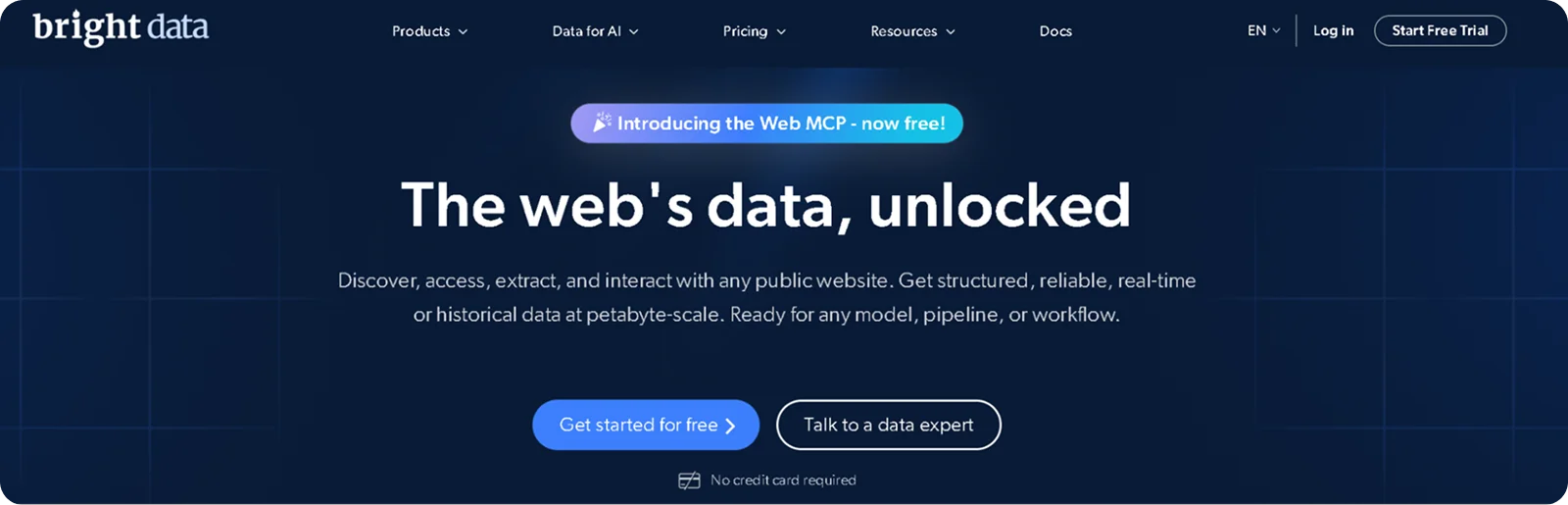
Bright Data targets enterprises and developers requiring high-volume data collection. The platform provides proxy networks, automated browser APIs, and pre-built scrapers for extracting data from sophisticated websites with anti-bot protection.
Key Features
Proxy network infrastructure: Provides access to 150 million residential IPs plus datacenter, ISP, and mobile proxies spanning 195 countries with targeting options down to city, ZIP code, carrier, and ASN levels
Web Scraper API with pre-built scrapers: Handles JavaScript rendering, CAPTCHA solving, and anti-bot bypass without custom infrastructure maintenance.
Browser API for complex interactions: Runs scraping scripts inside fully managed cloud browsers through Puppeteer or Playwright integrations
Web Unlocker for automated anti-bot bypass: Simulates real user patterns including browser headers, device fingerprints, and behavior sequences to bypass sophisticated protection systems
SERP API for search engine data: Returns structured search results in JSON or HTML with only successful requests counted toward usage
Pros
Includes 120+ pre-built scrapers eliminating custom scraper development
Provides Puppeteer and Playwright integration for browser-based scraping workflows
Handles CAPTCHA solving, JavaScript rendering, and anti-bot systems automatically
Cons
Uses bandwidth-based pricing creating cost unpredictability as page sizes vary significantly
Charges for failed requests on some products despite billing claims of success-only pricing
Shows degrading performance over time per user reports with high failure rates on complex sites
Pricing
Brightdata offers a pay-as-you-go model that starts at $1.50 per 1,000 requests. Subscription plans begin at $499/month for the Growth tier, $999/month for Business, and $1,999/month for Premium with volume discounts on per-request rates.
7. Cognism
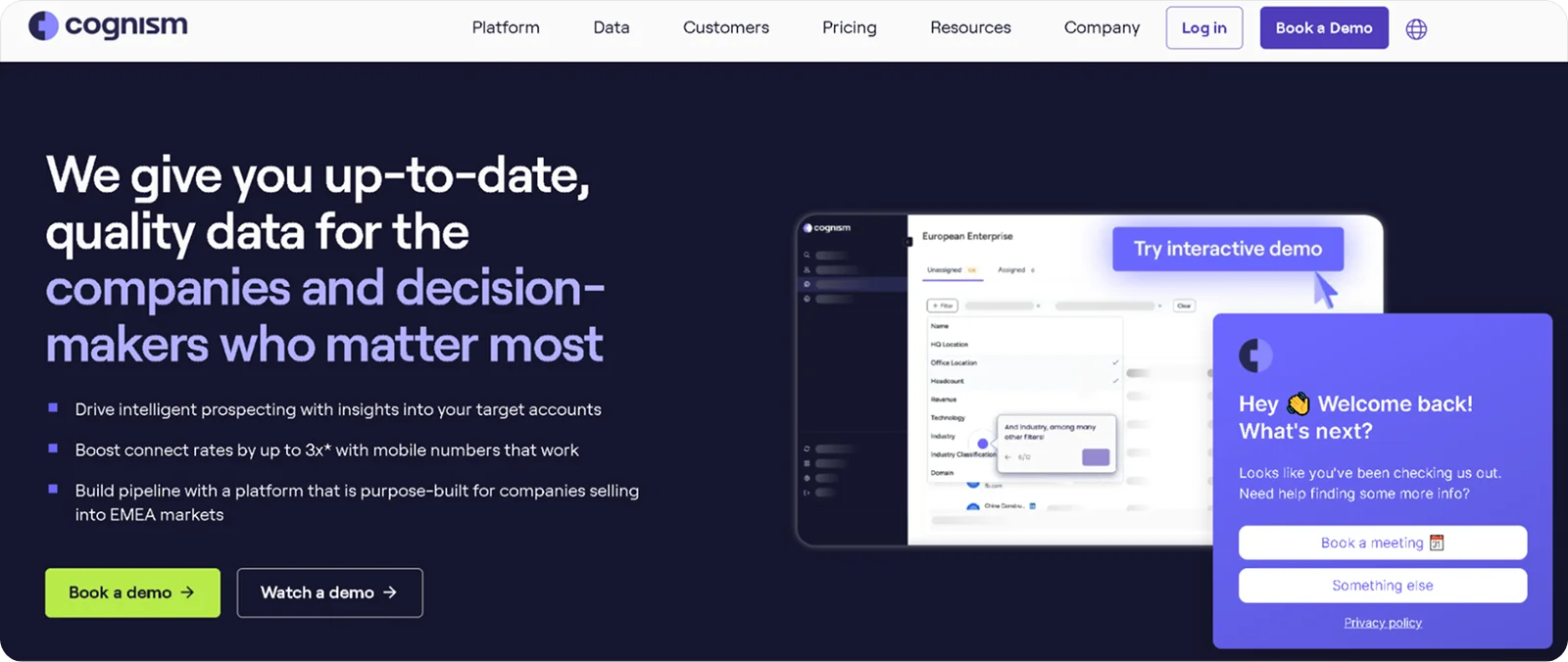
Cognism provides B2B sales intelligence with phone-verified mobile numbers and contact data across global markets. The platform specializes in GDPR-compliant European data with international coverage across EMEA, NAM, and APAC regions.
Key Features
Phone-verified mobile numbers (Diamond Data): Delivers human-verified mobile phone numbers achieving high connection rates through manual verification process
Global contact database: Searches over 400 million contacts across EMEA, NAM, and APAC regions using filters including job title, seniority, department, company size, industry, and location
Real-time enrichment options: Offers instant enrichment running in real-time as leads enter CRM, scheduled enrichment on cadences for database refresh, and on-demand CSV enrichment for uploaded contact lists
Intent data and signals: Monitors buying intent through Bombora partnership tracking technology research activity, job changes, funding rounds, company expansions, and technology adoption signals for outreach timing
Pros
Provides phone-verified mobile numbers with high connection rates
Screens contacts against international do-not-call lists for compliance
Offers unlimited access model without traditional credit restrictions
Cons
Features complex pricing with separate platform fees plus per-user charges
Shows data accuracy variation in smaller international markets according to user reviews
Pricing
Cognism offers custom pricing based on plan tier and user count.
8. Rocket Reach
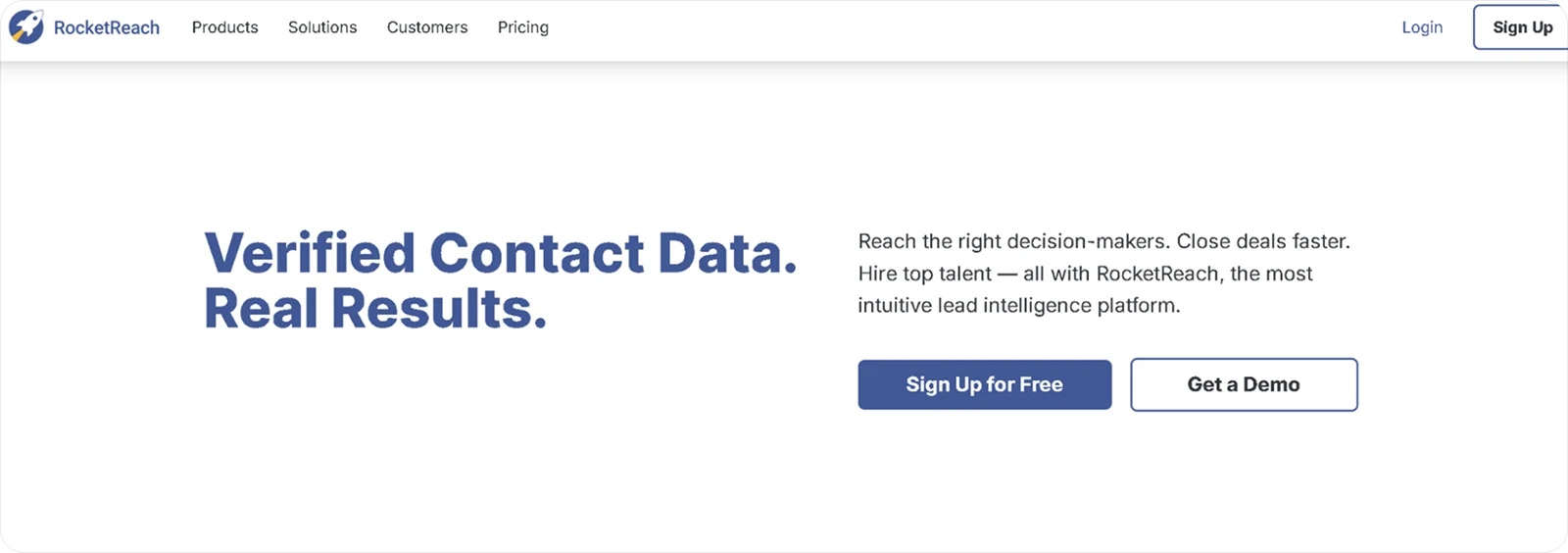
RocketReach provides contact intelligence through a database of 700 million professional profiles and 60 million companies worldwide. The platform specializes in finding verified email addresses and phone numbers with integrations for CRM systems and sales engagement tools.
Key Features
Contact database and search: Searches across 700 million professional profiles using filters including name, company, job title, industry, location, and technographics.
Chrome extension for prospecting: Captures contact information directly from company websites and social media platforms through a browser extension
Bulk enrichment capabilities: Accepts CSV uploads of incomplete contact lists and enriches missing data points, including email addresses, phone numbers, and company information
API and CRM integrations: Provides REST API for programmatic contact discovery, profile enrichment, and company search integrated into custom applications
Pros
Provides both email addresses and phone numbers in a single platform
Integrates directly with major CRM and sales engagement platforms
Includes browser extension for quick LinkedIn prospecting workflows
Cons
Relies on database aggregation rather than real-time data crawling
Separates lookups from exports with different credit systems, causing confusion
Shows data accuracy variation by region and industry according to user reviews
Pricing
RocketReach plans start at $69/user/month or $33/user/month when billed annually.
How to Choose the Right Enrichlayer Alternative
Most Enrichlayer alternatives fall into three categories: real-time scrapers, batch dataset providers, and hybrid platforms that offer both.
Real-time scraping platforms work best when data freshness matters more than cost efficiency. These platforms fetch current information on demand but charge premium rates for live data retrieval.
Batch dataset providers deliver better economics for high-volume enrichment where slight staleness is acceptable. Monthly or quarterly updates provide consistent data quality at predictable costs without per-request charges.
Hybrid platforms combine real-time APIs with cached databases, letting teams choose between speed and cost for each request. This flexibility suits workflows mixing time-sensitive enrichment with bulk processing.
Focus on three factors when looking at alternatives:
Data freshness requirements: Does your workflow require same-day accuracy, or can it tolerate weekly or monthly updates from cached databases?
Event-driven capabilities: Do you need webhook notifications when profiles change, or can scheduled batch jobs handle your monitoring requirements?
Source coverage: Does the platform aggregate multiple verified sources, or does it rely on single-source scraping that may miss information?
The more your workflows depend on real-time accuracy, automated event responses, and multi-source verification, the more critical the underlying data infrastructure becomes.
Why Crustdata Is the Best Enrichlayer Alternative
Enrichlayer provides API endpoints for professional profile enrichment with both cached and real-time options. Crustdata goes beyond data enrichment with a specialized event-driven architecture. This allows them to track signals from across the web and update data instantly.
While alternatives require polling APIs to check for data changes or running scheduled jobs to detect profile updates, Crustdata sends webhook notifications the moment tracked events occur. You receive instant alerts when target prospects change jobs, companies post new roles, or funding announcements happen, without writing monitoring scripts or querying endpoints repeatedly.
Crustdata offers the following:
Real-time data crawling: Pulls current company and people information when API calls are made, rather than returning cached records from periodic database refreshes
Event-driven webhooks: Delivers instant notifications when tracked companies or people trigger specific events without requiring manual polling or scheduled batch jobs
Multi-source aggregation: Combines verified data from 15+ sources, including professional networks, job boards, company websites, news sources, and social media into unified records
WebSearch API for unstructured intelligence: Converts live search results into structured data, capturing recent news, product launches, funding announcements, and executive activity that databases miss
API-first architecture: Provides REST endpoints and webhook infrastructure designed for autonomous agents and automated workflows rather than manual batch processing
Production-ready infrastructure: Handles high-volume requests with dedicated technical support for implementation, troubleshooting, and optimization
Unified data schema: Returns a consistent JSON structure across all endpoints eliminating the need to normalize data from multiple vendor APIs
When workflows require guaranteed current data rather than cached data, event-driven responses rather than polling, and multi-source verification rather than single-platform scraping, infrastructure designed for real-time intelligence becomes necessary.
Ready to upgrade your enrichment infrastructure?
Book a demo to see how Crustdata delivers real-time B2B intelligence through unified APIs.


Products
Popular Use Cases
Competitor Comparisons
Use Cases
95 Third Street, 2nd Floor, San Francisco,
California 94103, United States of America
© 2026 Crustdata Inc.
Products
Popular Use Cases
Competitor Comparisons
Use Cases
95 Third Street, 2nd Floor, San Francisco,
California 94103, United States of America
© 2025 CrustData Inc.
Products
Popular Use Cases
Competitor Comparisons
Use Cases
95 Third Street, 2nd Floor, San Francisco,
California 94103, United States of America
© 2026 Crustdata Inc.