8 Best CompanyEnrich Alternatives for B2B Data Enrichment
Explore the best CompanyEnrich alternatives to find fresher B2B data, improve prospecting workflows, and support smarter sales automation.
Published
May 22, 2026
Written by
Chris P.
Reviewed by
Nithish A.
Read time
7
minutes

CompanyEnrich works well for company-level enrichment, but it is not the right fit for every workflow. Teams running outbound at scale, building AI agents, or enriching records inside automated pipelines often need fresher data, deeper contact coverage, or stronger event tracking than a monthly-refreshed database can provide.
This guide breaks down the best CompanyEnrich alternatives in 2026, including tools built for real-time data enrichment, verified contact data, outbound prospecting, and developer-first workflows.
Key Takeaways
CompanyEnrich is built primarily around company-level data. Teams that need deep person-level enrichment, verified mobile numbers, or real-time data at the point of execution will find gaps in what the platform returns
A monthly refresh cycle introduces a staleness risk for teams running automated pipelines, where data accuracy at execution matters more than it does for manual prospecting
Coverage of 30M companies is strong for a focused dataset, but leaves gaps for teams prospecting into niche industries, emerging markets, or at high volume where single-source coverage limits match rates
The right alternative depends on whether your team needs more data types, fresher data, better geographic coverage, or a self-serve interface alongside API access
Where CompanyEnrich Falls Short
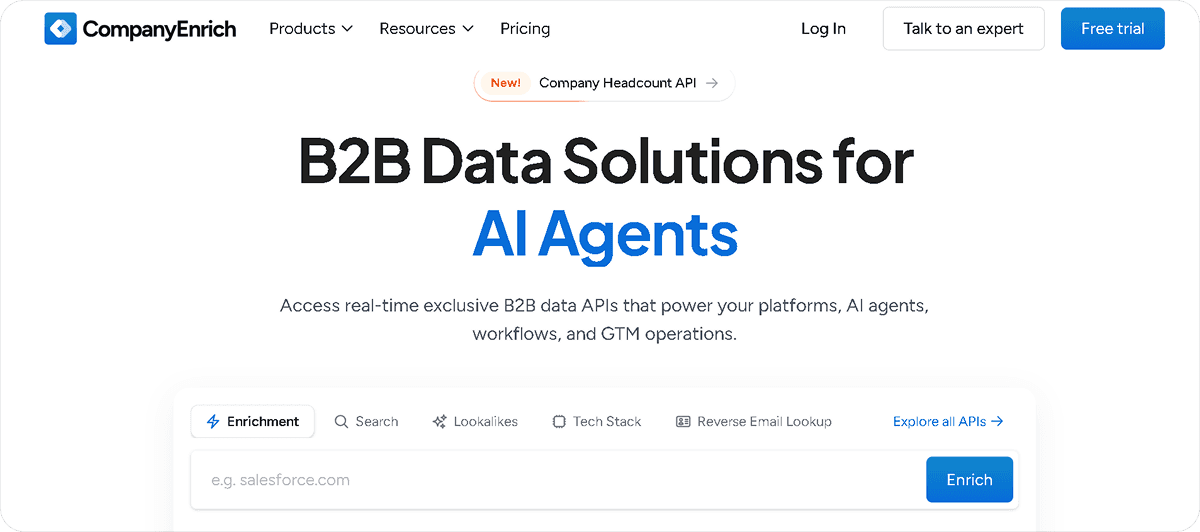
CompanyEnrich delivers clean, well-documented company enrichment for developer teams building on structured B2B data. Several limitations push teams toward other options.
Monthly refresh cadence: CompanyEnrich updates its database monthly. For teams running automated workflows or AI agents where data must be accurate at execution, a monthly refresh introduces lag that compounds across every automated action the pipeline takes on a given record
No real-time crawling: Data is served from a stored database rather than crawled live at the point of request. Teams that need signals reflecting the current company state cannot get them from CompanyEnrich natively
Limited person-level depth: People profiles cover 170M+ records but lack the depth of dedicated contact providers. Verified mobile numbers cost 30 credits per lookup, making phone-first outbound expensive at scale
No event monitoring: CompanyEnrich has no alert system for job changes, funding rounds, or headcount spikes. Teams that want event-triggered outreach need a separate monitoring layer entirely
8 Best CompanyEnrich Alternatives in 2026
The alternatives below cover different parts of the B2B enrichment stack. The table gives a quick side-by-side view before the detailed breakdowns.
Alternative | Best For | Database Size | Data Freshness | Pricing |
Crustdata | AI agents and real-time enrichment pipelines | 12M+ companies, 250M+ people profiles | Real-time crawling at point of request | Custom |
Apollo.io | SMB outbound teams needing contact data plus signals | 210M+ contacts, 35M+ companies | Monthly refresh with real-time verification at capture | From $49/user/month |
Diffbot | Data engineering teams building knowledge graphs | 246M+ organizations, 10B+ entities | Crawled every 4 to 5 days | From $299/month |
Lusha | Sales and recruiting teams needing verified contact data and signals | 280M+ verified contacts | Continuously updated and verified daily | From $29/user/month |
Hunter.io | Teams needing domain-based email finding and verification at scale | 6M+ domains indexed | Continuously crawled from public web sources | From $49/month |
Snov.io | Teams needing prospecting, email verification, and outreach automation in one platform | 500M+ profiles across 180+ countries | Regularly updated with real-time verification at export | From $39/month |
UpLead | Teams needing verified B2B contact data without technical setup | 160M+ contacts | Real-time email verification on request | From $99/month |
Datagma | Teams prioritizing live contact enrichment and waterfall prospecting workflows | Not publicly disclosed | Real-time enrichment from live web sources | From $49/month |
1. Crustdata
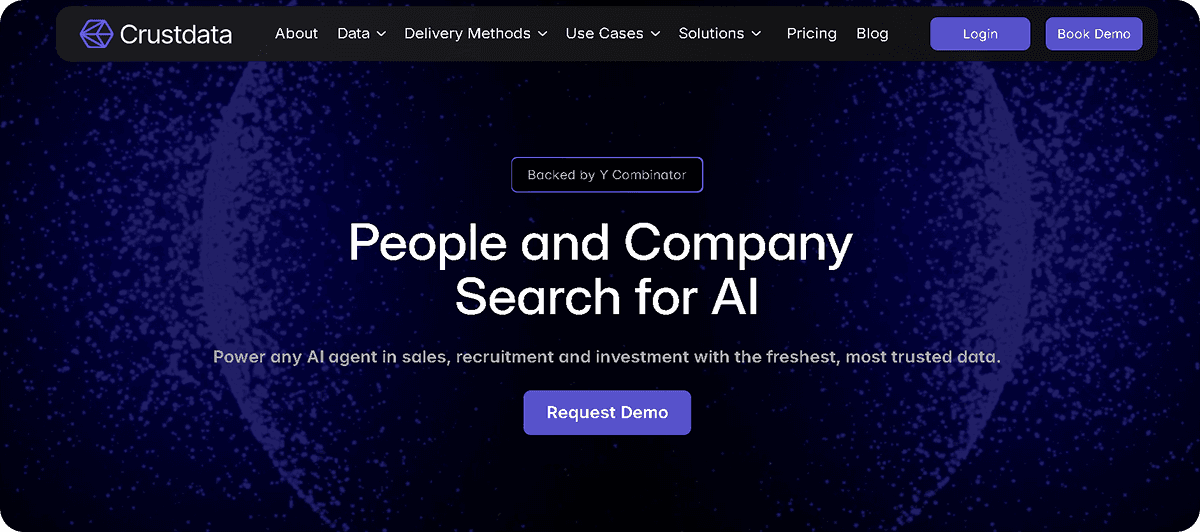
Crustdata is a B2B intelligence platform that pulls company and contact data from 10+ verified sources at the moment of each API request. Unlike CompanyEnrich’s monthly-refreshed database, Crustdata returns current signals at the time of execution, which matters most for teams where enrichment feeds automated routing, scoring, or outreach workflows rather than manual research.
Key features
Live enrichment at request time: Pulls company and contact data at the moment the API is called, returning current signals rather than a snapshot from the last database refresh
Watcher API with webhooks: Monitors a defined account set and fires a webhook the moment a qualifying event occurs, including a funding round, executive hire, headcount spike, or location change
250+ company and 90+ people data points: Covers firmographic data, headcount trends by department, funding history, technology stack, web traffic, and employee reviews in a single profile
95+ company filters and 60+ people filters: Supports nested boolean logic for building precise ICP queries across multiple combined criteria simultaneously
Jobs listing API: Surfaces real-time job postings and hiring velocity from target company career pages as additional signal layers for outreach timing
Developer-first API infrastructure: Well-documented endpoints, code samples, and webhook setup guides for teams building enrichment into automated pipelines
Pros
Returns company and person-level data in a single API call, removing the need to chain a company enrichment tool and a contact data provider the way CompanyEnrich requires
Fires event alerts the moment a signal occurs rather than surfacing changes in the next monthly batch, giving teams a timing advantage on outreach triggers
Handles complex ICP queries through nested boolean logic across multiple filter combinations simultaneously
Cons
Requires technical setup for webhook and API implementation, with no self-serve prospecting UI for non-technical users
Coverage is strongest for companies with a visible web and hiring footprint, so results may be thinner for very small private companies with limited public digital presence
Pricing
Crustdata uses custom pricing based on API usage volume and feature requirements. Contact the sales team for a quote.
2. Apollo.io
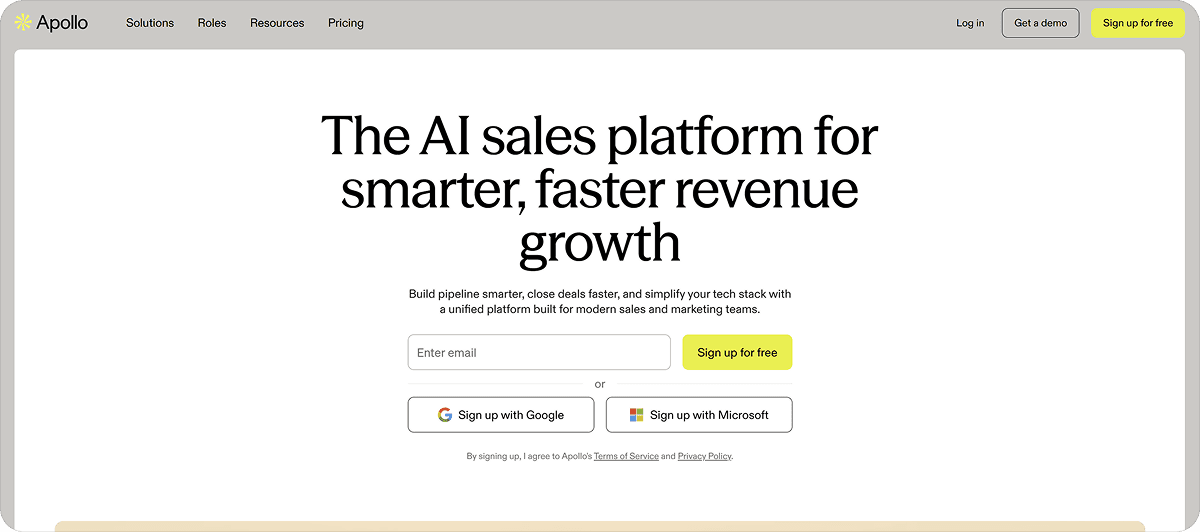
Apollo.io is an all-in-one sales intelligence and outreach platform that pairs a large contact database with company signal tracking and built-in email sequencing. It targets SMB and mid-market sales teams that want contact data, company signals, and outreach tooling in a single product.
Key features
B2B contact database: Covers 210M+ contacts and 35M+ companies with verified emails, direct dials, and firmographic data
Company signal alerts: Tracks funding events and job changes to surface outreach timing triggers across target accounts
Built-in email sequencing: Runs multichannel outreach sequences directly from the platform using enriched contact data
Intent data layer: Surfaces accounts showing active buying behavior through integrated third-party intent signals
CRM integrations: Syncs contact and company data bidirectionally into Salesforce and HubSpot for automated lead routing and enrichment
Pros
Combines contact data, company signals, and outreach sequencing in a single platform
Offers a free plan with meaningful data access, making it accessible for teams with limited budgets
Tracks funding and job change signals alongside contact data
Cons
Delivers contact data accuracy that varies by geography and industry
Bundles outreach tooling that teams with an existing engagement stack may not need,increasing cost without adding data value for those teams
Pricing
Apollo.io offers a free plan with limited credits. Paid plans start at $49 per user per month on annual billing.
3. Diffbot
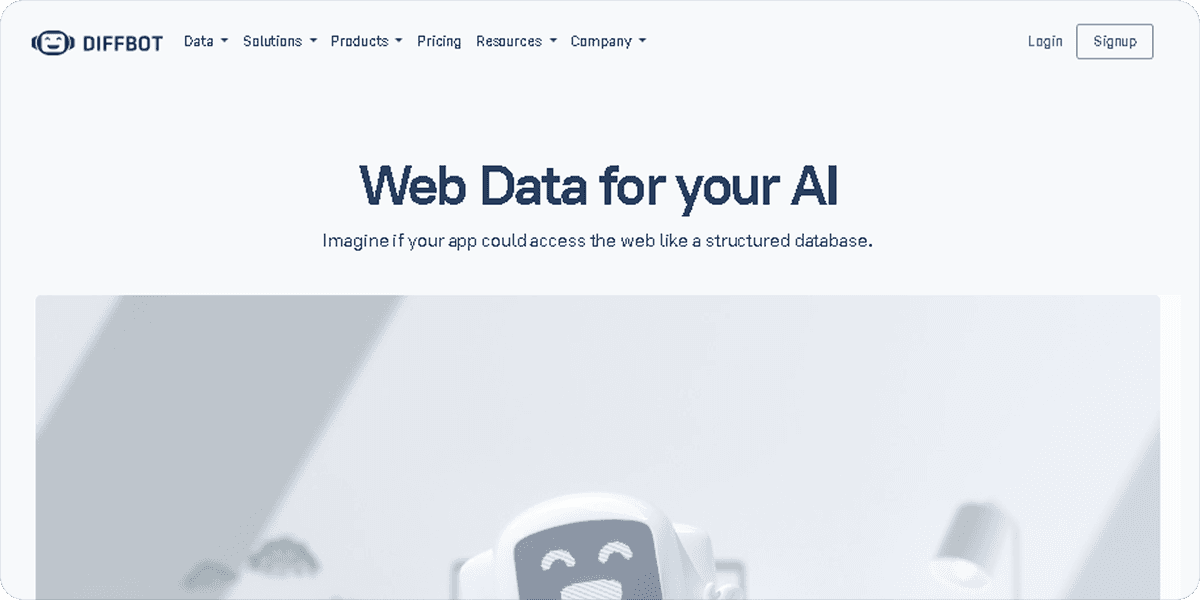
Diffbot is an AI-powered web intelligence platform that turns unstructured public web content into structured, queryable company and entity data. It targets data engineering and AI product teams that need web-scale entity resolution and company intelligence beyond what standard B2B databases cover.
Key features
Knowledge Graph: Maintains a database of 246M+ organizations and 10B+ entities with 1T+ facts, continuously refreshed from public web sources every four to five days
Automatic data extraction: Uses machine learning and computer vision to extract structured data from any public web page without manual scraping rules
Diffbot Query Language (DQL): Provides a proprietary query language for searching the Knowledge Graph by industry, employee size, funding, technology stack, and employee skills with complex boolean logic
Natural language processing API: Identifies entities, relationships, and sentiment from unstructured text for teams building research and intelligence products
MCP server: Exposes the Knowledge Graph to AI agents through a model context protocol server for teams building agentic data pipelines
Pros
Covers company and entity data at a scale no standard B2B database matches, built from live web crawling rather than a static dataset
Returns relationship data between companies, people, and technologies that structured B2B databases do not capture
Refreshes the Knowledge Graph every four to five days, keeping entity data more current than monthly-refresh alternatives
Cons
Requires familiarity with DQL to get meaningful results, with a learning curve that non-technical users consistently flag in G2 reviews
Returns no verified contact data, like emails or phone numbers, so teams need a separate provider for outbound prospecting
Pricing
Diffbot offers a free tier for testing. Paid plans start at $299 per month for the Startup tier, with Enterprise plans available on custom pricing.
4. Lusha
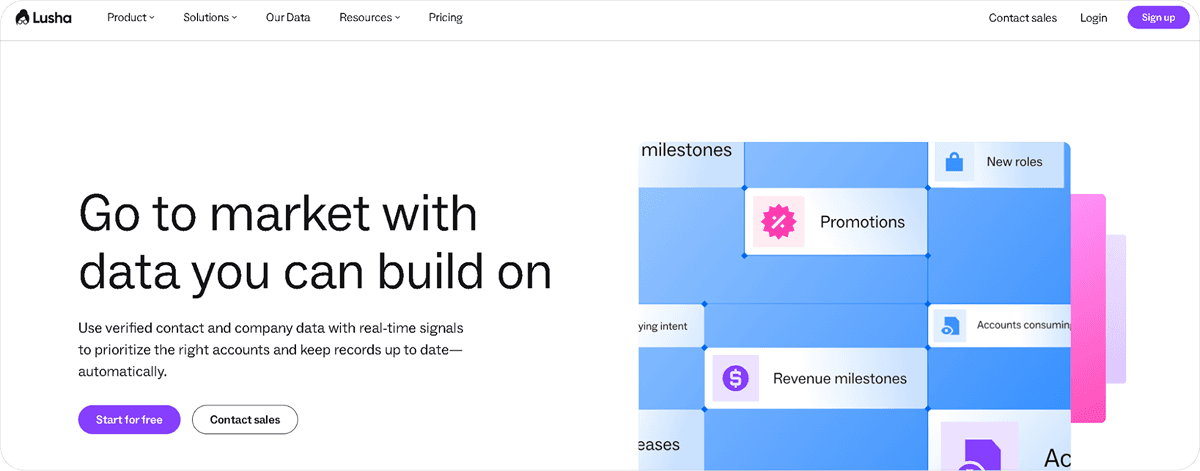
Lusha is a B2B contact data platform built around verified emails, direct dials, and company firmographics for sales and recruiting teams. It covers 280M+ verified contacts as of February 2026, continuously refreshed and verified daily across every major industry and region.
Key features
Company data included free: Covers industry, company size, revenue range, location, funding rounds, SIC and NAICS codes, and technology stack at no credit cost across all plans
Real-time signals API: Surfaces outreach timing triggers including job changes and company events through a dedicated signals layer launched in early 2026
Daily lead streaming: Delivers a qualified prospect feed to the platform homepage based on saved ICP criteria, available across paid plans
CRM integrations: Syncs verified contact and company data bidirectionally into Salesforce, HubSpot, and Pipedrive for automated lead routing and enrichment
API access: Supports programmatic enrichment and search for RevOps and sales teams building Lusha data into custom workflows and CRM automation
Pros
Delivers verified contacts with company data included at no additional credit cost
Refreshes and verifies records daily, reducing the staleness risk on key contact fields compared to batch-updated alternatives
Offers a free plan with 40 credits per month
Cons
Covers a smaller European dataset than US data
Credit costs scale steeply for phone number lookups and API usage at production volume
Pricing
Lusha offers a free plan with 40 credits per month. Paid plans start at $29 per user per month. Enterprise pricing is available on request.
5. Hunter.io
Hunter.io is a domain-based email finding and verification platform used by 6M+ professionals to find verified work email addresses for any company from a domain name, bulk list, or name-plus-company combination. It targets sales, marketing, and recruiting teams that need reliable email data without a full-scale sales intelligence platform.
Key features
Domain Search: Returns all publicly available email addresses associated with a company domain, including names, job titles, sources, and confidence scores
Email Finder: Returns the most likely professional email address for any person given their name and company domain, with a confidence score and source attribution
Bulk email finding and verification: Processes large contact lists through API or bulk tasks, returning verified deliverability status for each address before outreach runs
Email campaigns: Runs personalized cold email sequences with follow-up automation directly from the platform on All-in-One Outreach plans
Data Platform API: Provides programmatic access to email finding and verification at scale through a dedicated API with separate search and verification credit pools
Pros
Delivers strong domain-level email coverage built from continuous web crawling of public sources
Offers a free plan and transparent credit-based pricing
Credits roll over on annual Data Platform plans
Cons
Covers email finding and verification only, with no company firmographics, technographic data, funding signals, or person-level enrichment beyond basic contact fields
Returns no phone numbers or direct dials, so teams running phone-first outbound need a separate contact data provider alongside Hunter
Pricing
Hunter.io offers a free plan. The All-in-One Outreach plan starts at $49 per month, while the Data Platform API plan costs $61 for 1,000 search credits.
6. Snov.io
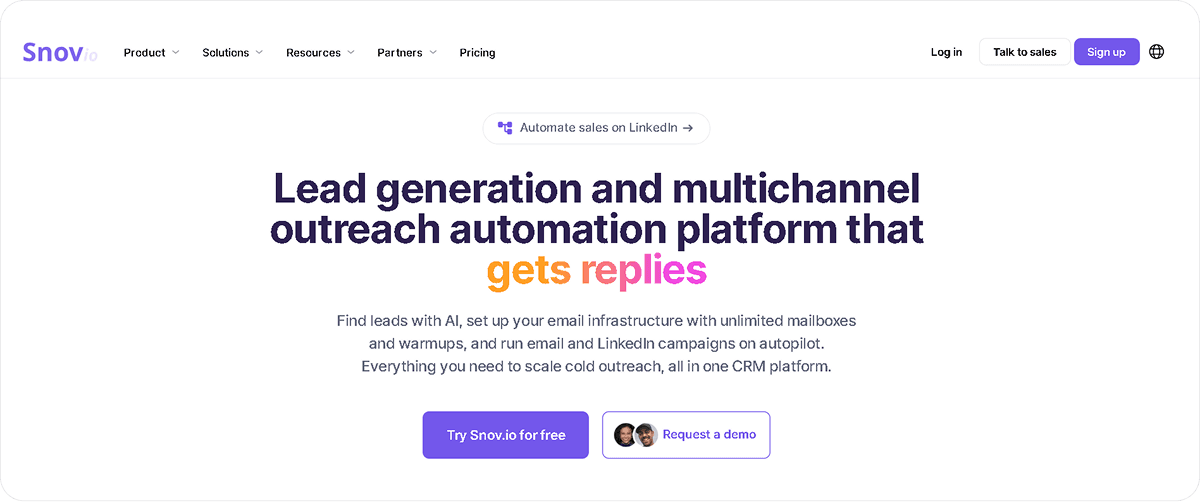
Snov.io is an all-in-one lead generation and outreach automation platform that combines contact database with email finding, real-time verification, multichannel sequencing, and a built-in CRM. It targets sales teams, SDRs, and marketing teams that want prospecting, enrichment, and outreach managed from a single platform without managing multiple vendor contracts.
Key features
B2B database search with AI: Searches 500M+ profiles across 180+ countries using AI-powered ICP matching, conversational queries, and standard firmographic filters
Email finder and verification: Finds and verifies professional email addresses at the domain, company, or individual level, with 7-tier email verification delivering an average 98% deliverability on verified results
Domain Search: Returns all available emails associated with a company domain, useful for building contact lists across target accounts without individual lookups
Multichannel outreach sequences: Runs automated email and outreach campaigns directly from the platform using enriched contact data, with A/B testing and AI-generated personalization on Pro plans
Built-in sales CRM: Manages deals, pipelines, and contact data within the platform across all plans at no additional cost
Pros
Includes a sales CRM at no additional cost across all paid plans, which most comparable platforms charge separately for or exclude entirely
Provides programmatic access to email finding, verification, prospect management, and campaign tracking
Offers a permanently free trial plan with 50 credits per month
Cons
Bundles outreach tooling that teams with an existing engagement stack may not need, adding cost without additional data value for those use cases
Delivers less company-level firmographic depth than dedicated company intelligence platforms, particularly for funding signals, headcount trends, and technographic data
Pricing
Snov.io offers a free trial plan with 50 credits per month. Starter plans begin at $39 per month. Pro plans start at $99 per month with higher credit and recipient limits, unlimited team seats, and full API access.
7. UpLead
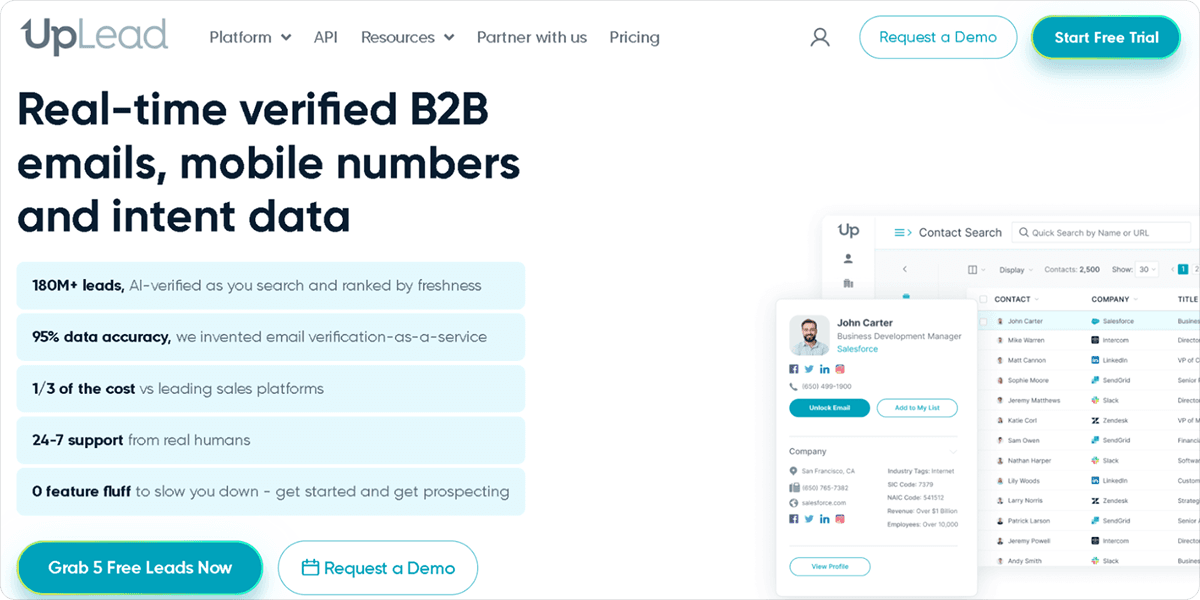
UpLead is a B2B contact and company data platform built around real-time email verification at the point of enrichment. It targets sales and marketing teams that need reliable, verified contact data for outbound prospecting without technical setup or API integration work.
Key features
Contact and company enrichment: Returns verified emails, direct dials, job titles, company size, industry, revenue range, and technology stack for 160M+ contacts
Technographic filters: Filters target companies by specific technology stack usage, covering 16,000+ technology categories for building tech-based prospect lists
CRM integrations: Syncs enriched contact and company data directly into Salesforce, HubSpot, Pipedrive, and other major CRMs for automated lead routing
Bulk list enrichment: Processes CSV uploads of existing contact lists and returns enriched, verified records for each matched contact
Intent data: Surfaces accounts showing active buying behavior through an integrated intent data layer available on higher-tier plans
Pros
Offers a simple, self-serve interface that non-technical users can operate independently without API integration or engineering support
Provides a 7-day free trial with real data access, allowing teams to test accuracy against their actual ICP before committing to a paid plan
Cons
Limits automation and API flexibility compared to API-first enrichment platforms, making it less suited for teams building enrichment into custom automated workflows
Intent data and some advanced filters are available only on higher-tier plans, increasing the cost for teams that need the full feature set at production volume
Pricing
UpLead offers a 7-day free trial. Paid plans start at $99 per month with credit-based usage tiers. Enterprise pricing is available on request.
8. Datagma
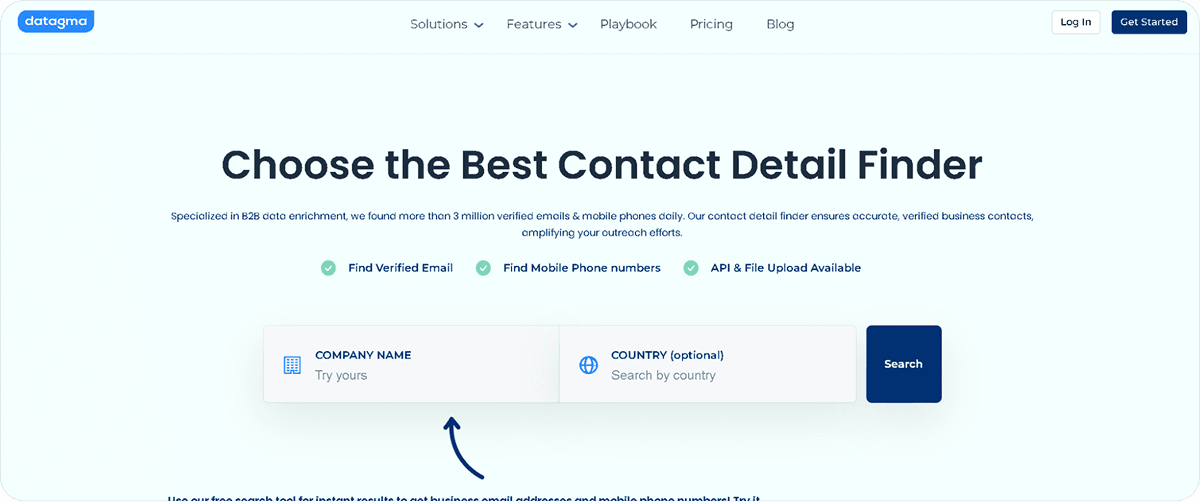
Datagma is a real-time B2B enrichment and prospecting platform focused on verified emails, and mobile numbers. Unlike CompanyEnrich’s database-first model, Datagma positions itself around live enrichment and waterfall-style contact discovery, making it a stronger fit for teams prioritizing outbound execution over pure company intelligence.
Key features
Real-time enrichment: Pulls contact and company data live from web sources instead of relying entirely on a static database, reducing stale records in active outbound workflows
Verified email and mobile lookup: Returns verified work emails alongside mobile numbers, with a credit-based system where one credit equals one email lookup and mobile numbers consume higher credit volumes
Job change detection: Tracks professional moves and surfaces alerts when contacts switch companies, helping teams trigger outreach during transition windows
Workflow integrations: Connects with HubSpot, Pipedrive, Zapier, Make, and n8n for enrichment automation and CRM syncing
API access: Provides API endpoints for enrichment and prospecting workflows, including bulk enrichment and CSV upload support
Pros
Focuses heavily on real-time enrichment rather than relying purely on monthly database refreshes
Supports waterfall-style contact discovery, helping teams recover contacts that single-source databases often miss
Includes job change monitoring and CRM enrichment automation without requiring separate tooling
Cons
Provides less company-level intelligence depth than platforms built primarily around firmographic and market intelligence data
Consumes credits quickly for mobile number lookups, increasing costs for phone-heavy outbound teams
Supports fewer advanced technographic, funding, and organizational structure insights than broader enrichment platforms
Pricing
Datagma offers a free plan with limited credits. Paid plans start at $49 per month, with higher tiers based on email and mobile enrichment volume. Enterprise pricing is available for larger teams and API usage.
How To Choose the Right CompanyEnrich Alternative
The best enrichment platform usually depends less on database size and more on how the data gets used after enrichment happens.
If your team mainly runs manual prospecting, a standard contact database with decent coverage may be enough. But once enrichment feeds automated workflows, lead scoring, AI agents, routing systems, or outbound triggers, data freshness starts to matter much more.
It also helps to separate company intelligence from contact enrichment. Some platforms focus heavily on firmographic data, while others are stronger at verified emails, mobile numbers, or outbound workflows. Very few handle both well in the same system.
Before choosing a platform, evaluate:
How often the data refreshes
Whether enrichment happens in real time or from stored records
The depth of company and people-level coverage
Support for webhook alerts and event monitoring
API flexibility for automation workflows
CRM and workflow integrations
Filtering depth for ICP targeting and segmentation
Whether the platform fits technical and non-technical teams equally well
For teams building automation-heavy workflows, the strongest platforms are usually the ones that combine live enrichment, event tracking, flexible APIs, and company plus contact data in a single workflow instead of splitting those functions across multiple tools.
Why Crustdata Is the Best CompanyEnrich Alternative
CompanyEnrich handles structured company enrichment well, especially for teams that mainly need firmographic data through an API. The gap appears when workflows depend on current signals instead of database snapshots.
Crustdata is built for teams that need enrichment tied to live company activity. Rather than serving records refreshed on a fixed monthly cycle, it pulls from multiple verified sources in real time and monitors changes continuously through APIs and webhook-based workflows.
That difference matters for teams running outbound automation, AI agents, lead routing, recruiting workflows, territory scoring, or signal-based prospecting. When enrichment happens automatically inside a workflow, stale data compounds quickly.
Key capabilities include:
Real-time company data and people enrichment at the moment of each API request
Watcher API with webhook alerts for funding rounds, hiring spikes, executive hires, promotions, and company changes
250+ company datapoints and 90+ people datapoints across firmographics, hiring, growth, funding, and engagement signals
Advanced ICP search with 95+ company filters and 60+ people filters using nested boolean logic
Job listing API for tracking hiring activity and identifying expansion signals across target accounts
MCP and API infrastructure designed for AI agents and automated enrichment workflows
Bulk enrichment and scalable datasets for RevOps, recruiting, and sales intelligence teams
For teams evaluating CompanyEnrich alternatives because they need fresher data, deeper signal coverage, or enrichment built for automation, Crustdata is one of the best options available.
Need enrichment data that reflects what is happening right now instead of what changed weeks ago?
Book a demo to see how real-time enrichment, webhook alerts, and live company signals fit into your workflows.
FAQs
Does CompanyEnrich have a free plan?
Yes. It offers a free trial with 500 credits, no card required. Paid plans start at $49/month, then scale to $149/month and $549/month based on credit volume, with rollover on higher tiers.
What is the difference between company enrichment and contact enrichment?
Company enrichment focuses on business-level data like industry, size, revenue, funding, and tech stack. Contact enrichment focuses on people-level data like job titles, emails, phone numbers, and work history. Most real workflows need both, either combined in one system or stitched together across multiple tools.
Is CompanyEnrich good for AI agent workflows?
It can work for basic agent setups through its API and MCP support, but it relies on a monthly-refreshed dataset. That means agents don’t always act on the current company state. For workflows that depend on live signals and real-time changes, that delay becomes a limitation.



Products
Popular Use Cases
Competitor Comparisons
Use Cases
95 Third Street, 2nd Floor, San Francisco,
California 94103, United States of America
© 2026 Crustdata Inc.
Products
Popular Use Cases
Competitor Comparisons
Use Cases
95 Third Street, 2nd Floor, San Francisco,
California 94103, United States of America
© 2025 CrustData Inc.
Products
Popular Use Cases
Competitor Comparisons
Use Cases
95 Third Street, 2nd Floor, San Francisco,
California 94103, United States of America
© 2026 Crustdata Inc.