How Waterfall Enrichment Works in B2B Prospecting
Waterfall enrichment queries providers sequentially until data is found. Learn how it differs from aggregated APIs and how to configure it for cost control.
Published
Written by
Abhilash C.
Reviewed by
Manmohit G.
Read time
7
minutes
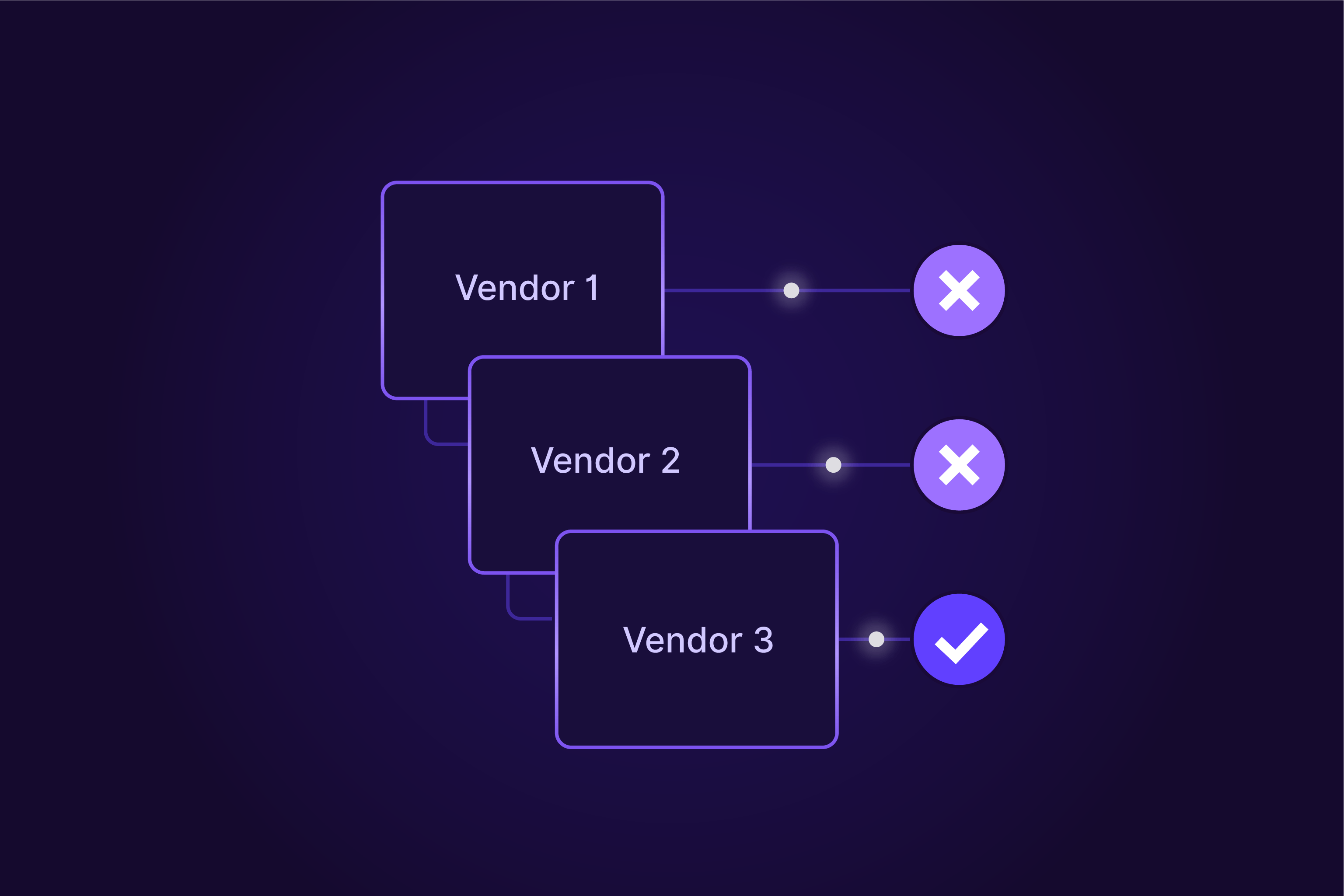
No single B2B data provider covers your entire target list. Most return verified contact info for roughly half of records, leaving the rest unreachable.
Waterfall enrichment fixes this by sending each record through multiple providers in sequence until a match is found, improving coverage.
We’re going to cover the process step by step, how it breaks down, and how the three main enrichment architectures compare: sequential, parallel, and aggregated.
What waterfall enrichment is and why B2B teams use it
Waterfall enrichment is a B2B data strategy where a contact record is sent through multiple data providers in sequence, stopping as soon as verified contact information is found.
The core problem it solves is coverage. Each provider has geographic strengths and different data collection methods, so single-source platforms typically return low match rates. A well-configured waterfall combining multiple providers can push things substantially higher.
The fields it targets most often are work and personal emails, mobile numbers, job titles, and company firmographics such as headcount, revenue, and industry. No single provider returns all of these reliably across every market, which is what makes the sequential architecture worth the added complexity.
💡 Check out our complete guide to data enrichment APIs if you want to understand how the underlying data retrieval works before configuring a waterfall.
How a waterfall enrichment sequence runs
Each record moves through providers in order, stopping at the first verified match and skipping the rest. Let’s go through the exact flow:
A record with missing fields enters the workflow, typically including a name and company domain or a professional profile URL.
The record is sent to the first provider in the sequence.
The provider attempts to return contact data for the record.
If verified contact data is returned, the process stops, and only that provider is charged.
If no data is returned or the data fails verification, the record is passed to the next provider.
Steps 3 to 5 repeat for each provider in sequence until a verified match is found or all providers are exhausted. The process outputs a single enriched record.
What drives outcomes beyond the basic flow
The flow is fixed, but outcomes aren’t. Cost, data quality, and coverage depend on how you configure what happens inside it:
Provider ordering affects both cost and quality since leading with a weakly verified source can waste credits on data that bounces. The right approach is to sequence providers by verification quality first, then coverage breadth.
Field-level merging allows a waterfall to combine partial results instead of relying on a single provider for all fields. This produces a more complete record by taking the best available data from each source.
Verification types determine the reliability of results since categories like verified (confirmed mailbox), valid (likely deliverable), and catch-all (domain accepts all, mailbox unconfirmed) carry different levels of risk. Teams configure waterfalls to include or exclude these types based on their tolerance for bounce rates.
Full enrich means querying every provider for maximum coverage rather than stopping at the first result. This improves completeness but increases credit consumption.
For an example of how this works in practice, Apollo's waterfall, Apollo always acts as the first source and cannot be reordered. Third-party sources from the Integrations Marketplace fire in the order admins define. Credits are consumed when any result is returned, including catch-all and unverified results, so the distinction between verification types has real cost implications, not just deliverability ones.
Implementing a waterfall enrichment workflow
There are three ways to build a waterfall enrichment workflow. The right choice comes down to one question: how much orchestration complexity are you willing to own in exchange for control over provider selection and cascade logic?
3 ways to implement a waterfall enrichment workflow
Each approach trades orchestration ownership for flexibility. Here's how they stack up.:
Managed waterfall platforms like FullEnrich and BetterContact come with pre-built provider sequences, pay-per-result pricing, and minimal setup. They're the right call for teams that want enrichment results without owning the orchestration logic.
Orchestration tools like Clay let you connect to dozens of providers and build custom sequences in a visual interface. You control provider order, conditional logic, and field-level routing. More flexible, but you manage the workflow and pay platform credits on top of provider costs.
Custom API pipelines built with Zapier, Make, or direct code give you maximum control. You call each provider's API in sequence with your own conditional logic. The tradeoff is that you own all the maintenance: API changes, rate limits, error handling, and schema normalization across providers. This is the right path for teams with B2B data API experience who need the waterfall embedded inside a larger automated system.
Cascade logic and when to query the next provider
The cascade fires under four conditions, and confusing them is where you misconfigure your workflow:
No result returned means the provider found nothing for this record. Move on.
Result returned but fails verification indicates the provider returned an email, but it's a catch-all or unverified. Depending on your bounce rate tolerance, this may count as a miss.
Result returned, but wrong field type means you needed a direct mobile number and got a corporate switchboard. The cascade continues for that specific field.
Confidence score below threshold applies when providers return results with a confidence score. If the score falls below your set minimum (e.g., 80%), the record is passed to the next provider.
What to watch for
Most waterfall failures come from the same configuration mistakes:
Start with your cheapest or highest-verification provider and escalate to more expensive sources only on a miss.
Set a hard provider cap: coverage gains taper off significantly past 10-15 providers, and the error risk keeps climbing.
Monitor bounce rates per provider over time, because accuracy degrades.
Decide upfront whether catch-all results count as a match or trigger a cascade. That one decision shapes both your coverage numbers and your deliverability.
Waterfall enrichment pros and cons compared to other methods
Before evaluating waterfall enrichment, it helps to understand the three architectures you're actually choosing between.
3 different enrichment architectures
Each model makes a different tradeoff between cost, accuracy, and how much infrastructure you own:
Sequential waterfall is the standard model. A record queries Provider 1, falls to Provider 2 on a miss, and stops at the first match. Most waterfall tools use this approach.
Parallel enrichment queries multiple vendors simultaneously and selects the highest-confidence result rather than the first match. For example, ZoomInfo's implementation queries 25+ vendors in parallel. This addresses the "first match is not the best match" problem, but costs more per lookup.
Aggregated multi-source sends a single API call that queries multiple sources internally, cross-references results with entity resolution, and returns one consolidated record. There's no external provider cascade to manage.
💡 For a broader comparison of B2B data API providers across these models, check out our ranked guide.
Pros
Waterfall enrichment earns its complexity in four specific ways:
Match rates climb higher when combining multiple providers. That gap translates directly into how much of your ICP is actually reachable versus sitting unreachable on a list.
Geographic coverage gaps get filled by sequencing region-specific providers that each handle markets your primary source misses. One provider strong in the US, paired with others covering the UK and continental Europe, means the waterfall handles markets your primary source would miss entirely.
Field-level merging produces more complete records than any single provider returns, pulling the best email from one source and the best phone number from another. The result is a composite record that's more useful for outreach than anything a single provider could return alone.
Pay-per-result pricing ties costs directly to outcomes, charging only when verified data is returned. Not all platforms work this way, though: some charge credits on any returned result, including catch-all addresses, so the pricing model is as important as the provider lineup.
Cons
The same architecture that improves coverage introduces six problems worth stress-testing before you commit:
Error stacking compounds inaccuracies across every provider in the chain, because each source carries its own error rate. The longer the chain, the harder it becomes to trace which source introduced bad data.
Sequential waterfalls stop at the first match, so if a later provider had fresher or more accurate data, you never see it. Parallel architectures solve this directly; sequential ones don't.
Coverage gains taper off eventually because most sources beyond that point share overlapping databases. You're paying for more providers without getting proportional improvement in match rates.
Credit complexity makes spending hard to predict, with each vendor running different credit systems and inconsistent charge-on-result policies. A waterfall that looks cost-efficient at the per-record level can produce unpredictable invoices at scale.
Data decay erodes coverage gains quickly, as B2B contact data decays at roughly 2.1% per month, and in high-turnover sectors, annual decay can exceed 70%. A one-time waterfall run is more of a snapshot than a solution.
Compliance overhead scales with each provider you add, as each data source requires its own DPA and compliance verification. A 10-provider waterfall means 10 separate agreements to maintain.
Using Crustdata as a data source in a waterfall workflow
Crustdata returns data via REST API with JSON responses, so it plugs into any orchestration layer that accepts API-based providers. That includes Zapier, Make, and custom-built pipelines with direct API integration.
Positioning Crustdata early in a waterfall sequence makes sense because its internal aggregation across 10+ sources covers the ground of multiple individual providers in a single call. The waterfall only needs to fire subsequent providers for fields that Crustdata doesn't return.
One API call returns 250+ company datapoints and 90+ person datapoints from cross-referenced sources with entity resolution built in, which reduces the number of downstream providers needed for most records.
💡 For a comparison of how Crustdata stacks up against other B2B data enrichment tools, check out our round-up.
When aggregated enrichment replaces a waterfall
For teams building automated workflows, AI agents, or data products via API, managing a multi-provider waterfall adds orchestration complexity that may not be worth it. When your enrichment needs can be met by a single well-aggregated source, the cascade becomes unnecessary overhead.
Crustdata's enrichment API is one example of this approach.
One API call returns 250+ company datapoints and 90+ person datapoints from 10+ cross-referenced sources, with entity resolution handling conflicts internally, such as different sources listing different job titles for the same person.
The Watcher API adds continuous monitoring on top of that: webhooks fire on job changes and funding events within hours. This addresses data decay without batch re-enrichment runs.
Flat per-call pricing removes the credit complexity that comes with multi-vendor waterfalls, with costs that are simply calls multiplied by price per credit, no variable costs depending on which underlying source fires.
This model fits teams that need email and company enrichment through a single API and want to avoid managing provider sequences. Book a demo to see how Crustdata fits into your enrichment stack.


Products
Popular Use Cases
Competitor Comparisons
95 Third Street, 2nd Floor, San Francisco,
California 94103, United States of America
© 2026 Crustdata Inc.
Products
Popular Use Cases
Competitor Comparisons
95 Third Street, 2nd Floor, San Francisco,
California 94103, United States of America
© 2026 CrustData Inc.
Products
Popular Use Cases
Competitor Comparisons
95 Third Street, 2nd Floor, San Francisco,
California 94103, United States of America
© 2026 Crustdata Inc.
🎉 We hit $10M ARR!
$600k to $10m in 1.5 years. Our entire GTM is powered by our own APIs.
🎉 We hit $10M ARR in 1.5 years!