5 B2B Data Validation Techniques to Improve Data Quality [Guide]
Discover B2B data validation techniques to improve data accuracy, reduce outreach errors, and keep your sales and marketing workflows reliable.
Published
Written by
Chris P.
Reviewed by
Nithish A.
Read time
7
minutes
B2B data validation is the process of checking that contact and company records are accurate and usable before they enter your sales, marketing, or automated workflows. Without it, outreach lands on the wrong contacts, pipelines reflect inflated numbers, and automated sequences execute on records that were outdated before anyone acted on them.
This guide covers the core B2B data validation techniques you can use to catch bad data before it compounds, how validation fits into an enrichment workflow, and the metrics that tell you whether your database is improving.
Key Takeaways
Validating email alone leaves most data quality problems unaddressed; job titles, phone numbers, firmographic fields, and URLs each require separate validation logic
Real-time validation prevents bad records from entering your systems; batch validation cleans what already exists, and both are necessary
Automated rules-based validation is the only approach that scales; manual review creates backlogs and inconsistency
Teams that validate continuously see measurable improvements in email deliverability, pipeline accuracy, and CRM completeness
What Is B2B Data Validation?
B2B data validation is the process of checking every field in a contact or company record against a defined quality standard. Most teams run an email check and consider the job done. Email verification is one check on one field, not a full validation pass.
A contact with a verified email, but a job title from 18 months ago is not clean data. The email delivers, but it reaches someone who no longer holds the role you are targeting, no longer controls the budget you are selling to, and may not even be at that company anymore.
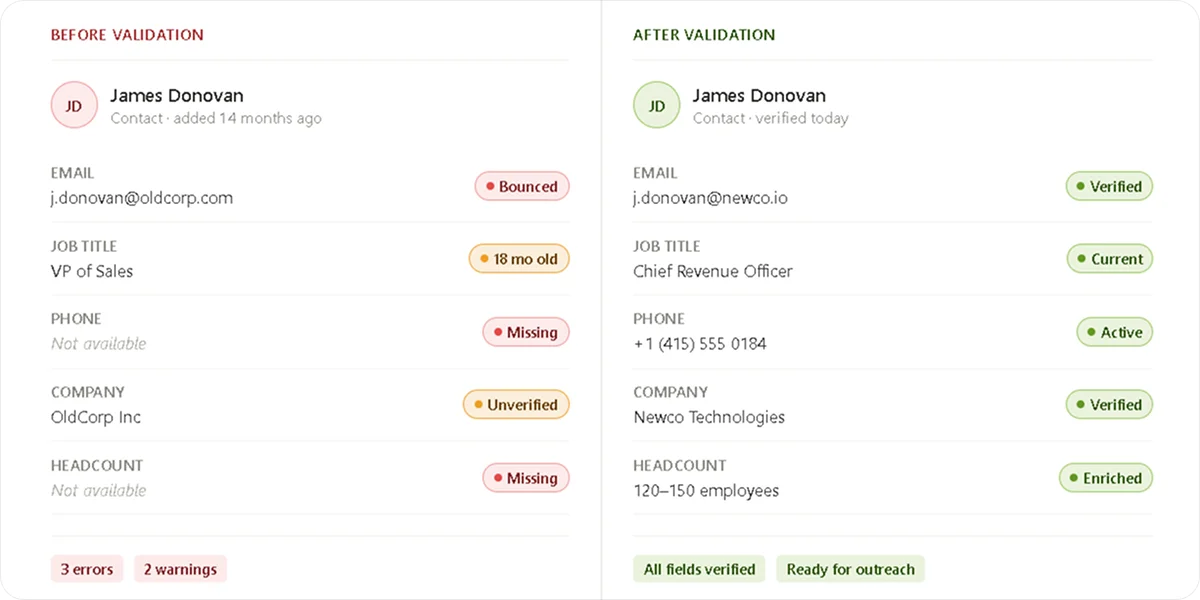
Real validation means applying appropriate checks to every field in a B2B record independently, because each field fails in its own way. The before side shows what some teams are working with. The after side shows what the same record looks like once full-field validation has run.
7 Fields That Require Separate Validation Logic
Most B2B records carry at least seven fields that can go wrong independently of each other. Here is what validation looks like for each one.
Email address: Checks run in sequence from simplest to most expensive: syntax validation against RFC 5322 rules, MX record lookup to confirm a functioning mail server, SMTP verification to test whether the specific mailbox accepts mail, and disposable domain detection to flag throwaway addresses.
Phone number: Format checks confirm E.164 compliance for the relevant country. Line-type identification distinguishes mobile, landline, and VoIP numbers, which affects both compliance and connect rate. Carrier lookup confirms the number is active. Disconnect detection flags decommissioned numbers.
Job title: This is the most commonly skipped field and one of the most consequential. 65.8% of B2B contacts change job titles within a year. Validation means checking tenure thresholds against external signals, specifically job posting data and professional profile updates, to flag records where the title is likely outdated.
Company name: Standardization against official registry data catches variants that break deduplication logic. "Acme Inc.," "Acme Incorporated," and "Acme" represent the same entity but fragment CRM records. Validation here also flags acquired, merged, or dissolved companies.
Firmographic fields: Employee count, revenue range, and industry code need cross-referencing against at least one external source. These fields go wrong not because of bad data entry, but because the company changed, and the record was never updated.
Website URL: Domain existence checks confirm the URL resolves. Redirect chain analysis catches rebranded or acquired domains. Site-down detection flags domains returning error codes, which often signal a dissolved company before any other field reflects it.
Physical address: Postal validation confirms the address exists in the country's address registry. Format normalization catches inconsistencies that break deduplication rules. Deliverability checks confirm the address can receive mail, relevant for teams running direct mail alongside digital outreach.
Running a single pass that checks email syntax and stops there leaves six fields unverified and most of the actual data quality risk unaddressed.
5 B2B Data Validation Techniques
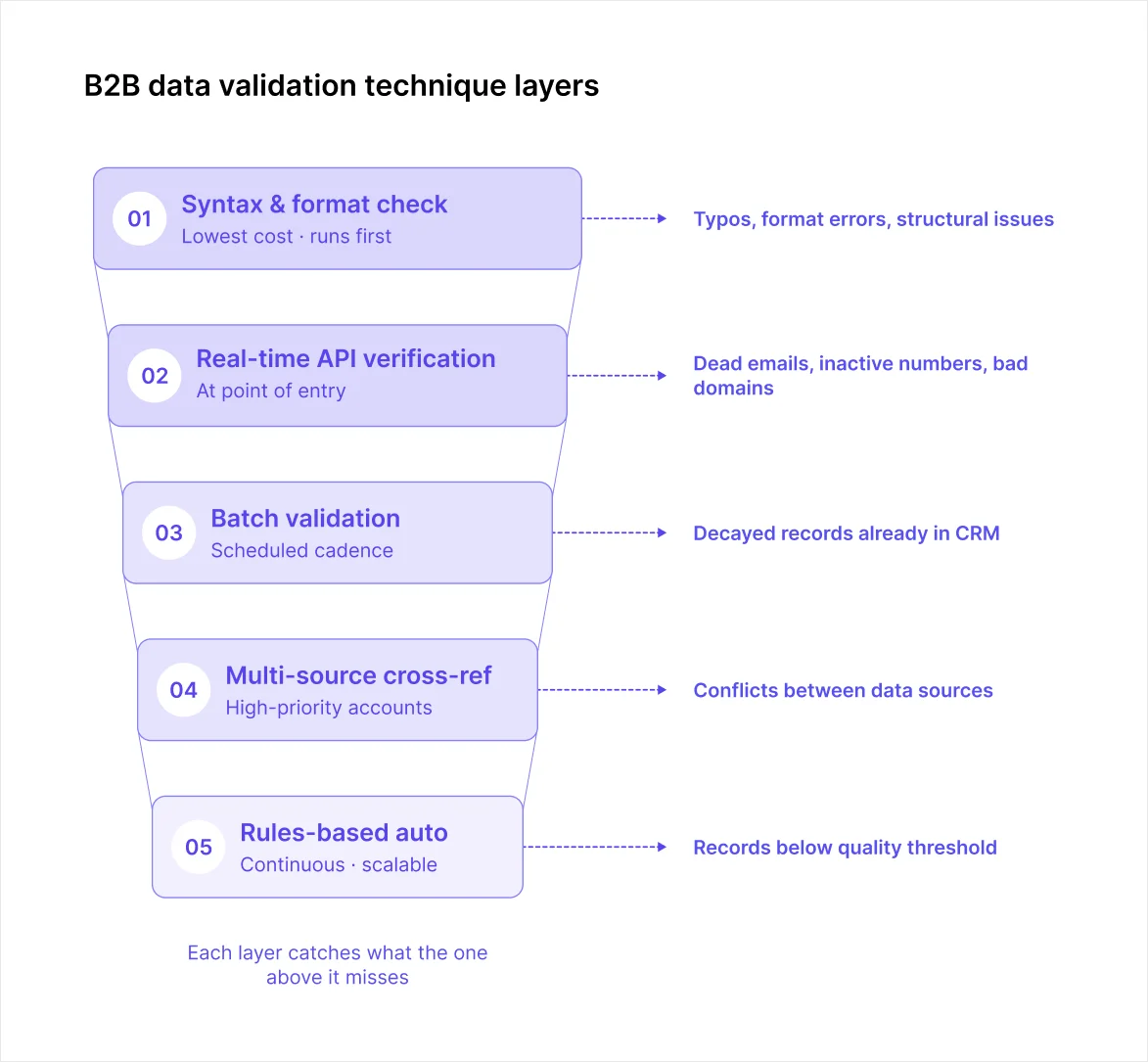
Knowing which fields to validate is only half the picture. The other half is knowing which technique to apply and when. Different problems need different approaches, and using the wrong one at the wrong stage either misses errors or wastes resources catching problems that a cheaper check would have flagged earlier.
1. Syntax and Format Validation
Start here before running any external checks. Syntax validation confirms that data matches the expected pattern for its field type: email addresses follow RFC 5322 structure, phone numbers conform to E.164 format, and country codes match ISO standards. It catches typos, formatting inconsistencies, and structural errors at the point of entry.
It does not confirm whether the data is real, only whether it is correctly formed. Think of it as the filter that stops obviously broken records from burning API credits on more expensive verification steps.
2. Real-Time API Verification
This is what catches bad data before it enters your system. Real-time verification queries external sources in real time when a record is collected or enriched. For email, that means an SMTP handshake against the actual mail server.
For phone numbers, this means carrier lookup APIs that confirm the line is active and identify its type. For domains, it means live resolution checks. The advantage over batch verification is timing: bad data gets flagged before it has been routed, scored, or personalized against, not after.
Dedicated services handle these checks on their own. AbstractAPI's email validation API runs the SMTP handshake in real time, so a bad address is caught at the point of entry rather than after a campaign has gone out.
Crustdata's company and people enrichment APIs query live sources at the moment of each request rather than serving cached records, which removes the lag that makes real-time verification worthwhile in the first place.
3. Batch Validation
Real-time verification protects new records. Batch validation handles everything else. It runs scheduled jobs across records already stored in your CRM or database, covering contacts imported before validation was in place, trade show lists, and data that has decayed since it was originally collected.
For most B2B databases, quarterly batch runs are the minimum. For teams in fast-moving sectors like SaaS or tech, where contact data becomes inaccurate faster, monthly runs are more appropriate.
4. Multi-Source Cross-Referencing
No single data provider is complete or error-free. Cross-referencing validates critical fields against two or more independent external sources rather than trusting one. A job title confirmed by one provider but contradicted by a second signals a record that needs review or re-enrichment before it goes anywhere near an active sequence.
This technique pays off most on high-priority accounts where acting on a wrong assumption carries real pipeline risk, and on firmographic fields like headcount and revenue, where single-source data is frequently inconsistent.
5. Automated Rules-Based Validation
At production volume, manual review creates a bottleneck that compounds every week it runs. Rules-based validation defines threshold conditions that flag, quarantine, or route records automatically without human intervention.
Practical examples:
Flag any contact where the estimated job tenure exceeds 18 months without a confirmed title check
Quarantine records where headcount conflicts with revenue range;
Route records with fewer than four populated fields to an enrichment queue before they enter any active sequence
The rules themselves are simple to define. The value is that they run continuously without anyone having to remember to check.
Real-Time vs. Batch Validation: When to Use Each
Teams often frame this as a choice between real-time and batch validation. It is not. They solve different problems at different points in the data lifecycle, and running one without the other leaves a gap. Here is how they compare.
Real-Time Validation | Batch Validation | |
When it runs | At point of entry or enrichment | On a scheduled cadence |
Best for | Inbound forms, API enrichment, CRM saves | Existing database hygiene |
Speed | Immediate | Overnight or scheduled |
Cost per record | Higher | Lower at volume |
Primary function | Prevents bad data entering systems | Cleans what already exists |
Recommended cadence | Always on | Quarterly minimum |
Most RevOps teams that take data quality seriously run both: real-time validation on every new record coming in, and scheduled batch jobs to catch decay in records that are already in the system.
How Data Validation Fits Into a B2B Enrichment Workflow
Validation and enrichment are easy to conflate because they often run close together in the same pipeline. But they are distinct steps, and the order matters. Enriching records that have not been validated means spending API credits appending accurate data to a broken foundation. Validating after enrichment without a structured sequence means errors introduced during enrichment go undetected. Here is the order that works.
The Validation-Enrichment Sequence
Skipping steps two or three here produces lower match rates and higher bounce rates that compound across every downstream action the pipeline takes on a given record.
Collect or import raw records from inbound forms, CRM imports, trade show lists, or manual uploads
Run syntax and format checks on all fields to catch structural errors before any external API call runs
Validate email, phone, and URL fields via real-time verification before enrichment begins; enriching a record built on a dead email address returns accurate data on the wrong person
Enrich validated records with firmographic, technographic, and contact fields from a verified external source
Cross-reference high-value accounts against a second source to catch discrepancies introduced at the enrichment step
Score records by field completeness and confidence level before routing them into any active sequence
Route low-confidence records to a remediation queue, not into outreach, until they meet a minimum quality threshold
Teams building this into an automated pipeline can collapse steps 3 through 5 by using a provider that pulls from multiple verified sources at the point of request.
Crustdata's enrichment API does this at the moment of each call, pulling current contact and company data without requiring a separate validation pass after enrichment. You can see how that fits into a broader B2B data enrichment pipeline alongside other tools in your stack.
Common B2B Data Validation Mistakes
Most validation failures follow the same patterns. These four show up consistently across teams that have a validation process in place but are still seeing data quality problems downstream.
Treating Email Validation as a Complete Data Quality Fix
It is the most common assumption in B2B data management, and it is wrong. A verified email on a contact who changed jobs six months ago still delivers, just to the wrong person. A record with a verified email address but an outdated job title, incorrect company name, or invalid phone number is still poor data; it is just valid poor data. Email validation is where you start, not where you stop.
Running Validation as a One-Time Project
The database was clean after the last validation run. That was four months ago. B2B data does not stay clean for very long. The best practice is to validate new data in real time as it comes in and perform batch validation on your existing database at least once a quarter. Teams that treat validation as a project with an end date find themselves running the same cleanup six months later at higher cost and with a larger backlog.
Validating at Campaign Launch Rather Than at Data Entry
By the time a record reaches an active sequence, it has already been imported, routed, scored, and personalized against. Catching a bad record at campaign launch means undoing several automated steps. Catching it at the point of entry means it never touches those systems. It matters if you’re running AI sales agent workflows because every automated step the agent takes on a bad record compounds the error further downstream.
Relying on a Single Data Source for Validation
Single-source validation inherits every gap and refresh lag of that one provider. No source of information can be considered entirely accurate; validating contact data through several vendors makes the process more robust, and validating firmographic data against publicly and privately sourced data strengthens it further. For high-priority accounts, multi-source cross-referencing is the standard, not an optional upgrade.
How Crustdata Approaches B2B Data Validation
Most data quality problems start before validation runs. If your enrichment provider serves records from a stored database, the data entering your pipeline is already aging by the time it arrives. Validation catches errors after the fact. It cannot fix a freshness problem upstream.
Crustdata pulls from 10+ verified sources at the moment of each API request, returning current data rather than a cached snapshot. For teams where enrichment feeds automated routing, scoring, or outreach sequences, that distinction removes one of the most common failure points in the validation-enrichment sequence.
Key capabilities:
Real-time enrichment: Every API call returns current company and contact data across 10+ verified sources at the moment of request, not from a monthly-refreshed database
Watcher API with webhooks: Monitors a defined account set and fires a webhook the moment a qualifying change occurs, including executive hires, headcount shifts, and funding events
250+ company and 90+ people data points: Covers firmographics, headcount trends, funding history, technology stack, and web traffic in a single profile
Jobs listing API: Surfaces real-time hiring signals from target company career pages as an additional layer for validating company activity and growth state
For teams building validation into automated pipelines, see what it means for overall B2B data quality across your stack.
Book a demo to see Crustdata's real-time enrichment in action.
FAQ
What is the difference between data validation and data verification in B2B?
Validation checks whether a record meets your quality standards: correct format, complete fields, logical consistency. Verification checks whether the data is actually true by matching it against external sources. A complete data quality process needs both.
How often should B2B contact data be validated?
Validate new records in real time at the point of entry. Run batch validation on existing records quarterly at a minimum, and monthly for teams in high-turnover sectors like SaaS and tech.
Can automated validation replace manual data review entirely?
For most fields at production volume, yes. Manual review still applies when automated cross-referencing flags a conflict it cannot resolve, and when auditing your validation rules quarterly to confirm they reflect your current ICP.



Products
Popular Use Cases
Competitor Comparisons
95 Third Street, 2nd Floor, San Francisco,
California 94103, United States of America
© 2026 Crustdata Inc.
Products
Popular Use Cases
Competitor Comparisons
95 Third Street, 2nd Floor, San Francisco,
California 94103, United States of America
© 2026 CrustData Inc.
Products
Popular Use Cases
Competitor Comparisons
95 Third Street, 2nd Floor, San Francisco,
California 94103, United States of America
© 2026 Crustdata Inc.
🎉 We hit $10M ARR!
$600k to $10m in 1.5 years. Our entire GTM is powered by our own APIs.
🎉 We hit $10M ARR in 1.5 years!