7 Best Mixrank Alternatives to Choose in 2026 [Comparison]
Explore the best Mixrank alternatives and find tools that improve data accuracy and fit your workflow for sales, research, and enrichment.
Published
Written by
Chris P.
Reviewed by
Nithish A.
Read time
7
minutes
Mixrank is a B2B data platform covering company profiles, people data, mobile app and SDK intelligence, and web technographics. It serves sales, marketing, investment, and fraud-prevention teams that need access to large-scale datasets through API, flat-file, or hosted-database delivery.
Despite its coverage, Mixrank has some limitations that push teams to look for alternatives that better fit their workflow. This guide covers the 7 best Mixrank alternatives in 2026, what each one does well, where it falls short, and which use cases it fits.
Key Takeaways
Most Mixrank alternatives specialize in one capability rather than replicating its full stack, so the right choice depends on which part of Mixrank's offering your team actually needs to replace
For teams running automated workflows, AI agents, or enrichment pipelines, data freshness at the point of request matters more than database size, since stale records corrupt every downstream action they feed
API-first tools require engineering resources to extract value and are not suited for non-technical sales teams who need a self-serve interface and Chrome extension
Technographic depth and contact verification are separate capabilities, and most tools on this list are stronger at one than the other
Waterfall enrichment across multiple providers consistently delivers higher match rates than single-source databases, but adds configuration complexity and makes costs harder to predict at scale
What Mixrank Does and Why Teams Are Looking For Alternatives
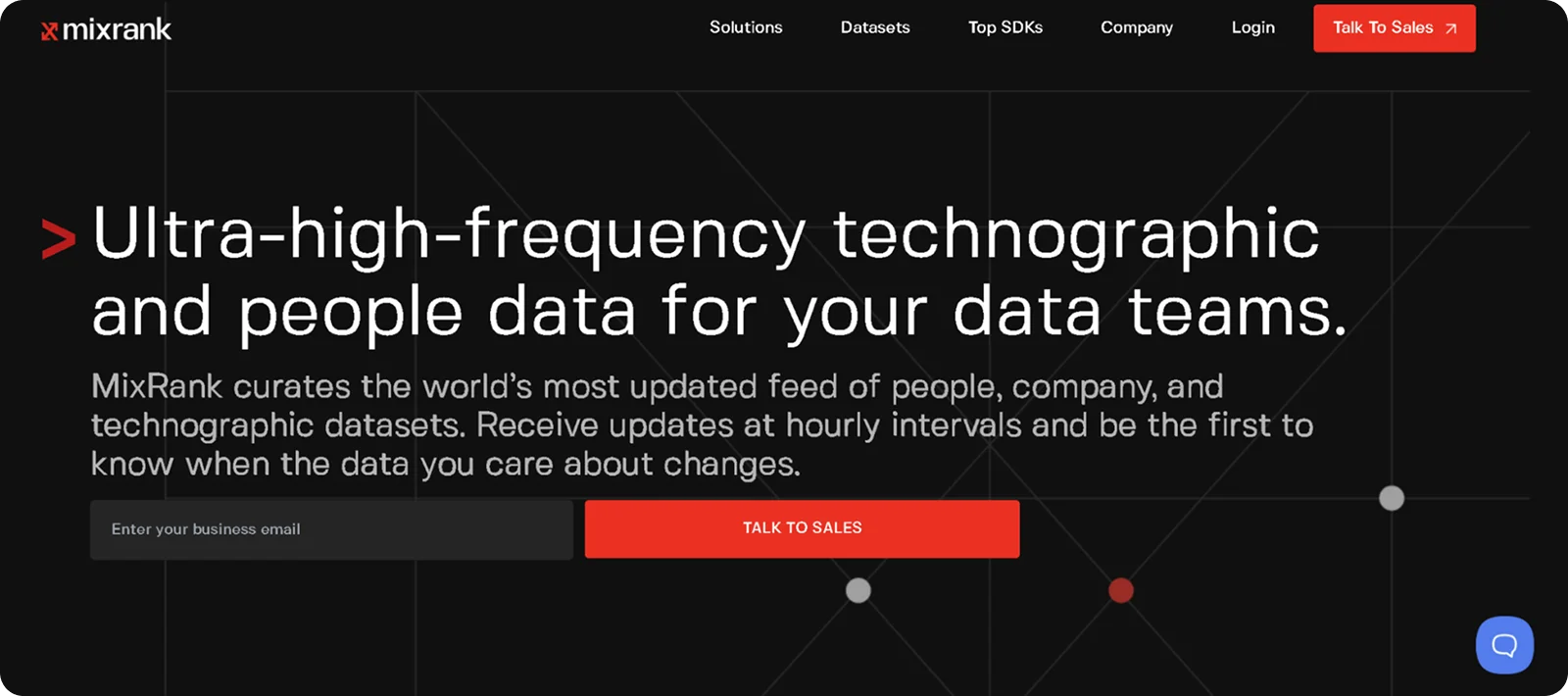
Mixrank delivers solid company and people data, but the following downsides make teams consider other options:
Data accuracy drops in specific niches: While broad in scope, detection accuracy weakens for smaller indie publishers, developers, and specific SDK identification, where the platform sometimes incorrectly flags technology usage.
Performance slows under heavy queries: Large queries can take noticeably longer to load, which disrupts research workflows that require moving quickly between searches and exports.
Reporting is limited: Export and reporting features offer minimal customization, making it harder to build repeatable analysis workflows from Mixrank data without additional tooling.
Support is tiered: Users on lower-tier contracts report long wait times for technical support, which becomes a problem when data discrepancies need quick resolution.
How We Selected These Mixrank Alternatives
The platforms on this list were selected based on six criteria.
Data freshness and update frequency: How recently records are verified and how often the dataset is refreshed, since outdated data directly affects outreach performance
People and company data depth: The range of data points available per contact and company record, including firmographics, employment history, and funding signals
Technographic and SDK coverage: The ability to identify technologies, software tools, and mobile SDKs in use across target companies, which is a core Mixrank use case
Pricing transparency: Whether pricing is publicly available or requires a sales conversation, since opaque pricing is one of the main reasons teams leave Mixrank
API and data delivery options: Support for API access, flat file delivery, and data warehouse integrations like Snowflake or BigQuery for teams building enrichment into custom systems
CRM and workflow integration: Native connections to Salesforce, HubSpot, and other tools in the sales stack, reducing manual export and import work
7 Best Mixrank Alternatives Compared
Mixrank covers a broad range of use cases, from company and people data to mobile app intelligence and technographics. The alternatives below address different parts of that stack, so the right choice depends on which capability matters most to your team.
The table below gives a quick side-by-side comparison before the detailed sections.
Alternative | Best For | Data Freshness | Pricing |
Crustdata | AI agents and real-time enrichment pipelines | Real-time crawling | Custom |
Coresignal | Developer teams needing multi-source company and employee datasets | 695M+ records refreshed monthly | From $49/month |
People Data Labs | Engineering teams building enrichment into custom products | Monthly refresh | From $98/month |
BuiltWith | Tech-led GTM teams targeting by technology stack | Continuous web crawl | From $295/month |
Forager.ai | Teams needing verified mobile numbers and intent signals | Refreshed every 14 days | From $50/month |
Apollo.io | SMBs that want all-in-one prospecting and outreach | Daily updates | Free plan; from $49/month |
Clay | RevOps teams orchestrating multi-source waterfall enrichment | Varies by source | From $185/month |
1. Crustdata
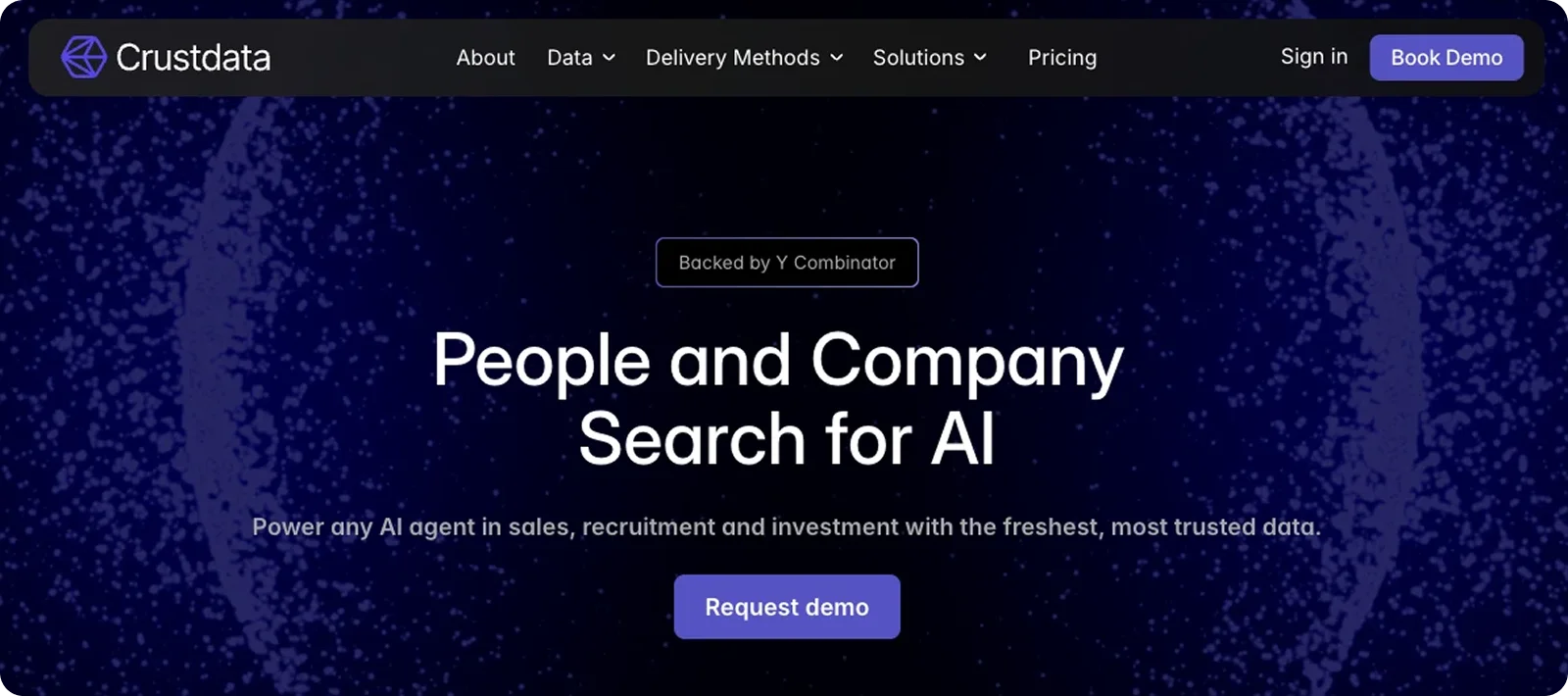
Crustdata is a B2B intelligence platform built around real-time web indexing rather than a stored database. It targets teams building AI agents, automated enrichment pipelines, and webhook-driven workflows that depend on data being current at the point of use.
Key features
Watcher API with webhooks: Sends alerts when contacts change jobs, companies raise funding rounds, or candidates earn certifications, triggered at the moment the signal occurs rather than in batch updates
250+ company and 90+ people datapoints: Covers firmographic data, headcount growth by department, funding history, technology stacks, web traffic trends, and employee reviews in single profiles
60+ people and 95+ company filters: Supports nested boolean logic for building precise ICP queries across multiple criteria simultaneously
Job posting API: Surfaces real-time job postings and social activity from target companies as additional signal layers for outreach timing
Developer-first API infrastructure: Provides code samples, error handling documentation, rate limit guidance, and webhook setup instructions for teams building AI agents and automated pipelines
Pros
Enriches contact and company data at the moment of your API request, ensuring records reflect the current state of a prospect
Handles complex ICP queries through nested boolean logic across multiple filter combinations simultaneously
Aggregates verified sources, including job boards, funding databases, and professional profiles, into unified records
Cons
Requires technical setup for webhook and API implementation
Pricing
Crustdata uses custom pricing based on API usage volume and feature requirements. Contact the sales team for a quote tailored to your data consumption patterns.
2. Coresignal
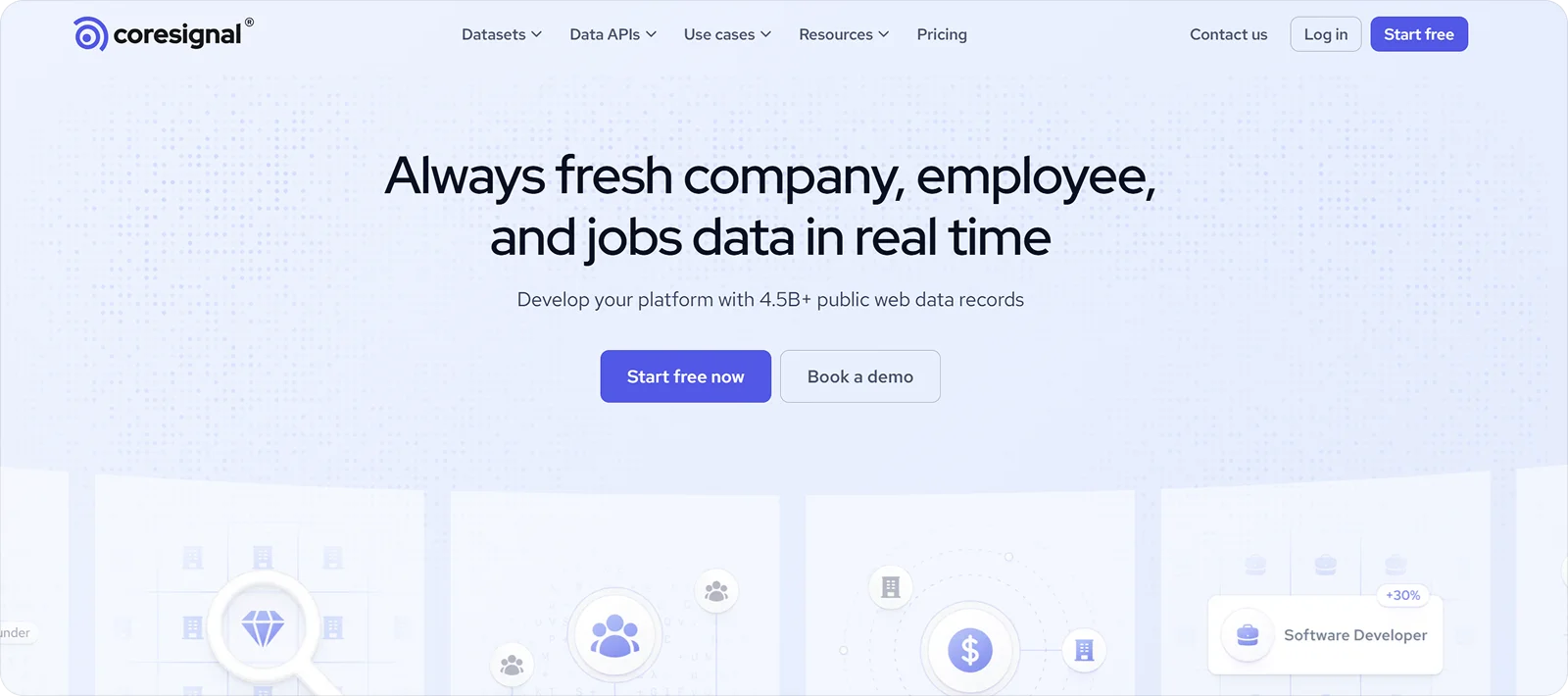
Coresignal is a B2B data provider that aggregates public web data across companies, employees, and job postings into a single API and dataset delivery model. It serves investment intelligence, sales, HR tech, and market research teams that need large-scale, frequently refreshed datasets delivered programmatically.
Key features
Multi-source company and employee data: Aggregates 792M+ employee records and 103M+ company records from 15+ public web sources into a single unified dataset
Historical data access: Provides up to five years of historical headcount and company data for trend analysis, portfolio monitoring, and forecasting
High-frequency updates: Refreshes more than 695M records monthly, with API records updated in real time and dataset deliveries available on hourly frequency
Flexible delivery options: Supports API access, flat file downloads, Snowflake and Redshift datashares, and PostgreSQL shared or dedicated databases
Job postings data: Tracks active job postings across companies for building hiring signals and intent workflows
Pros
Covers one of the largest publicly available employee and company datasets with consistent refresh cycles
Offers flexible data delivery formats suited to teams building enrichment into custom products and pipelines
Provides historical data going back several years, which most Mixrank alternatives do not offer
Cons
Requires engineering resources to extract value, with no user interface for non-technical users
Multi-source company data consumes double credits, which can make costs harder to predict at scale
Unused credits do not roll over on monthly plans, expiring at the end of each billing cycle
Pricing
Coresignal offers a free trial with 200 Collect and 400 Search credits valid for 14 days. API subscription plans start at $49 per month. Dataset purchases start at $1,000 and are priced based on contract length, data sources, and delivery frequency.
3. People Data Labs
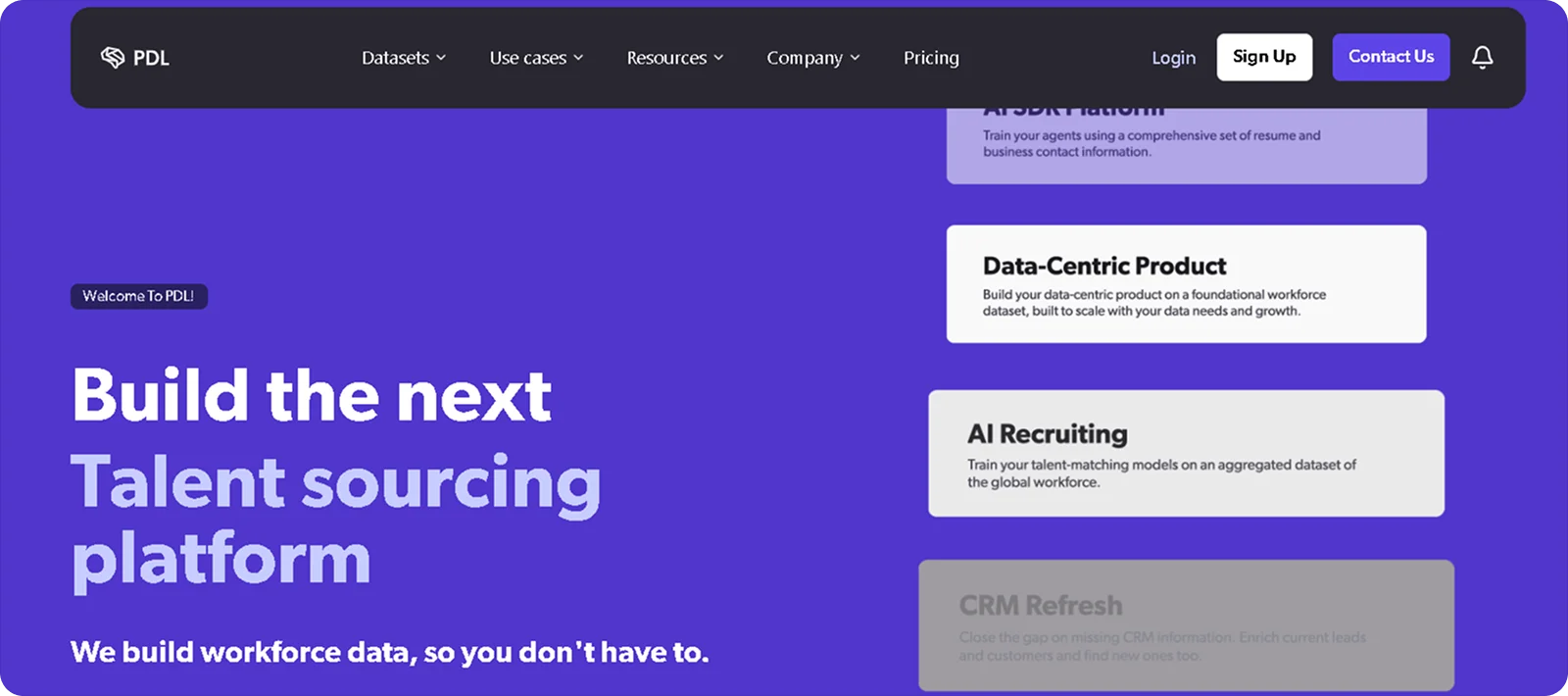
People Data Labs is an API-first B2B data provider covering person, company, and IP enrichment across 1.5B+ individual profiles and millions of company records. It is built for engineering and data teams that need to wire large-scale enrichment and identity resolution directly into custom products and pipelines.
Key features
Person enrichment API: Returns verified professional data including job title, employer, work email, phone, education, and social profiles for individual contacts
Company enrichment API: Provides firmographic data including industry, employee count, revenue range, technology stack, and funding details for company records
Person search API: Queries the full dataset using boolean filters to build targeted contact lists at scale
IP enrichment API: Resolves IP addresses to company, location, and contact data for website visitor identification and lead routing
Bulk enrichment: Processes large volumes of records in a single request, consuming up to 100 credits per call with charges applied only on successful matches
Pros
Charges credits only on successful matches, so failed lookups do not consume budget
Offers one of the most developer-friendly APIs with thorough documentation and code samples in multiple languages
Cons
Requires developer resources for every interaction, with no web interface or self-serve search for non-technical users
Updates its dataset monthly from aggregated sources, meaning records may already reflect outdated job titles or employers by the time they are used
Pricing
People Data Labs offers a free plan with 100 person and company lookups per month. The Pro plan starts at $98 per month for 350 person enrichment credits and 1,000 company lookups.
4. BuiltWith
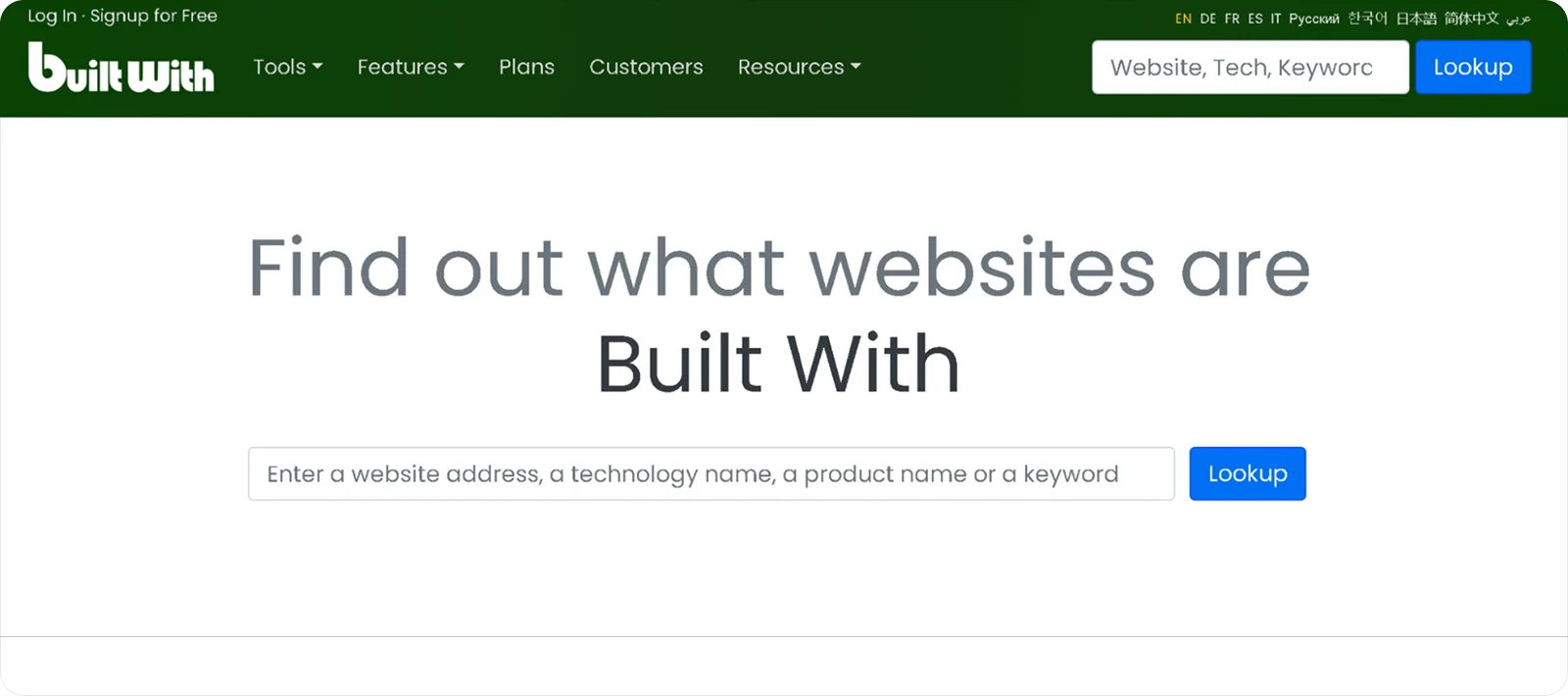
BuiltWith is a web technology intelligence platform that identifies the technology stacks running across 250M+ websites globally. It serves sales, marketing, and competitive intelligence teams that build prospect lists and trigger outreach based on what software a company uses.
Key features
Technology detection across 110,000+ web technologies: Identifies CMS platforms, analytics tools, ecommerce carts, advertising networks, JavaScript frameworks, hosting providers, and CDN services
Lead list building: Filters companies by technology usage, company size, location, and industry to export targeted prospect lists in CSV or Excel format
Technology change alerts: Notifies users when target accounts add or drop specific tools, providing a time-sensitive reason to reach out
Browser extension: Surfaces an instant technology profile of any website visited without leaving the browser
API access: Available on Pro and Enterprise plans for programmatic technographic enrichment and CRM automation at scale
Pros
Tracks years of technology adoption history, enabling trend analysis and market share research
Flags technology changes at target accounts the moment they happen, giving sales teams a timely outreach trigger
Covers more web technologies than any alternative on this list
Cons
Produces large CSV exports that frequently require manual cleanup before the data is usable in a CRM or outreach tool
Misses backend and server-side technologies that leave no visible trace in HTML or page header
Pricing
BuiltWith offers a free browser extension for individual site lookups. Paid plans with list-building and bulk export start at $295 per month, with the Pro plan at $495 per month for unlimited technology targets.
5. Forager.ai
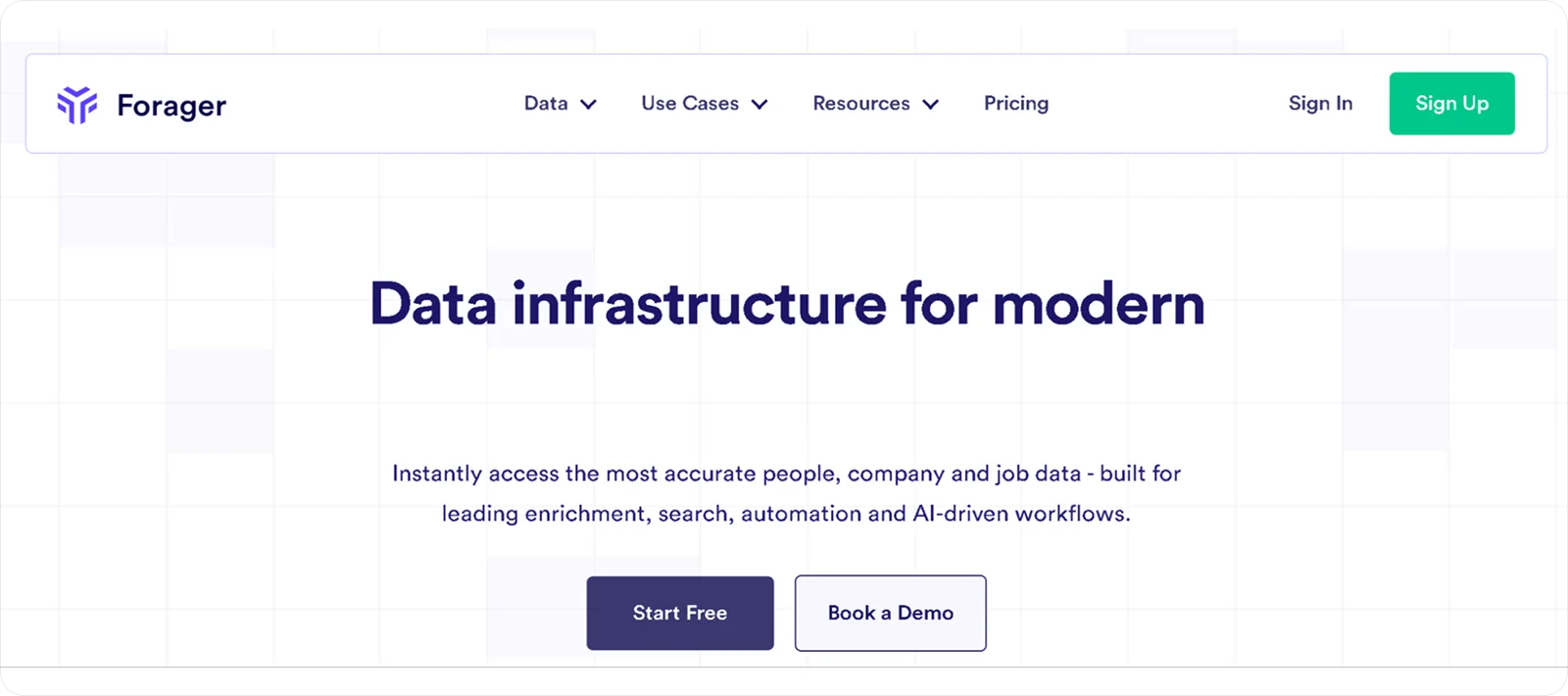
Forager.ai is a B2B contact data platform covering 825M+ global person and company profiles. It serves sales and GTM teams that prioritize verified mobile numbers and intent signals for outbound prospecting.
Key features
200M+ verified mobile numbers: Covers direct dials and mobile numbers across global markets with 95%+ accuracy across email and phone data
Intent signals: Ingests 100M+ intent signals monthly, covering job postings, technology adoption, and funding activity to surface companies showing active buying behavior
Bulk enrichment and people search: Supports large-scale contact enrichment and filtered prospect searches across firmographic and technographic criteria
CRM and workflow integrations: Connects natively with HubSpot, Salesforce, Snowflake, and Zapier for automated data sync into existing sales stacks
API access: Offers full API access across all plans for teams building enrichment into custom workflows and data pipelines
Pros
Keeps bounce rates lower with bi-weekly refresh cycle
Rolls over unused credits on monthly plans, reducing wasted spend during slower prospecting periods
Cons
Optimizes most self-serve plans for mobile-heavy outreach
Lacks sufficient independent user reviews outside of Datarade
Pricing
Forager.ai offers three self-serve plans. The Starter plan costs $50 per month, the Growth plan costs $100 per month, and the Pro plan costs $250 per month. Annual billing saves 10% and grants all credits upfront. Enterprise pricing is custom and available on request.
6. Apollo.io
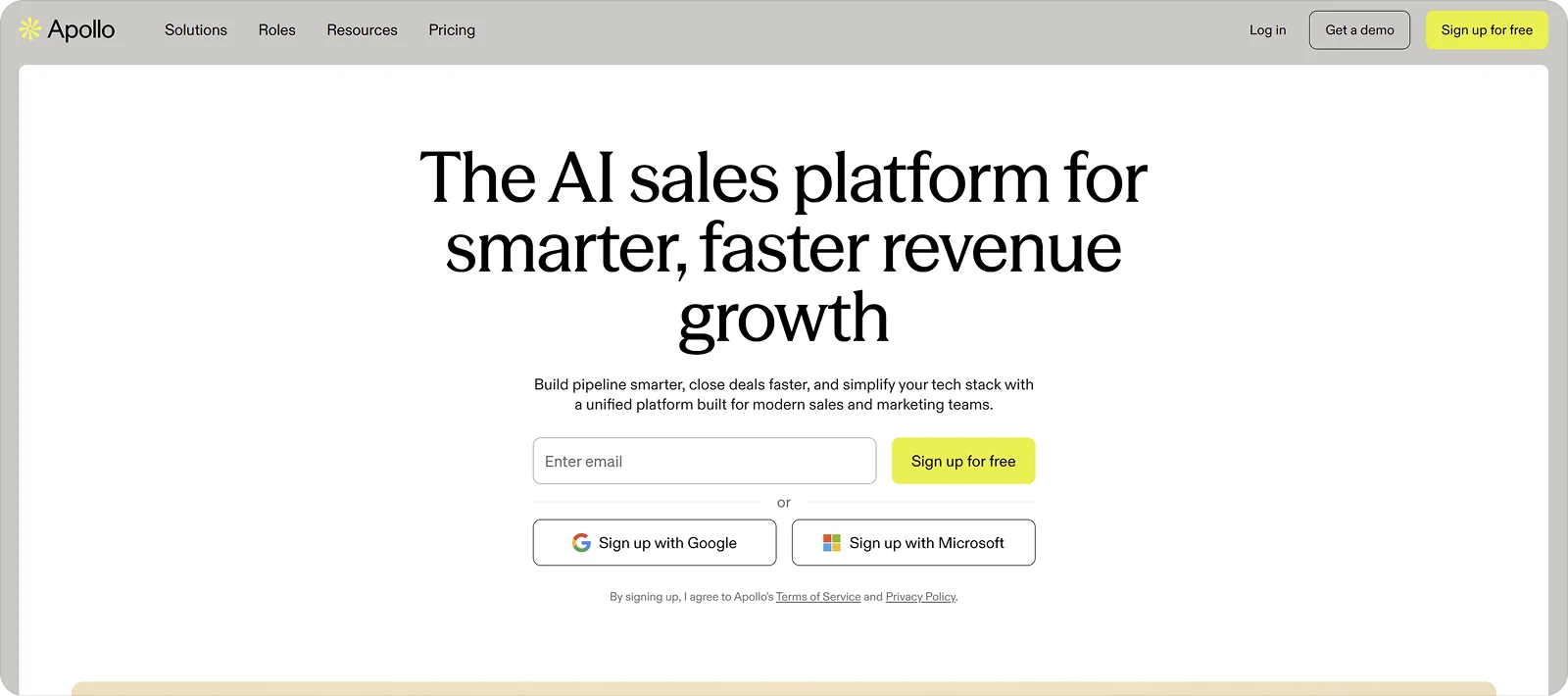
Apollo.io is an all-in-one sales intelligence platform combining a contact database with built-in prospecting, email sequences, a dialer, and CRM integrations. It targets SMBs and growing sales teams that want contact data and outreach tools in a single platform without managing separate subscriptions.
Key features
210M+ contact database: Covers contacts across 35M+ companies with 200+ search filters, including job title, company size, industry, technology stack, funding status, and seniority
Built-in engagement tools: Provides email sequences, A/B testing, call recording, and a native dialer without additional subscriptions
Waterfall enrichment: Checks Apollo’s own data first, then pulls from trusted third-party sources automatically when records are missing
Buying intent signals and job change alerts: Surfaces contacts at companies actively researching relevant categories and notifies users when monitored contacts switch roles
Native CRM integrations: Syncs contacts and activity data bidirectionally into Salesforce, HubSpot, and Pipedrive
Pros
Consolidates contact database, email sequences, and dialer without purchasing separate tools
Offers a free plan and monthly billing without locking into annual contracts
Reduces the need for supplementary data sources for most outbound use cases
Cons
Expires credits monthly on annual plans with no rollover, creating wasted spend during slower periods
Delivers inconsistent data accuracy on phone numbers and some international contacts based on user reports
Pricing
Apollo.io offers a free plan with 75 credits per month. Paid plans start at $59 per user per month or $49 per user per month billed annually.
7. Clay
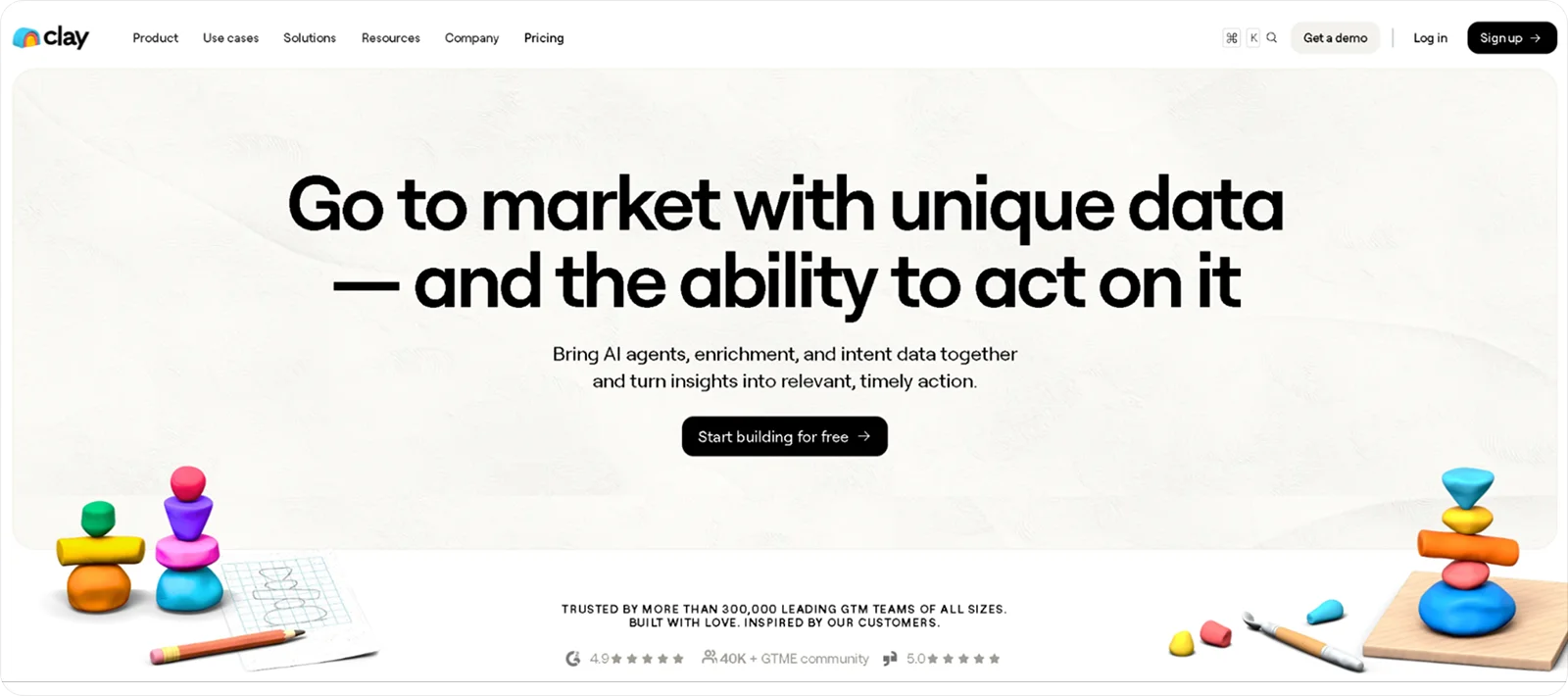
Clay is a data orchestration platform that pulls from 75+ enrichment providers in a waterfall sequence to find verified contact and company data. It targets RevOps and growth teams that want to automate enrichment, lead routing, and personalized outreach across their existing stack without managing multiple data subscriptions separately.
Key features
Waterfall enrichment: Queries multiple data sources in sequence until a verified result is found, delivering higher match rates than single-source tools
AI research agent (Claygent): Browses the web to find information that structured databases do not cover, including custom firmographic research and account context
CRM and outreach integrations: Connects with Salesforce, HubSpot, and outreach platforms for automated enrichment and lead routing workflows
No charge for failed lookups: Data credits are only consumed when a provider returns a successful result
Generative AI for personalization: Uses enriched data to write personalized outreach messages at scale directly within the platform
Pros
Aggregates 75+ data providers into one workflow, removing the need to manage multiple enrichment subscriptions
Charges credits only on successful lookups, reducing wasted spend on unmatched records
Covers a wide range of enrichment use cases from contact data to custom AI-powered account research
Cons
Requires time to configure waterfall sequences and workflows, with a steeper learning curve than plug-and-play tools
Splits usage into two credit types, Data Credits and Actions, which adds complexity to budgeting
Pricing
Clay offers a free plan with 100 data credits per month. Paid plans start at $185 per month for the Launch plan and $495 per month for the Growth plan. Enterprise pricing is custom.
How to Choose the Right Mixrank Alternative
Start with the type of data your team actually needs. If technographic coverage is the priority, look for a platform built specifically around technology detection. If you need raw dataset access for a custom product, prioritize API-first tools with flexible delivery formats over platforms designed for self-serve prospecting.
Next, consider how your team consumes data. Non-technical sales teams need a UI and a Chrome extension. Engineering teams need clean API documentation, bulk enrichment, and delivery options that connect to existing infrastructure.
Data freshness becomes the deciding factor when your use case involves automation. Batch-updated databases introduce a lag between data collection and delivery, which compounds in automated workflows where every downstream action depends on the record feeding it.
For teams building AI agents, real-time enrichment pipelines, or webhook-driven workflows, the only provider that removes this variable entirely is one that crawls data live at the point of request rather than serving it from a stored database.
Why Crustdata Is the Best Mixrank Alternative for Real-Time Data
Mixrank’s limitation is its architecture. Everything it delivers comes from a stored database refreshed on a fixed cycle. For teams doing manual research, that works. For teams running AI agents, automated outreach, or enrichment pipelines, aging data corrupts every downstream action it feeds.
Crustdata crawls verified sources at the moment of each request and returns what is true at that moment. That distinction matters across every metric that affects pipeline quality:
Match rate reflects current coverage, not what was indexed weeks ago
Bounce rate stays low because email addresses are verified at the point of request
Job change and funding alerts fire when signals occur, not at the end of a batch cycle
AI agents and automated workflows receive data that is current at execution, not from a previous crawl
Are you ready to see how it fits your pipeline?
Book a demo to see Crustdata in action.


Products
Popular Use Cases
Competitor Comparisons
95 Third Street, 2nd Floor, San Francisco,
California 94103, United States of America
© 2026 Crustdata Inc.
Products
Popular Use Cases
Competitor Comparisons
95 Third Street, 2nd Floor, San Francisco,
California 94103, United States of America
© 2026 CrustData Inc.
Products
Popular Use Cases
Competitor Comparisons
95 Third Street, 2nd Floor, San Francisco,
California 94103, United States of America
© 2026 Crustdata Inc.
🎉 We hit $10M ARR!
$600k to $10m in 1.5 years. Our entire GTM is powered by our own APIs.
🎉 We hit $10M ARR in 1.5 years!