People Data Labs vs Clearbit: Which One Is Better in 2026?
Compare People Data Labs vs Clearbit and choose the right data solution for your team based on workflows, flexibility, and data freshness.
Published
Written by
Chris P.
Reviewed by
Nithish A.
Read time
7
minutes

If you’re comparing People Data Labs vs Clearbit, the first thing worth knowing is that these two tools no longer compete in the same space. People Data Labs is an API-first data provider built for developers and data teams. Clearbit, now fully absorbed into HubSpot as Breeze Intelligence, is a CRM enrichment add-on that only works if you are already a paying HubSpot customer.
That shift matters before you read a single feature comparison. The choice comes down to how your team works, whether you need enrichment built into a CRM workflow or flexible data access you can control. In this guide, you will find a breakdown of what each tool covers, where each falls short, and which use cases each fits in 2026.
Key Takeaways
People Data Labs is a developer-first API with 1.5B+ person profiles and 70M+ company records, suited for engineering teams building data products or enrichment pipelines
Clearbit is no longer a standalone product. It now exists only as Breeze Intelligence inside HubSpot, requiring a paid HubSpot subscription to access
Neither tool supports real-time data crawling at the point of request, meaning the records returned reflect a stored snapshot rather than live company or contact state
Teams building AI agents or automated prospecting workflows need data that is current at the moment of execution, which neither PDL nor Breeze Intelligence delivers natively
For teams that need live enrichment, event-triggered alerts, and API flexibility without CRM lock-in, Crustdata is a stronger alternative to both
What is People Data Labs?
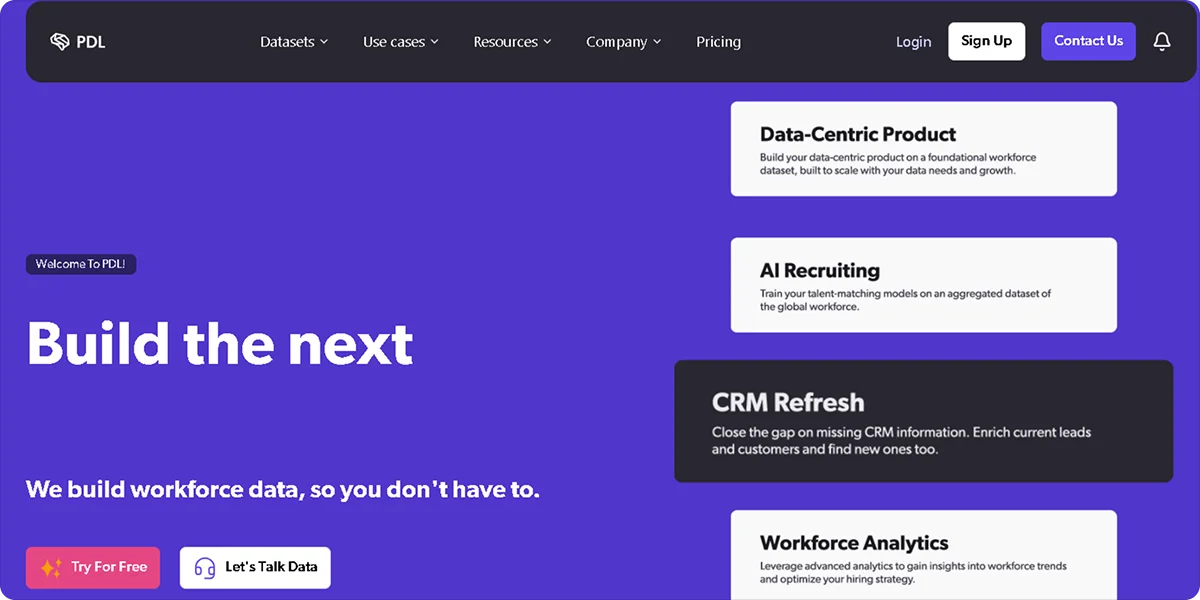
People Data Labs (PDL) is a B2B data-as-a-service platform built for engineers, data scientists, and product teams. It provides access to large-scale person and company data through REST APIs, bulk data licenses, and integrations with platforms like Snowflake and Databricks.
PDL does not offer a sales dashboard, prospecting UI, or Chrome extension. The product is API-first. If you don’t have the technical resources to build and maintain an integration, it’s not a practical option regardless of data quality.
The dataset covers over 1.5B person profiles and 70M+ company records, with updates released on a monthly production cycle. Profile depth is one of PDL’s strengths. Person records can include work history, education, skills, certifications, inferred salary ranges, and social profiles alongside standard contact fields.
That level of detail makes PDL a strong fit if you’re building recruiting platforms, investment tools, or ML models that rely on structured biographical data at scale.
What is Clearbit?
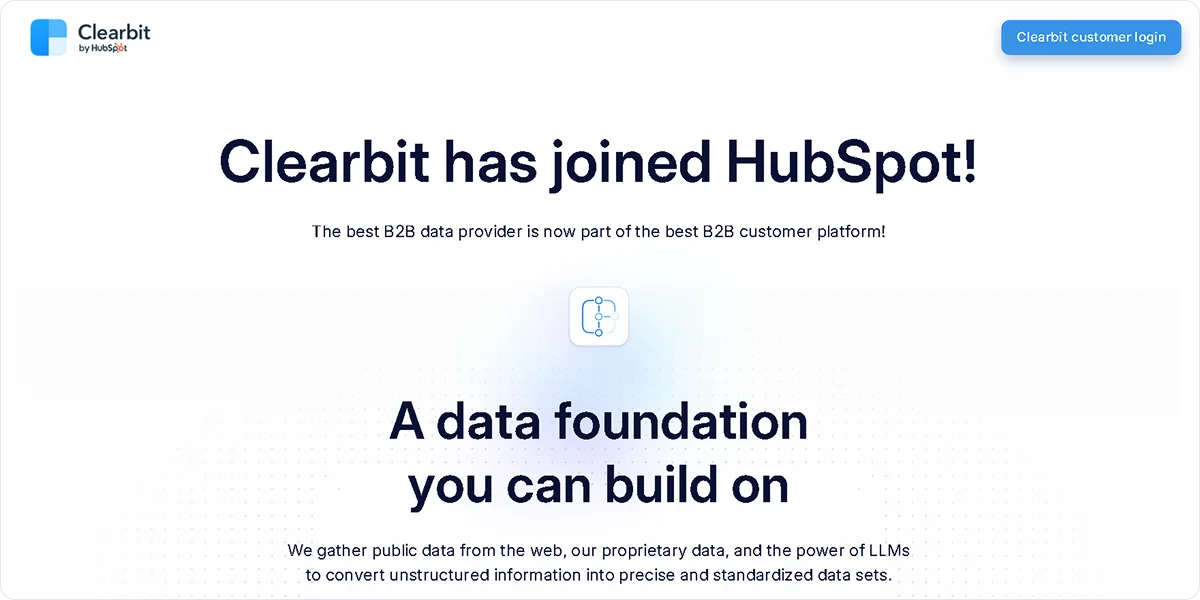
Clearbit was acquired by HubSpot in late 2023 and is now being integrated into Breeze Intelligence. It is no longer positioned as a standalone product. Access to its enrichment features is tied to HubSpot, and new usage is effectively limited to HubSpot customers.
Inside HubSpot, Breeze Intelligence focuses on three core functions:
Data enrichment: Fills in missing firmographic and technographic fields on contact and company records
Visitor identification: Identifies companies visiting your website based on IP data
Form shortening: Auto-fills known form fields so you can capture more data with fewer inputs
The integration is useful if you’re already using HubSpot. Enriched data flows directly into workflows, lead scoring, and routing without extra setup. Outside that environment, the use cases are limited, as the product is built to work within HubSpot rather than as a standalone data layer.
People Data Labs vs Clearbit (Breeze Intelligence): Side-by-Side Comparison
The table below is a quick side-by-side overview to highlight the core differences before getting into the more details.
People Data Labs | Breeze Intelligence (Clearbit) | |
Best for | Building data products, enrichment pipelines, and ML use cases | Enriching inbound data inside HubSpot |
Database size | Over 1.5B person profiles and a large global company dataset | Not publicly disclosed by HubSpot |
Data freshness | Monthly production updates; record-level timestamps; pre-built dataset | Not publicly disclosed; based on stored data, not live enrichment |
API access | Full REST API with flexible query capabilities | Access tied to HubSpot; legacy Clearbit API being deprecated |
Self-serve access | No native UI (API-first) | Available inside HubSpot only |
CRM integration | Works with any CRM via API | HubSpot only |
Free tier | Limited free tier with monthly credits | No standalone free tier |
Pricing | Starts at $98/month (credit-based) | Not publicly listed; requires HubSpot subscription + usage-based credits |
Credit rollover | Credits carry forward within plan limits | Credits expire monthly |
Data Freshness
PDL updates its dataset on a monthly production cycle. Each record includes a last-updated timestamp, but enrichment results come from a pre-built dataset, not live sources. In practice, that means some records can lag behind recent changes, especially for fast-moving updates like job switches.
Breeze Intelligence does not publish a clear refresh cadence. Like PDL, it relies on stored data rather than live, request-time enrichment. You’re enriching records based on what’s already in its database, not pulling fresh data at the moment you run the query.
API Access
PDL is built around its API. You get full REST access with flexible query logic, which means you can search, enrich, and structure data however you need. If you’re building pipelines, internal tools, or data products, that flexibility matters.
With Breeze Intelligence, access is tied to HubSpot. You’re not working with a standalone API in the same way. The legacy Clearbit API is being deprecated, and most functionality now lives inside HubSpot workflows and automation. That limits how far you can extend it outside your CRM.
Self-serve Access
PDL does not have a native UI. There’s no way to browse or export data without going through the API. If you want to inspect records or build lists, you’ll need to set that up yourself or rely on someone technical.
Breeze Intelligence is easier to use day to day. You can see and use enriched data directly inside HubSpot, without writing queries or managing infrastructure. The trade-off is that everything stays within HubSpot.
CRM Flexibility
PDL is CRM-agnostic. You can connect it to any system as long as you handle the integration. That gives you control, but also adds setup work. Meanwhile, Breeze Intelligence is locked to HubSpot so if your data and workflows already live there, it fits naturally. If not, there’s no straightforward way to use it with another CRM.
Pricing Structure
PDL uses a credit-based model starting from a fixed monthly plan. You get a set number of credits, and usage scales from there. Costs become more predictable once you understand your volume, but they still increase as usage grows.
Breeze Intelligence pricing is less transparent. You pay for a HubSpot subscription plus usage-based credits, but HubSpot does not publish full pricing tiers. What you end up paying depends on your plan and how heavily you use enrichment.
Where People Data Labs Falls Short
PDL offers strong coverage and deep profile data, but you’ll start to notice the trade-offs once you try to use it day to day. These gaps show up quickly, especially if you need fresh data or don’t have engineering support.
No self-serve UI: PDL is API-first. There’s no interface for browsing, filtering, or exporting contacts. If you want to search or enrich data, you’ll need to work through API calls or rely on someone technical to set it up.
Data freshness varies: PDL updates its dataset on a monthly cycle, and results come from a pre-built dataset rather than live sources. You do get last-updated timestamps, but some records can still lag behind recent changes, especially for things like job moves.
Costs increase with usage: PDL uses a credit-based model. The Pro plan includes a set number of credits, and once you go beyond that, you’ll need to buy more or upgrade. Costs can add up quickly as your usage grows.
No native event tracking: PDL gives you data when you ask for it. It doesn’t track accounts or alert you when something changes. If you want signals like job changes or funding events, you’ll need to build that layer yourself or use another tool.
Where Clerbit (Now Breeze Intelligence) Falls Short
Breeze Intelligence works best inside HubSpot. Outside that setup, the limitations show up quickly. Below are some of the issues with Clearbit (now Breeze Intelligence):
HubSpot lock-in limits flexibility: You can only use Breeze Intelligence inside HubSpot. If you’re on Salesforce, Pipedrive, Attio, or anything else, it’s not an option. The old standalone Clearbit API has been sunset, so if you built workflows around it, you’ll need to rebuild them inside HubSpot or move elsewhere.
Total cost isn’t clear upfront: Pricing starts at $45 per month for 100 credits, but you’ll also need a paid HubSpot plan. HubSpot doesn’t publish full credit pricing, so what you actually pay depends on your usage and plan. As volume grows, costs can climb quickly.
Credits expire monthly: Your credits reset every month with no rollover. If you don’t use them, you lose them. If you use more than expected, you may need to upgrade or pay extra.
Coverage varies by market: Data quality is strongest for large US companies. If you’re working with smaller businesses, international contacts, or fast-changing roles, you’ll likely run into gaps. Phone number enrichment isn’t supported.
People Data Labs vs Clearbit (Now Breeze Intelligence): Which Should You Choose?
Choosing between People Data Labs and Breeze Intelligence comes down to how you plan to use the data. They solve different problems, and the right choice depends on your setup, technical resources, and whether you need flexibility or a tool that works directly inside your CRM.
People Data Labs is a good fit if you:
Have engineering resources to build and maintain API integrations
Need large-scale person data for ML models, recruiting platforms, or identity verification products
Want deep profile data including work history, education, and skills at scale
Do not need a self-serve UI and are comfortable with credit-based API pricing
Clearbit (Breeze Intelligence) is a good fit if you:
Already use HubSpot as your primary CRM and marketing platform
Need native enrichment of inbound CRM records without building a custom integration
Want form shortening and website visitor identification inside HubSpot workflows
Do not need phone number enrichment, outbound prospecting, or data outside the HubSpot ecosystem
Why Crustdata Is the Better Alternative for Both
PDL and Breeze Intelligence share a limitation that affects every team building automated workflows or AI agents: both serve data from a stored database. PDL refreshes monthly. Breeze Intelligence has no published refresh cadence for contact-level data.
In either case, the record your pipeline acts on reflects where a company or person was at some point in the past, not necessarily where they are right now. Crustdata is built differently. Rather than serving records from a stored snapshot, it crawls 10+ verified sources at the moment of each API request.
A company that raised a funding round yesterday, hired a new VP of Sales last week, or crossed a headcount threshold this month appears with its current profile in Crustdata's results.
If you’re building AI sales agents or automated prospecting pipelines, this difference compounds across every action the pipeline takes. Every misrouted lead, every email to a contact who changed roles, and every outreach to a company that no longer fits the ICP traces back to the same root cause: acting on data that was accurate when collected but outdated when used.
Beyond live enrichment, Crustdata returns in a single API call what PDL and Breeze Intelligence require separate requests or tools to cover:
Pulls firmographic data live: Provides industry, headcount, revenue range, headquarters, and company type at the point of each request
Tracks headcount growth: Surfaces six-month, one-year, and two-year growth percentages alongside current count
Surfaces funding signals: Returns total investment raised, funding stage, and most recent round date from live sources
Delivers technographic signals: Pulls tool usage from job postings and company descriptions rather than web crawls alone
Fires event alerts immediately: Sends a webhook the moment a funding round closes, an executive joins, headcount spikes, or a new office opens through the Watcher API
Supports complex ICP queries: Offers 95+ company filters and 20+ people filters with nested boolean logic for precise targeting across multiple criteria simultaneously
PDL is a strong data layer for teams building technical data products. Breeze Intelligence is a useful add-on for HubSpot-native inbound teams. Neither is built for the use case that matters most in 2026: accurate enrichment at the exact moment your pipeline executes.
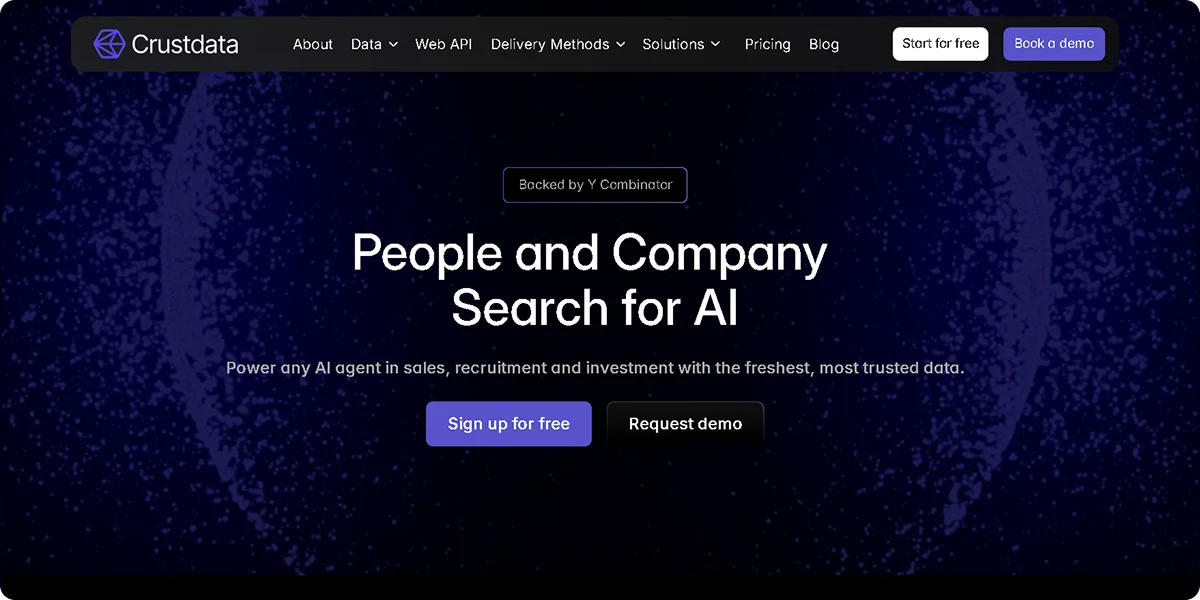
Looking to replace PDL or Clearbit with live enrichment that fits your automated workflows?
Book a demo to see how Crustdata's real-time APIs and Watcher alerts compare.
FAQs
Is Clearbit still available as a standalone product in 2026?
No. Clearbit has been folded into HubSpot as Breeze Intelligence, and new users can only access it through HubSpot. The standalone version is being phased out, so existing workflows are gradually moving into the HubSpot ecosystem.
Does People Data Labs provide emails and phone numbers?
Yes. Email data is widely available across plans, while phone number enrichment is typically included on higher-tier plans with expanded access.
Which is better for outbound sales teams: People Data Labs or Clearbit?
Neither is purpose-built for outbound prospecting. PDL has no prospecting UI and requires API integration for every data request. Breeze Intelligence is focused on enriching inbound CRM records inside HubSpot rather than building outbound lead lists.
If you’re running outbound prospecting workflows it’s better to go for tools built around prospecting search, verified contact data, and live enrichment rather than either of these platforms.


Products
Popular Use Cases
Competitor Comparisons
95 Third Street, 2nd Floor, San Francisco,
California 94103, United States of America
© 2026 Crustdata Inc.
Products
Popular Use Cases
Competitor Comparisons
95 Third Street, 2nd Floor, San Francisco,
California 94103, United States of America
© 2026 CrustData Inc.
Products
Popular Use Cases
Competitor Comparisons
95 Third Street, 2nd Floor, San Francisco,
California 94103, United States of America
© 2026 Crustdata Inc.
🎉 We hit $10M ARR!
$600k to $10m in 1.5 years. Our entire GTM is powered by our own APIs.
🎉 We hit $10M ARR in 1.5 years!