ROI of Sales Intelligence for Companies: Metrics & Impact
Discover the ROI of sales intelligence for companies to improve targeting, shorten sales cycles, and drive stronger revenue outcomes.
Published
Written by
Chris P.
Reviewed by
Nithish A.
Read time
7
minutes
Most companies buying sales intelligence measure the wrong things. They track logins, exports, and contacts added, which tells you about adoption, not return. The global sales intelligence market is projected to grow from $4.5 billion in 2025 to $11.7 billion by 2035. The spend is accelerating, but the ability to justify it is not keeping pace.
This guide covers the ROI of sales intelligence for companies, the metrics that capture it accurately, how to calculate it, and why it falls short when companies expect more than they get.
Key Takeaways
Most companies track the wrong metrics after buying sales intelligence; adoption numbers tell you nothing about whether the tool is generating a return
Sales intelligence ROI shows up across four areas: sales cycle length, win rate, rep research time, and pipeline accuracy; missing any one of them means undercounting the actual return
You cannot attribute improvement to the investment without a baseline; set one before the tool goes live, not after
A tool reps look up manually when they remember to will always underperform one that is built into the workflow
Leading indicators move within 30 to 60 days; if they are improving and revenue metrics have not moved yet, that is normal, not a red flag
What Is the ROI of Sales Intelligence?
The ROI of sales intelligence is the measurable return from using external data, signals, and insights to improve the speed, accuracy, and conversion rate of sales activity. It is not a single number. It is a combination of improvements across the sales workflow that each contributes to revenue differently.
The reason most teams struggle to quantify it is not that the return is not there. It is because they are tracking the wrong metrics.
Why Most Teams Mismeasure Sales Intelligence ROI
Tracking tool adoption tells you whether reps are using the product, not whether it is working. Metrics that connect to ROI are outcome metrics, and they require a pre-implementation baseline to mean anything. Without knowing your sales cycle length, win rate, rep research time, and pipeline accuracy before the tool went in, you cannot attribute any change to the investment.
These are the four metrics that matter:
Metric | What It Measures | Why It Matters for ROI |
Sales cycle length | Days from first touch to close | Shorter cycles mean more deals per rep per quarter |
Win rate | Percentage of qualified opportunities closed | Directly tied to revenue per pipeline dollar |
Rep research time | Hours per week on manual account research | Recovered time maps to additional selling capacity |
Pipeline accuracy | Percentage of forecast that closes as predicted | Reduces wasted effort on low-fit or stalled deals |
Establish a baseline for each before implementation. That baseline is what makes the ROI calculation credible when you review results at 90 days.
Where Sales Intelligence Has the Most Measurable Impact
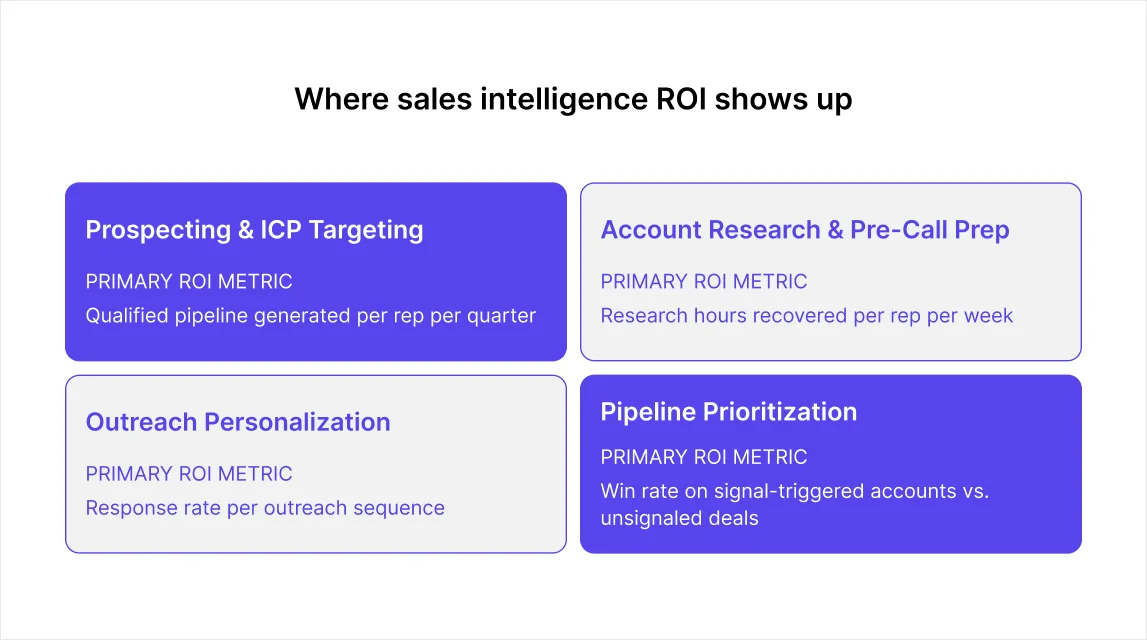
Sales intelligence touches multiple parts of the revenue workflow, but the ROI is not evenly distributed. These four areas consistently produce the most measurable return.
1. Prospecting and ICP Targeting
The quality of your ICP targeting determines the quality of everything downstream. Sales intelligence that returns accurate firmographic, technographic, and intent data at the prospecting stage means reps work accounts that match the ICP rather than discovering mismatches late in the cycle.
The ROI shows up in two ways: fewer hours spent prospecting accounts that never convert, and more qualified pipeline generated per rep per quarter.
2. Account Research and Pre-Call Preparation
A rep spending four hours per week on manual account research, confirmed against a fully-loaded cost of $80,000 to $120,000 annually, loses significant selling capacity to a task that automation handles more accurately.
86% of sales teams using AI tools report positive ROI within their first year, with most reaching break-even by month four to six. The fastest path to that break-even is recovering research hours and redirecting them into discovery calls.
For teams building automated pre-call account research workflows, this is where the compounding effect starts.
3. Outreach Personalization and Response Rates
Generic outreach performs poorly at every stage of the funnel. Sales intelligence gives reps the company context, role context, and timing signals they need to send messages that are relevant. The ROI metric here is response rate per outreach sequence, tracked before and after intelligence is embedded in the personalization layer.
Higher response rates reduce the number of touches required to book a meeting, which compresses the top of the funnel and accelerates pipeline velocity.
4. Pipeline Prioritization and Forecast Accuracy
This is the most underused application of sales intelligence and produces some of the strongest ROI when applied consistently. Account signals, including funding events, headcount changes, and technology stack shifts, tell reps which accounts in the existing pipeline are heating up or cooling down.
The metric to track is win rate on deals that receive signal-triggered attention versus those that do not. Teams building signal-based account scoring systems find that gap is where the strongest ROI case gets made.
How to Calculate Sales Intelligence ROI
ROI calculation for sales intelligence does not require a complex model. It requires a clear baseline, a defined measurement period, and the right metrics in each category.
The Sales Intelligence ROI Formula
The standard formula applies:
ROI = (Value Generated − Cost of Investment) / Cost of Investment × 100
The challenge is defining value generated accurately. Most teams undercount it by including only direct revenue impact and leaving out productivity gains, reduced churn from better-fit customers, and forecast accuracy improvements that reduce resource waste.
A complete value calculation includes four components:
Direct revenue impact: Additional closed revenue from improved targeting, shorter cycles, and higher win rates
Productivity value: Dollar value of research hours recovered, calculated at rep fully-loaded cost
Pipeline efficiency value: Revenue protected by eliminating low-fit deals earlier in the cycle
Forecast accuracy value: Resource allocation savings from improved pipeline visibility
A Practical Example
Take a ten-person sales team where each rep spends four hours per week on manual account research, at an average fully-loaded cost of $100,000 per rep annually. That is roughly $200,000 in annual labor going to research alone.
If sales intelligence reduces that by even 50%, the productivity value before any revenue impact is $100,000. Add the revenue contribution from the additional selling hours and any win rate improvement, and the ROI case builds quickly.
The point is not the specific numbers, but the structure. Every team should run this calculation against their own baseline figures before and after implementation so the return is traceable rather than assumed.
Why Sales Intelligence ROI Falls Short
Most teams that invest in sales intelligence and see less return than expected share a common set of failure points. These are the four most consistent ones.
Data Quality Problems Upstream
Sales intelligence is only as good as the data it runs on. If the enrichment provider serves records from a database refreshed monthly, the intelligence reaching your reps already reflects a company state that may have changed.
Reps personalize outreach based on a funding round that closed eight months ago or a headcount figure that predates a recent restructure. The message lands but lands wrong, and the response rate reflects it.
This is where enrichment source matters as much as the intelligence layer itself. Crustdata queries live sources at the moment of each API request, returning current signals rather than a cached snapshot.
For teams where sales intelligence depends on data being accurate at execution, that distinction drives a measurable difference in outreach outcomes.
Intelligence Used as a Lookup Tool Rather Than a Workflow Layer
The most common pattern is a sales intelligence platform that reps access manually when they remember to, rather than one embedded into the workflow so intelligence surfaces automatically at the right moment. Manual lookup produces inconsistent usage. Workflow integration produces consistent outcomes.
The difference between the two is not which tool you buy. It is how deeply it connects to the systems reps already live in, specifically the CRM, the sequencing tool, and the routing logic.
Measuring Activity Instead of Outcomes
Tracking logins, searches, and exports tells you about adoption, not ROI. Teams that consistently demonstrate sales intelligence ROI are the ones that established a baseline before implementation and tracked the four outcome metrics from day one.
Without a pre-implementation baseline, attributing any improvement to the investment becomes guesswork, which makes it harder to defend the budget at renewal.
Poor ICP Definition Going Into the Tool
Sales intelligence surfaces more of whatever you ask it for. If your ICP definition is broad or inconsistently applied, the tool returns a large pool of accounts that match loosely rather than a precise pool that matches tightly. Volume looks healthy. Conversion does not.
Tightening ICP criteria before deploying intelligence at scale is the step most teams skip, and it is the one that most directly affects the quality of the pipeline the tool generates.
Metrics to Track Sales Intelligence ROI Over Time
ROI measurement is not a one-time calculation. It is an ongoing tracking exercise that tells you whether your investment is holding its value and where the biggest gains are coming from.
Leading Indicators
These metrics move first and signal whether ROI will follow:
Response rate per outreach sequence: Improves when intelligence is embedded in personalization
Meeting booked rate per rep per week: Improves when targeting precision increases
Time from lead creation to first meeting: Shortens when research time is reduced
ICP match rate on new pipeline: Improves when intelligence is applied at the prospecting stage
Lagging Indicators
These metrics confirm whether leading indicator improvements are translating to revenue:
Win rate on qualified opportunities: The clearest single indicator of sales intelligence quality
Average sales cycle length: Tracks whether intelligence is accelerating deal progression
Pipeline accuracy at 30, 60, and 90 days: Confirms whether signal-based prioritization is improving forecast reliability
Revenue per rep per quarter: The composite measure that captures all upstream improvements
When to Review
Review leading indicators monthly. Review lagging indicators quarterly. Do not make tool decisions on monthly lagging indicator data because the sales cycle length means changes in pipeline quality take a full quarter to show up in closed revenue.
If leading indicators are improving and lagging indicators are not yet moving, that is expected behavior in the first 60 to 90 days, not a signal that the investment is not working.
How Crustdata Improves Sales Intelligence ROI
The ROI framework in this article assumes one thing: that the intelligence your reps act on reflects reality. When it does not, every metric degrades. Win rates drop because outreach is personalized to outdated context. Cycle times stay long because reps are working signals that have already passed.
Most sales intelligence platforms aggregate data into a stored database, refresh it on a schedule, and serve whatever was accurate at the last update. The problem compounds in automated workflows where no human review step catches the lag before the pipeline acts on it.
Crustdata triggers a live pull across 10+ verified sources at the moment of each API request rather than serving from a stored snapshot. For the four ROI metrics this article covers, that distinction matters in specific ways:
Sales cycle length: Current signals at the point of outreach mean personalization reflects where the account actually is today, which improves response rates and reduces the touches required to progress a deal.
Win rate: Accurate firmographic and technographic data at the prospecting stage improves ICP match quality, which is the single biggest driver of win rate improvement.
Rep research time: 250+ company data points and 90+ people data points in a single API call eliminate the need to chain multiple lookups, which is where most manual research time goes.
Pipeline accuracy: The Watcher API monitors target accounts and fires a webhook the moment a qualifying signal occurs, including executive hires, funding events, and headcount shifts, so your pipeline reflects current account state rather than the state at last refresh.
For teams building a structured intelligence layer, two resources connect directly to what this article covers. The first is how to build an account research layer for SDRs and AEs, where intelligence most directly affects cycle time and win rate. The second covers why sales intelligence is still challenging for most teams, which maps to the failure points in the previous section.
Book a demo to see how Crustdata's real-time data layer fits your existing sales workflow.
FAQ
Is sales intelligence worth it for small sales teams?
Yes, often more so than for large teams. A five to ten person team has less capacity to absorb wasted research time and low-fit pipeline, so productivity gains compound faster per head. The key is choosing a tool that fits the workflow rather than one built for enterprise complexity that goes underused.
What is the difference between sales intelligence and intent data?
Sales intelligence is the broad category covering contact data, firmographics, technographics, and account signals. Intent data tracks which companies are actively researching topics related to your product.
It is one input into a larger intelligence picture, not a replacement for it. Teams combining both layers can see how first-party and third-party signals work together in a single account score.
Should sales intelligence replace manual prospecting entirely?
Not entirely. Sales intelligence handles research, signal monitoring, and enrichment at a scale no manual process can match. Strategic judgment, relationship context, and complex negotiation still require human input. The goal is removing the research burden so reps spend time on work that actually requires them.
How does sales intelligence connect to CRM hygiene?
Sales intelligence feeds your CRM with enriched, current data. Without a consistent enrichment layer, records decay as contacts change roles and companies evolve. Teams that connect their intelligence tool directly to CRM update logic maintain cleaner data, which improves scoring, routing, and forecast accuracy over time.
Building a CRM enrichment workflow that stays current is what makes intelligence ROI sustainable rather than front-loaded.

Products
Popular Use Cases
Competitor Comparisons
95 Third Street, 2nd Floor, San Francisco,
California 94103, United States of America
© 2026 Crustdata Inc.
Products
Popular Use Cases
Competitor Comparisons
95 Third Street, 2nd Floor, San Francisco,
California 94103, United States of America
© 2026 CrustData Inc.
Products
Popular Use Cases
Competitor Comparisons
95 Third Street, 2nd Floor, San Francisco,
California 94103, United States of America
© 2026 Crustdata Inc.
🎉 We hit $10M ARR!
$600k to $10m in 1.5 years. Our entire GTM is powered by our own APIs.
🎉 We hit $10M ARR in 1.5 years!