How Recruiting Teams Turn a Raw Candidate Pool Into a Working Shortlist
Learn how recruiting teams narrow hundreds or thousands of sourced candidates into a working shortlist using structured scoring, company context, and tiered human review.
Published
Written by
Chris Pisarski
Reviewed by
Abhilash Chowdhary
Read time
7
minutes
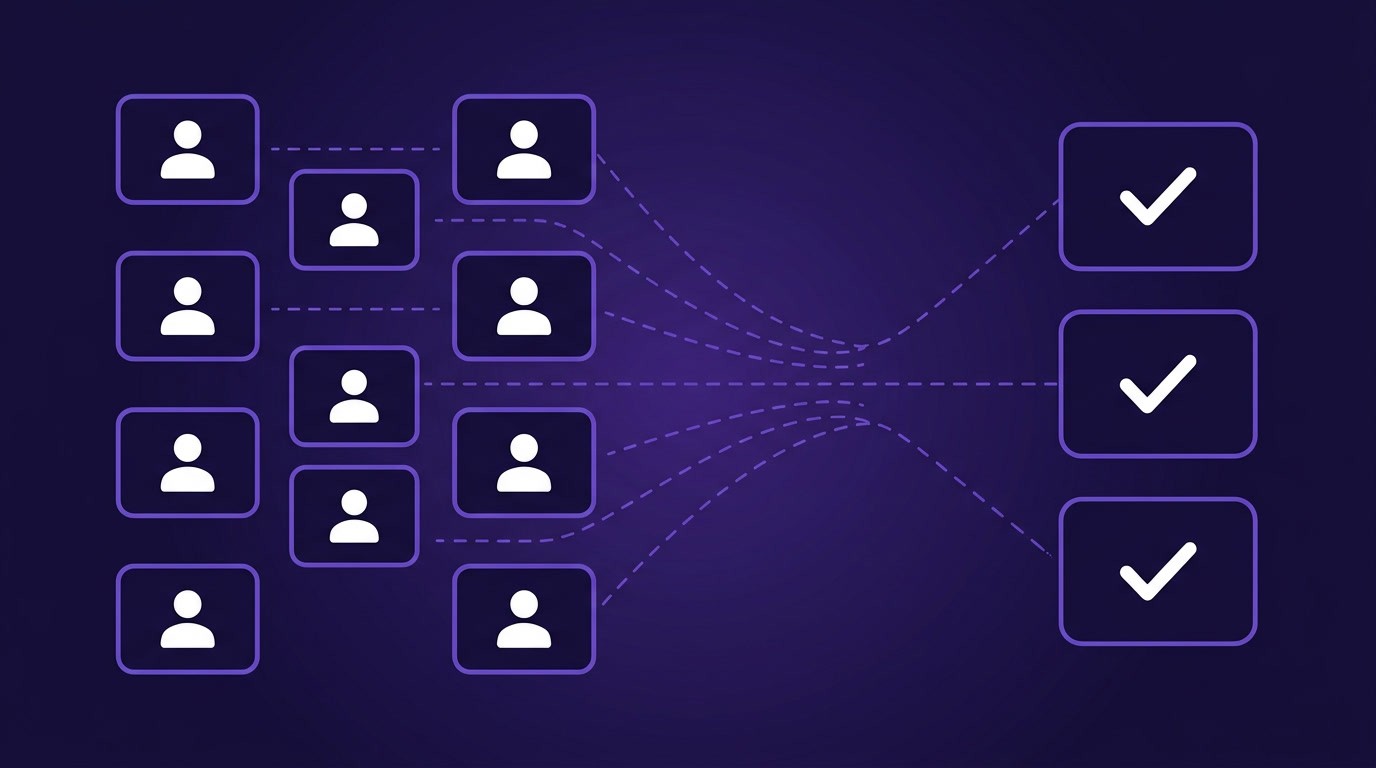
A recruiting team runs a people search and gets 800 profiles back. The profiles are relevant to the search criteria, but the team now faces a problem. Eight hundred candidates is not a working list. Narrowing a pool that size starts with the search layer in how to build a custom candidate search engine.
This is the shortlisting problem. Shortlisting sourced candidates means evaluating profiles within an already-targeted set, where the profile pool matches your search criteria and the challenge is identifying which profiles are worth acting on right now, rather than filtering out people who never should have applied in the first place.
This article walks through how recruiting teams compress pools of 500 to 2,000 sourced candidates into working lists of 50 to 100 that recruiters trust enough to contact without reviewing every profile.
Why a raw pool of 500 to 2,000 candidates is not a usable list
In most sourcing tools, a pool of 800 profiles for a senior controls engineer role will include people whose "robotics" experience was a single semester of coursework, and people at companies the hiring manager has never heard of. The profiles matched the search query, but they require evaluation that the search itself cannot perform.
An executive search firm based in Switzerland who we talked to described their version of this problem. They source roughly 2,000 candidates per engagement, analyze and score all of them, and deliver 75 to 100 to the client. The founder noted the credit burn on profiles during the early filtering stages is significant because the vast majority of sourced candidates will not survive to the final deliverable.
A two-person boutique agency specializing in robotics and hardware roles described the same dynamic at a smaller scale: out of roughly 700 search results, "maybe about 200 are worth my time clicking into, about 500 aren't a fit." According to research from SmartRecruiters and Harver, 52% of talent acquisition leaders say selecting the right candidates from a large applicant pool is the hardest part of recruitment. For teams working with sourced pools, the problem is more acute because the pool is already targeted and every profile looks like they could pass through at first glance.
The implication is that deciding which found candidates deserve attention takes more effort than finding them in the first place. In my opinion, it should. This blog doesn't claim to automate it and replace a recruiter, rather build a layer in between the sourced candidate pool and the step where the human judgement is the final call.
What teams evaluate before opening a single profile
Experienced recruiters do not start by reading resumes. They evaluate structured data points that are visible before clicking into any profile, and they use those data points to sort the pool into tiers before committing time to individual review.
Current employer context: A candidate's current company, its size, its funding stage, its industry, and what it actually does all inform whether the person is likely to be a fit. One recruiting platform founder building AI-powered sourcing tools noted that 90% of recruiters do not know what the companies on a candidate's profile actually do. They see a company name, assume it is relevant because the candidate's title matches, and click in to find out whether the assumption was right.
Title and seniority alignment. Structured search filters catch exact title matches, but adjacent titles require judgment. A "Staff Software Engineer" at a 50-person startup and a "Senior Software Engineer" at a 10,000-person company may carry equivalent responsibility. Seniority level as a structured data point, separate from title, helps resolve these ambiguities before the recruiter opens the profile. For teams building search interfaces that handle these edge cases, normalizing skills, titles, and ambiguous company entities is a deeper challenge.
Tenure and career trajectory. A candidate who has spent four years in a core function role carries different signal than someone whose relevant experience was a three-month internship listed alongside 15 other short stints. When career history is stored as structured data with separate records per position, each with its own timeline, the recruiter can evaluate trajectory without reading a full resume.
Employment recency. Candidates who changed roles months ago should never appear on a shortlist for active outreach. Live employment data, where the profile reflects the candidate's actual status right now rather than a cached version from the last database refresh, is a prerequisite for accurate shortlisting. Teams that also want to identify candidates likely open to change before they publicly signal availability can layer behavioral signals on top of recency data.
Geographic and logistic fit. For roles with location requirements, geography is a binary filter. For remote-eligible roles, timezone alignment and willingness to travel become softer criteria that still deserve pre-open evaluation.
These five dimensions focus human judgment rather than replacing it, so that instead of opening 800 profiles and forming impressions one at a time, the recruiter reviews a structured view of the pool and identifies which clusters deserve deeper attention.
How a four-layer filtering pipeline actually works
The teams that have operationalized shortlisting at volume all converge on a similar structure: multiple filtering layers, ordered from cheapest to most expensive, where each layer reduces the pool before moving on to the next one.
A talent intelligence platform that processes candidates continuously described their pipeline as four distinct stages: "There's the Crustdata first layer, then a syntactic keyword layer, then a semantic search layer, before finally it passes through a final LLM judge."
Layer 1: Structured data filters
A query against a people search API filtering on hard criteria like geography, seniority, employment status, and years of experience. This is the cheapest layer and removes the largest percentage of the pool, because candidates who fail binary criteria should never reach a scoring step.
With Crustdata, it's possible to combine 60+ filters in almost unlimited combinations due to our nesting capability, so you end up finding candidates that fit your niche criteria.
Layer 2: Syntactic keyword checks
Keyword matching across multiple fields: headline, summary, current job description, and past job descriptions. This catches candidates whose structured data passed the first filter but whose actual work does not match. A candidate with "robotics" in their title but whose job description reveals they work in robotics process automation (software), not physical robotics, gets filtered here.
Layer 3: Semantic search
Lateral matching that keyword checks miss. A controls engineer at a medical robotics company and a controls engineer at an aerial robotics company use different vocabulary for overlapping work. Keyword matching misses the overlap because the words differ, while semantic matching catches it because the underlying experience is equivalent.
Layer 4: LLM judge
Each remaining candidate is evaluated against the full job context with a structured rubric, producing a score, a ranking, and a written explanation of why the candidate landed where they did. Whatever makes it through this final stage lands in the recruiter's inbox or Slack channel with the reasoning attached.
Why this ordering matters
Each layer costs more per candidate than the previous one, so the pool must shrink at every stage. Running an LLM evaluation on 800 candidates is slow and expensive. Running it on the 60 that survived three cheaper filters is fast and produces better results because the LLM is comparing candidates within a tighter quality band.
For a technical walkthrough of implementing this as a four-stage pipeline, see the guide to multi-layer candidate filtering with Claude. Teams building these pipelines can work with structured candidate data APIs that return the fields needed for each layer, from hard-filter dimensions like geography and seniority through enrichment fields like company context and career history.
For technical roles, the scoring layers above confirm who looks right on paper. Whether they can actually do the work is a separate question, and teams hiring engineers usually add a skills-assessment step before a shortlist reaches a hiring manager, using a platform like HackerEarth to run coding tests and live or async technical interviews across 40+ programming languages. That step turns a strong-looking profile into a validated one, which is what makes a shortlist worth acting on.
Where shortlisting doesn't work with existing tooling
Across multiple customers who came to us from different platforms, the same patterns kept appearing. The tools were different, the team sizes were different, and the shortlisting didn't work for different reasons, but the result was always the same - recruiters spending most of their time re-evaluating candidates that a tool had already claimed to evaluate.
The false-match problem: A two-person recruiting agency specializing in robotics, hardware, and ML roles was running searches on Juicebox that returned roughly 700 results per role. Juicebox labeled many of those as "100% match" candidates, but the matches were wrong in ways that only became visible after clicking in.
An electrical engineering search surfaced a Tesla electronics designer as a top match, because the tool conflated "electronics" with "electrical."
A PCB design requirement counted anyone who mentioned "PCB" anywhere on their profile with five years of cumulative experience, whether PCB was a core function or a three-month internship listed alongside 15 other short stints.
The founders estimated that out of 700 results, roughly 500 were not worth their time, and 80% of each founder's week went to sourcing because every "scored" result still needed manual verification.
The multi-tool patchwork: A founder building an AI-powered sourcing platform for the European staffing market had assembled a chain of tools to get from search to shortlist - a LinkedIn automation tool extracted search results, Apify scraped full profiles from those results, and the profiles were pushed into his platform's matching engine for scoring.
He had tried routing through Apollo's people search first but abandoned it because the search interface was poor and the data lagged. Each search returned roughly 800 matching profiles, but the trim from 800 to 100 took days because recruiters had to click into each profile to figure out whether the employer was relevant. His observation was that 90% of recruiters do not know what the companies on a candidate's profile actually do, and with no company context visible in the list view, every evaluation required a click on their profiles.
The credit-burn funnel. An executive search firm in Switzerland and Germany sources roughly 2,000 candidates per engagement, drawing from Apollo and other providers. Their workflow enriches candidates across multiple providers to assemble complete profiles, then applies multi-layer scoring, and delivers 75 to 100 candidates to the client.
The firm's founder described the early filtering stage as having a "quite huge burn rate on profiles," because a large portion of the 2,000 candidates sourced will not make the final deliverable, and every profile enriched during the filtering stages costs credits regardless of whether it survives to the shortlist.
What changed when the data and scoring improved
Each of these breakdowns traces back to the same root cause: the recruiter has to re-evaluate what the tool already claimed to evaluate. The fix is a shortlist where each entry carries enough context that the recruiter can act without opening the profile.
The two-person robotics recruiting agency replaced their Juicebox workflow with a structured scoring pipeline that evaluates each candidate against the full job context. Their searches now produce 50 to 70 high-confidence candidates per role instead of 700 results that required manual review. The founders described their bar for the output - if a candidate is scored as a 100% match, the recruiter should not have to open that profile to verify it. That trust freed enough capacity to take on 43% more clients without hiring a third recruiter.
For the recruiting platform founder, the fix is combining the multi-tool chain (LinkedIn automation, Apify, Apollo) into a single people search and company enrichment layer. When company context (what the employer does, its size, its funding stage) is returned alongside each candidate in the search results, recruiters can evaluate company fit from the list view instead of clicking into every profile. That eliminates the bottleneck he described.
For the executive search firm, the leverage point is filtering order. When hard filters on geography, experience, and employment status run against the people search API before any enrichment credits are spent, candidates who would fail binary criteria never reach the enrichment or scoring layers. The 2,000-to-100 compression still happens, but the credit burn concentrates on candidates who have already passed the cheapest checks.
Where human judgment still matters
Structured scoring handles the extremes well, advancing high-confidence matches and dropping clear misses. The value of human judgment is concentrated in the middle band, and knowing where that band starts and ends is what makes the difference between a recruiter who reviews 800 profiles and one who reviews 80.
Tier 1 - High-confidence matches (above 80% weighted score): These candidates scored well across all dimensions. The data supports the match, and the recruiter's role shifts from evaluating fit to scanning for red flags. A batch review of 20 high-confidence profiles takes a fraction of the time that 20 individual evaluations would, because the recruiter is confirming rather than deciding. These candidates move directly into outreach or client presentation.
Tier 2 - The judgment band (60% to 80%): This is where recruiter expertise creates the most value. A candidate in this band might be at a company in an adjacent industry whose skills transfer directly, or hold a title that does not map cleanly to the target role, or show an unusual tenure pattern that could mean either high growth or instability. These are the candidates that a scoring system correctly flags as uncertain.
One agency founder with 20 years of recruiting experience described this band as representing 25% to 35% of the best candidates for any search, the non-obvious matches that only a veteran recruiter would know to pursue. A medical robotics engineer whose skills transfer to aerial robotics, a defense avionics specialist who fits commercial drone systems, or a controls engineer at a 40-person startup that no sourcing tool has indexed.
This is also why lookalike candidate search often breaks down for specialized roles. These candidates share career trajectories, employer profiles, and industry adjacencies with the target role rather than sharing keywords, and those patterns show up only when a human examines the context.
Tier 3: Below threshold (under 60%). These candidates failed on too many weighted dimensions. In most cases, they should be removed from the shortlist without further review. The exception is when the tier-2 band is thin, which may signal that the search criteria are too narrow rather than that the pool lacks quality. In that case, the scoring thresholds need adjustment rather than the recruiter's time.
The Tier 2 band is also where the shortlisting workflow feeds back into the search itself. Every rejected candidate and every non-obvious match the recruiter surfaces teaches the scoring system what "fit" looks like for this specific role. Over time, that feedback loop means the scoring criteria get more precise, the judgment band gets narrower, and the recruiter spends less time on each subsequent search for the same role type.
According to a 2026 industry survey compiled by InCruiter, 93% of hiring managers say human involvement in candidate evaluation remains essential even as AI adoption in recruiting reaches 87%. That data confirms that the highest-value human contribution is concentrated in the judgment band, and structured scoring is what makes that concentration possible.
Ready to build candidate shortlists from structured, live people data? Book a demo to see how recruiting teams use Crustdata's People Search and Enrichment APIs to compress sourced pools into working shortlists.
In summary
The teams that shortlist sourced candidates efficiently share a consistent pattern. They evaluate structured data, including employer context, career trajectory, tenure, and employment recency, before opening a single profile. They run cheap filters first to shrink the pool before spending time or credits on deeper evaluation. They build shortlists where each entry carries enough context and reasoning that the recruiter can act without re-evaluating. And they concentrate human review on the 60% to 80% match band where recruiter expertise creates the most value, rather than spreading it across the full pool.
The teams who struggle are the ones scrolling through profiles one at a time, which is exactly the bottleneck that sourcing was supposed to eliminate. If the sourcing step itself still needs work, see the comparison of AI sourcing tools that evaluates platforms on data freshness and accuracy. For a broader look at how shortlisting fits into the full recruiting pipeline, see the guide to building internal recruiting tools with real-time people data, or for a hands-on walkthrough of connecting Claude to a people search API, see how to integrate a people search API into your recruiting workflow.
Start with better candidate data to build shortlists your team trusts.



Products
Popular Use Cases
Competitor Comparisons
95 Third Street, 2nd Floor, San Francisco,
California 94103, United States of America
© 2026 Crustdata Inc.
Products
Popular Use Cases
Competitor Comparisons
95 Third Street, 2nd Floor, San Francisco,
California 94103, United States of America
© 2026 CrustData Inc.
Products
Popular Use Cases
Competitor Comparisons
95 Third Street, 2nd Floor, San Francisco,
California 94103, United States of America
© 2026 Crustdata Inc.
🎉 We hit $10M ARR!
$600k to $10m in 1.5 years. Our entire GTM is powered by our own APIs.
🎉 We hit $10M ARR in 1.5 years!