Why AI Data Enrichment Matters for Revenue Teams
Published
Written by
Chris P.
Reviewed by
Nithish A.
Read time
7
minutes

CRM data doesn’t stay accurate for long. A good portion of records become inaccurate each year, so without continuous, automated maintenance, manual cleanup alone cannot keep pace with the rate of change.
AI data enrichment promises to fix this, but the term covers very different approaches. Some tools rely on LLM inference, others orchestrate multiple databases, and some pull real-time data via APIs. Those differences directly impact accuracy, compliance, and whether your AI workflows actually work.
This article breaks down what AI data enrichment really means, what AI changes, where current tools fall short, and why the underlying data source matters most.
What AI data enrichment is
AI data enrichment is the process of automatically appending, verifying, and updating CRM records using external data sources, powered by Machine Learning (ML), Natural Language Processing (NLP), and Large Language Models (LLMs). Instead of relying on a single static database refreshed every few months, modern enrichment systems continuously pull, cross-check, and refine data from multiple sources.
This shift exists for a simple reason: B2B data decays at roughly 22.5% per year. If you enrich once and revisit months later, you’re working with data that already no longer reflects reality.
At a practical level, enrichment fills in four key types of data that revenue teams use daily:
Firmographic (industry, revenue, headcount) – helps route and segment leads by company size.
Technographic (software stack) – shows whether an account already uses a competitor.
Behavioral/intent (funding, hiring, engagement) – surfaces accounts actively showing buying signals.
Demographic (title, seniority, career history) – enables accurate personalization.
Geospatial (HQ location, regional footprint, office expansions) – helps territory planning and routing leads by region.
It’s also worth separating terms that often get mixed together. Enrichment adds new external data to a record. Enhancement cleans or standardizes what’s already there. Augmentation generates synthetic data, usually for model training. When revenue teams say “enrichment,” they almost always mean the first.
Traditional enrichment relied on batch matching against a single provider. AI-driven approaches now chain multiple providers together in waterfall sequences, pushing match rates much higher. The result is broader coverage, more complete records, and less manual research.
What AI enables in enrichment workflows
76% of CRM users say less than half their data is accurate and complete, and 37% report directly losing revenue due to poor data quality. Additionally, Gartner puts the average annual cost of poor data quality at $12.9 million.
To target this problem, AI speeds up enrichment and changes how it works at a systems level, replacing one-time batch updates with continuous, multi-step workflows that improve both coverage and accuracy. It also automates what used to require hours of manual research, turning data maintenance into a continuous, scalable process rather than a periodic cleanup task.
Here’s how:
Waterfall enrichment across multiple providers: Instead of relying on a single database, the workflow queries multiple sources in sequence. If one provider can’t verify an email address or company record, the system moves to the next. For revenue teams, that translates directly into fewer dead leads and better coverage on niche or international accounts.
Confidence scoring before data is written to the CRM: Each data point is evaluated based on how consistently it appears across sources. Setting a threshold (for example, 0.85) ensures SDRs only see records that have been cross-verified. Without this layer, enrichment pipelines tend to dump unverified data into the CRM, trading completeness for accuracy.
Entity resolution: AI systems can reconcile variations like “OpenAI,” “Open AI,” and “openai.com” into a single canonical record. This prevents duplicate accounts and conflicting data, which are common failure points in traditional enrichment workflows.
Extract signals from unstructured sources using NLP: Job postings, press releases, and news articles often reveal changes before any provider updates its dataset. A company hiring a “Salesforce Administrator” is a strong technographic signal, even if no database has recorded it yet. These signals help teams prioritize accounts based on real-world activity.
How AI-first enrichment tools work
Modern AI-first enrichment tools are built around an orchestration model. Instead of acting as a single source of truth, they sit on top of dozens or even hundreds of data providers and coordinate how data is fetched, verified, and written back to your CRM.
At a high level, the workflow looks like this: a record enters the system, the tool runs a predefined waterfall sequence across multiple providers, evaluates the results, and writes the best version back into your CRM or downstream system. This all happens through a UI or API, which is why these tools feel fast and flexible compared to older batch-based enrichment.
The biggest advantage is automation at scale. What used to require manual research – checking professional profiles, company websites, multiple databases – now happens in seconds. Waterfall enrichment improves coverage, while built-in logic determines which provider to trust for each field. Many tools also layer in LLMs to infer missing attributes from scraped web data, filling gaps that structured databases don’t cover.
A few tools have become reference points for how this model works in practice:
Clay acts as a pure orchestration layer. It connects to 150+ providers, lets users define waterfall logic, and uses LLMs to infer attributes when structured data is missing. Importantly, it’s not a database itself – it’s a control layer on top of other sources.
Clearbit (now part of HubSpot as Breeze Intelligence) offers native enrichment inside the HubSpot ecosystem. It’s tightly integrated and easy to deploy, but requires a paid HubSpot plan and operates within that environment.
Warmly focuses on real-time visitor identification. It enriches anonymous website traffic and pushes that data into CRM systems, making it useful for inbound and product-led growth workflows.
These tools have pushed the category forward in a meaningful way. They’ve improved match rates, reduced manual effort, and made enrichment workflows programmable instead of static. For most revenue teams, that’s a real step change from older approaches.
For a deeper comparison of enrichment tools, see Crustdata's guide to the best B2B data enrichment tools.
But there’s an important constraint: orchestration routes and evaluates data, but doesn’t create it. The quality of the output still depends on the underlying providers – how fresh their data is, how often it’s updated, and how transparently it’s sourced. The orchestration layer decides where to look and how to combine results, but it can’t fix stale or low-quality inputs.
Where AI-first enrichment tools have gaps
The same capabilities that make these tools powerful also introduce new limitations:
LLM-inferred attributes are inherently probabilistic: When a tool analyzes a company’s website and “decides” what the company does, that’s a best guess based on available text. It can be directionally useful, but it’s not the same as verified data. If downstream workflows act on incorrect inferences, the impact is amplified at scale.
Confidence scores can give a false sense of precision: A score like 0.78 sounds authoritative, but it still implies a meaningful error rate. When enrichment feeds automated outreach or AI agents, even small inaccuracies compound across thousands of records.
Compliance considerations: When enrichment relies on scraped web data and LLM inference, tracing the origin of each data point becomes harder. Regulators expect you to have a documented Legitimate Interest Assessment and signed vendor DPAs. That means teams using AI-first enrichment tools should confirm their vendors can explain where every data point originates.
The common thread is that most of these gaps come from the data underneath the orchestration layer. If the sources are stale, incomplete, or inferred, the output will reflect those limitations. AI-first tools make enrichment more efficient, but they don’t eliminate the dependency on high-quality data.
Why the data layer underneath your AI tools matters
AI enrichment tools don’t generate truth. They orchestrate access to it. That distinction is easy to miss, but it determines the quality of everything downstream.
The tools covered earlier – whether it’s Clay, a custom workflow, or an AI agent – sit on top of data providers. They decide which sources to query and how to combine results. But they can’t improve the underlying data itself. If those sources are stale or incomplete, the output will be too. Running waterfall enrichment across three outdated databases still produces outdated results. Swap those inputs for a real-time data source, and the same workflow produces fundamentally different outcomes.
This is where a shift in philosophy matters. Most data providers optimize for coverage – more contacts, more companies, larger datasets. The tradeoff is freshness. Records are often updated in batches, which means what you retrieve may already be weeks or months out of date. An alternative approach prioritizes freshness over breadth, ensuring that each record reflects the current state of the company at the moment you query it. For revenue teams running automated outreach or AI SDR workflows, that tradeoff is decisive. One accurate, timely record consistently outperforms ten stale ones.
In practice, a real-time data layer changes how enrichment fits into your stack. Instead of enriching records periodically, you query live data when you need it or trigger updates based on events.
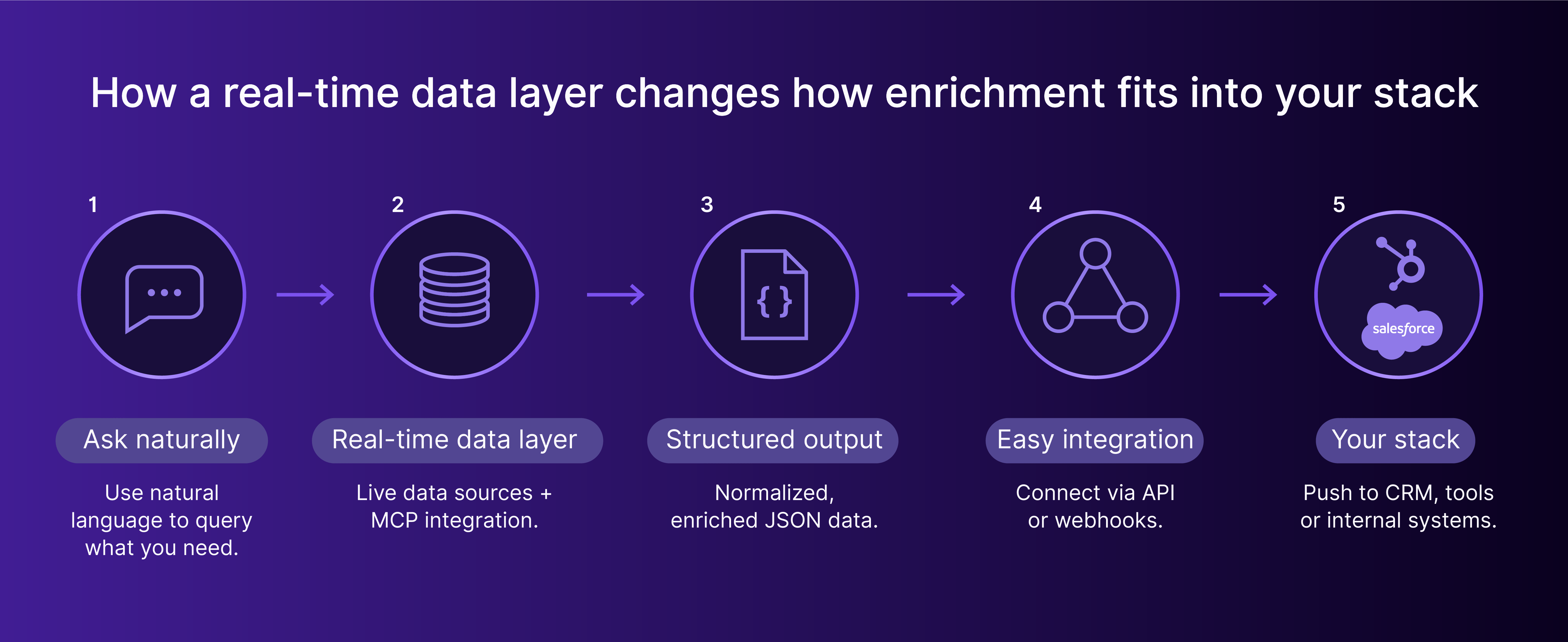
With Crustdata’s MCP integration, for example, you can ask Claude in natural language: “Find Series A SaaS companies in NYC with 50–200 employees that are hiring engineers,” and receive structured, up-to-date results instantly. That can function as a standalone workflow or feed directly into tools like Clay or your internal systems.
Integration into CRMs is straightforward when the data is structured. The Company Enrichment API returns normalized JSON that maps cleanly to fields in platforms like Salesforce or HubSpot, either through direct API connections or webhooks. This removes the need for manual imports or periodic batch jobs.
The bigger shift is toward continuous enrichment via the Watcher API. Instead of re-enriching your CRM every quarter, event-driven systems push updates when something changes – funding rounds, hiring surges, job changes. The API triggers workflows the moment those signals appear, allowing AI agents or orchestration tools to act within hours instead of weeks.
For teams without heavy engineering resources, MCP-style integrations lower the barrier further. Instead of building API pipelines, you can query live data through natural language interfaces and plug the results into your existing stack.
To learn more about how real-time data powers AI sales agents specifically, read Crustdata’s post on What an AI sales agent is.
The takeaway is simple. AI changes how enrichment is orchestrated, but the data layer determines whether it actually works.
How Crustdata fits into your stack
Crustdata is the data layer that powers the workflows described above with a Company Enrichment API (250+ data points from 16+ sources), a People Enrichment API (90+ attributes per profile), and Company and People Search APIs with 60+ filters across billions of records. For ongoing updates, the Watcher API pushes webhook alerts when trigger events happen – funding rounds, hiring spikes, or role changes – so your workflows react in real time.
You can use APIs for live enrichment and triggers, or bulk datasets via S3 to populate your CRM baseline. For a full technical walkthrough, check out the data enrichment API complete guide.
Not to mention, MCP integration lets you query live data through Claude using natural language, lowering the technical barrier.
Crustdata is also expanding into technographic data, positioning it as a standalone provider rather than just a layer beneath other enrichment tools.
Using Crustdata’s real-time enrichment, behavioral signals, and trigger-based automation via a single API, an AI SDR company increased reply rates from about 2% to 8–12%, enabling outreach within hours of key events instead of weeks later.
So don’t wait any longer. Book a demo today and see how Crustdata fits into your stack!


Products
Popular Use Cases
Competitor Comparisons
95 Third Street, 2nd Floor, San Francisco,
California 94103, United States of America
© 2026 Crustdata Inc.
Products
Popular Use Cases
Competitor Comparisons
95 Third Street, 2nd Floor, San Francisco,
California 94103, United States of America
© 2026 CrustData Inc.
Products
Popular Use Cases
Competitor Comparisons
95 Third Street, 2nd Floor, San Francisco,
California 94103, United States of America
© 2026 Crustdata Inc.
🎉 We hit $10M ARR!
$600k to $10m in 1.5 years. Our entire GTM is powered by our own APIs.
🎉 We hit $10M ARR in 1.5 years!