B2B Prospecting Tools Ranked by Data Freshness and Price
B2B prospecting tools ranked by how fast data updates and what you'll actually pay. Verified pricing, credit breakdowns, and a stack-building framework.
Published
Written by
Chris P.
Reviewed by
Nithish A.
Read time
7
minutes

Every B2B prospecting tools comparison follows the same formula: list 20+ products alphabetically, call each one "great for teams of all sizes," and move on. Nobody tells you which tools update data fast enough to matter, and nobody breaks down what you'll actually spend once credits, seats, and add-ons are factored in.
This piece takes a different approach, ranking tools based on two factors that directly determine ROI: how fresh the data is and the realistic price tag.
We’re assuming you’re evaluating whether to replace, supplement, or restructure your prospecting stack, and you already know what an ICP is, understand basic outbound concepts, and have decided you need tooling. The question now is – which tooling?
What B2B prospecting tools do and why the category is confusing
B2B prospecting tools are software that helps sales teams find, research, and contact potential business customers. The problem is that this single label covers five distinct functions that most articles treat as interchangeable.
Contact databases are UI-based platforms where reps search for emails and phone numbers. ZoomInfo, Apollo.io, and Cognism are a part of this category.
Real-time data infrastructure refers to API-first providers like Crustdata that power prospecting tools and AI agents with live data.
Email finders and verification tools are lightweight products for discovering and verifying email addresses. Hunter.io is a typical example of this category.
Engagement platforms handle sequencing and outreach automation, and Outreach and Salesloft are the big names here.
Intent and intelligence layers are signal providers that tell you who's in-market – think Bombora and 6sense.
These categories are not directly comparable. Comparing a data provider to a sequencing platform is comparing two tools that belong in the same stack, not the same ranked list. A 5-person startup might pair an all-in-one platform with a cold email tool. A 30-person mid-market team might layer an enterprise data provider with a sequencing platform and European visitor identification. A technical team running AI SDRs would pair a real-time data API with custom enrichment and webhook triggers.
This is why we’re comparing these tools based on data freshness and realistic price, as these are important considerations for all of them.
What to look for based on your team's use case
Instead of guessing which tool might fit your situation, based on a flat tooling list, let’s consider four dimensions that narrow your shortlist based on how your team actually operates.
Geography and compliance
EMEA teams need tools that actively screen Do Not Call registries, not just a "GDPR-compliant" badge on a features page. The strongest compliance posture in the category includes DNC screening across the US, Canada, Australia, UK (TPS/CTPS), France, Germany, and additional European countries, plus ISO27001 and SOC 2 Type 2 certification.
B2B cold email is permitted under GDPR's "legitimate interest" basis, but that requires a documented balancing test. Before signing with any vendor, ask three questions:
Which DNC registries do you screen, and in which countries?
What's your lawful basis for processing?
How do opt-outs flow back to the data source?
If a vendor can't answer all three with specifics, their compliance claim is marketing, not infrastructure.
Timing and signals
Intent data tells you who's in-market right now. It comes in two types: first-party, which includes your own website visitors, and third-party, which includes content consumption data from co-op networks or predictive platforms that combine both with AI.
But the delivery mechanism matters just as much as the data itself.
Webhooks fire the moment a change is detected. Polling means re-running queries on a schedule. The gap between those two determines whether your team acts in hours or weeks.
Crustdata's Watcher API pushes alerts the moment a profile update is detected. The People Discovery API's "recently changed jobs (last 90 days)" filter is a named product use case, giving teams the ability to find prospects during the window when they're most open to vendor conversations. For a deeper look at how real-time enrichment fits into automated workflows, see Crustdata's guide to B2B data enrichment tools.
Email finders also fit under timing, but as a different sub-category. Domain-based email discovery tools (like Hunter.io), email finders with built-in CRM features, and one-click contact capture extensions for professional profiles each serve a slightly different workflow. Specific tools are covered in the comparison sections below.
Stack architecture
Most teams need two to three tools, not one. The combination depends on team size and technical maturity.
5-person startup: An all-in-one platform (Apollo.io) paired with a cold email tool handles both data and outreach in one motion.
30-person mid-market team: An enterprise data provider (ZoomInfo or Cognism) layered with a sequencing platform (Outreach or Salesloft) and a European visitor identification tool (Dealfront) covers multiple regions and channels.
Technical team running AI SDRs: A real-time data API (Crustdata) paired with custom enrichment and webhook triggers delivers the speed automated agents require.
For how CRM enrichment fits into these stacks, see Crustdata's CRM enrichment guide. For phone-heavy outreach, phone-verified mobile number providers (Cognism's Diamond Data, Lusha) are the right category.
Budget model
Credit-based, seat-based, and hybrid pricing models behave very differently at scale.
In a credit-based model, each action has a defined cost. Revealing an email might cost 1 credit, while a phone number costs 5–10. That distinction adds up fast. A 5-person team doing 500 email lookups and 50 phone number lookups per month needs thousands of credits per year, and the entry-level tier might not cover it.
Seat-based models (ZoomInfo, Cognism) charge a flat rate per user but lock features behind higher tiers. Hybrid models combine both. The specific credit mechanics for each tool are broken down in the comparison section. The important takeaway: always model usage at your anticipated monthly contact volume before signing an annual contract.
Free B2B prospecting tools and what they actually get you
Free plans are evaluation tools, not pipeline generators. Use them to test data quality for your ICP segment before committing budget. If your team is serious about outbound, plan for paid. Here's what the most notable free tiers offer.
Apollo.io free plan
Apollo.io offers 900 credits/user/year, granted monthly, at $0. The free tier includes 2 sequences, Chrome extensions for Gmail and Salesforce, AI research, and basic filters.
At 1 credit per email reveal, that's roughly 75 emails per month – enough to test Apollo's data quality for one ICP segment, not enough to run outbound at scale. Of all the free tiers in this category, Apollo offers the most generous feature set (sequencing included), even if the credit count runs behind others.
Lusha free plan
Lusha offers a free plan with up to 40 credits per month.
Credits cover verified emails and phone numbers. One credit reveals an email, and 10 credits reveal a phone number. That means 70 credits could get you 70 email reveals, or just 7 phone reveals – enough to test Lusha's coverage for your target segment before committing to paid plans.
Hunter.io free plan
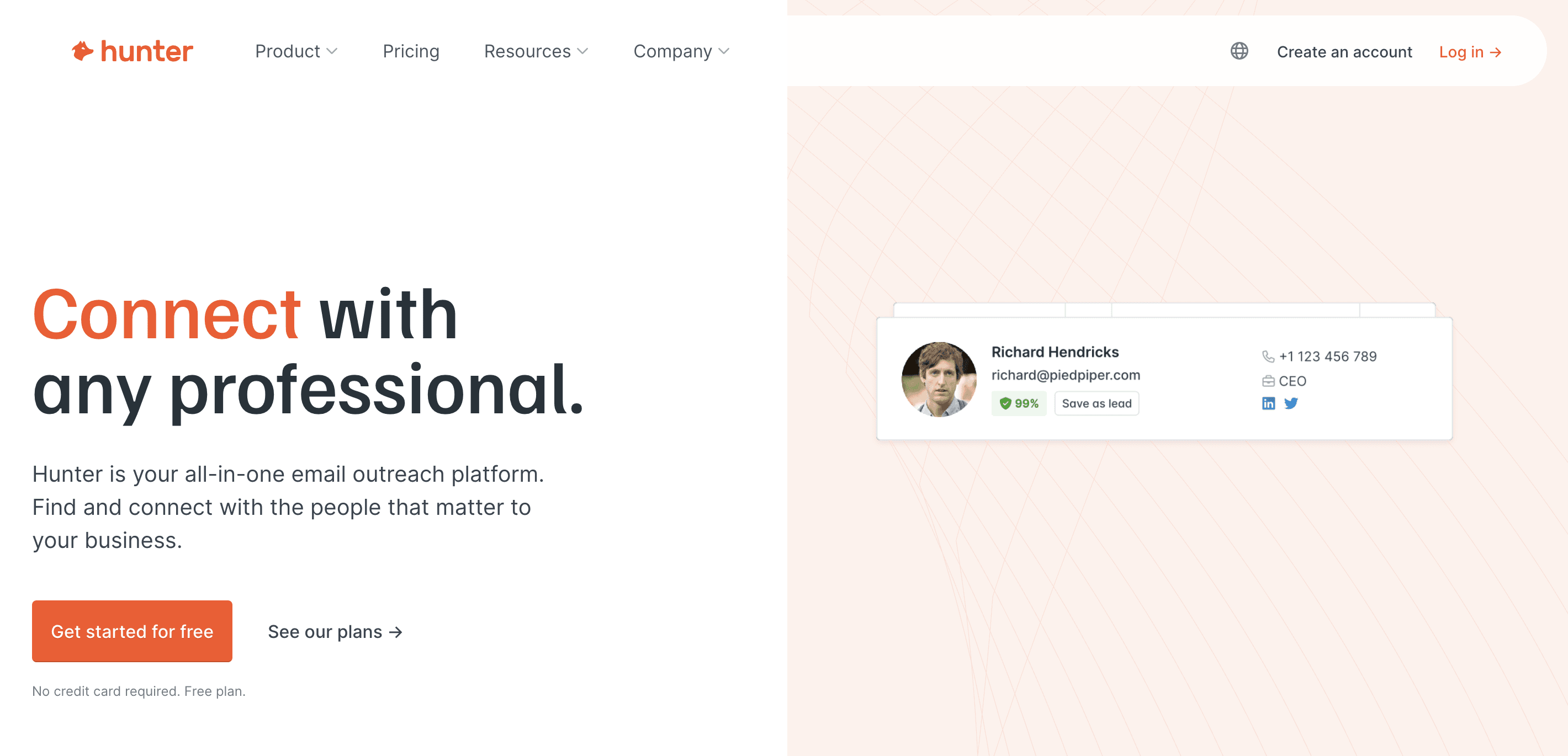
Hunter.io offers 50 free credits per month on its free plan. Hunter migrated to a unified credit system in mid-2025, so credits now cover both email finding and verification from a single pool.
Hunter's primary strength is email format discovery. Search a company domain and see the common pattern – firstname.lastname@, first@, and so on. No phone numbers, no company intelligence. Hunter is an email verification layer, not a prospecting database. It pairs well with other tools in a stack rather than standing alone.
Kaspr free plan
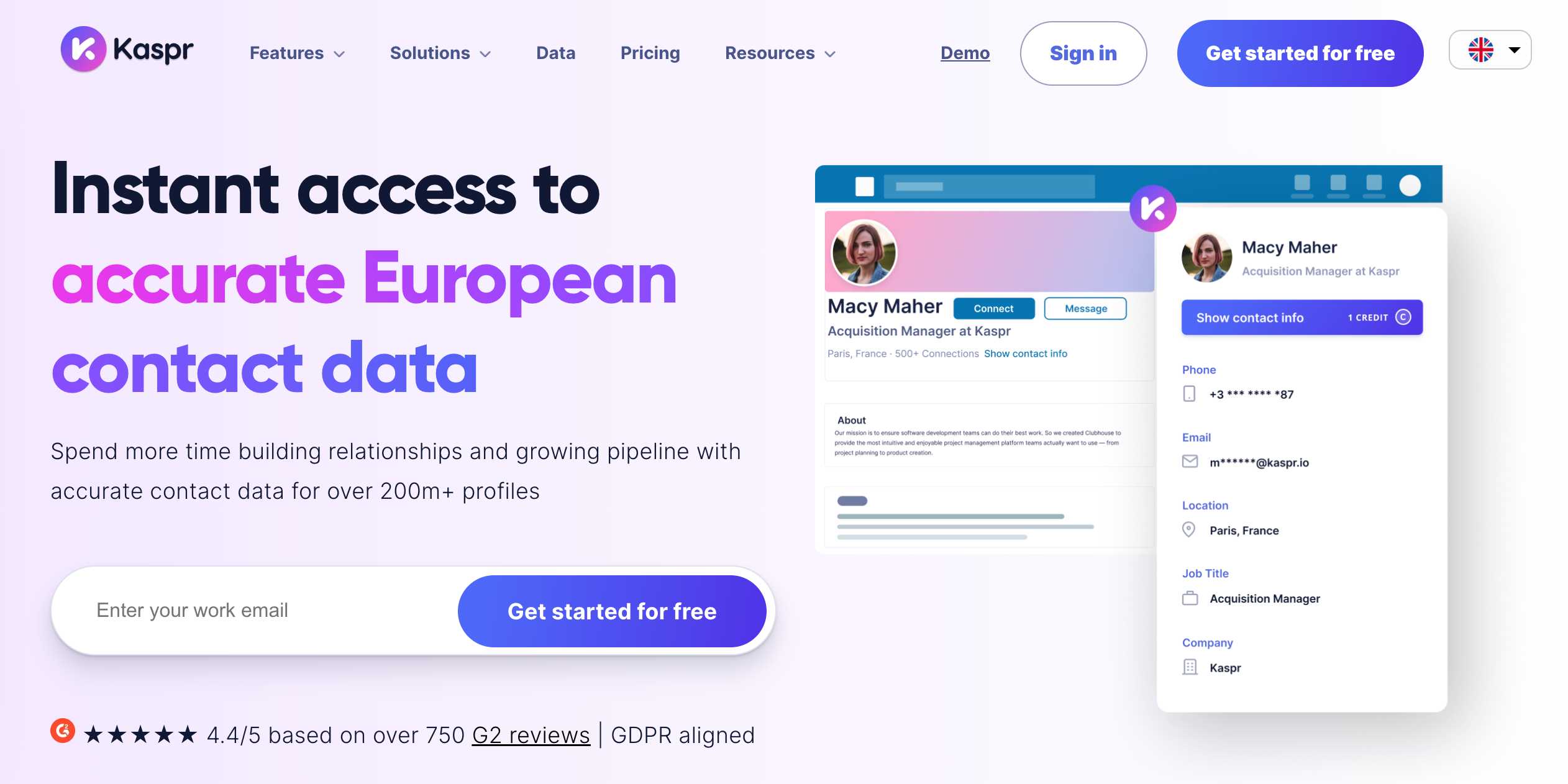
Kaspr is a free Chrome extension that reveals emails and phone numbers from professional profiles. Part of the Cognism Group, it's designed for individual contributors rather than team-scale prospecting.
The free tier includes 15 B2B email credits, 5 phone credits, and 5 direct email credits per month (Kaspr pricing). That's enough for a handful of lookups – useful for testing data quality in specific regions, particularly Europe, where Kaspr benefits from Cognism's data infrastructure.
Premium prospecting tools ranked by data freshness and price
Here's the comparison this article is built around.
The ranking methodology: tools are ordered by data freshness (how quickly records reflect real-world changes) with realistic pricing for each. Stale data wastes outreach on people who've already moved on. Opaque pricing hides true cost until you're locked in. These two dimensions matter more than database size claims.
Tool | Database size | Refresh frequency | Pricing model | Realistic annual cost | Best fit |
1B+ (real-time) / 300M+ (DB) | Live at request / monthly (DB) | Credit-based API, custom pricing | Contact sales for a quote | AI SDR platforms, technical teams | |
420M+ emails and phone numbers | Monthly batch | Credit + seat-based | $50,000+/yr all-in | Enterprise, NA-focused | |
210M+ verified emails and phone numbers | Rolling, days-weeks lag | Credit-based | $2,940–$8,568/user/yr | Startups, SMBs | |
Not publicly stated | Regular + human verification | Platform fee + seat-based, annual | ~$22,500–$50,000+/yr (est.) | EMEA, cold calling | |
Not publicly stated | Regular updates | Credit-based | ~$450–$3,600/yr (Starter to Premium); Scale custom | Individual reps | |
155M+ emails and phone numbers | Real-time email verification | Credit-based | $1,188–$2,388/yr | Tech stack targeting | |
55M companies | Regular updates | Credit-based | $732/yr starting | Lookalike search |
Sources: Crustdata People Discovery API, Crustdata Pricing, ZoomInfo Sales Page, Apollo Pricing, Fifty Five and Five ZoomInfo Pricing, MarketBetter Cognism Pricing, Lusha Pricing, UpLead Pricing, Ocean.io Pricing.
1. Crustdata
Crustdata is an API-first data infrastructure, not a UI-based prospecting tool. It's the real-time data layer that powers prospecting tools and AI SDR platforms.
The People Discovery API offers two modes.
In DB search queries, with a database of 300M+ profiles with 60+ filters, refreshed monthly.
Real-time web search covers 1B+ profiles with 20+ filters, crawled live at the moment of request. That real-time mode is why Crustdata tops this ranking.
The Watcher API pushes alerts via webhook the moment a profile change is detected, such as job changes, funding rounds, and hiring surges. No polling required, no waiting for a monthly refresh. The platform aggregates from 10+ data sources with entity resolution that handles variations like "OpenAI" vs. "Open AI" automatically, reducing duplicate records and cleanup work downstream.
Pricing: Credit-based API model with custom pricing based on volume. No self-serve free tier. You can book a demo to get a quote and test the data against your ICP.
What Crustdata does NOT do: There's no user interface, no Chrome extension, and no built-in sequencing. Teams without developers should look at Apollo or ZoomInfo instead.
Best for: Companies building AI-powered sales products and enterprise teams with engineering resources who need the freshest data layer underneath their stack. For a detailed feature-by-feature comparison with legacy providers, see Crustdata's B2B data API providers ranking.
2. ZoomInfo
ZoomInfo is the enterprise standard for North American emails and phone numbers. The platform covers 420M+ global contacts and 145M+ companies.
The core database receives monthly batch updates. Some real-time signals are available via Bombora intent integration on higher tiers. But a contact who changed jobs two weeks ago may still show their old title and phone number until the next refresh cycle.
Pricing is not published and requires a sales process. Third-party estimates put Professional at ~$15,000/year (1–3 seats, 5,000 credits), Advanced at ~$24,000+ (adds intent data), and Elite at ~$40,000+. True all-in cost frequently exceeds $50,000/year once add-ons like additional credit packs, email verification, and global data are factored in.
US email accuracy is rated at 97%+ per Salesmotion's independent assessment, which is the highest in the category for North American data.
Best for: Enterprise teams where North American deal size justifies the cost and US email accuracy matters more than price or refresh speed.
Trade-off: Top accuracy for US emails, but monthly refresh lags Crustdata, and your first pricing quote is the start of a negotiation, not a final number. For a detailed feature-by-feature comparison, see Crustdata's ZoomInfo alternative page.
3. Apollo.io
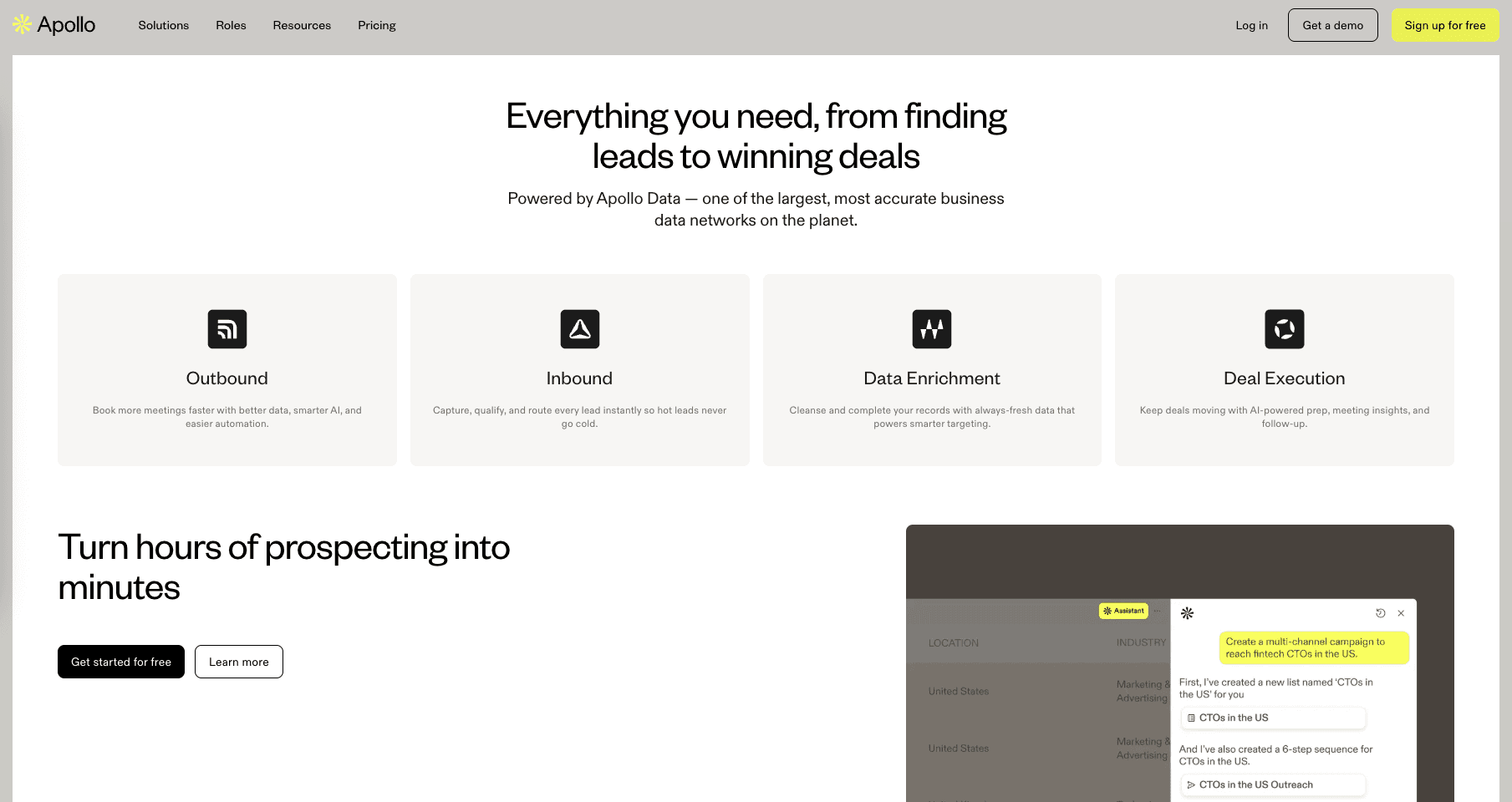
Apollo.io is the all-in-one CRM enrichment and B2B prospecting platform for startups and SMBs. The platform includes 210M+ verified emails and phone numbers with built-in email sequencing, a dialer, and CRM integrations for Salesforce, HubSpot, Outreach, and Salesloft.
Data refresh happens on a rolling basis, but records often lag days to weeks behind actual changes. User feedback confirms this trade-off: the data isn't the best in terms of accuracy, but for the price, it's fine.
Pricing is confirmed from Apollo's pricing page:
Free: $0, 900 credits/yr granted monthly.
Basic: $49/user/month (annual), 30,000 credits/yr upfront.
Professional: $79/user/month, 48,000 credits.
Organization: $119/user/month (minimum 3 users), 72,000 credits.
Credit costs: 1 credit = email, 8 credits = phone number, 1–8 credits = enrichment per record.
Worked example: Worked example: A 5-person team where each rep does 500 email lookups plus 50 phone number lookups per month needs roughly 54,000 credits per year (500 + 400 = 900 credits/rep/month × 5 × 12). Basic's 30,000 credits doesn't come close. Professional is the realistic floor at $79/user/month with 48,000 credits – and even that may require top-ups.
Best for: Early-to-mid-stage teams wanting a database, sequencing, and a dialer in one product.
Trade-off: The most affordable full-featured option, but data freshness and accuracy trail behind Crustdata.
4. Cognism
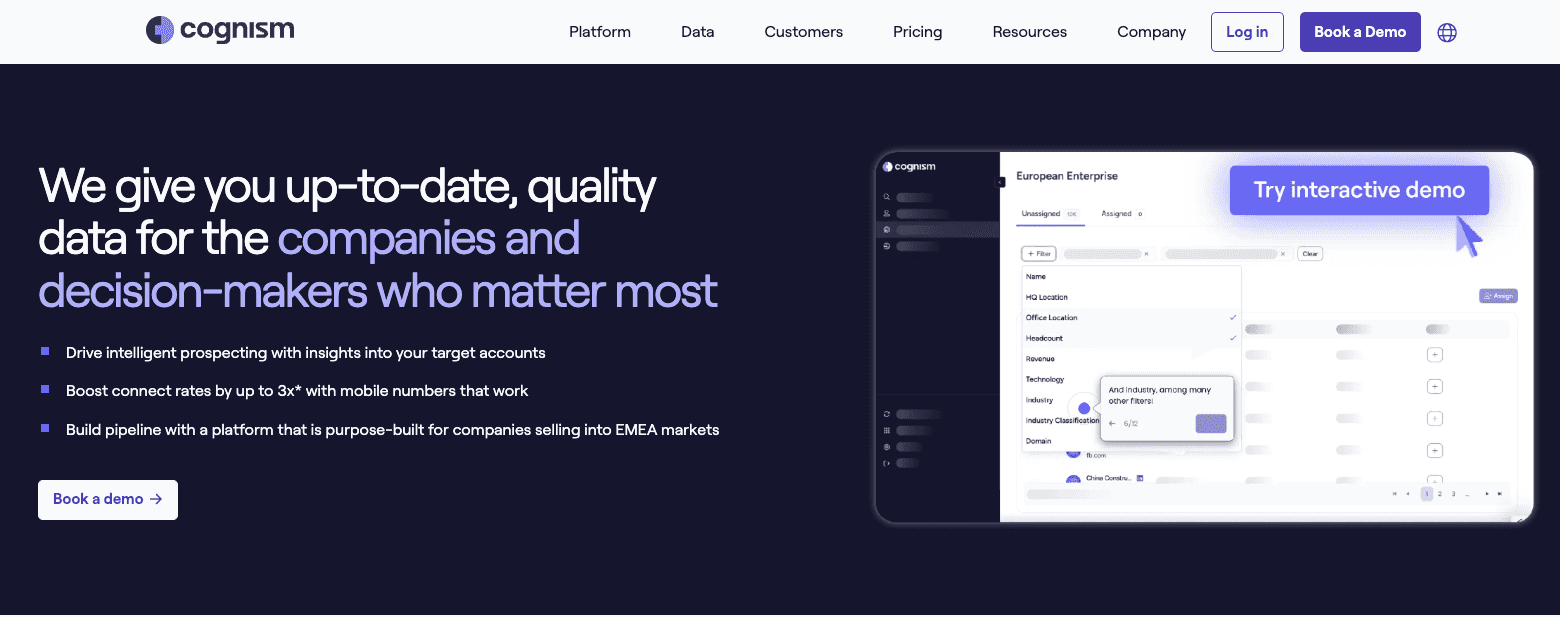
Cognism is a good alternative for EMEA prospecting and cold calling.
The core differentiator is Diamond Data, which is phone-verified mobile numbers. The platform covers 10M+ verified phone numbers globally, and an independent study shows phone-verified numbers are 3x more likely to connect.
DNC screening runs across the US, Canada, UK (TPS/CTPS), France, Germany, Australia, and additional European countries (full country list available on request per Cognism's Diamond Data page). The platform is GDPR and CCPA compliant with ISO27001 and SOC 2 Type 2 certification.
Cognism does not include built-in sequencing. It's always a stack component alongside a sequencing platform.
Pricing is not published and requires a sales call.
Best for: Teams prospecting in Europe, where compliance is non-negotiable and cold calling is part of the outreach motion.
Trade-off: The strongest phone number data and compliance infrastructure in the category, but North American coverage trails ZoomInfo, and pricing opacity makes evaluation difficult before talking to sales.
5. Lusha
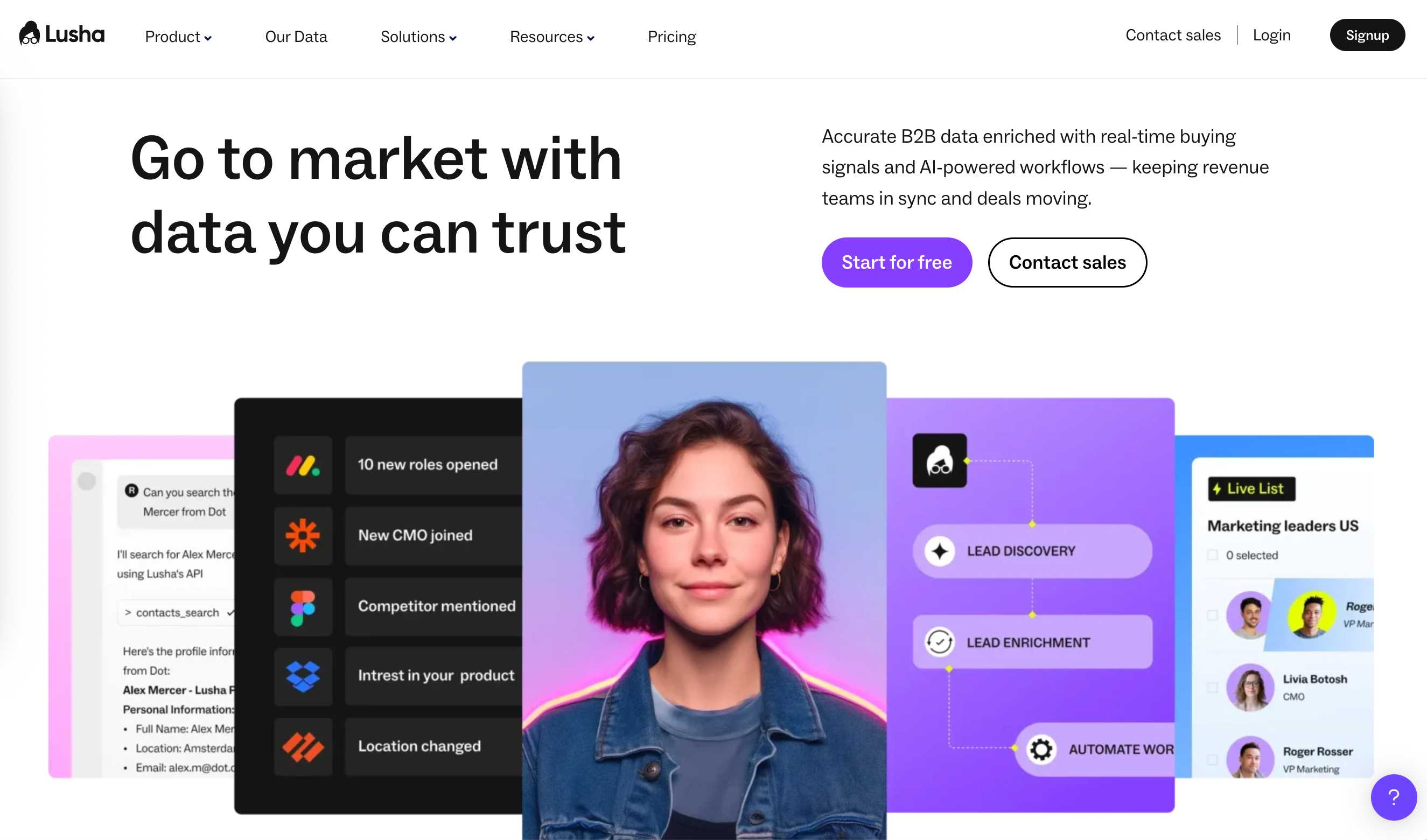
Lusha is a Chrome extension with verified phone numbers and emails, built for individual reps who need quick contact reveals.
Free plan: up to 40 credits/month.
Paid plans: Free plan: 40 credits/month. Paid plans: Starter at $37.45/user/month (billed yearly, 4,800 credits/year, 1 seat), Pro at $52.45/user/month (billed yearly, 7,200 credits/year, 2 seats included), Premium at $299.95/month (billed yearly, 40,800 credits/year, 5 seats included), and Scale with custom pricing. Credits cost 1 per email and 5 per phone number reveal, so a phone-heavy team will burn through allowances quickly.
6. UpLead
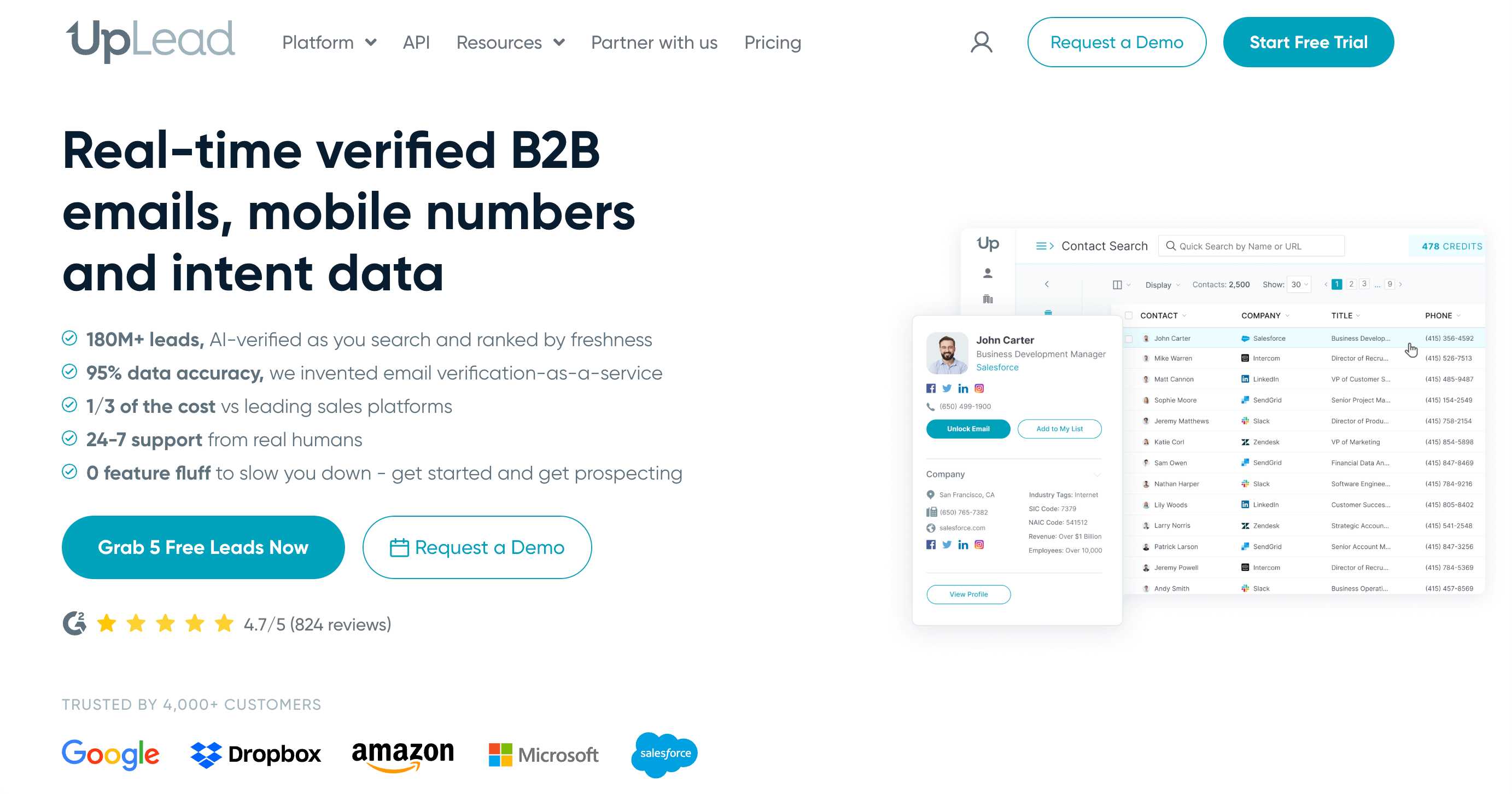
UpLead offers 155M+ verified emails and phone numbers with real-time email verification at the point of download, claiming 95% accuracy.
The standout feature is technographic data across 16,000+ technologies, which is useful for SaaS sellers targeting companies that run specific software stacks.
Pricing: Essentials plan at $99/month (170 credits), Plus at $199/month (400 credits), and Professional requires contacting sales. Free trial: 5 credits for 7 days.
7. Ocean.io
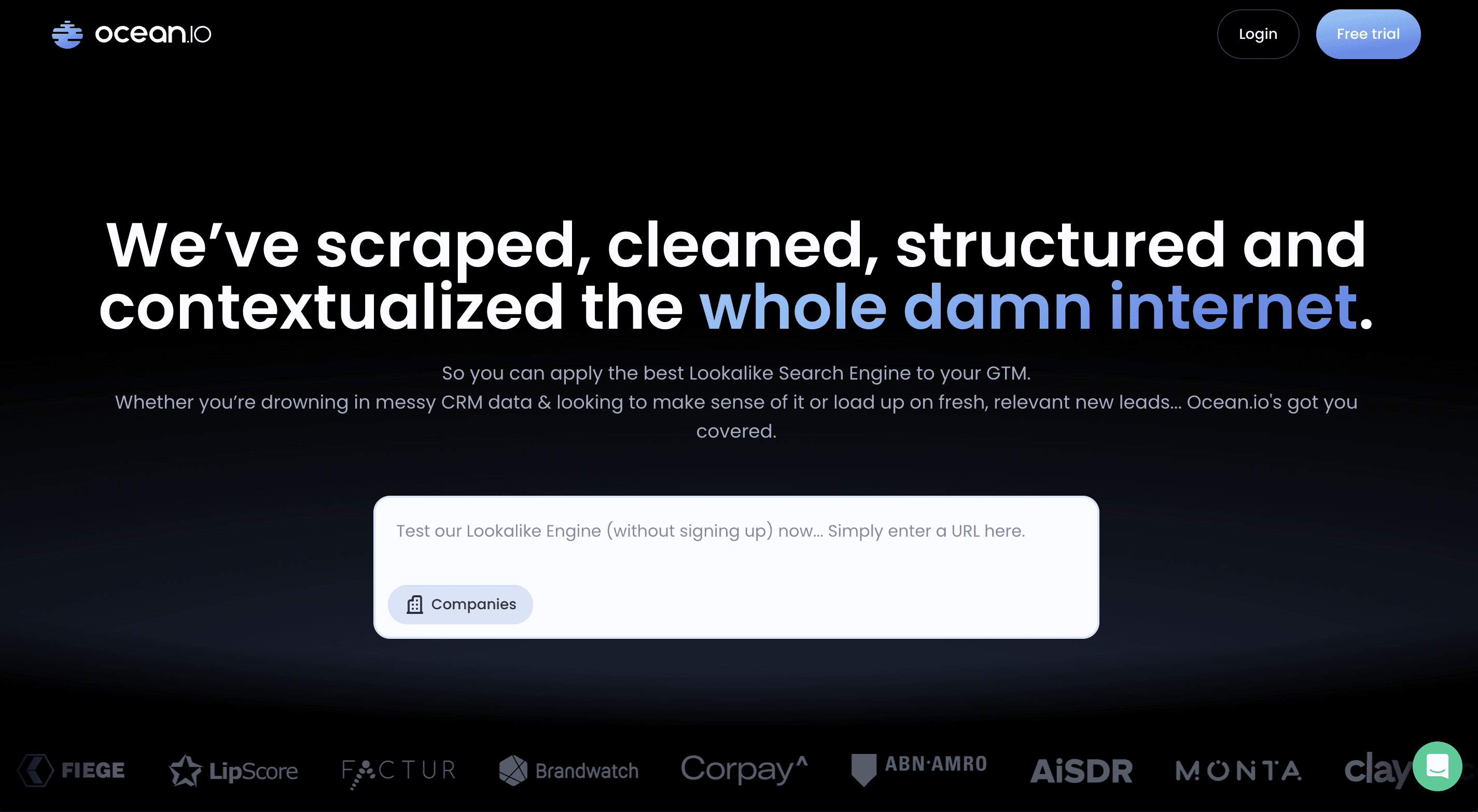
Ocean.io is differentiated by lookalike search, where you can upload your best customers and find companies that match. The platform covers 55M company profiles.
Ocean.io's pricing is as follows: $0.061/credit, $61/month billed annually at $732 for 12,000 credits, with unlimited seats. Credits break down to: 1 = verified email, 10 = direct phone number, 0.2 = search result. Waterfall enrichment from 16+ data sources and AI-powered lookalike filters are included on all plans.
Why data freshness should drive your next prospecting decision
Most prospecting tools serve cached data that's days or weeks old. Outreach built on yesterday's org charts wastes rep time and damages sender reputation. Signal-personalized emails achieve a much better response rate than generic cold outreach, but that advantage disappears if your signals are stale by the time they reach a rep's queue.
For teams building AI-powered sales products, custom enrichment pipelines, or automated prospecting workflows, the freshness of the underlying data determines whether everything downstream works or fails. An AI SDR congratulating someone on a job they started three months ago goes beyond being ineffective to actively erode trust.
What you need is a tool that can crawl live at the moment of request across billions of profiles and notify you the instant a prospect changes jobs or a company raises funding. No polling, no manual re-enrichment, no monthly refresh cycles.
If you need a point-and-click UI, the tools in the comparison above are the right fit. If you need the freshest data powering your stack, book a demo with Crustdata and test it against your target ICP segment.


Products
Popular Use Cases
Competitor Comparisons
95 Third Street, 2nd Floor, San Francisco,
California 94103, United States of America
© 2026 Crustdata Inc.
Products
Popular Use Cases
Competitor Comparisons
95 Third Street, 2nd Floor, San Francisco,
California 94103, United States of America
© 2026 CrustData Inc.
Products
Popular Use Cases
Competitor Comparisons
95 Third Street, 2nd Floor, San Francisco,
California 94103, United States of America
© 2026 Crustdata Inc.
🎉 We hit $10M ARR!
$600k to $10m in 1.5 years. Our entire GTM is powered by our own APIs.
🎉 We hit $10M ARR in 1.5 years!