7 Best Predictleads Alternatives To Use in 2026 [List]
Explore the best Predictleads alternatives and discover smarter tools to enrich prospect data, track buying signals, and improve outreach workflows.
Published
May 15, 2026
Written by
Chris P.
Reviewed by
Nithish A.
Read time
7
minutes
Predictleads alternatives come up most often when teams need more than company-level signal data. Predictleads is an API-first B2B intelligence platform that tracks 29 signal categories across 100M+ companies, including job postings, funding events, technology stack detection, and news events, delivered through API, flat files, and webhooks.
This guide covers 7 Predictleads alternatives worth considering in 2026, what each does well, where each falls short, and which teams each fits best.
Key Takeaways
Predictleads covers company-level signals only. Teams that need verified contact data alongside signals need a separate tool or a combined alternative
API-only delivery means no self-serve interface. Non-technical users cannot browse, filter, or export companies without engineering support
Signal freshness at the moment of execution matters more than refresh cadence for teams building AI agents or automated workflows
Single-source signal tools consistently leave qualified accounts out of pipelines. Multi-source platforms reduce that blind spot without requiring separate vendor contracts
Why Teams Look for Predictleads Alternatives
Predictleads delivers strong structured signal coverage across a wide range of company event types. The following are reasons you might consider other options.
No contact data: Predictleads returns company-level signals only. Teams that need verified emails, phone numbers, or person-level enrichment must integrate a separate contact provider
No self-serve interface: The entire product runs through API, flat files, and webhooks. Non-technical users cannot access, filter, or export data without engineering support
No person-level enrichment: Individual contact details, job titles, and social profiles are not part of any Predictleads dataset regardless of plan
Thinner coverage for smaller private companies: Signal coverage is strongest for companies with a visible web and career page footprint. Smaller private companies and non-English markets return fewer signals across most categories
Pricing scales with volume: The free tier covers 100 API requests per month. Teams running high-volume or real-time pipelines report costs rising significantly as request volume grows
Criteria for Selecting These Predictleads Alternatives
Not every B2B data tool competes in the same space as Predictleads. Some focus on contact data, others on intent signals, and others on raw web intelligence. The tools on this list were selected based on five criteria.
Signal coverage and freshness: The range of signal types each tool tracks and how current the data is at the point of delivery
Contact and person-level data: Whether the tool returns verified contact details alongside company signals, which Predictleads does not
API flexibility and delivery format: Support for webhooks, flat files, and programmatic access for teams building into automated systems
Pricing transparency: Whether plans are publicly listed without requiring a sales call first
Use case fit: Whether the tool serves GTM teams, data engineering teams, AI builders, or a combination of the three
7 Best Predictleads Alternatives to Try in 2026
The alternatives below cover different parts of the B2B signal and enrichment stack. The table gives a quick side-by-side view before the detailed breakdowns.
Alternative | Best For | Signal Types Covered | Contact Data | Pricing |
Crustdata | AI agents and real-time enrichment pipelines | Funding, hiring, job postings, tech stack, web traffic, headcount growth | Yes | Custom |
Bombora | Intent-driven GTM and ABM teams | Buying intent surge data across 5,000+ B2B publisher sites | No | Custom |
Apollo.io | SMB outbound teams needing signals plus contact data | Funding events, job changes, company news alerts | Yes | From $49/user/month |
Diffbot | Data engineering teams building knowledge graphs | Web-crawled company signals, news events, technographics | Partial | From $299/month |
BuiltWith | Technographic-focused prospecting teams | Technology stack detection, 110,000+ technologies tracked | No | From $295/month |
Owler | Sales teams needing lightweight company news alerts | Funding, news, acquisitions, revenue estimates, competitor tracking | No | From $35/month |
Forager.ai | Outbound teams needing verified mobile numbers plus intent signals | Job postings, hiring signals, intent signals | Yes | From $50/month |
1. Crustdata
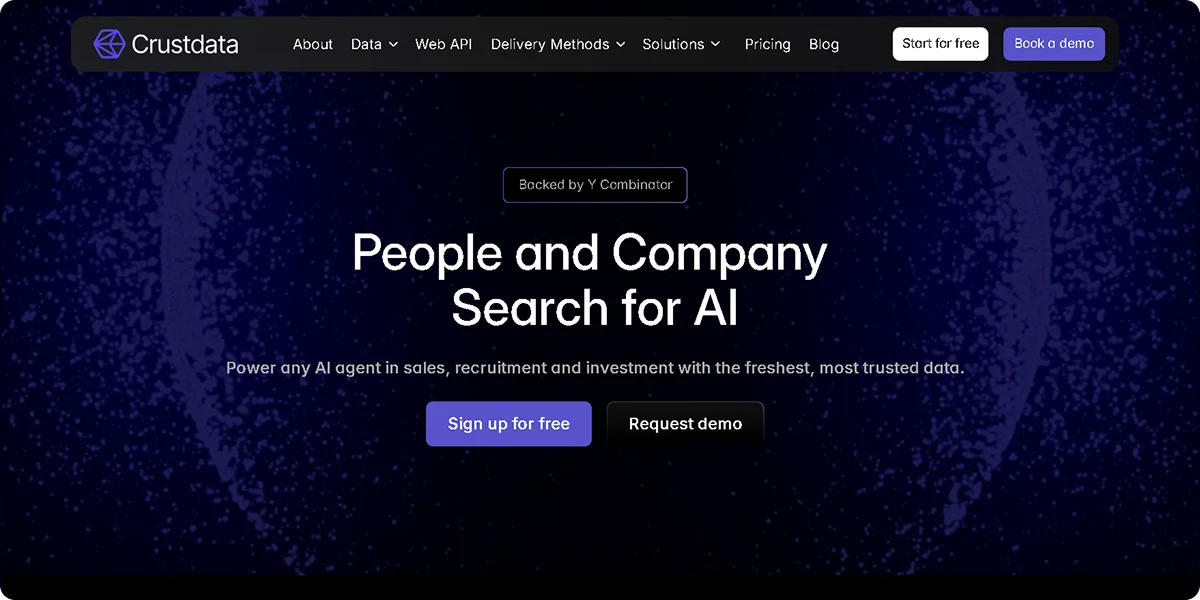
Crustdata is a B2B intelligence platform built around real-time web crawling rather than a stored database. It targets teams building AI agents, automated enrichment pipelines, and webhook-driven workflows where data needs to be current at the moment of execution, not at the last dataset refresh.
Key features
Live enrichment at request time: Pulls company and contact data when the API is called, returning current job titles, employers, and company signals rather than a cached snapshot
Watcher API with webhooks: Sends alerts the moment a contact changes roles, a company raises funding, headcount spikes above a threshold, or an executive joins a key function
250+ company and 90+ people data points: Covers firmographic data, headcount trends by department, funding history, technology stack signals, web traffic, and employee reviews in a single profile
60+ people and 95+ company filters: Supports nested boolean logic for building precise ICP queries across multiple combined criteria
Developer-first API infrastructure: Provides code samples, error handling documentation, and webhook setup guides for teams building enrichment into automated pipelines
Pros
Returns data that reflects where a prospect actually is at the moment of the request, not where they were when the database last refreshed
Gives teams an outreach trigger before competitors act on the same information
Handles complex ICP queries through nested boolean logic across multiple filter combinations at once
Cons
Requires technical setup for webhook and API implementation
Pricing
Crustdata uses custom pricing based on API usage volume and feature requirements. Contact the sales team for a quote.
2. Bombora
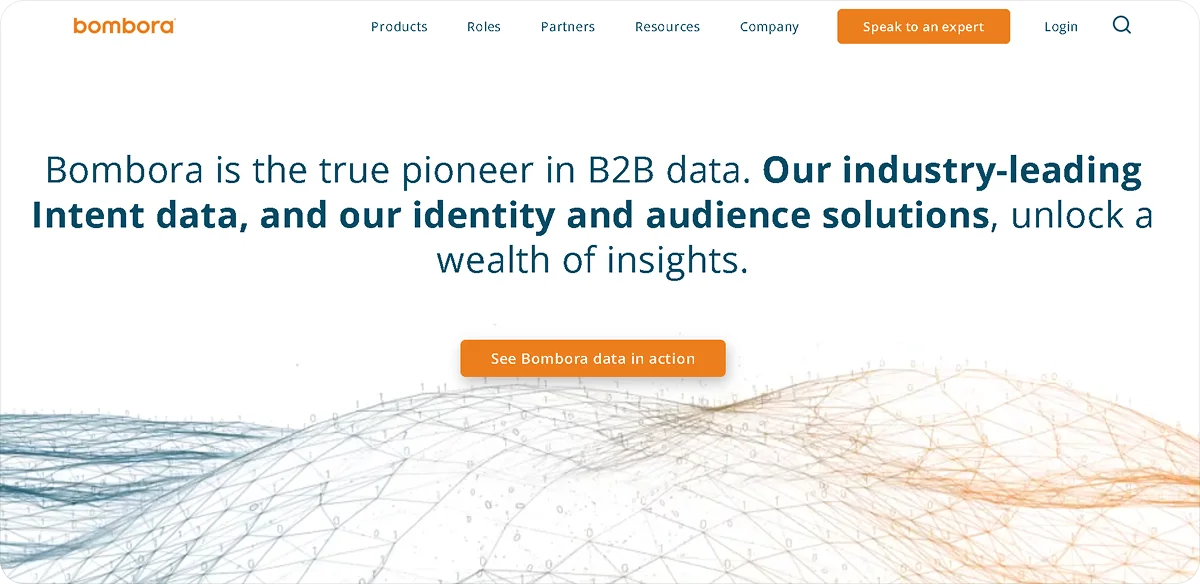
Bombora is a B2B intent data provider built around a cooperative of 5,000+ publisher sites. It identifies companies actively researching topics relevant to your product by tracking content consumption patterns across the B2B web, making it useful for GTM and ABM teams that want to prioritize accounts based on buying behavior rather than firmographic fit alone.
Key features
Company Surge data: Tracks when a company's research activity around a specific topic spikes above its baseline, surfacing accounts that are actively in a buying cycle for relevant solutions
20,100+ B2B topic taxonomy: Organizes intent signals across a structured topic library, allowing teams to track research activity around specific categories, competitors, or use cases
Business identity graph: Resolves research signals to 2.8 million businesses using a patented combination of deterministic, behavioral, and IP-to-company data
Platform integrations: Delivers intent data natively into major CRM, marketing automation, and advertising platforms without requiring a separate integration build
First-party data activation: Allows teams to combine Bombora third-party intent signals with their own first-party website data for a more complete view of account activity
Pros
Covers buying intent signals across the widest B2B publisher network available
Integrates directly into existing CRM and marketing automation platforms
Tracks early-stage research behavior before accounts show any first-party engagement, surfacing buying windows that would otherwise go undetected
Cons
Returns no contact data, so teams need a separate provider for verified emails, phone numbers, or person-level enrichment
Measures research intent rather than behavioral actions like funding events or hiring signals, which limits its use as a standalone signal source for outbound prospecting
Pricing
Bombora uses custom pricing based on usage and team size. Contact sales for a quote.
3. Apollo.io
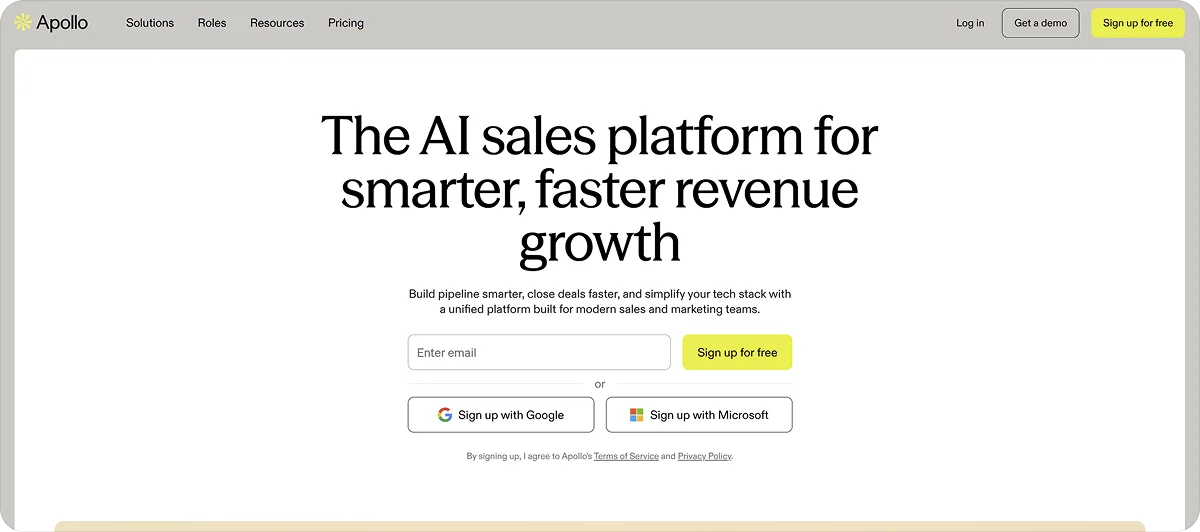
Apollo.io is an all-in-one sales intelligence and outreach platform that combines a B2B contact database with company signal tracking and built-in email sequencing. It targets SMB and mid-market sales teams that want contact data, company signals, and outreach tooling in a single product without managing multiple vendor contracts.
Key features
B2B contact database: Covers 210M+ contacts and 35M+ companies with verified emails, direct dials, and firmographic data
Company signal alerts: Tracks funding events, job changes, and company news to surface outreach timing triggers across target accounts
Built-in email sequencing: Runs multichannel outreach sequences directly from the platform, using enriched contact data without exporting to a separate tool
Intent data layer: Surfaces accounts showing active buying behavior through integrated third-party intent signals
CRM integrations: Syncs contact and company data bidirectionally into Salesforce and HubSpot for automated lead routing and enrichment
Pros
Combines contact data, company signals, and outreach sequencing in a single platform, removing the need to manage separate tools for each function
Offers a free plan with contact data access, making it accessible for teams with limited data budgets
Tracks funding and job change signals alongside contact data, giving outbound teams a timing layer without a separate signal provider
Cons
Delivers contact data accuracy that varies by geography and industry
Bundles outreach tooling that teams with an existing engagement stack may not need, increasing cost without additional data value
Pricing
Apollo.io offers a free plan with limited credits. Paid plans start at $49 per user per month on annual billing.
4. Diffbot
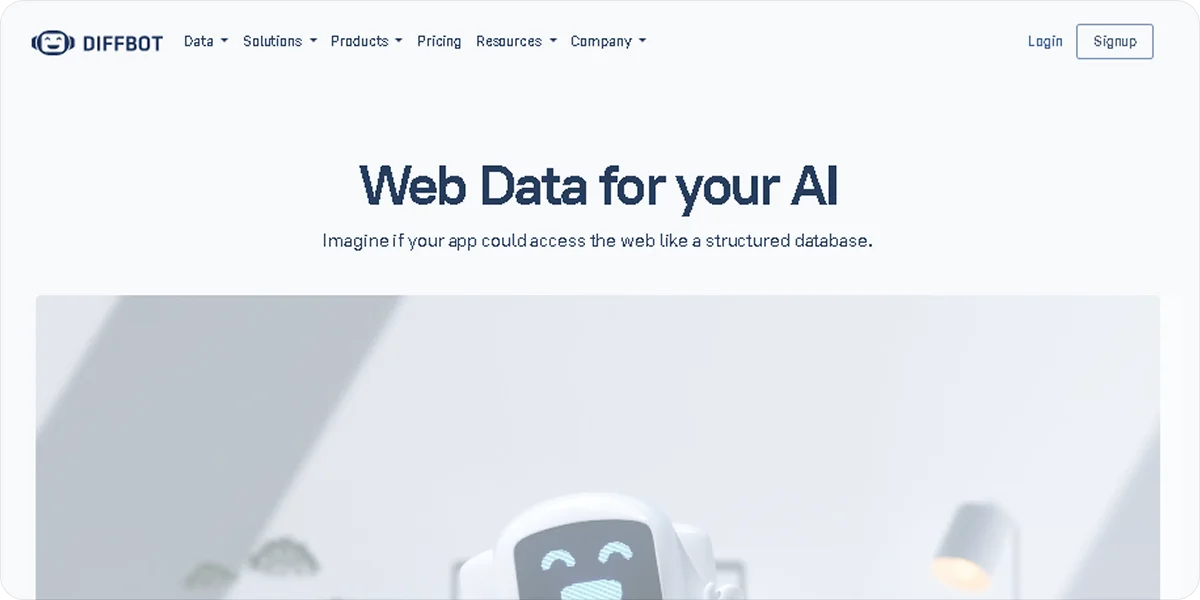
Diffbot is an AI-powered web intelligence platform that turns unstructured public web content into structured, queryable company and entity data. It targets data engineering and AI product teams that need web-scale entity resolution and company intelligence beyond what standard B2B databases cover.
Key features
Automatic data extraction: Uses machine learning and computer vision to extract structured data from any public web page without manual scraping rules
Diffbot Query Language (DQL): Provides a proprietary query language for searching the Knowledge Graph by industry, employee size, funding, technology stack, and employee skills with complex boolean logic
Natural language processing API: Identifies entities, relationships, and sentiment from unstructured text for teams building research and intelligence products
Crawlbot: Runs large-scale web crawls across defined domains or URL sets and delivers structured JSON output
MCP server: Exposes the Knowledge Graph to AI agents through a model context protocol server for teams building agentic data pipelines
Pros
Covers company and entity data at a scale no standard B2B database matches, with 246M+ organizations built from live web crawling rather than a static dataset
Returns relationship data between companies, people, and technologies that structured B2B databases do not capture
Refreshes the Knowledge Graph every four to five days from public web sources
Cons
Requires familiarity with DQL to get meaningful results, with a learning curve that non-technical users consistently flag in G2 reviews
Returns no verified contact data like emails or phone numbers, so teams need a separate provider for outbound prospecting
Pricing
Diffbot offers a free tier for testing. Paid plans start at $299 per month for the Startup tier, with Enterprise plans available on custom pricing.
5. BuiltWith
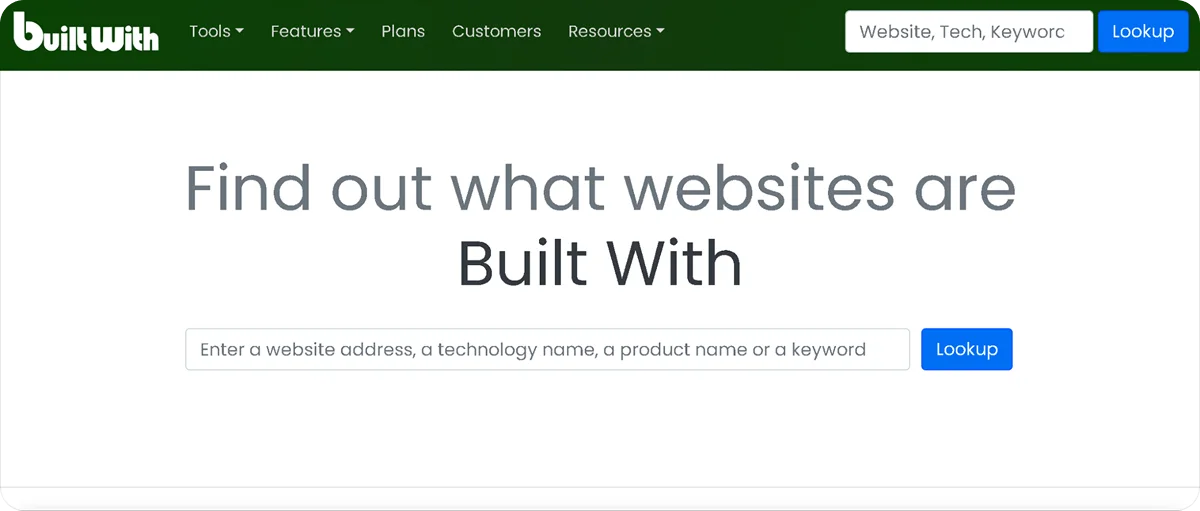
BuiltWith is a technographic intelligence platform that identifies the technology stack of any website by detecting frontend scripts, DNS records, and hosting infrastructure. It targets sales and marketing teams that prospect based on technology usage and need to build lists of companies running specific tools.
Key features
Tech spend estimation: Provides estimated technology spend per company based on detected tools and market pricing, giving a proxy for budget and scale alongside stack data
List building by technology: Builds targeted company lists filtered by specific tool combinations, allowing teams to identify companies running competitor products or compatible integrations
Historical technology data: Tracks when technologies were adopted or removed, surfacing migration signals and competitive displacement opportunities
API access: Delivers technographic data programmatically for teams building enrichment into CRM workflows or prospecting pipelines
Relationship intelligence: Identifies supplier and customer relationships based on technology dependencies and integration patterns across tracked websites
Pros
Covers a large technographic dataset, with 110,000+ technologies tracked across hundreds of millions of websites
Surfaces historical stack changes that most technographic providers do not track, making competitive displacement targeting more precise
Builds company lists filtered by specific technology combinations, which most signal platforms handle only at a surface level
Cons
Returns no contact data, verified emails, or phone numbers alongside technographic records, requiring a separate provider for outbound prospecting
Detects frontend and DNS-visible technologies reliably but misses backend infrastructure and internally hosted tools that leave no public trace
Pricing
BuiltWith has a free plan for site lookup. Basic plan starts at $295 per month and Enterprise pricing is available on request.
6. Owler
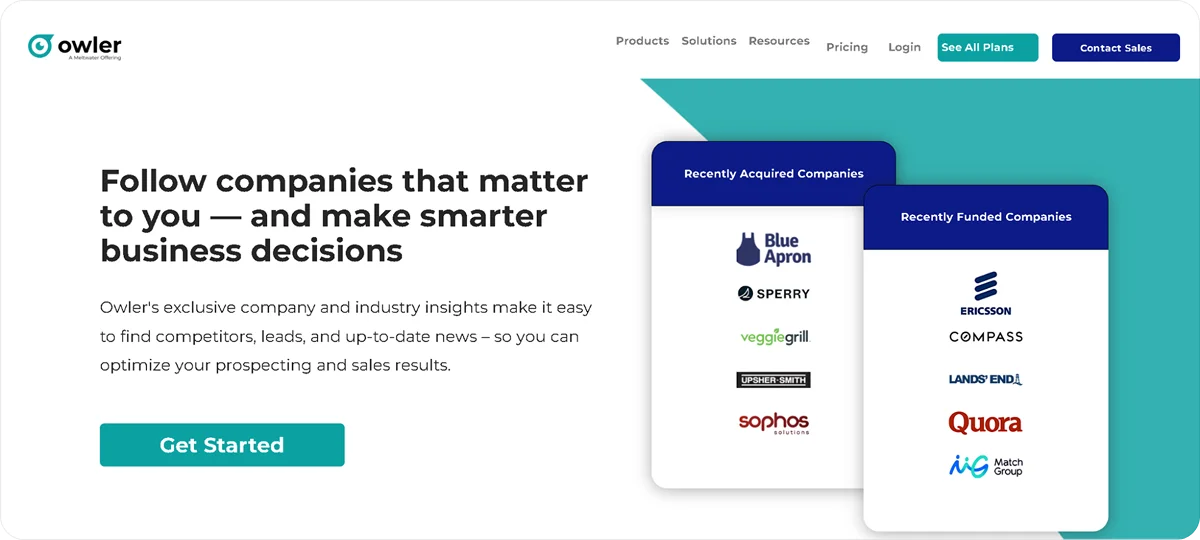
Owler is a business intelligence platform that tracks company news, funding events, acquisitions, executive changes, and competitive relationships across 15M+ public and private companies. It targets sales and marketing teams that need lightweight account monitoring and competitive context without a full data enrichment stack.
Key features
Company news alerts: Delivers daily and real-time alerts on tracked companies covering funding rounds, acquisitions, leadership changes, product launches, and office openings
Competitive relationship mapping: Identifies direct and indirect competitors for any tracked company using a community-verified competitor graph
Revenue and headcount estimates: Provides community-verified revenue and employee count estimates for private companies where official figures are not publicly available
CRM integrations: Syncs company data and sales triggers into Salesforce and HubSpot on the Enterprise plan
Daily Snapshot emails: Delivers personalized daily briefings covering news and signals for followed companies directly to your inbox
Pros
Tracks 180,000+ company events per week across a database of 15M+ companies, giving sales teams a broad coverage layer for account monitoring
Provides community-verified revenue and competitor data for private companies that most enrichment APIs estimate poorly
Offers a free tier and an accessible Pro plan, making it one of the lowest entry-cost options on this list
Cons
Returns no verified contact data, emails, or phone numbers, so it cannot support outbound prospecting without a separate contact provider
Delivers thinner and sometimes outdated data for companies outside major North American and Western European markets, with non-English content relying on machine translation that users report as inconsistent
Pricing
Owler offers a free Community plan. The Pro plan starts at $35 per month billed annually. Enterprise pricing is custom.
7. Forager.ai
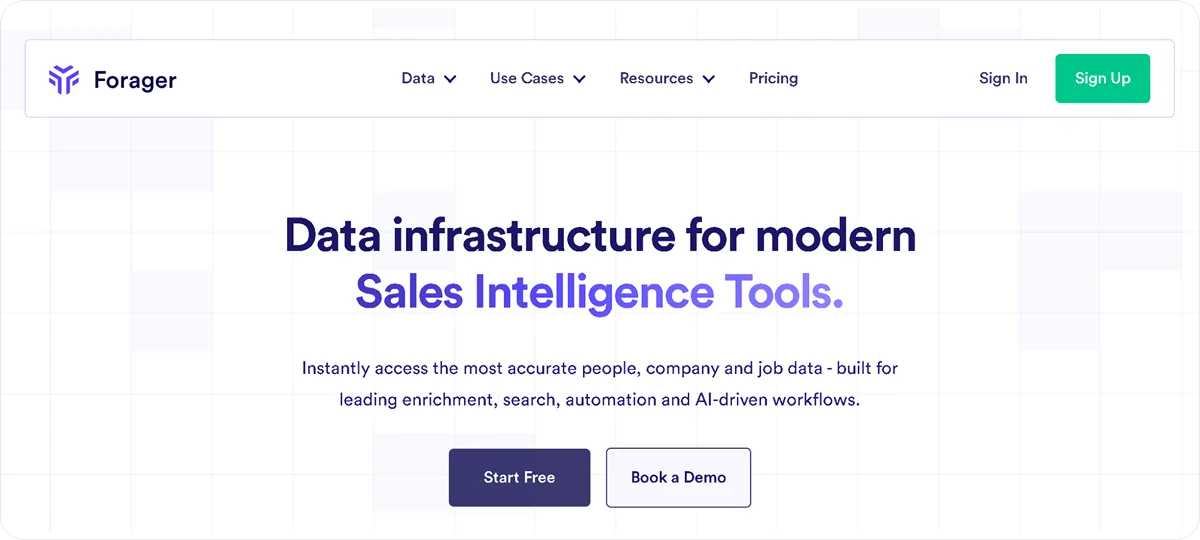
Forager.ai is a B2B prospecting platform built around verified mobile numbers and hiring signal data. It targets outbound sales teams that prioritize phone-first prospecting and need contact data that stays current between refresh cycles through a bi-weekly update cadence.
Key features
Hiring signal tracking: Surfaces job postings and hiring velocity data from target companies as a signal layer for outreach timing
Intent signals: Identifies accounts showing active buying behavior through integrated intent data alongside contact and company records
Contact enrichment: Returns verified emails, direct dials, and firmographic data for target contacts in a single profile
CRM integrations: Syncs enriched contact and company data into Salesforce and HubSpot for automated lead routing
List building: Builds targeted prospect lists filtered by industry, company size, location, and signal type
Pros
Delivers phone-verified mobile numbers on a bi-weekly refresh cycle, which reduces contact-at-wrong-number rates compared to monthly or quarterly refresh alternatives
Combines hiring signals and intent data with contact enrichment, removing the need for a separate signal provider alongside a contact database
Offers an accessible entry price at $50 per month for teams that need verified mobile data without an enterprise contract
Cons
Covers a smaller overall database than established contact providers, with thinner coverage for companies outside North America
Focuses primarily on contact-level enrichment and hiring signals, with less depth on company-level signals like funding events, product launches, or partnership announcements
Pricing
Forager.ai does not have a free plan. It offers a Starter plan from $50 per month, a Growth plan at $100 per month, and a Pro plan at $250 per month.
How to Choose the Right Predictleads Alternative
The right choice comes down to three questions worth answering before you look at a single feature list.
First, do you need contact data alongside signals? Several tools on this list return company-level signals only. If your team needs verified emails or phone numbers in the same workflow, you need a provider that covers both. Fewer tools do this well at the signal level, and fewer still do it with data that is current at the point of request rather than from a stored database.
Second, does your team have engineering resources? API-first tools give you more flexibility over how data is delivered and used, but require technical setup to extract value. If your team does not have that capacity, a self-serve interface matters more than raw API access regardless of how strong the underlying data is.
Finally, how much does data freshness matter for your use case? For manual prospecting and static list building, a monthly or quarterly refresh cycle is workable. For automated workflows, AI agents, and event-triggered outreach, the record feeding each action needs to reflect current reality at the moment it runs.
The more your pipeline depends on timing, the more data freshness becomes the deciding factor rather than a secondary consideration.
Why Crustdata Is the Strongest Predictleads Alternative for Real-Time Pipelines
Predictleads does structured signal delivery well. The gap it leaves is the one most teams notice first: no contact data, no person-level enrichment, and no live data at the moment of execution. Every signal it returns reflects where a company was at the last dataset refresh, not necessarily where it is right now.
That gap matters less for teams using signals to inform manual research. It matters a lot when signals feed directly into pipelines where every downstream action depends on the record driving it being accurate at that exact moment. When benchmarking B2B data providers for AI SDRs, data freshness at execution is one of the sharpest differentiators between providers.
Crustdata crawls 10+ verified sources at the moment of each API request, so the company profile your pipeline receives reflects current reality. It also returns contact and person-level data alongside company signals in a single call, removing the need to chain a signal tool and a contact provider together.
For each company your pipeline targets, a single API call returns:
Firmographic data: Covers industry, headcount, revenue range, headquarters, and company type
Headcount growth percentages: Tracks changes across six-month, one-year, and two-year windows
Funding signals: Surfaces total investment raised, funding stage, and most recent round date from live sources
Technographic signals: Pulls tool usage from job postings and company descriptions
Web traffic trends and employee skill distribution: Indicates company scale and growth trajectory at the moment of request
Hiring signals: Surfaces real-time job postings and hiring velocity from target company career pages
95+ company filters and 60+ people filters: Builds precise ICP queries using nested boolean logic across multiple combined criteria
The Watcher API monitors a defined account set and fires a webhook the moment a qualifying event occurs, including a new funding round, an executive hire, a headcount spike, or a location change. For teams automating lead enrichment or building account research layers for SDRs and AEs, same-day alerts close the gap between when a signal occurs and when your team acts on it.
If your pipeline depends on timing, the freshness problem has to be solved at the data layer. Crustdata removes that variable by returning data at the moment your system needs it.
Want to see how live signal data compares to batch delivery in your pipeline?
Book a demo to see Crustdata's real-time APIs and Watcher alerts in action.
FAQs
Does Predictleads have a free plan?
Yes. Predictleads offers 100 free API credits per month with no credit card required. Paid plans scale on a pay-as-you-go basis with volume discounts. Flat file, webhook, and MCP access are available on paid tiers.
What is the difference between Predictleads and a sales intelligence platform?
Predictleads delivers raw structured signals through API, flat files, and webhooks for teams that build those signals into their own tools. A sales intelligence platform packages similar data into a UI with built-in prospecting, list building, and outreach. Predictleads is a data layer. A sales intelligence platform is a finished product built on top of one.
Can Predictleads be used without a developer?
Not effectively. There is no browsing interface, filter builder, or export UI. The entire product runs through API endpoints, flat file downloads, and webhooks. Teams without engineering resources will get limited value from it regardless of data quality.


Products
Popular Use Cases
Competitor Comparisons
Use Cases
95 Third Street, 2nd Floor, San Francisco,
California 94103, United States of America
© 2026 Crustdata Inc.
Products
Popular Use Cases
Competitor Comparisons
Use Cases
95 Third Street, 2nd Floor, San Francisco,
California 94103, United States of America
© 2025 CrustData Inc.
Products
Popular Use Cases
Competitor Comparisons
Use Cases
95 Third Street, 2nd Floor, San Francisco,
California 94103, United States of America
© 2026 Crustdata Inc.