7 Best Explorium Alternatives for Better B2B Data Enrichment
Explore top Explorium alternatives and find the right data enrichment tools to improve accuracy, streamline workflows, and power smarter outreach.
Published
Apr 23, 2026
Written by
Chris P.
Reviewed by
Nithish A.
Read time
7
minutes
Explorium is a B2B data platform that aggregates signals from 50+ sources for enrichment, AI agent workflows, and GTM intelligence. It serves sales, marketing, and data science teams that need company and contact enrichment, ML feature engineering, and automated prospecting through a credit-based API.
Despite its breadth, Explorium has limitations that push teams toward more targeted alternatives. This guide covers 7 alternatives worth considering in 2026, what each does well, where it falls short, and which use cases it fits.
Key Takeaways
Explorium is an enterprise platform, making most of the alternatives on this list more accessible for mid-market teams without a dedicated data engineering budget
API-first tools require engineering resources and are not suited for sales teams who need self-serve prospecting, so the right choice depends on which team will own the integration
Managed waterfall enrichment consistently delivers lower bounce rates than single-source databases, but adds cost and reduces configuration control for teams that want to manage their own provider sequence
Data freshness is the deciding factor for teams building automated workflows or AI agents, since batch-updated databases introduce lag that compounds across every downstream action the enriched record feeds
Why Teams Look for Explorium Alternatives
Explorium delivers broad external data coverage through a flexible credit model, but several limitations push teams toward other options.
Data mismatches across sources: Because Explorium aggregates from dozens of providers, records from different sources sometimes conflict. Users consistently recommend cross-referencing output data, which adds manual overhead.
Limited point-in-time historical data: Users flag the absence of granular historical snapshots as a recurring gap, particularly for teams building predictive models or tracking company changes over time.
Credit expiry with no rollover: All credits expire after 12 months and cannot be carried over, which creates pressure to consume credits within the validity window regardless of actual usage needs.
Steep initial learning curve: The volume of available data signals can be disorienting for new users, requiring hands-on onboarding before the platform becomes productive.
How These Explorium Alternatives Were Selected
The tools on this list were selected based on five criteria.
Enrichment depth and data accuracy: The range of verified fields returned per record and the freshness of underlying data sources
Multi-source coverage: Whether the tool aggregates from multiple providers or relies on a single proprietary database, since single-source tools consistently deliver lower match rates
Pricing transparency: Whether plans are publicly available without a sales conversation, since Explorium's opaque enterprise pricing is one of the main reasons teams look elsewhere
API and delivery flexibility: Support for API access, webhook integration, and data warehouse delivery for teams building enrichment into automated systems
Use case fit: Whether the tool serves GTM teams, data engineering teams, or both, since Explorium bridges those two audiences in a way most alternatives do not
7 Best Explorium Alternatives in 2026
The explorium alternatives below cover different parts of the enrichment stack. Before we proceed into details, the table below compares them side-by-side.
Alternative | Best For | Database Size | Data Freshness | Pricing |
Crustdata | AI agents and real-time enrichment pipelines | 60M+ companies, 1B+ people profiles | Continuously updated | Custom |
Leadspace | Enterprise teams needing AI-powered data unification and lead scoring | 800M+ people, 240M+ companies | Monthly refresh | Custom |
Cognism | EMEA-focused teams needing GDPR-compliant verified mobile numbers | 440M+ contacts, 100M+ companies | Continuous verification | Custom |
Ocean.io | ABM teams building hyper-targeted account lists with AI | 55M company profiles, 250M+ people profiles | Continuously updated | Custom |
Amplemarket | Sales teams needing managed waterfall enrichment with built-in outreach | 200M+ business profiles | Weekly refresh, real-time verification | From $3,200/user/year |
Coresignal | Developer teams needing multi-source company and employee datasets | 859M+ people records, 75M+ company records | Continuous update | From $49/month |
Clay | RevOps teams orchestrating multi-source waterfall enrichment | Data from 150+ providers (no proprietary database) | Varies by source | From $185/month |
1. Crustdata
Crustdata is a B2B intelligence platform built around real-time web crawling rather than a stored database. It targets teams building AI agents, automated enrichment pipelines, and webhook-driven workflows that depend on data being current at the point of use.
Key features
Live enrichment and search: Pulls company and contact data from 10+ verified sources at the moment of each API request, returning records that reflect current job titles, employers, and company signals rather than a stored snapshot
Watcher API with webhooks: Sends alerts the moment a contact changes jobs, a company raises funding, or a candidate earns a new certification, rather than batching signals at the end of a cycle
250+ company and 90+ people data points: Covers firmographic data, headcount trends by department, funding history, technology stack, web traffic, and employee reviews in a single unified profile
60+ people and 95+ company filters: Supports nested boolean logic for building precise ICP queries across multiple combined criteria
Jobs listing API: Surfaces real-time job postings and social activity from target companies as additional signal layers for outreach timing
Developer-first API infrastructure: Provides code samples, error handling documentation, and webhook setup guides for teams building enrichment into data enrichment pipelines and automated systems
Pros
Returns data that reflects where a prospect actually is at the moment of the request, not where they were when the database was last refreshed
Fires job change and funding alerts the moment a signal occurs, giving teams an outreach trigger before competitors act on the same information
Handles complex ICP queries through nested boolean logic across multiple filter combinations simultaneously
Cons
Requires technical setup for webhook and API implementation
Strongest coverage is for companies with a visible web footprint, thus lacking coverage for small private companies or industries with limited public digital presence
Pricing
Crustdata uses custom pricing based on API usage volume and feature requirements. Contact the sales team for a quote.
2. Leadspace
Leadspace is a B2B customer data platform that unifies first-party and third-party data from 30+ embedded sources into a single enrichment and scoring layer. It serves enterprise marketing and sales operations teams that need to resolve lead-to-account matching and build AI-driven ICP models.
Key features
Multi-source data unification: Aggregates first-party CRM data with third-party enrichment, including Bombora intent data, into a unified B2B buyer graph covering company and contact records
AI-powered lead scoring and persona modeling: Scores leads against fit and intent signals using predictive models trained on customer data, surfacing high-priority accounts for sales and marketing activation
Lead-to-account matching: Resolves leads to the correct parent accounts across CRM and marketing automation platforms, reducing routing errors and duplicate records at enterprise scale
Buying center mapping: Identifies key decision-makers and influencers within target accounts using the platform's buyer graph of 70M+ companies and 280M+ buying centers
CRM and MAP integrations: Syncs enriched and scored data bidirectionally into Salesforce, Marketo, HubSpot, Pardot, and Eloqua for automated lead routing and campaign activation
Pros
Aggregates 30+ data sources into a single unified layer, removing the need to manage multiple enrichment vendor contracts separately
Delivers strong lead-to-account matching and buying center mapping at enterprise scale, which most point solutions do not cover
Integrates deeply with Salesforce and Marketo, with near real-time webhook-based enrichment confirmed by users
Cons
Requires a dedicated RevOps or data team to implement, tune, and maintain, with no self-serve access for smaller teams
Produces inconsistent lead-to-account matching results, with users reporting delays of up to a week when offline mapping updates are needed
Pricing
Leadspace uses custom pricing. Contact sales for a quote.
3. Cognism
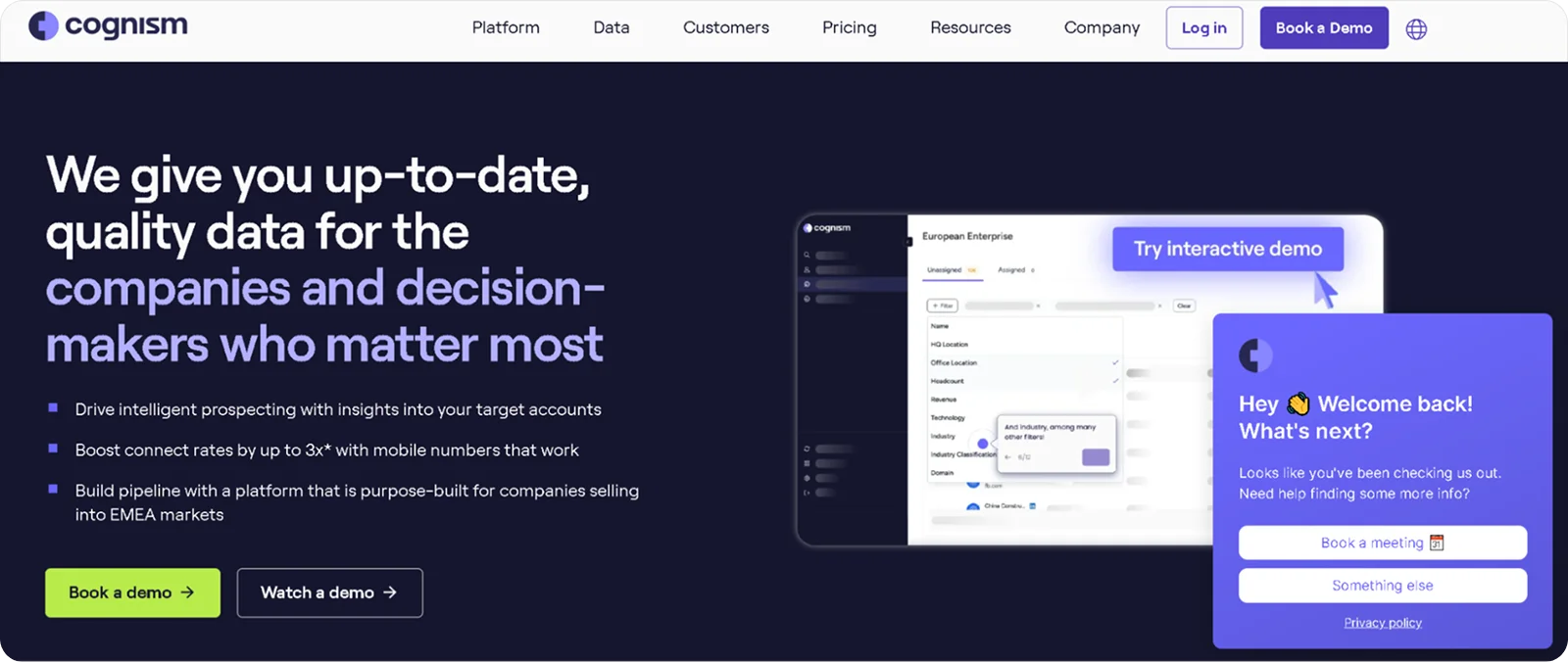
Cognism is a sales intelligence and contact data platform built specifically around GDPR-compliant data collection and phone-verified mobile numbers. It serves outbound sales teams, particularly those prospecting into European markets, that need verified contact data with built-in compliance processes.
Key features
Diamond Data: Provides manually phone-verified mobile numbers with 98% connect rates, significantly higher than standard direct dial accuracy across the industry
GDPR and CCPA compliance: Collects and maintains data under consent-based processes, with built-in compliance workflows and DPA availability for regulated markets
Diamonds-on-Demand: Allows users to request fresh phone number verification within 48 hours when existing contact data does not meet quality standards
Technographic and intent data: Identifies technology stack usage and integrates Bombora intent signals for prioritizing accounts showing active buying behavior
CRM integrations: Syncs bidirectionally with Salesforce, HubSpot, Outreach, and Salesloft for automated enrichment and contact routing
Pros
Delivers phone-verified mobile numbers with 98% connect rates, which outperforms most alternatives for teams running cold calling campaigns
Maintains GDPR and CCPA compliance natively, removing the legal overhead that global enrichment tools often introduce for European teams
Provides Diamonds-on-Demand for fresh verification on request, rather than relying solely on cached data
Cons
Covers a smaller database than US-focused alternatives, particularly for North American contacts in niche industries
Offers less mature intent data capabilities compared to dedicated intent providers
Pricing
Cognism uses custom pricing. Contact sales for a full quote.
4. Ocean.io
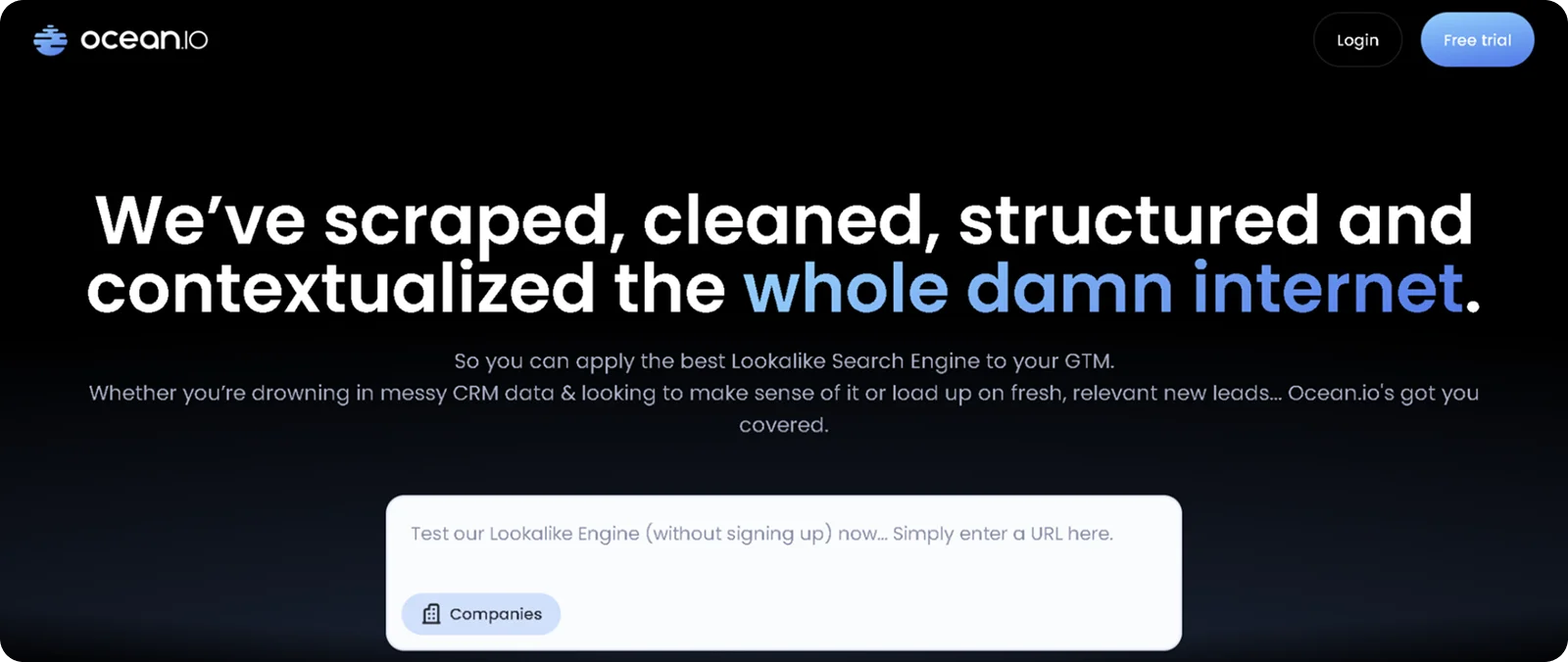
Ocean.io is an AI-powered B2B prospecting platform that builds hyper-targeted company segments using lookalike modeling rather than traditional keyword and firmographic filters. It serves sales and marketing teams focused on account-based marketing who need to find companies that match their best customers without manually building filter combinations.
Key features
AI lookalike modeling: Analyzes a sample of ideal customers and generates a ranked list of companies with similar attributes across industry, tech stack, growth signals, and business model
Hyper-targeted segments: Builds account lists based on behavioral and contextual signals beyond standard firmographic filters, covering attributes like product type, business model, and market positioning
Natural language search: Allows users to describe their ideal customer profile in plain language and returns matching companies without requiring manual filter configuration
Contact enrichment: Surfaces decision-maker contacts at target accounts, including verified emails and LinkedIn profiles
CRM integrations: Exports account and contact lists directly to Salesforce and HubSpot
Pros
Surfaces accounts that match a best-customer profile using AI rather than manual filter stacking, reducing list-building time significantly
Covers contextual and behavioral attributes that standard firmographic filters miss, improving ICP precision for ABM campaigns
Offers natural language search, making it accessible to non-technical sales and marketing users without enrichment expertise
Cons
Focuses primarily on company-level discovery rather than comprehensive contact enrichment
Targets mid-market and enterprise use cases, making it less cost-effective for smaller teams with limited ABM budgets
Pricing
Ocean.io uses custom pricing based on team size and usage.
5. Amplemarket
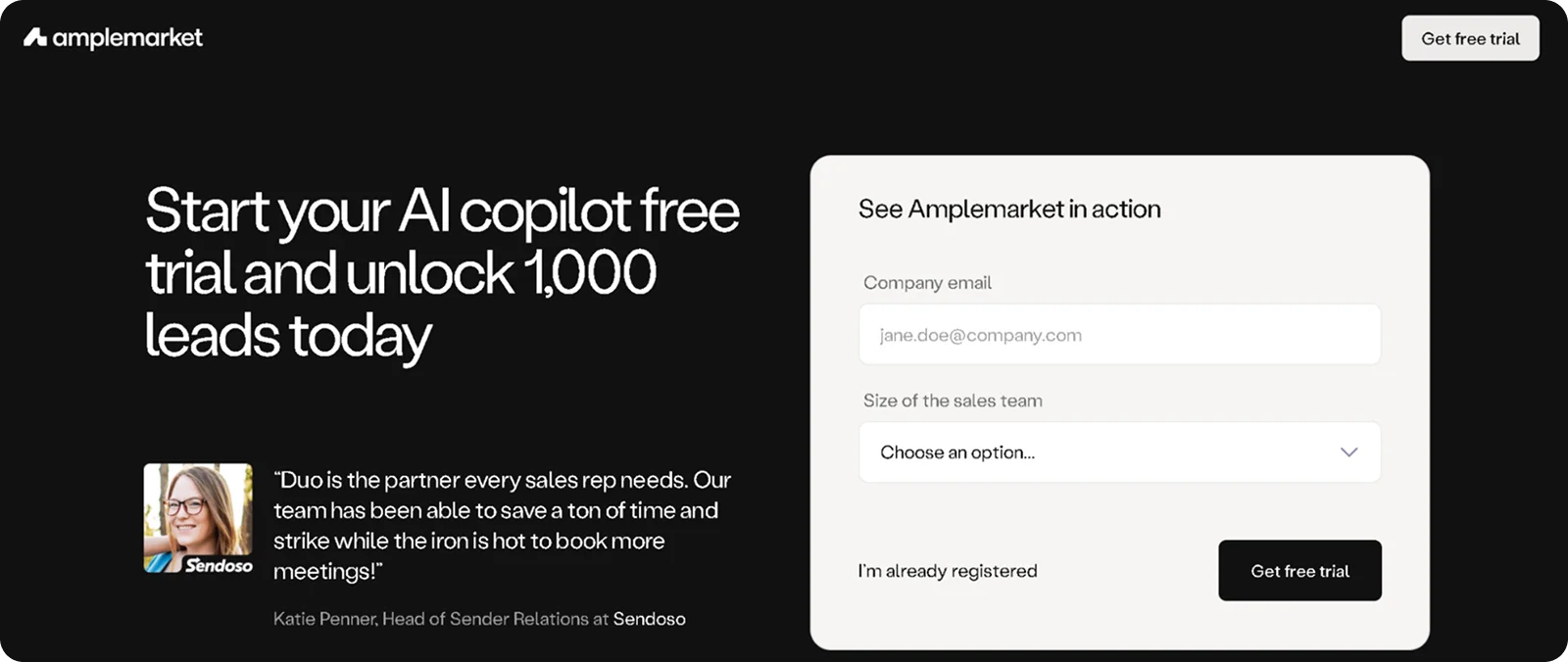
Amplemarket is a managed waterfall enrichment and sales engagement platform that combines multi-source contact data with built-in email sequencing, a dialer, and deliverability tools. It serves B2B sales teams that want high-accuracy enrichment without building or maintaining their own data workflows.
Key features
Managed waterfall enrichment: Runs contact lookups across curated multi-source providers in a pre-optimized sequence, returning under 3% email bounce rates without requiring users to configure the waterfall themselves
Weekly data refresh: Refreshes 70M+ records weekly with real-time verification built into every enrichment request, reducing the lag between data collection and delivery
Built-in email sequencing and dialer: Combines enrichment with multichannel outreach, including email, phone, and LinkedIn, without requiring separate tools
AI-powered sequence generation: Uses enriched data to generate personalized outreach messages at the point of enrichment, rather than as a separate downstream step
Intent signals: Surfaces accounts showing active buying behavior through integrated intent data layered on top of contact enrichment
Pros
Delivers under 3% email bounce rates through managed waterfall enrichment without requiring users to configure or maintain data sources
Combines enrichment, sequencing, and deliverability in a single platform, removing the integration overhead that standalone enrichment tools require
Refreshes data weekly with real-time verification, reducing the risk of contacting prospects at outdated employers or roles
Cons
Bundles outreach capabilities that teams with an existing engagement stack may not need, increasing cost without additional value
Offers less configuration flexibility than DIY waterfall tools for teams that want to control their own provider sequence
Pricing
Amplemarket offers custom pricing for specific configurations.
6. Coresignal
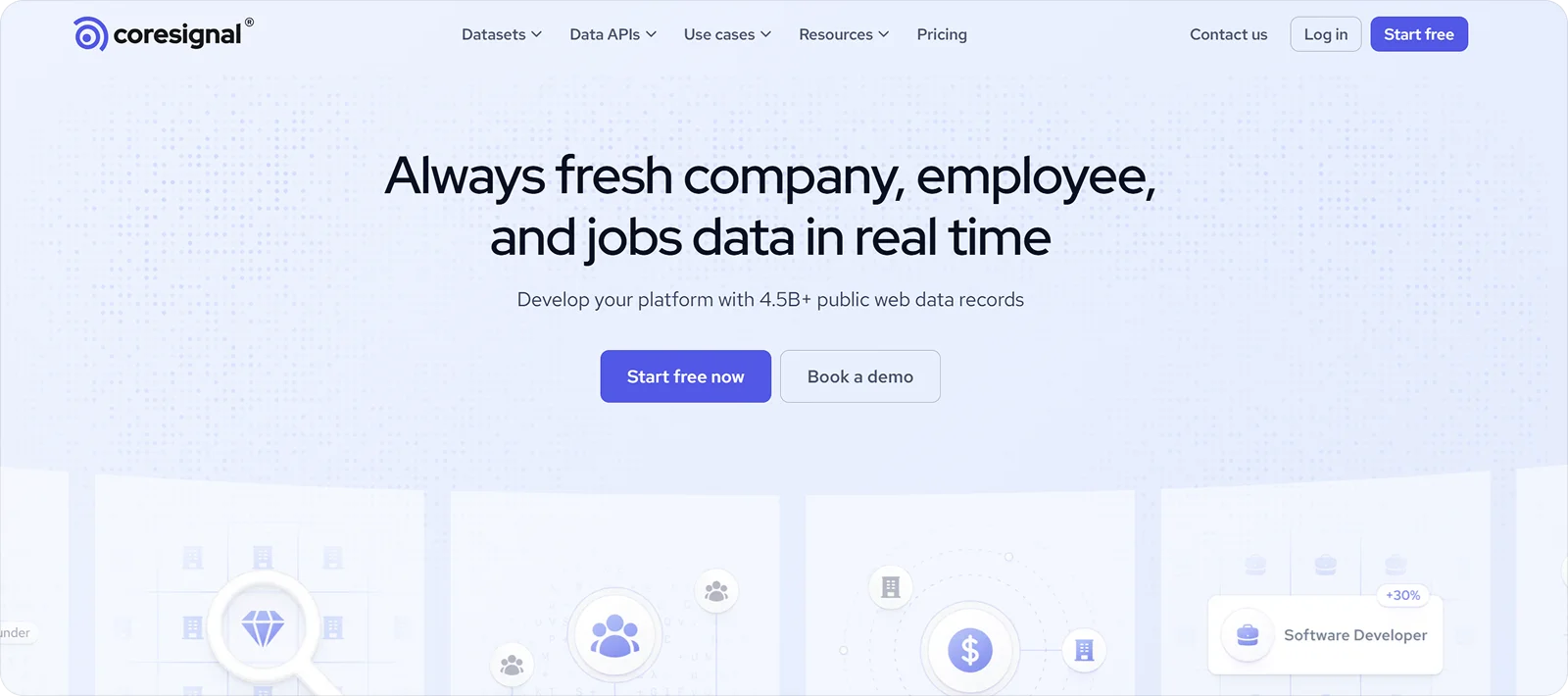
Coresignal is a B2B data provider that aggregates public web data across companies, employees, and job postings from 15+ sources into a single API and dataset delivery model. It serves investment intelligence, sales, HR tech, and market research teams that need large-scale, frequently refreshed datasets delivered programmatically.
Key features
Multi-source company and employee data: Aggregates 859M+ employee records and 75M+ company records from public web sources into a unified dataset
Historical headcount data: Provides up to nine years of historical headcount and company data for trend analysis, portfolio monitoring, and forecasting
High-frequency updates: Refreshes more than 695M records monthly, with API records updated in real time and dataset deliveries available on an hourly frequency
Flexible delivery options: Supports API access, flat file downloads, Snowflake and Redshift datashares, and PostgreSQL shared or dedicated databases
Job postings data: Tracks active job postings across companies for building hiring signals and intent workflows
Pros
Covers one of the largest publicly available employee and company datasets with consistent refresh cycles
Provides historical data going back several years, which most enrichment alternatives do not offer
Delivers data through multiple formats suited to teams building into custom products and pipelines
Cons
Requires engineering resources to extract value, with no user interface for non-technical users
Charges double credits for multi-source company data, making costs harder to predict at scale
Expires unused credits at the end of each monthly billing cycle with no rollover
Pricing
Coresignal offers a free trial with 200 Collect and 400 Search credits valid for 14 days. API subscription plans start at $49 per month.
7. Clay
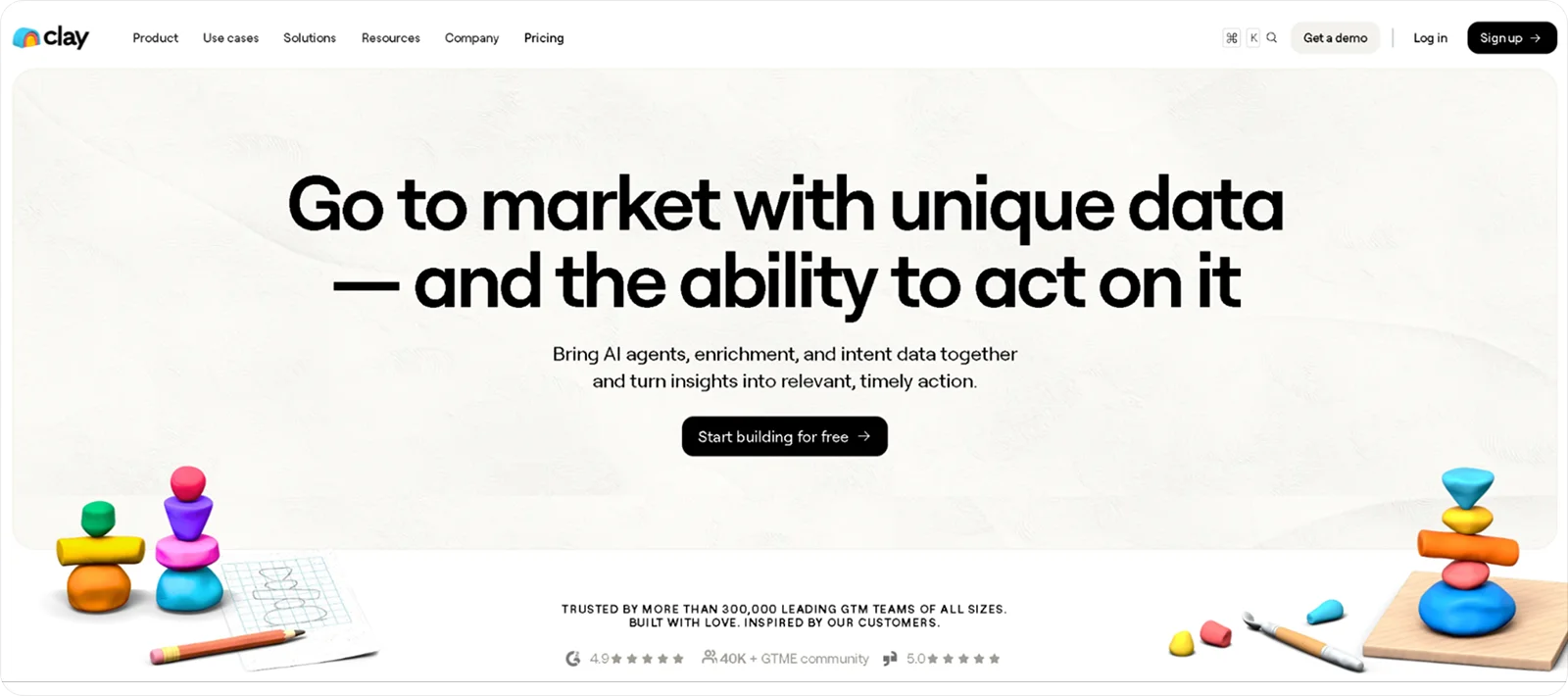
Clay is a data orchestration platform that pulls from enrichment providers in a waterfall sequence to find verified contact and company data. It targets RevOps and growth teams that want to automate enrichment and lead routing across their existing stack without managing multiple data subscriptions.
Key features
Waterfall enrichment across 150+ providers: Queries multiple data sources in sequence until a verified result is found, delivering higher match rates than single-source tools
AI research agent (Claygent): Browses the web to find information that structured databases do not cover, including custom firmographic research and account context
CRM and outreach integrations: Connects with Salesforce, HubSpot, and outreach platforms for automated enrichment and lead routing workflows
No charge for failed lookups: Consumes data credits only when a provider returns a successful result
Generative AI for personalization: Uses enriched data to write personalized outreach messages at scale directly within the platform
Pros
Removes the need to manage multiple enrichment subscriptions separately by aggregating 75+ data providers into one workflow
Charges credits only on successful lookups, reducing wasted spend on unmatched records
Supports a wide range of enrichment use cases from contact data to custom AI-powered account research
Cons
Requires significant time to configure waterfall sequences and workflows, with a steep learning curve for teams expecting plug-and-play simplicity
Depends on third-party provider quality for data accuracy, so results vary by source and geography rather than reflecting a single verified standard
Pricing
Clay offers a free plan with 100 data credits per month. Paid plans start at $185 per month for the Launch plan and $495 per month for the Growth plan.
How to Choose the Right Explorium Alternative
The right choice depends on three factors.
Technical setup: API-first tools require engineering resources and are not suited for sales teams who need a self-serve interface. Tools built for non-technical users offer less raw data flexibility in return.
Primary use case: Outbound prospecting teams need verified contact data with low bounce rates. Teams building predictive models or AI agents need deep, structured datasets with flexible delivery formats. Teams prospecting into European markets need GDPR-compliant data with phone verification built in.
Data freshness: When enrichment feeds into automated workflows, a scheduled refresh cycle introduces lag that compounds across every downstream action. The only way to remove that variable entirely is a provider that crawls data live at the point of request rather than serving it from a stored database.
Why Crustdata Is the Best Explorium Alternative for Real-Time Enrichment
Explorium's architecture is built around aggregating stored data from external sources and serving it back through a unified layer. That works well for ML feature engineering and batch enrichment. It does not work well for teams running automated workflows where the accuracy of each action depends on the data feeding it at that exact moment.
Crustdata pulls from verified sources with continuous updates, so enriched records reflect where a company and contact actually are rather than where they were at last refresh. For teams where that distinction matters most, here is a concrete example.
A sales team running an AI agent that triggers outreach when a prospect changes jobs needs three things to happen in sequence: the job change is detected, the new company is enriched against ICP criteria, and a personalized message is generated using current role and company context.
If any step in that chain uses stale data, the message references the wrong company, the wrong title, or a role the prospect already left. Batch-refreshed databases introduce that risk at every step. A continuously updated source reduces it to the lag between the real-world change and the next crawl cycle, which for high-priority signals is typically hours rather than weeks.
That specific workflow, enrichment feeding an automated action where accuracy decays with every hour of delay, is where Crustdata fits and where batch-refreshed alternatives introduce compounding risk.
Are you ready to see how real-time enrichment fits your pipeline?
Book a demo to see Crustdata in action.
FAQs
Does Explorium offer a free trial?
Explorium offers a 90-day free trial with credits that expire at the end of the trial period. Paid plans start at $50,000 per year based on usage and package selection. The free trial does not require a credit card and provides access to the full suite of account and prospect enrichments.
How do I know if my enrichment data is accurate?
The most reliable way is to test a provider on your actual CRM records rather than a vendor-curated sample. Measure email bounce rate, phone connect rate, and field fill rate against your own ICP.
Providers that pull data live at the moment of the request, rather than from a stored database, are less likely to return records that were accurate when collected but outdated by the time you act on them.
Does B2B data enrichment work for AI-powered sales workflows?
It depends on how the enrichment is delivered. Most tools serve data from a stored database refreshed on a fixed schedule, which introduces a lag that compounds in automated pipelines.
For AI agents and event-driven workflows, the enrichment needs to be current at the exact moment of execution. Providers that crawl data live at the point of each request are the better fit for those use cases.


Products
Popular Use Cases
Competitor Comparisons
Use Cases
95 Third Street, 2nd Floor, San Francisco,
California 94103, United States of America
© 2026 Crustdata Inc.
Products
Popular Use Cases
Competitor Comparisons
Use Cases
95 Third Street, 2nd Floor, San Francisco,
California 94103, United States of America
© 2025 CrustData Inc.
Products
Popular Use Cases
Competitor Comparisons
Use Cases
95 Third Street, 2nd Floor, San Francisco,
California 94103, United States of America
© 2026 Crustdata Inc.